

If you offer Bilva leaves but wonder how that act answers an ecological crisis, your instinct is sound. Devotion cannot be reduced to symbolism, yet a sacred tree should change more than the appearance of an altar. It should change how you take, use, return, measure, and share.
The bridge from worship to environmental action is stewardship. You can begin with one correctly identified leaf, one carefully tended tree, and one household resource loop. The same discipline can then grow into a temple grove, a sangha project, or an ecovillage without losing its spiritual center.
Bilva worship is a conservation discipline, not a symbol alone
The Bilva tree, Aegle marmelos, is especially associated with Shiva, but its sanctity also reaches into traditions of Lakshmi worship. That conjunction matters. Shiva evokes restraint and inward balance; Lakshmi’s shrī is prosperity that nourishes a household, protects a community, and sustains the living world. The same tree can therefore signify both renunciation of excess and responsible abundance.
The three leaflets of Bilva patra make this ethical balance visible. Traditional readings connect them with the three guṇas, the powers of intention, knowledge, and action, or the pursuits of dharma, artha, and kāma under the discipline of mokṣa. These interpretations vary among lineages and regions; you do not need to force one reading into every ritual. The practical point remains stable: desire, wealth, and action cannot be separated from right order.
That gives you a simple test for sacred ecology. If leaves are stripped carelessly, new buds are damaged, discarded offerings become litter, or a temple consumes branches faster than its grove can replace them, the outward ritual is contradicting its inward meaning. Reverence becomes conservation only when it governs conduct.
This discipline need not be confined to one Hindu sect. The wider Dharmic family offers complementary ecological habits: ahimsa limits needless harm, Jain aparigraha questions accumulation, Buddhist mindfulness makes consumption visible, and Sikh seva turns concern into shared work. These paths are not interchangeable, but they can cooperate around land, water, food, and care for living beings.
Start with the tree: identify it, cultivate it, and harvest gently
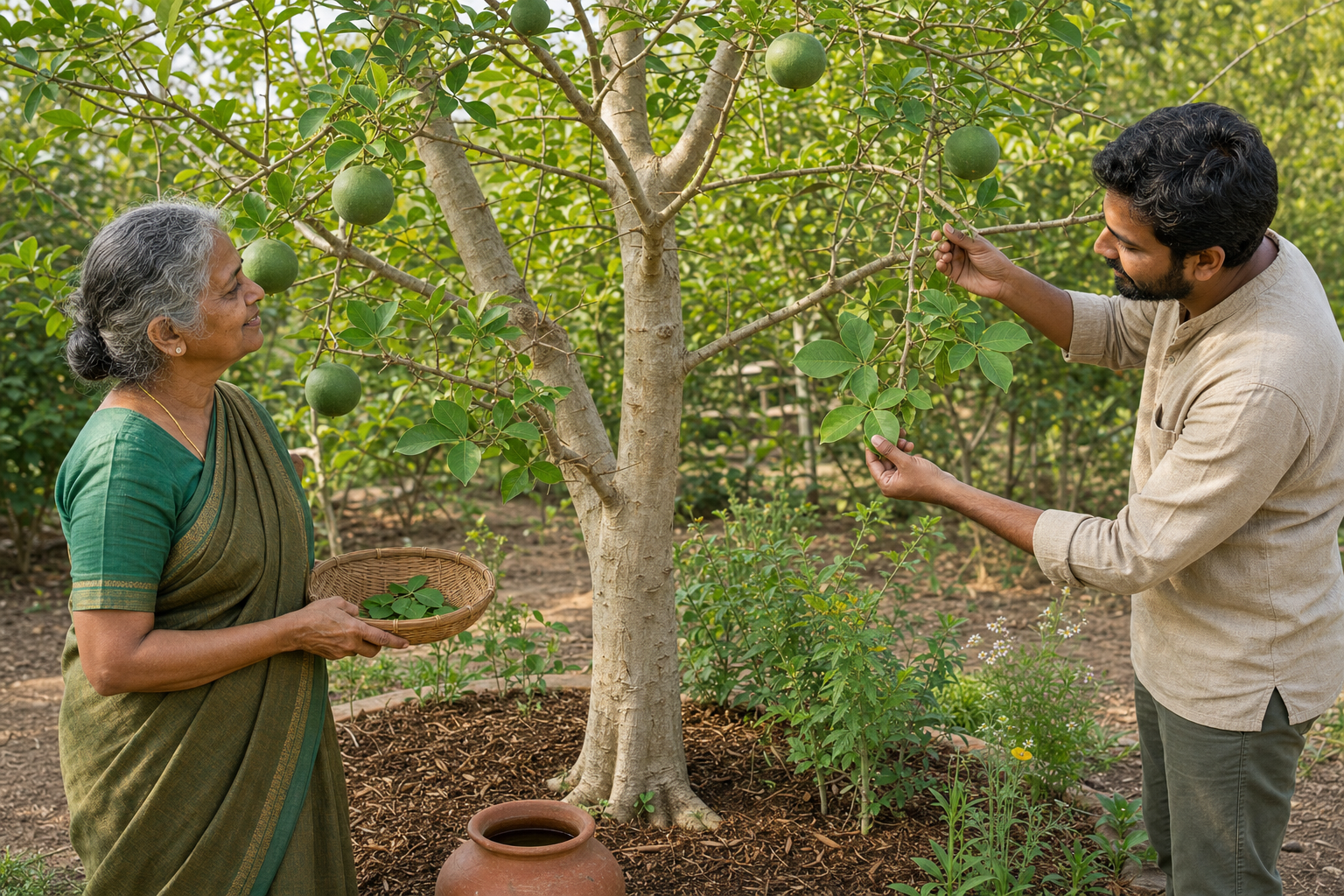
Good intention does not correct a mistaken species. Aegle marmelos, commonly called Bilva, bael, or bel, belongs to the citrus family. Its leaves are usually trifoliate and have an aromatic, slightly resinous scent when gently crushed. It is not the unrelated wood apple, Limonia acidissima. When purchasing a sapling, ask for the botanical name rather than relying on a common label. If you remain uncertain, consult a knowledgeable nursery or temple gardener before treating the plant as a source of ritual leaves.
Bilva is native to the Indian subcontinent and has also become established across parts of South and Southeast Asia. It can tolerate poor soils and dry conditions in semi-arid to tropical settings. That resilience does not make it suitable for every climate or every unattended container. If you live outside an appropriate growing region, ask a local horticultural specialist whether protected or container cultivation is realistic. Supporting a well-managed temple grove is better than repeatedly replacing trees that cannot thrive where you live.
A living Bilva contributes more than ritual material. Its fragrant flowers support pollinators, its fruit feeds birds and small mammals, its roots help stabilize soil, and its canopy moderates the immediate microclimate. A courtyard or temple precinct planted with Bilva can therefore become a working habitat as well as a place of worship.
Use this harvesting sequence whenever local custom permits you to collect leaves:
- Ask whether harvesting is necessary. Use leaves already available from a trusted, sustainably maintained tree before cutting from a stressed or unfamiliar plant.
- Select only what the rite requires. More leaves do not make the offering more sincere. Restraint protects the tree and reduces discarded material.
- Prefer a customary morning harvest. Choose whole, fresh, clean leaves and leave new buds undisturbed. Avoid tearing branches to reach a desirable cluster.
- Handle the leaves gently. A light rinse is sufficient when needed. Torn, desiccated, or worm-eaten leaves are generally avoided in formal worship, but ritual selection should never become an excuse for damaging the tree.
- Return remnants responsibly. After pūjā, place biodegradable leaves in soil, a plant bed, or an appropriate compost stream. Do not leave used offerings on paths, in drains, or around a shrine as litter.
The fruit and other parts of Bilva also appear in Ayurvedic foodways and formulations. Unripe fruit is traditionally associated with digestive support, while ripe pulp is used in refreshing foods and drinks. Sacred status, however, is not a medical prescription. Leaves, bark, roots, and concentrated preparations should be used clinically only with qualified Ayurvedic guidance.
Make your pūjā a small regenerative cycle

A ritual becomes ecological when each stage establishes a corresponding household habit. You do not need to invent a new liturgy. Keep the form authorized by your family, guru, or temple, and make its ethical implications explicit.
- Set a saṅkalpa for right prosperity. State that the household seeks resources through dharma and will use them for care, hospitality, dāna, and the well-being of living beings. This prevents Lakshmi worship from collapsing into a request for private acquisition.
- Offer Bilva without waste. Present whole leaves during archana or touch them respectfully to the kalasha where this agrees with your custom. Some families include Bilva in Lakshmi observances, while others do not. Regional practice is not a universal command.
- Connect the three leaflets with a real decision. Name your intention, the knowledge you still need, and the action you will perform. For example: reduce avoidable electricity use, check the household’s actual consumption, and change the lighting schedule.
- Let naivedya become sharing. Prepare an amount that can be consumed, distribute prasāda, and keep edible food out of the waste stream. The movement from offering to sharing is part of the prosperity being invoked.
- Complete the material cycle. Return leaves and other suitable plant offerings to soil or compost. Clean the altar without sending solid offerings into a drain. The rite ends only when its materials have been placed responsibly.
You can add one ecological vrata to the observance without burdening it. Choose a single, visible commitment for the period before the next pūjā: segregate household organics, care for a sapling, reduce unnecessary lighting, restore a neglected plant bed, or volunteer in a temple grove. At the next observance, report honestly to yourself whether the action happened. This turns repetition into accountability.
Do not measure devotion by the quantity of material consumed. A smaller offering harvested with care, shared without waste, and followed by sustained seva expresses sacred abundance more clearly than an elaborate display that leaves damaged plants and bags of refuse behind.
Scale the ethic across water, food, energy, and waste
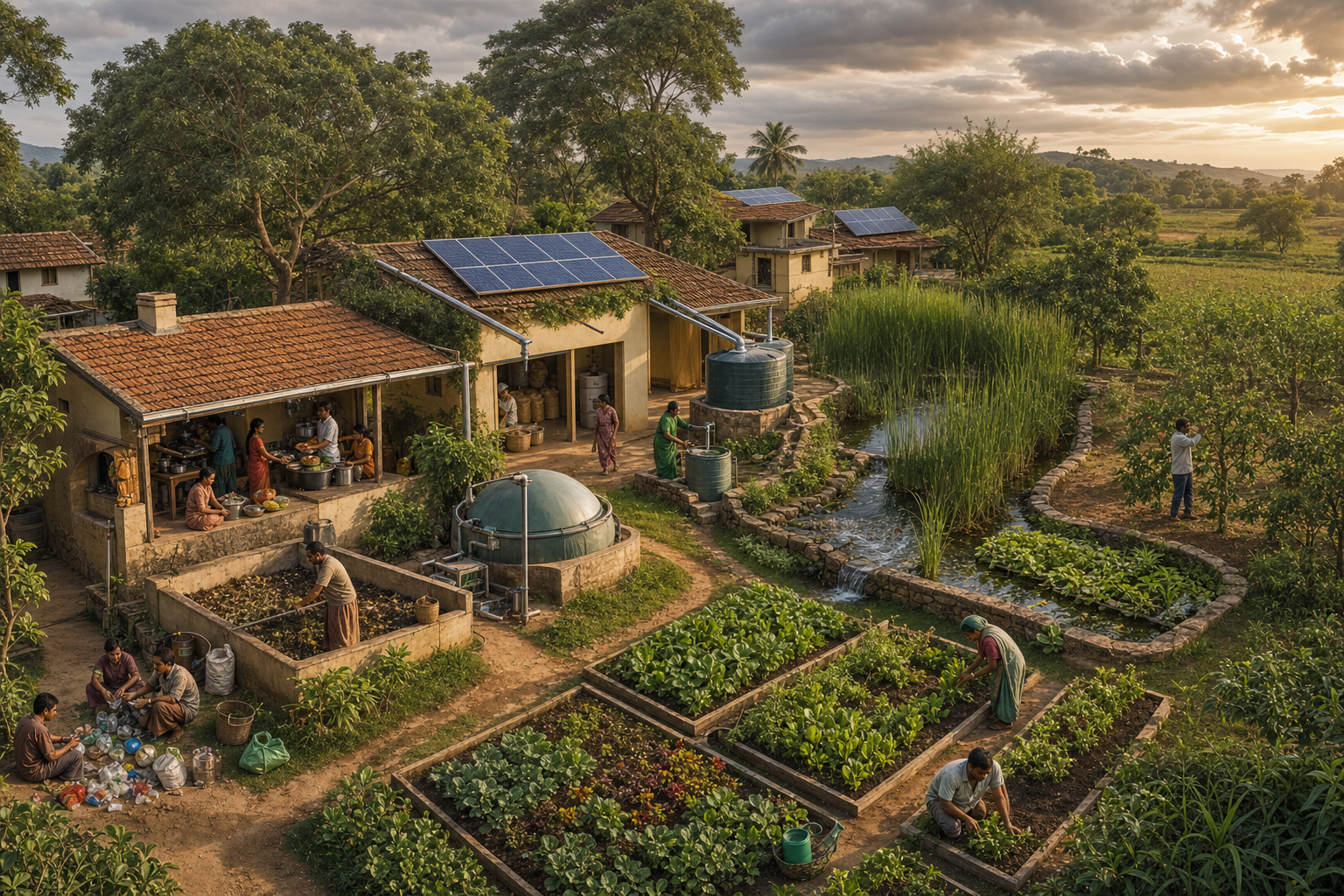
An ecovillage is not simply a large garden with a temple. Its strength comes from connected systems. Rain is captured or directed toward groundwater recharge; wastewater can be treated through decentralized natural processes; organic matter returns to fields through compost or managed biogas systems; passive design lowers cooling demand; and reduced energy consumption makes renewable generation more effective. At Govardhan Ecovillage in Wada, Maharashtra, these systems operate alongside kīrtan, japa, yoga, study, and seva, so environmental management remains part of a spiritual rhythm rather than a separate technical department.
You can use the same logic at household, temple, school, or sangha scale. The technologies will differ, but the questions remain consistent:
| Sacred principle | Practical system | What to observe or record |
|---|---|---|
| Take without exhausting renewal | Protect Bilva buds, cultivate a reliable supply of ritual plants, and preserve canopy | Tree survival, canopy growth, and seasonal observations of pollinators, birds, or other fauna |
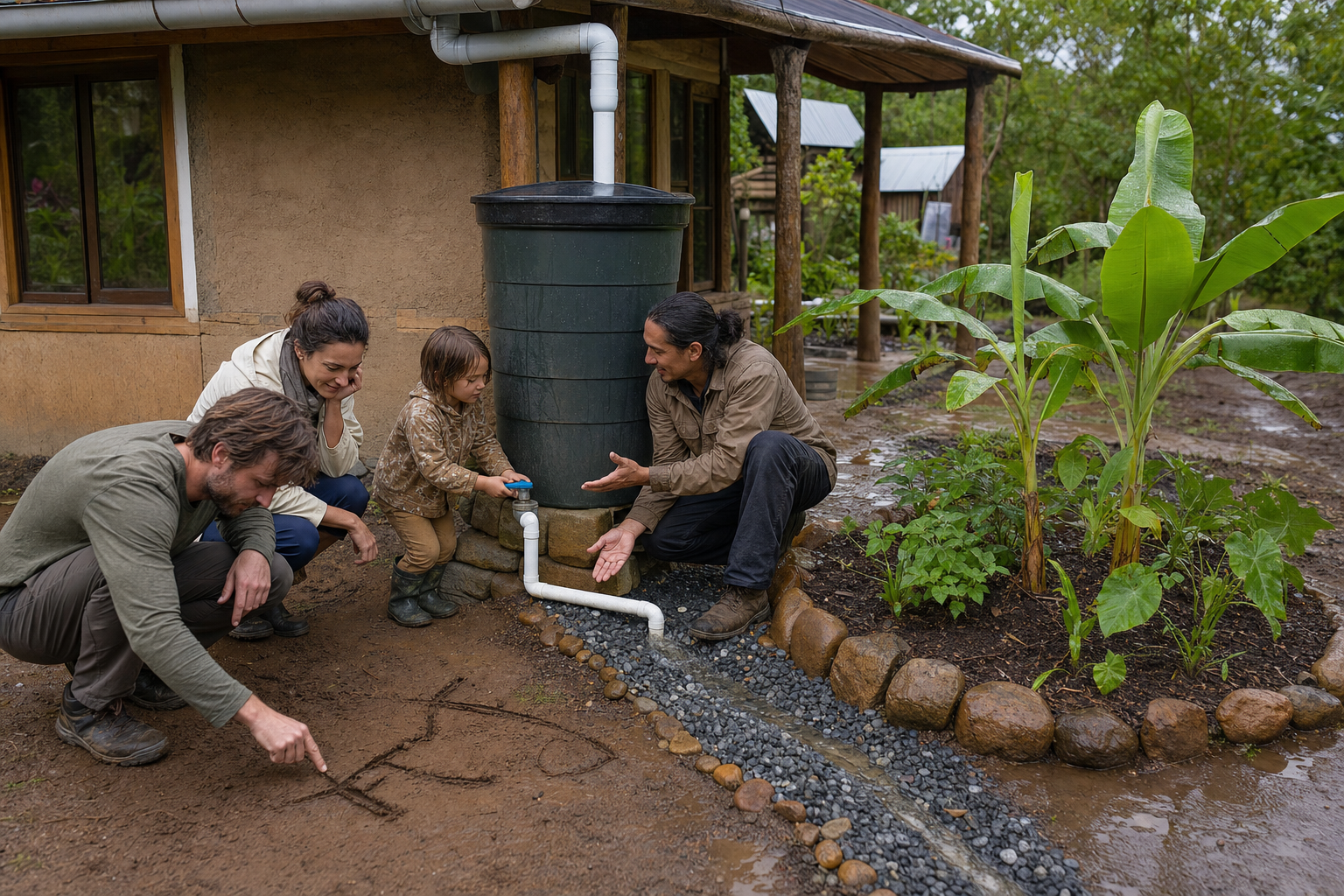
| Hold water as a shared trust | Map roof runoff, support rainwater capture or percolation, and reuse water only where treatment makes it suitable | Liters of water harvested or recycled and changes in freshwater demand |
| Return nourishment to the soil | Separate organic material, compost it, mulch planted areas, and use managed nutrient loops | The proportion of organic waste composted and, where agriculture is involved, soil organic matter trends |
| Reduce demand before adding supply | Use daylight, efficient lighting, sensible scheduling, and then evaluate solar generation where appropriate | Kilowatt-hours consumed, reduced, or generated |
| Build with climate rather than against it | Prioritize shade, cross-ventilation, thermal mass, and locally appropriate low-energy materials | Cooling-energy demand and whether occupied spaces remain usable with less mechanical conditioning |
The order of work matters. First, trace the flow: where water, food, energy, leaves, flowers, and packaging enter; where they are used; and where they leave. Next, reduce needless demand. Then connect an output to a responsible next use. Only after that should you invest in equipment. A solar array attached to unchecked consumption, or a compost enclosure with nobody assigned to manage it, does not create a regenerative system.
For a community project, begin with one clearly bounded place: a temple kitchen, a sacred grove, a dining hall, a school garden, or a residential courtyard. Record an ordinary cycle of bills, waste collection, and maintenance. Select one flow, assign named responsibility for it, and choose a measure that volunteers can continue recording. Seasonal records are more useful than a single ceremonial clean-up because they reveal whether the practice survives changes in weather, attendance, and leadership.
Some loops require professional design. Do not assume harvested rainwater or naturally treated wastewater is safe to drink; potable use requires appropriate treatment, testing, and compliance with local requirements. Biogas digesters and wastewater systems also involve sanitation, gas, structural, and maintenance risks. Treat them as infrastructure, not as improvised weekend seva.
Measurement is not opposed to reverence. Liters of water retained, organic material composted, electricity reduced, soil condition, canopy growth, and seasonal biodiversity observations tell a community whether its declared care is producing a material result. The metric does not replace the sacred relationship. It keeps the relationship honest.
Use an ecovillage visit to bring home one working change
A pilgrimage to an ecovillage can renew devotion, but admiration alone travels poorly. Go as a learner with one problem from your own setting. It might be temple flower waste, high electricity demand, a failing garden, water runoff, or the absence of a sustainable Bilva supply. A defined question will help you see operating details that a general tour can hide.
Govardhan Ecovillage extends across more than 100 acres in Maharashtra’s Palghar district and combines devotional practice with organic agriculture, water management, earthen and climate-responsive construction, waste segregation, composting, cow-linked nutrient cycles, and renewable energy where deployed. Its value to a visitor lies not in copying the campus at a smaller scale, but in understanding why each element fits its land, climate, labor, and spiritual routine.
During a guided eco-tour, ask five questions about any system you hope to adapt:
- What material or resource enters this system?
- Where is it stored, treated, or transformed?
- Who performs the daily and seasonal maintenance?
- Which result is recorded, and how does that record change decisions?
- Which parts depend on local climate, land, regulations, skills, or community scale?
If time allows, a three- or four-day immersion can hold both spiritual and technical learning: campus darśan and orientation, hands-on seva, sustainability workshops, meditative walking, yoga, kīrtan, and scriptural dialogue. Keep notes on maintenance tasks as carefully as you note attractive buildings or landscapes. The unglamorous work of sorting, cleaning, monitoring, repairing, and training is what makes an ecological system durable.
Before leaving, choose one practice that fits your actual authority and resources. An apartment resident might improve organic segregation and electricity scheduling. A temple volunteer might establish ethical leaf harvesting and a clean return path for biodegradable offerings. A school or sangha might maintain a demonstration garden and record its compost, soil, and biodiversity observations. A village institution might study water recharge or biogas with qualified technical support. One maintained loop is better than a list of systems nobody owns.
Key takeaways
- Sacred ecology begins when worship changes how you handle living plants and material resources.
- Confirm Aegle marmelos before planting or harvesting; Bilva and wood apple are not the same species.
- Take only the leaves required, protect new growth, and return suitable remnants to soil or compost.
- Pair pūjā with one ecological vrata that can be checked at the next observance.
- At community scale, map one resource flow, assign responsibility, and track a meaningful result across seasons.
- Use ecovillages as learning environments, then adapt one locally appropriate practice instead of copying an entire campus.
At your next Bilva pūjā, begin where your hands already are. Harvest carefully, return the leaves to a living cycle, and write down one resource flow in your home or temple that needs better stewardship. Give that flow a responsible person, a visible measure, and a place in the rhythm of seva. That is how a sacred leaf begins to shape a sacred settlement.
References
- DharmaRenaissance Blog — Bilva Tree and Goddess Lakshmi: Timeless Symbolism, Prosperity Rituals, and Sacred Ecology
- Dandavats — Govardhan Ecovillage Yatra 2026: A Transformative, Sacred Eco-Spiritual Pilgrimage to ISKCON Wada