
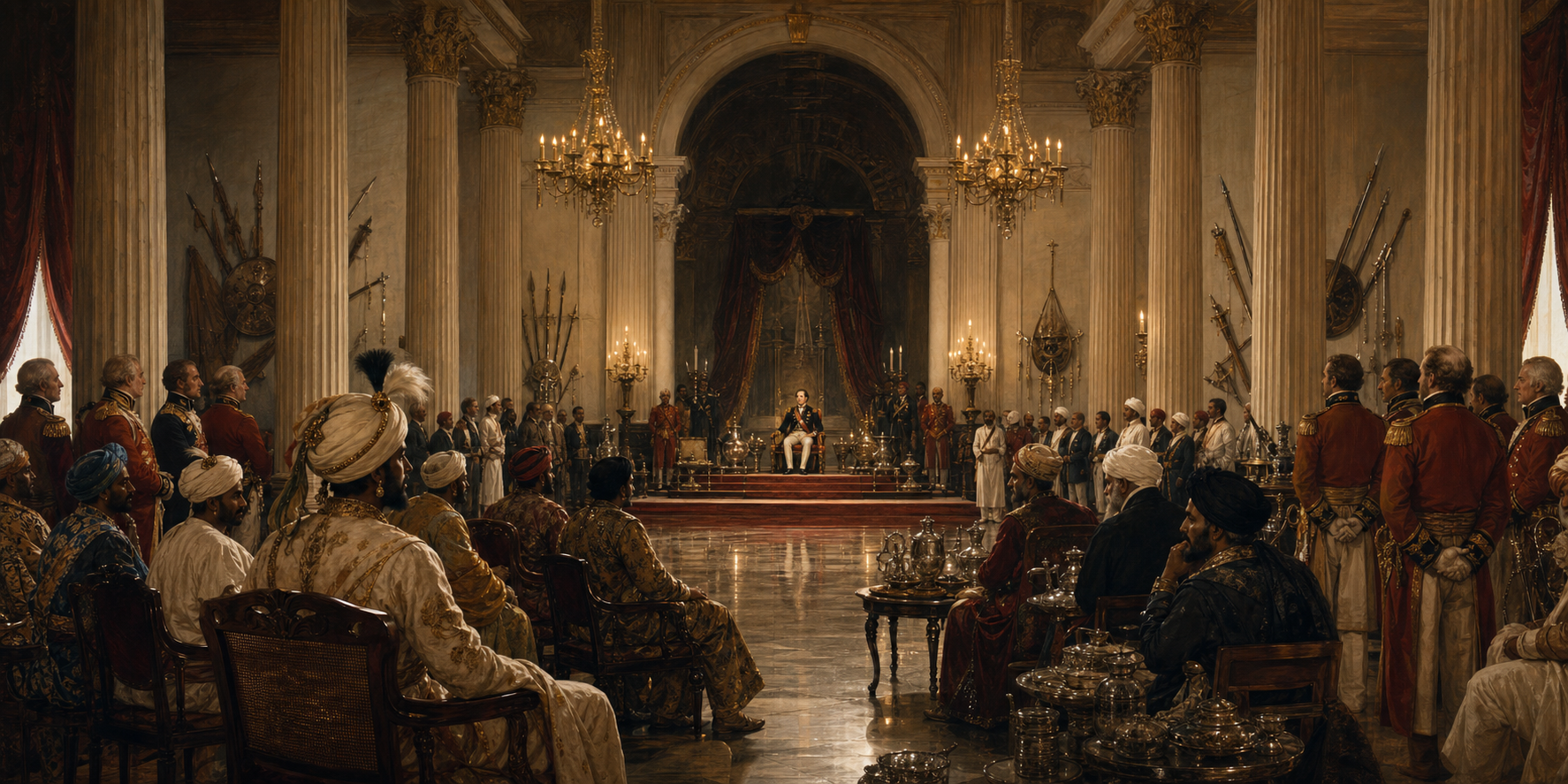
If you want to understand how Marquis Wellesley exercised colonial power in Calcutta, do not look only at military victories or administrative orders. Look at where he received people, what surrounded his chair, who sat closest to him, and who had to wait farther down the room.
The gathering held at the newly completed Government House on January 26, 1803 turns those details into a readable system. The palace, the regalia of a defeated Indian ruler, the seating rules, and the carefully managed hospitality show you how conquest was converted into visible authority.
Key takeaways
- Government House was conceived as a political statement: Wellesley wanted India governed from a palace rather than a country house.
- A crimson-and-gold musnud from Tipu Sultan’s throne placed conquest at the symbolic centre of colonial government.
- The banquet’s seating order reproduced Company rank, even among women whose precedence depended on their husbands’ seniority.
- A diverse gathering of about 800 people demonstrated reach and organizational capacity, but attendance did not make the assembly equal.
- To read colonial spectacle accurately, ask who paid, whose symbols were appropriated, who assigned rank, and whose authority the ceremony made natural.
The palace made an argument before Wellesley spoke
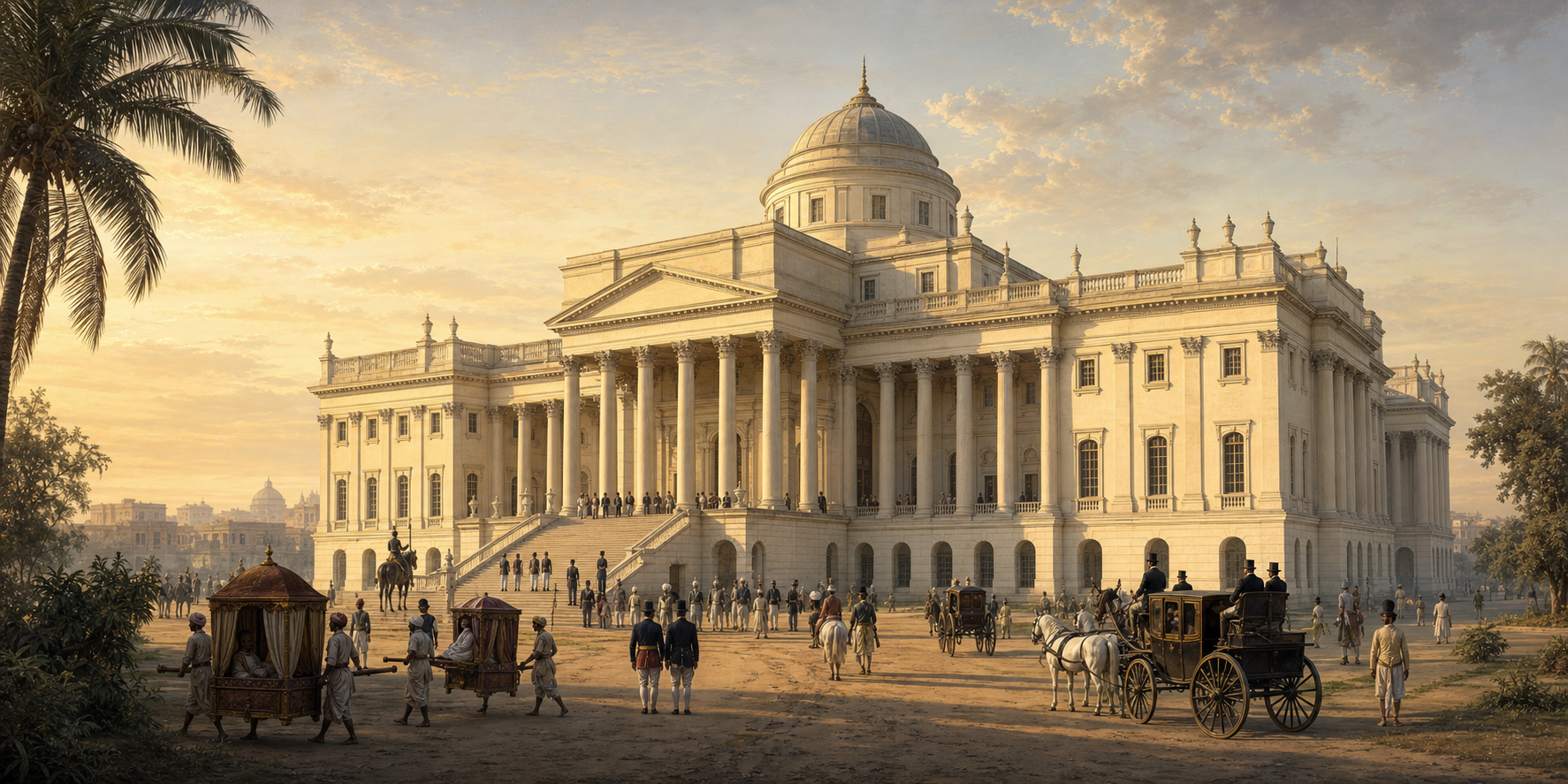
Wellesley had already stated his purpose in 1799: India should be governed from a palace, not from a country house. Government House was therefore more than an enlarged office or a comfortable residence. Its palatial character was part of the governing method.
The building was completed in four years at a recorded cost of ₹13 lakh and inaugurated on January 18, 1803. Wellesley’s great gathering followed on January 26. That sequence matters. Intention, expenditure, construction, inauguration, and political performance formed one continuous project.
A palace does three kinds of political work. Its scale makes the occupant appear greater than an ordinary official. Its permanence suggests that the governing order has settled in for the long term. Its internal arrangement teaches visitors where authority sits and how everyone else stands in relation to it. You do not have to accept the ruler’s claims for the building to affect how you encounter him.
The capacity of Government House reinforced that message. After Wellesley’s welcome at 10 p.m. and the ballroom proceedings, about 800 guests could be accommodated at supper in the marble hall below. The evening continued until shortly before dawn. Hosting on that scale displayed logistics as well as luxury: the colonial administration could assemble a large elite, order its movement, feed it, entertain it, and keep Wellesley at the centre of the occasion.
When you examine another colonial building, read it in the same sequence. Find the ruler’s declared intention, the scale of expenditure, the political moment of completion, the capacity of its ceremonial rooms, and the rules governing access. Architecture becomes historical evidence when you connect its physical features to the conduct it enabled.
The strongest symbol inside Government House was not British in origin. A crimson-and-gold musnud formerly associated with Tipu Sultan’s throne had been installed with a rich chair and stool of state designated for Wellesley. Chairs for council members and judges flanked it.
This was not a conquered object left in storage or presented as a detached curiosity. It was incorporated into the active arrangement of government. Wellesley’s place was marked through the regalia of a defeated Indian sovereign, while administrative and judicial officers were positioned around him. The hall joined victory, ceremony, government, and judgment in a single visual composition.
That placement tells you more than the mere survival of an object could. Removal from Tipu Sultan’s setting altered the musnud’s political meaning. In its former setting, it participated in his sovereignty. At Government House, it proclaimed his defeat and magnified the authority of the man who now occupied the place prepared beside it. Colonial appropriation worked by retaining the prestige of the conquered symbol while reversing the direction of its allegiance.
This gives you a practical test for museums, palaces, paintings, and ceremonial photographs. Do not stop at identifying an impressive object. Ask where it came from, who previously controlled it, how it arrived in its new setting, where it was placed, and whose status increased through that placement. Provenance tells you what an object is; ceremonial position tells you what power made it do.
The banquet turned Company rank into social reality
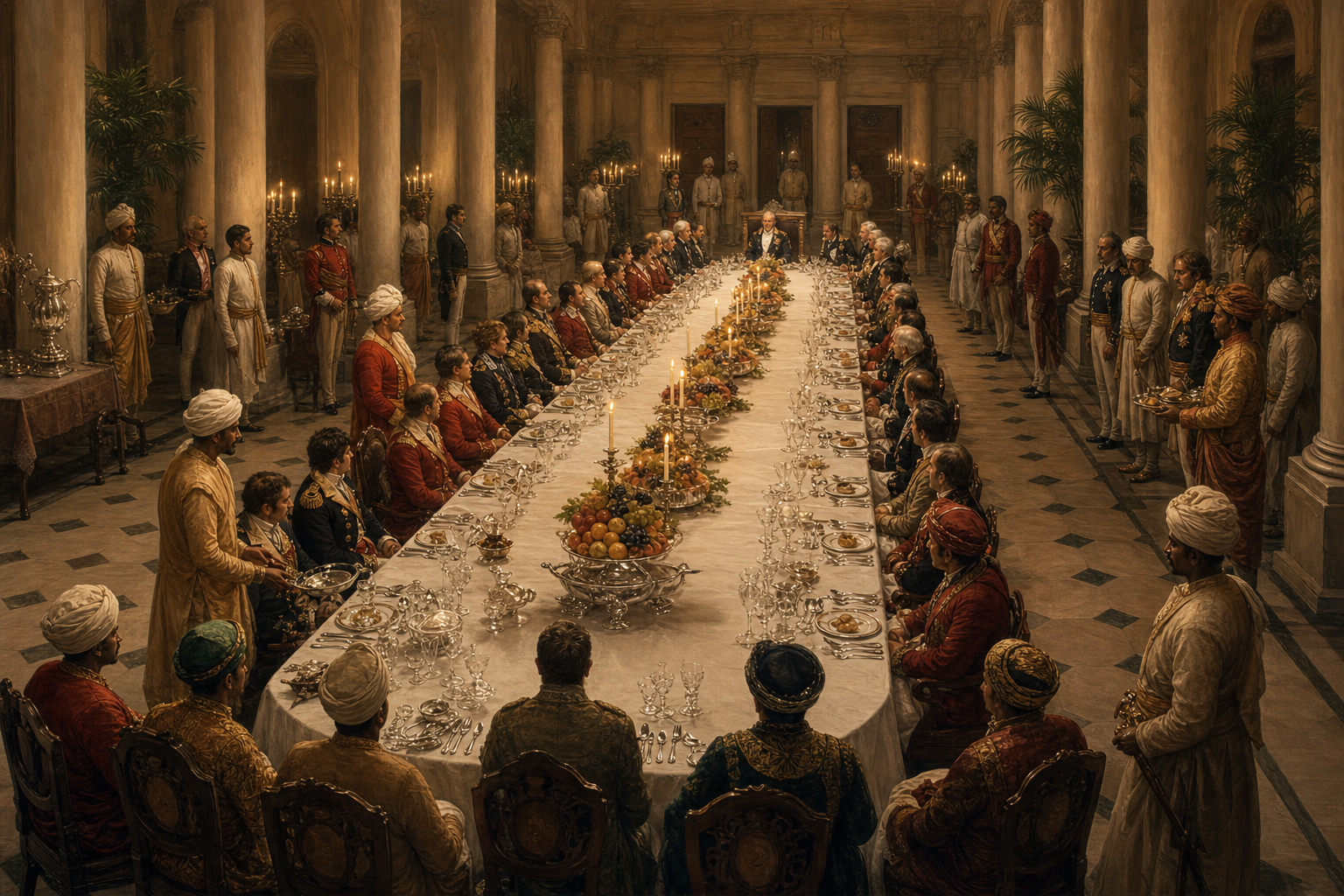
Government House did not merely hold a crowd. It classified one. Seats for elite European women ran down both sides of the room, and the women were placed according to strict precedence determined by their husbands’ seniority in Company service.
The rule is revealing because no woman’s individual accomplishment determined her place. Her position publicly expressed her husband’s institutional rank. A personnel hierarchy was carried into social life, converted into spatial order, and made visible to hundreds of observers. Rank ceased to be an entry in an administrative record and became an experience: everyone could see who came before whom.
This complicates the familiar colonial pose of judging Indian social structures from an assumed position of British equality. The useful conclusion is not that every hierarchy is identical or that Varna can be reduced to a European seating chart. It is narrower and firmer: the colonial elite did not inhabit a rankless social world. It maintained its own exacting gradations and performed them publicly.
The room also contained officers, nabobs, Persians, Armenians, and people described with the period label of natives. White chunam pillars reflected the light; varied fabrics and uniforms heightened the theatrical effect. Viscount Valentia compared the multinational scene to a masquerade.
Diversity in the room should not be confused with equality within it. A guest list tells you whom a regime could attract, employ, accommodate, impress, or oblige. It does not by itself tell you who set the terms. Wellesley hosted the gathering in the palace built to express his authority. Company seniority organized precedence. Tipu Sultan’s regalia marked the place of state. Those facts reveal the structure beneath the colour of the occasion.
Local elite participation also requires careful interpretation. In 1781, Nabakrishna Deb, the founding Maharaja of the Sovabazar Raj, had hosted a nautch and elaborate entertainment for Emma Wrangham’s birthday within a relationship shaped by Warren Hastings’ influence. Such occasions show that colonial society could operate through patronage and social obligation, not only through formal commands. Attendance, hospitality, and celebration can record accommodation to power without proving wholehearted consent.
When you meet a description of a colonial reception, mark each participant by role rather than ethnicity alone. Identify the host, the official inner circle, the ranked guests, the intermediaries, the entertainers, and those grouped under generic labels. Then ask who established the categories. That produces a power map; merely admiring the variety of the crowd does not.
What the spectacle proves—and what it does not

Wellesley’s banquet makes the relationship between conquest and display unusually visible. The setting appeared soon after Tipu Sultan’s defeat, and a part of Tipu’s throne had become an emblem within Wellesley’s ceremonial environment. The palace had cost ₹13 lakh, and its great hall could receive roughly 800 people. These details establish scale, timing, appropriation, and political symbolism.
They do not provide an itemized account tracing every rupee spent on the building or banquet to a particular act of plunder. That distinction matters. You can say confidently that conquest supplied one of the evening’s central symbols and that colonial resources supported a deliberately royal display. You should not invent a financial chain that the surviving details do not establish.
The same discipline applies to motive. A person’s presence at the gathering does not prove admiration, resistance, fear, opportunism, or coercion. Different guests could have had different reasons for attending. What can be established is the structure they entered: Wellesley’s palace, Wellesley’s hospitality, Company precedence, and conquered regalia repurposed around Wellesley’s place of state.
A useful way to prevent overstatement is to separate fact, inference, and limit in your notes. The musnud’s origin and placement are facts. The conclusion that it staged Wellesley as a successor to conquered authority is a strong inference from that placement. The private response of every Indian or European guest remains beyond what the scene can prove. This method lets you recognize colonial domination without turning interpretation into imagined testimony.
Hospitality itself deserves the same scrutiny. Food, dance, courtesy, and anticipation of a guest’s wishes are genuine social goods in many settings. In a political palace, however, they can also make unequal authority pleasant to approach. A ruler who impresses guests through generosity may secure deference that an order alone could not produce. The enjoyment of the evening and the operation of power are therefore not mutually exclusive.
A Dharmic test for imperial magnificence

Lavishness by itself is not the decisive moral issue. Dharmic civilizations have never required beauty, abundance, ordered ceremony, or generous hospitality to disappear. The sharper question is what these things serve. Restraint is not ugliness, hierarchy is not automatically oppression, and hospitality is not automatically benevolence.
Hindu, Buddhist, Jain, and Sikh traditions are not interchangeable systems, and their teachings should not be compressed into a single slogan. Yet restraint, duty, dignity, and communal well-being provide a shared ethical horizon from which to examine the Calcutta spectacle. Did magnificence serve responsible government or the self-magnification of the governor? Did social order protect dignity or advertise dependence? Did hospitality honour the guest while respecting the wider community, or did it soften the appearance of domination?
The use of Tipu Sultan’s regalia makes the test particularly concrete. An object carrying the prestige of a defeated ruler was used to elevate the victor’s representative. Whatever pleasure the banquet offered, its central symbolism asked guests to encounter conquest as settled order. A Dharmic reading should notice that conversion of another ruler’s loss into one’s own splendour.
This perspective also prevents an easy reversal in which every Indian participant is condemned and every social accommodation is treated as betrayal. Colonial relationships could constrain choices through office, patronage, precedence, and dependency. Dharma requires attention to duty and consequence, but sound judgment also requires attention to the freedom a person actually possessed. Examine the institution that arranged the choices before assigning equal responsibility to everyone inside it.
When you next encounter a colonial palace, banquet, durbar, or ceremonial portrait, write five questions in the margin: who paid, whose symbol was taken, who assigned rank, who formed the audience, and who benefited from the finished scene. Apply those questions to Wellesley’s Government House, now known as Lok Bhavan of West Bengal, and the evening stops looking like ornamental trivia. It becomes a compact lesson in how colonial rule taught people to see power.
References
