

If your next encounter with the Ramayana is likely to be a film, a streaming series, or a contentious clip, the first question is not whether it looks impressive. The question is whether it helps you receive a sacred inheritance or quietly replaces that inheritance with the assumptions of its makers.
You do not have to reject art, adaptation, scholarship, or difficult questions. You need an order of approach: encounter the Ramayana on its own terms, learn its moral architecture, and only then decide what a modern interpretation preserves, compresses, or overturns.
Begin as a receiver, not a content consumer

A consumer asks whether a story was entertaining. A receiver asks what kind of attention the story demands and what change it asks of the listener. That difference determines whether the Ramayana remains sacred tradition in your life or becomes one more cultural product competing for an evening.
The Ramayana can be approached as narrative, kavya, civilizational memory, moral instruction, and an object of devotion. These dimensions are related, but they are not interchangeable. A plot summary can tell you what happened without teaching you how a vow, temptation, separation, act of service, or refusal should be contemplated. Historical analysis may answer a historical question, but it cannot by itself measure the spiritual force of a sacred narrative.
Before you begin a reading session, name your purpose. Are you reading for devotion, family instruction, literary understanding, or critical study? More than one purpose can be present, but one should lead. If your purpose is devotional, do not let an argument about dates consume the entire encounter. If your purpose is critical study, do not pretend that the critical lens exhausts everything the text is.
A simple discipline keeps the reading grounded:
- Begin with an intention. Decide that you are present to understand, not merely to collect facts or ammunition for a debate.
- Read a bounded passage. Resist the urge to rush through the narrative merely to finish it.
- Identify the moral pressure. Ask what duty, loyalty, desire, fear, or sacrifice is being tested.
- Carry one demand into conduct. Patience, truthful speech, restraint, service, courage, or fidelity should become more than a theme you admired.
This method prevents two opposite mistakes. One is sentiment without attention, in which reverence becomes a vague feeling. The other is analysis without receptivity, in which a living tradition is treated as a specimen that cannot speak back to the person examining it.
Build a textual baseline before judging adaptations

You cannot reliably identify a distortion if a screen adaptation is your only baseline. Establish direct familiarity with the Ramayana before allowing an actor, director, commentator, or social-media editor to supply the voices, motives, and emotional meaning of its characters.
Choose an edition that tells you what you are reading
A useful edition should identify its underlying text, distinguish translation from commentary, preserve the work’s major divisions, and disclose substantial abridgement. An editor may explain difficult words or cultural settings, but you should be able to tell where translation ends and interpretation begins.
Keep three columns in a notebook or reading file: what the passage narrates, what question of dharma it raises, and what remains unclear. This protects you from mistaking your first reaction for the only possible meaning. It also gives you precise questions to take to a teacher, commentary, or later reading.
A living tradition can include retellings without granting every retelling equal authority. The useful distinction is not old versus new or written versus cinematic. It is between an interpretation that openly enters a relationship with the tradition and one that uses familiar names while reversing their moral meaning.
Changes of medium require selection and compression. A film cannot reproduce every passage, and newly composed dialogue is not automatically disrespectful. The decisive question is what the change does. Does it clarify a conflict already present, or manufacture a new moral message and place it in the mouth of a revered character? Does an omission shorten the narrative, or conceal the very act that explains a character’s conduct?
Test the moral architecture, not the visual polish
Large sets, solemn music, familiar costumes, and declarations of respect cannot answer whether an adaptation is faithful. Examine the pattern of moral authority that remains after the production has made its changes:
- Ravana: Does dramatic complexity become an excuse to make his intelligence the story’s ethical compass? An antagonist may be capable and compelling without having adharma repackaged as wisdom.
- Sita: Is her strength allowed to emerge through dignity, conviction, endurance, and choice, or is she flattened into whichever stereotype is currently marketable? Reducing her to helpless submission and remaking her as a conventional action heroine are different distortions produced by the same failure to understand her on her own terms.
- Lakshmana: Is his defence of righteousness examined within the duties and relationships of the narrative, or is he made shameful simply because a new script needs a modern scolding scene?
- Hanuman: Does his extraordinary action remain inseparable from devotion and service, or is he presented mainly as a source of spectacle and physical power?
- The audience: After the changed scene, what will a viewer now believe about dharma, loyalty, restraint, and devotion? That effect matters more than a creator’s claim that no offence was intended.
This test is more useful than asking whether an adaptation is completely literal. Fidelity is not mechanical duplication. It is the preservation of identity, relationship, moral consequence, and sacred orientation even when one medium must speak through the techniques of another.
Make sacred literacy a household practice

Literacy becomes civilizational when it gives a person direct access to inherited wisdom. During adult-literacy efforts in rural Karnataka in the 1950s, newly literate villagers reportedly asked why they should learn to read if they could not read the Ramayana and Mahabharata. That remembered question about the purpose of literacy carries a challenge for families with far greater access to books: access has little value if sacred reading is always postponed.
You do not need to reproduce a formal classroom at home. Establish a recurring time, keep one identified text at the centre, and let different members read, retell, and question. Consistency matters more than turning the occasion into a performance.
After a passage, ask a child or younger reader to retell what happened without relying on images from a film. Then ask which choice changed the course of the episode and what another character had to bear because of it. This moves the conversation from costume and combat to conduct and consequence.
Use three clear labels whenever versions differ: what the text before you narrates, what a particular retelling shows, and how your family or teacher understands the difference. Those labels prevent an interpretation from being passed off as an unquestionable line of scripture.
If a child has absorbed a misleading scene from the screen, do not make anger the proof of reverence. Read the relevant passage together, identify the alteration, and explain why it changes the moral meaning. A child who learns to compare versions gains discernment. A child who is only scolded may learn that sacredness means being afraid to ask.
Questions should therefore be welcomed, but not left floating without study. Record what nobody in the room can answer. Return with a commentary, a teacher’s explanation, or a closer reading. Humility is not pretending that every question has an immediate answer; it is refusing to convert uncertainty into either cynicism or invention.
Use scholarship without surrendering the sacred mode
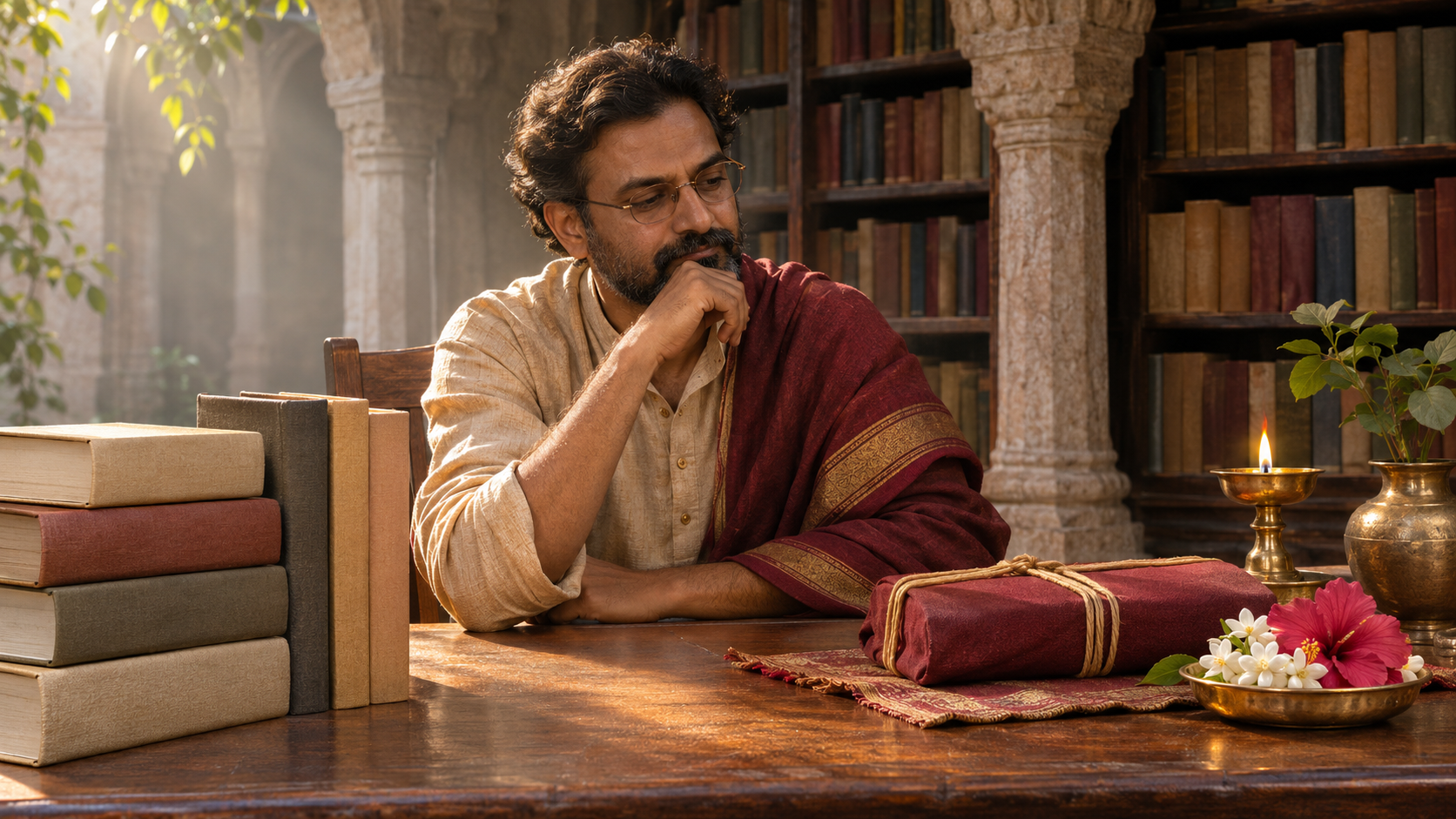
Reason and reverence are not enemies. The conflict begins when one method claims authority over questions it was not designed to answer. Historical inquiry can examine chronology and transmission. Literary inquiry can illuminate structure, voice, and imagery. Social or political inquiry can explore how communities have used a narrative. Sacred reading asks what the narrative discloses about dharma, devotion, character, and the reader’s own obligations.
These approaches can assist one another, but none should be smuggled in as the whole. A method that measures only external features will naturally find only external features. Its inability to measure sanctity does not establish that sanctity is unreal.
Hanuman’s leap across the ocean makes the problem easy to see. If you permit only the kind of question used to verify an ordinary administrative event, you have rejected the mode of sacred kavya before the episode can address you. You may still ask historical questions, but you should also notice devotion, courage, service, and the transformation of apparent impossibility through unwavering purpose.
When reading an academic or ideological interpretation, ask:
- What does this lens help me notice?
- What does it exclude by design?
- Is the writer drawing a limited conclusion, or claiming that the limit of the method is the limit of reality?
- Does the interpretation explain the narrative’s moral world, or replace it with categories brought from outside?
- After reading it, can I return to the Ramayana with greater clarity, or only with greater contempt?
The final question is not a demand for agreement. It is a check against intellectual vanity. A demanding interpretation can deepen your reading. A reductive one often leaves you less capable of seeing why generations have approached the Ramayana with love, discipline, and reverence.
Key takeaways
- Meet the Ramayana through an identified text before allowing an adaptation to become your baseline.
- Name your purpose for reading so historical, literary, critical, and devotional questions do not displace one another unnoticed.
- Judge adaptations by what they do to character, moral consequence, devotion, and dharma, not by visual polish or declared intentions.
- Distinguish compression from inversion: shortening an episode is not the same as reversing its moral meaning.
- Teach children to compare the text, the retelling, and an interpretation without treating honest questions as irreverence.
- Use scholarship for the questions it can answer, but do not mistake the limits of a method for the limits of the Ramayana.
Open the Ramayana you already own before watching the next adaptation or debate about it. Read one complete passage, write down the choice at its centre, and name one response it asks of you. Then return to the text. Sacred tradition remains living when attention becomes remembrance and remembrance becomes conduct.
References

Leave a Reply
You must be logged in to post a comment.