
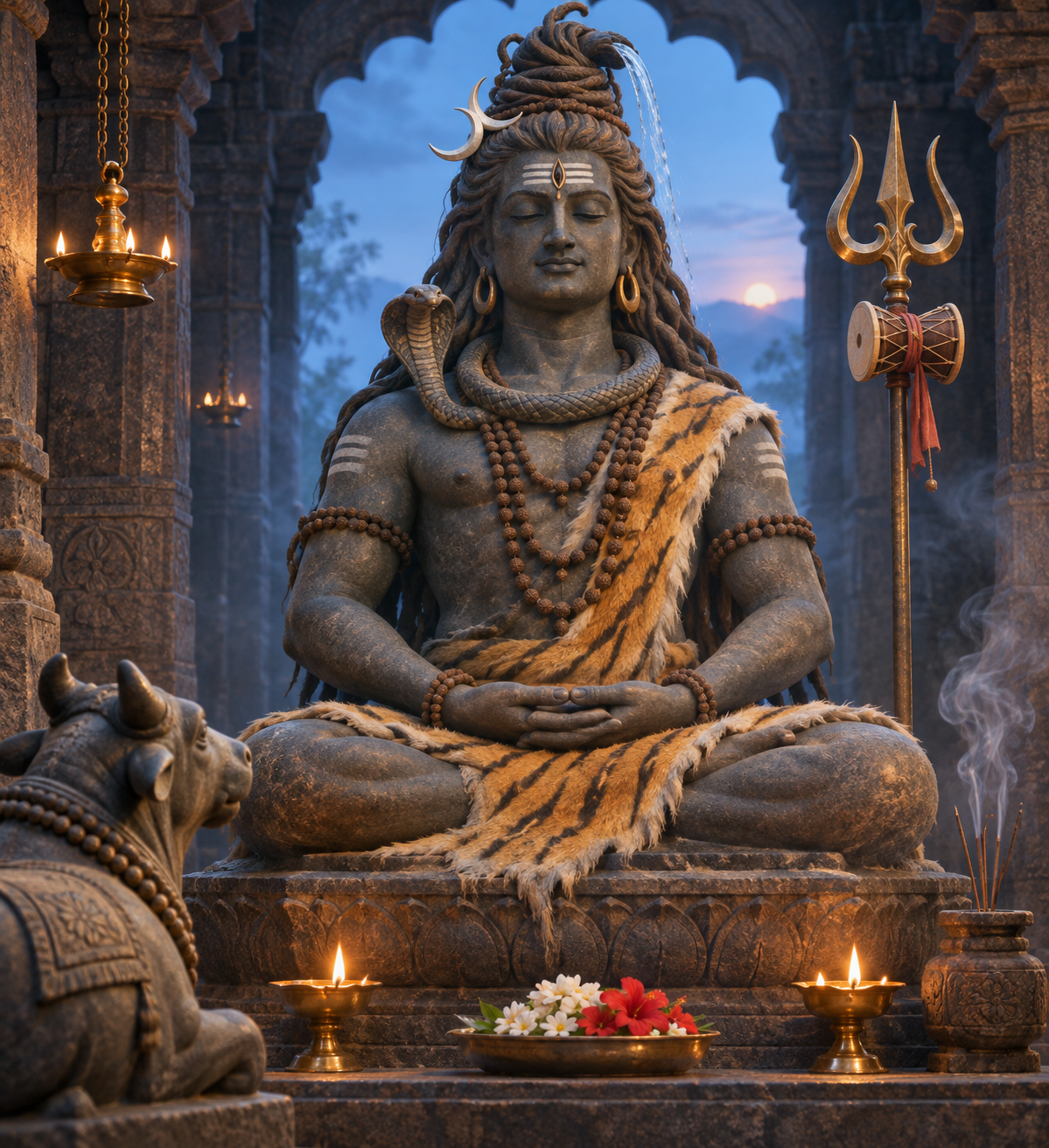
You may recognize Shiva in a temple and still wonder what, exactly, you are seeing. Is this a distinct deity, an incarnation, a symbolic composition, or Shiva shown in relationship with Shakti? The confusion usually begins when every image is treated as a portrait with a different costume.
A better approach is to read the structure of the murti before trying to interpret its symbolism. Notice whether the representation is a linga or a human-shaped figure, whether it contains one body or two, how the figures share space, and what the form is called. Those observations will help you distinguish two especially important forms: Ardhanarishvara and Sambashiva.
First distinguish a form of Shiva from an avatara
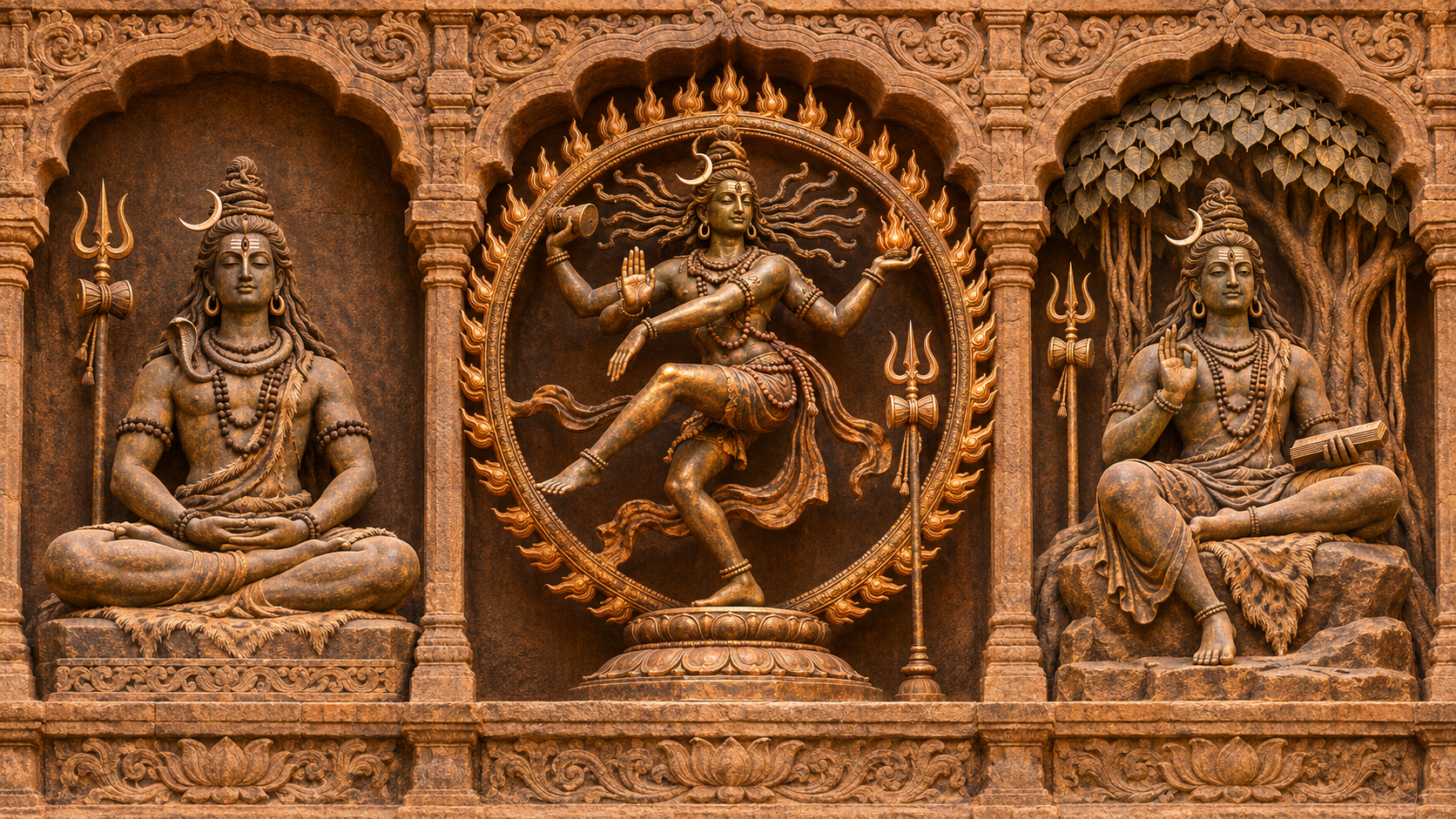
The word “form” can mislead you if it makes you imagine a succession of incarnations. Within the Shaiva Siddhanta classification, 108 human-shaped forms are identified as Maheshvara Murtis. They are described as forms of Shiva rather than avataras.
This distinction changes the question you ask. Do not begin with, “When did Shiva become this person?” Begin with, “What aspect of Shiva is this murti making visible?” A form can present Shiva as a solitary presence, as inseparable from Shakti, or in a particular relationship with her without requiring a separate incarnation story.
That also explains why a large number of forms does not imply a large number of unrelated Shivas. Iconography gives worshippers several visual approaches to the same divine reality. The name, bodily arrangement, and relationship between figures tell you which approach is before you.
Begin with the linga-human form distinction
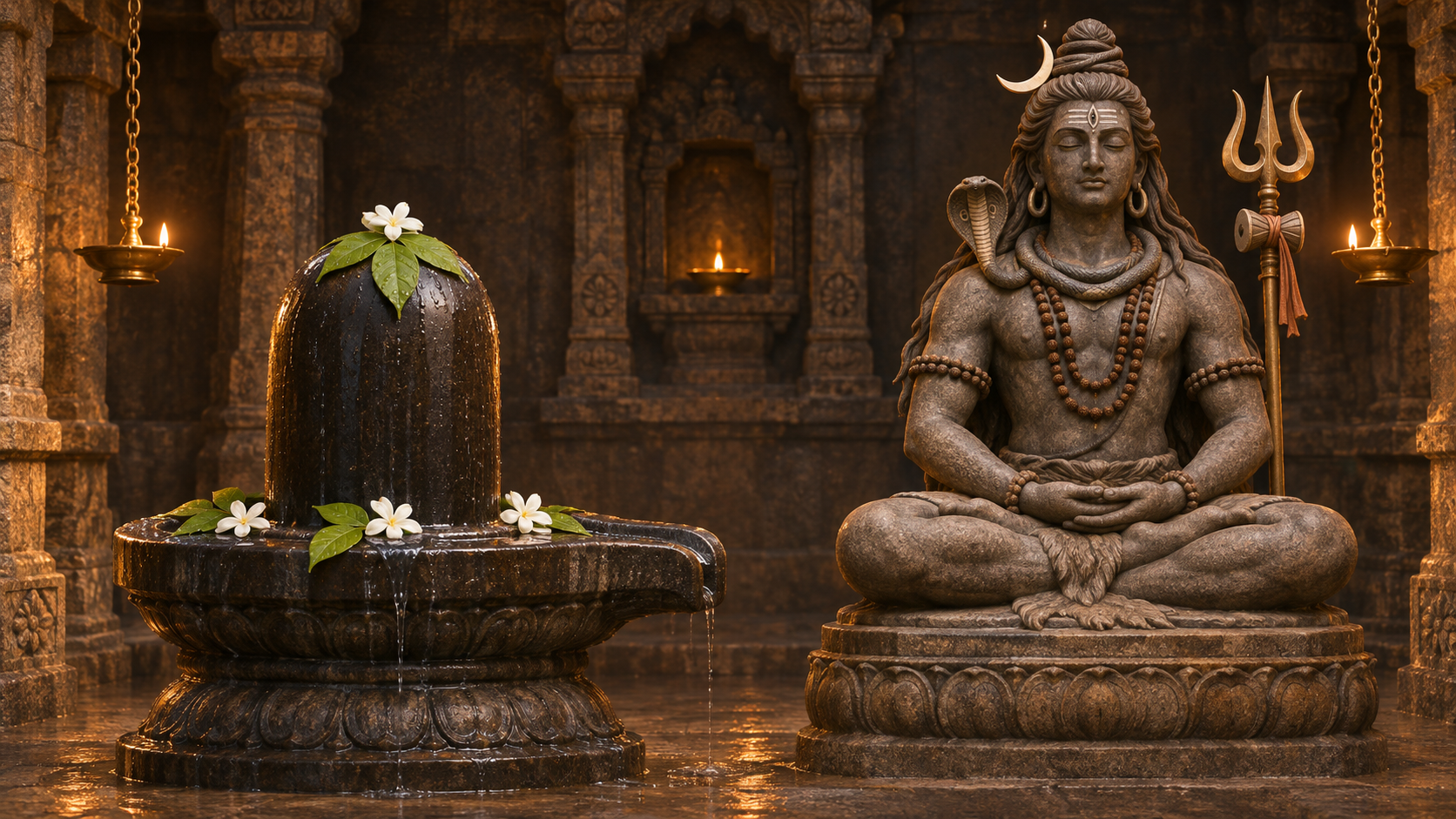
Before studying ornaments or gestures, determine the basic type of representation. The Maheshvara Murtis are anthropomorphic, meaning that Shiva is represented with a human-like body. They are treated as secondary forms in relation to the primary Shivalingam.
“Primary” and “secondary” describe an iconographic relationship; they need not be read as a competition in devotional value. The linga and the human-shaped murti do different visual work. A linga does not depend on facial expression, bodily division, a shared seat, or the placement of a consort. An anthropomorphic form can communicate through all of those features.
When Shiva appears in human shape, make three observations before assigning a meaning:
- Count the bodies. Is there one figure, a composite body, or more than one distinct figure?
- Notice the arrangement. Are the figures side by side, joined into one body, or sharing a seat?
- Identify the relationship. Is Shakti absent, present as a separate person, or embodied as one half of the same figure?
These structural observations are more reliable than making an identification from one ornament. Details can vary across images, but the defining composition of a named form gives you a firmer starting point.
Ardhanarishvara and Sambashiva express unity differently
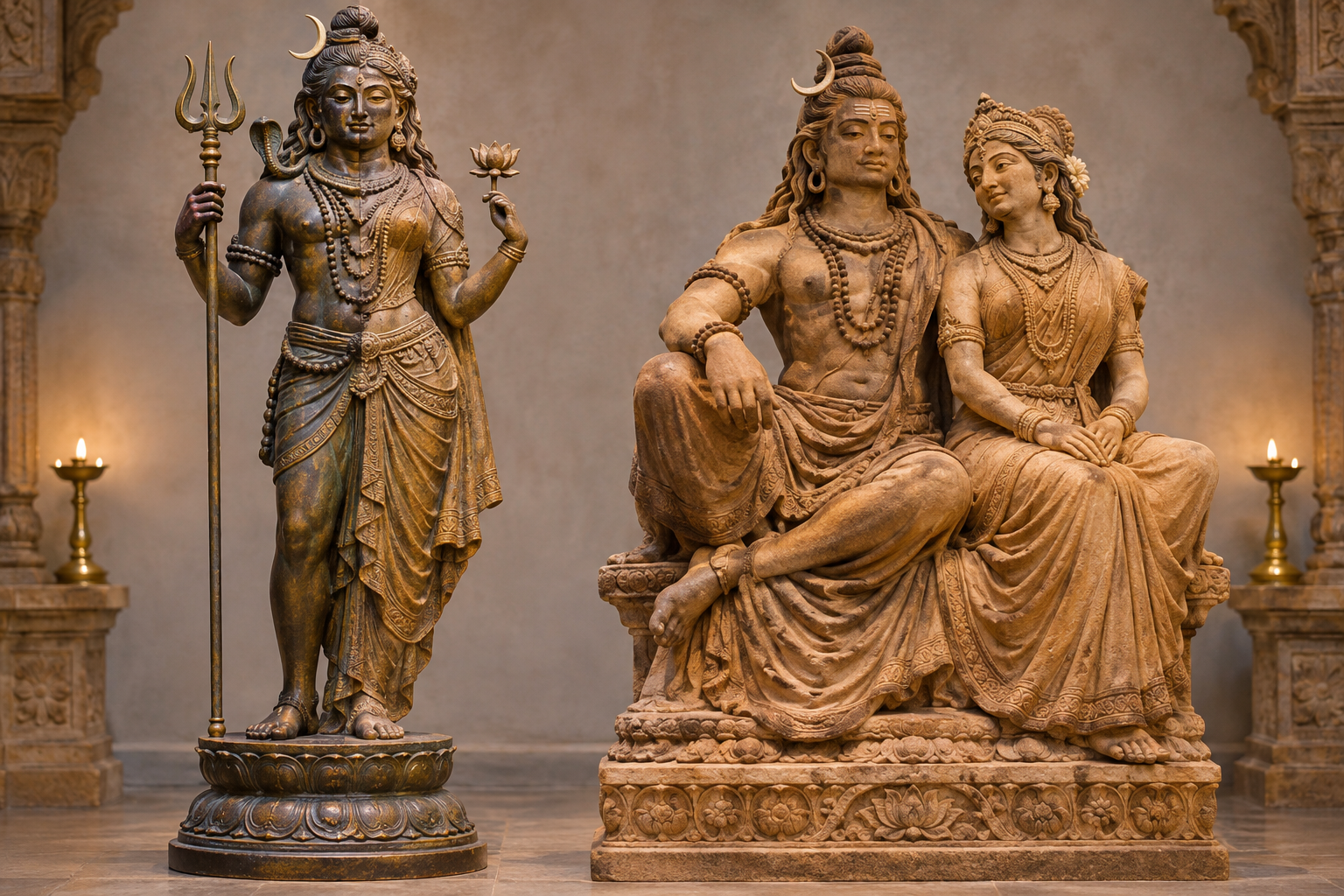
Ardhanarishvara and Sambashiva both bring Shiva and Shakti into one composition. They should not be collapsed into the same image, however. One joins them in a single body; the other shows two persons sharing a single seat.
Ardhanarishvara: one body, two visibly differentiated halves
The name Ardhanarishvara means a form that is half man and half woman. The murti is a single composite of Shiva and Parvati, with Shiva on the right and Parvati on the left. The central identifying fact is not merely that masculine and feminine figures appear nearby. They constitute one figure.
Read the vertical division first. If you look only at jewellery, clothing, or facial details, you may miss the theological force of the composition. The murti presents distinction without separation: Shiva remains identifiable as Shiva, Parvati remains identifiable as Parvati, yet neither appears as an independent body.
This gives you a useful interpretive boundary. Ardhanarishvara should not be reduced to an anatomical curiosity, nor should every contemporary idea about gender automatically be projected onto it. Begin with what the icon actually establishes: differentiated halves belong to one divine form. Broader philosophical reflection should grow from that structure rather than replace it.
Sambashiva: two figures united through one seat
Sambashiva preserves the visible distinction between Shiva and Shakti as two figures. Shakti is seated on Shiva’s lap, and the shared seat gives the form the name Ekasana Murti – the form of one seat.
Here the key is relationship rather than bodily fusion. Shiva and Shakti remain visually distinguishable, but the composition denies remoteness between them. The single seat becomes the organizing feature. If Ardhanarishvara asks you to contemplate unity within one body, Sambashiva asks you to notice intimacy and participation while two figures remain visible.
| What to inspect | Ardhanarishvara | Sambashiva or Ekasana Murti |
|---|---|---|
| Number of bodies | One composite body | Two distinguishable figures |
| Placement of Shakti | Parvati forms the left half | Shakti sits on Shiva’s lap |
| Defining structure | Two halves of one figure | Two figures sharing one seat |
| First interpretive question | How does difference appear without separation? | How does relationship express unity without bodily fusion? |
The shortest reliable distinction is therefore: one body versus one seat. Remembering that contrast will prevent one of the most common mistakes when encountering Shiva-Shakti imagery.
A five-step method for reading a Shiva murti
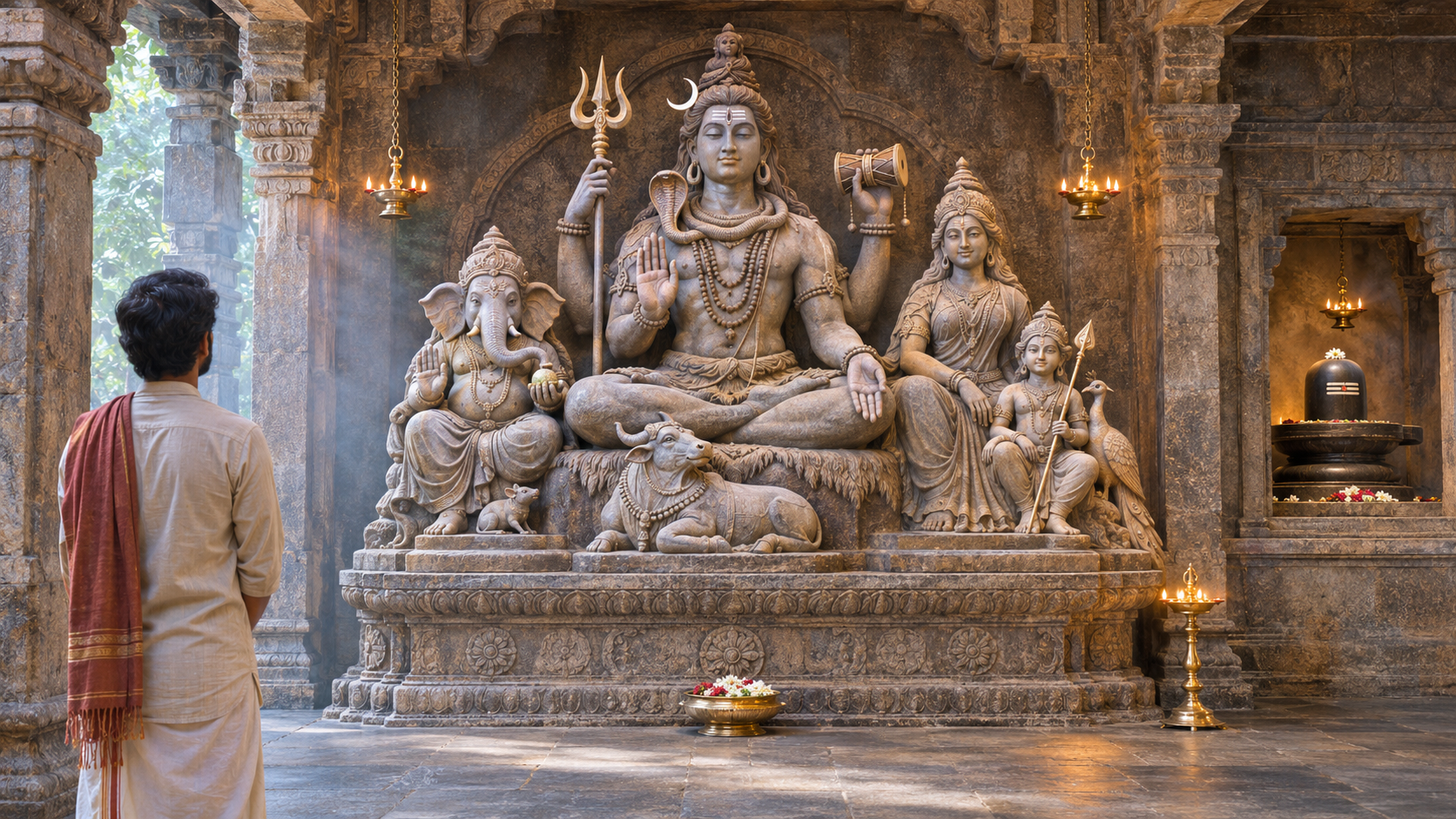
You do not need to memorize 108 names before you can look carefully. Use the following sequence in a temple, museum, book, or photograph:
- Classify the representation. Decide whether you are looking at a linga or an anthropomorphic murti. Do this before interpreting bodily details.
- Count bodies and seats. A shared body and a shared seat are not interchangeable. This immediately separates Ardhanarishvara from Sambashiva.
- Trace the central axis. In a composite form, look for a deliberate division within one figure. For Ardhanarishvara, identify Shiva’s right half and Parvati’s left half.
- Ask what remains distinct. In Ardhanarishvara, the halves remain recognizable. In Sambashiva, the persons remain recognizable. The particular way difference is preserved is part of the meaning.
- Confirm the traditional name. Use a temple label, catalogue, or informed local explanation when available. The name tells you which iconographic relationship the community recognizes, and it protects you from inventing an interpretation from appearance alone.
If you are keeping notes, record the structure before the interpretation: “one composite body, right and left halves” or “two figures, one seat, Shakti on Shiva’s lap.” That discipline separates what you actually observed from what you later concluded.
Also resist the urge to force every Shiva murti into one universal decoding chart. A tradition that recognizes 108 Maheshvara Murtis expects meaningful variation. The task is not to flatten those forms into a single slogan, but to see how each arrangement directs attention toward a particular dimension of Shiva.
Key takeaways
- A form of Shiva is not automatically an avatara; the 108 Maheshvara Murtis are classified as anthropomorphic forms.
- The Shivalingam is primary in relation to these human-shaped representations, so begin by identifying which basic type you are viewing.
- Ardhanarishvara is one composite body: Shiva forms the right half and Parvati the left.
- Sambashiva or Ekasana Murti shows Shakti seated on Shiva’s lap, with two figures sharing one seat.
- Read structure before symbolism: count bodies, count seats, locate the axis, and only then interpret the relationship.
At your next encounter with a Shiva murti, pause before searching for a name. Ask one concrete question: “What has the sculptor joined, and what has the sculptor kept distinct?” Once you can answer that, the name and meaning of the form become much easier to approach with care.
References
- Hindu Pad – Significance of Ardhanarishvara | Lord Shiva’s Half Man-Woman form
- Hindu Pad – 108 Forms of Lord Shiva | Maheshvara Murtis
- Hindu Pad – Sambashiva, a Form of Lord Shiva with Ma Shakti Devi

Leave a Reply
You must be logged in to post a comment.