
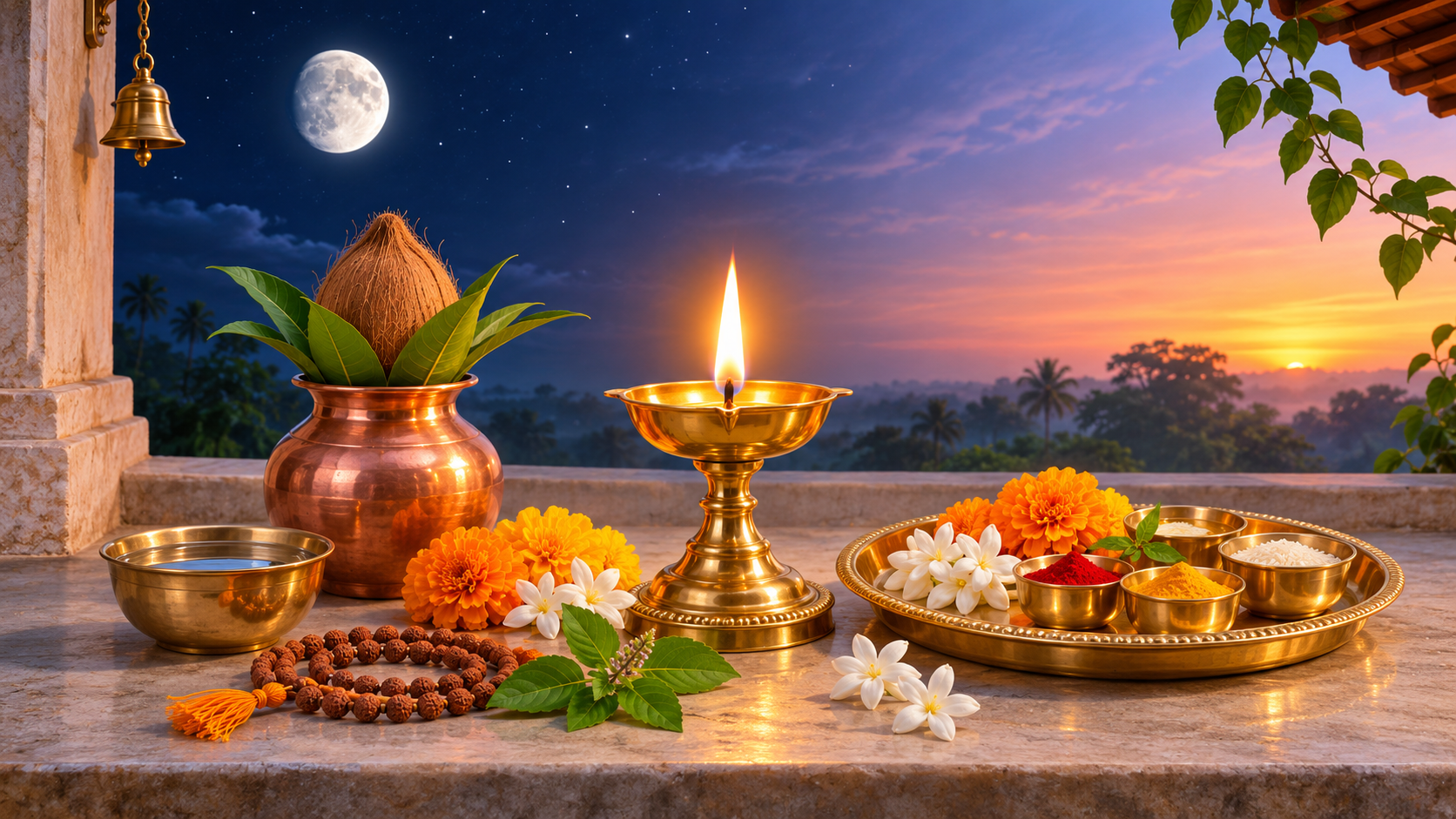
If you are deciding how to observe Sunday, November 22, the detail that matters most occurs early in the morning. The date begins under Shukla Paksha Dwadashi, but Trayodashi takes over at 1:36 AM.
That makes this principally a Trayodashi day for ordinary daytime planning. It does not, however, make one clock time or one ritual rule portable to every location. Use the transition below as your starting point, then confirm the local Panchang before fixing a vrata, puja, sankalpa, or muhurta.
The tithi change on November 22
Sunday falls in Shukla Paksha, the waxing or light half of the lunar cycle. In most regions, Dwadashi continues until 1:36 AM and Shukla Paksha Trayodashi follows.
| Period on November 22 | Prevailing tithi | Plain meaning |
|---|---|---|
| From the beginning of the civil date until 1:36 AM | Shukla Paksha Dwadashi | The twelfth lunar day of the waxing half |
| After 1:36 AM | Shukla Paksha Trayodashi | The thirteenth lunar day of the waxing half |
If you simply need the tithi associated with normal morning or daytime worship, Trayodashi is the relevant answer wherever this timing applies. Dwadashi matters when you are identifying the tithi during the short period after midnight and before the transition.
Why the calendar date alone can mislead you
A civil date changes at midnight. A tithi does not. It follows lunar reckoning and can begin or end at any point on the clock. November 22 therefore carries two tithis even though most of its practical religious use falls under the later one.
This distinction becomes important when you write a sankalpa or follow a vrata rule. Do not choose Dwadashi merely because it is present when the civil date begins. Equally, do not erase that early Dwadashi interval if you are recording the tithi of an event that occurred before 1:36 AM.
The correct question is not only, “What tithi touches November 22?” Ask, “Which tithi prevails at the time my observance requires?” Some observances are tied to sunrise, while others depend on a prescribed part of the day. A family or temple tradition may also specify which condition governs the observance. Apply the rule belonging to that practice rather than transferring a rule from a different vrata.
How to plan worship without overreading one tithi line
First, identify the city where the worship will occur. Panchang times are local calculations, so a clock reading presented for most regions should not automatically be treated as universal. If your trusted temple or city-specific calendar gives a different local transition, use the calculation prepared for your location.
Next, separate the tithi from the muhurta. Knowing that Trayodashi prevails after 1:36 AM does not by itself establish an auspicious time for every ceremony. A complete decision may also require local sunrise and sunset, the relevant ritual rule, and other Panchang elements. The tithi alone cannot tell you the nakshatra, rashi, yoga, karana, Rahu Kalam, Abhijit Muhurat, or a ceremony-specific auspicious window.
For routine home worship, you can use Trayodashi as the day’s operative tithi after confirming the local transition. For a vrata with precise observance or completion rules, consult the calendar followed by your sampradaya or temple. For a major samskara or another ceremony requiring a muhurta, do not select the time from this tithi change alone.
If you will make a sankalpa, check the local tithi at the actual time of worship rather than copying a date label prepared for another city. This small step prevents the most common practical error: treating a lunar day as though it begins and ends with the civil date.
Key takeaways
- November 22, 2026 falls on a Sunday.
- Shukla Paksha Dwadashi continues until 1:36 AM in the published timing.
- Shukla Paksha Trayodashi begins after 1:36 AM, making it the relevant tithi for ordinary daytime planning where that timing applies.
- The early Dwadashi interval still matters for an event or observance occurring before the transition.
- A tithi change is not a complete muhurta. Confirm your city, the local Panchang, and the rule for the particular vrata or ceremony.
Before finalizing your Sunday observance, write down three things: the location, the time you intend to worship, and the rule your tradition applies. Then check them against a city-specific Panchang. That will tell you whether the 1:36 AM transition is the correct local basis for your sankalpa and practice.

References

Leave a Reply
You must be logged in to post a comment.