

You may know what you ought to do and still shrink before it. The duty is visible, the next step is possible, yet an old conclusion rises first: you are not capable enough, confident enough, learned enough, or important enough to attempt it.
Hanuman offers a precise way through that paralysis. His example is not a promise that every obstacle is imaginary or that confidence can replace preparation. It shows something more demanding: capacity must be remembered truthfully, disciplined by dharma, and placed in service of something higher than the ego. That is how potential becomes power you can trust.
Hanuman changes the question behind self-doubt

In the Ramayana tradition, Hanuman possesses extraordinary abilities from childhood. He can fly, alter his size, and cross an ocean in a single leap. Yet his playful misuse of those gifts brings restraint from sages, and the story turns on the difference between possessing strength and remembering it. His forgotten capacity has to be awakened before it can answer a worthy need.
This changes the question you ask when you feel powerless. Instead of immediately asking, What power do I lack?, ask, What have I forgotten? You may have forgotten a skill you already demonstrated, a difficulty you already survived, a discipline you allowed to lapse, or the reason the present duty matters. The answer must rest on evidence. Vague declarations of greatness are not remembrance; they are another way of avoiding reality.
Begin by separating three conditions that can feel similar from the inside:
- A real limit: You lack necessary knowledge, physical capacity, authority, time, or material support. Respect the limit, obtain help, train, or change the plan.
- A forgotten capacity: You have relevant evidence from your own conduct, but fear is preventing you from applying it. Name that evidence and test it through a bounded action.
- An ethical restraint: You could act, but doing so would violate a duty, promise, or legitimate boundary. Refusing such action is not weakness. It is self-command.
This distinction protects Hanuman’s teaching from becoming magical thinking. You are not being told that you can do anything merely by believing. You are being asked not to call yourself helpless before you have examined what is actually present.
When the sentence I cannot do this appears, make it more exact. Write down the task in observable terms. Then ask: What part can I not do? What part am I afraid to do? What part have I done before in another form? What must I learn or request before proceeding? Precision reduces a total verdict about yourself to a set of decisions you can handle.
Remembering your strength is not feeding the ego
There is a reason Hanuman is a better guide to inner power than the modern fantasy of becoming invulnerable. His immense strength does not make him self-absorbed. He can become vast when the work demands vastness and small when subtlety is required. The governing question is not, How impressive can I appear? It is, What form does the duty require?
That flexibility exposes two errors. The first is self-negation: denying a genuine ability because visibility feels uncomfortable or because humility has been confused with weakness. The second is self-inflation: treating an ability as proof of superiority and using every task as a stage. Both keep attention fixed on the self. Hanuman’s humility is different. It does not deny strength; it removes the demand that strength glorify its possessor.
You can test your own understanding with a simple inventory. For each capacity you claim, record:
- The capacity: State it without exaggeration, such as patient listening, physical endurance, careful analysis, teaching, organising, or remaining steady in conflict.
- The evidence: Name a concrete occasion when your conduct demonstrated it. If you cannot identify evidence, treat the capacity as something to develop rather than something already mastered.
- The service: Identify the person, duty, community, or dharmic purpose that the capacity can support now.
- The discipline: Name what prevents the capacity from becoming reckless: training, consultation, truthful speech, consent, restraint, or accountability.
This exercise gives confidence a firm basis. Evidence prevents fantasy. Service prevents vanity. Discipline prevents power from becoming harmful.
It also corrects a common misuse of humility. Saying that you are only an instrument does not excuse carelessness. An instrument must still be prepared. If the work requires study, study. If it requires practice, practise. If another person knows more, seek guidance. Surrender releases possessiveness over the result; it does not release you from competence.
Seva turns capacity into dharmic power
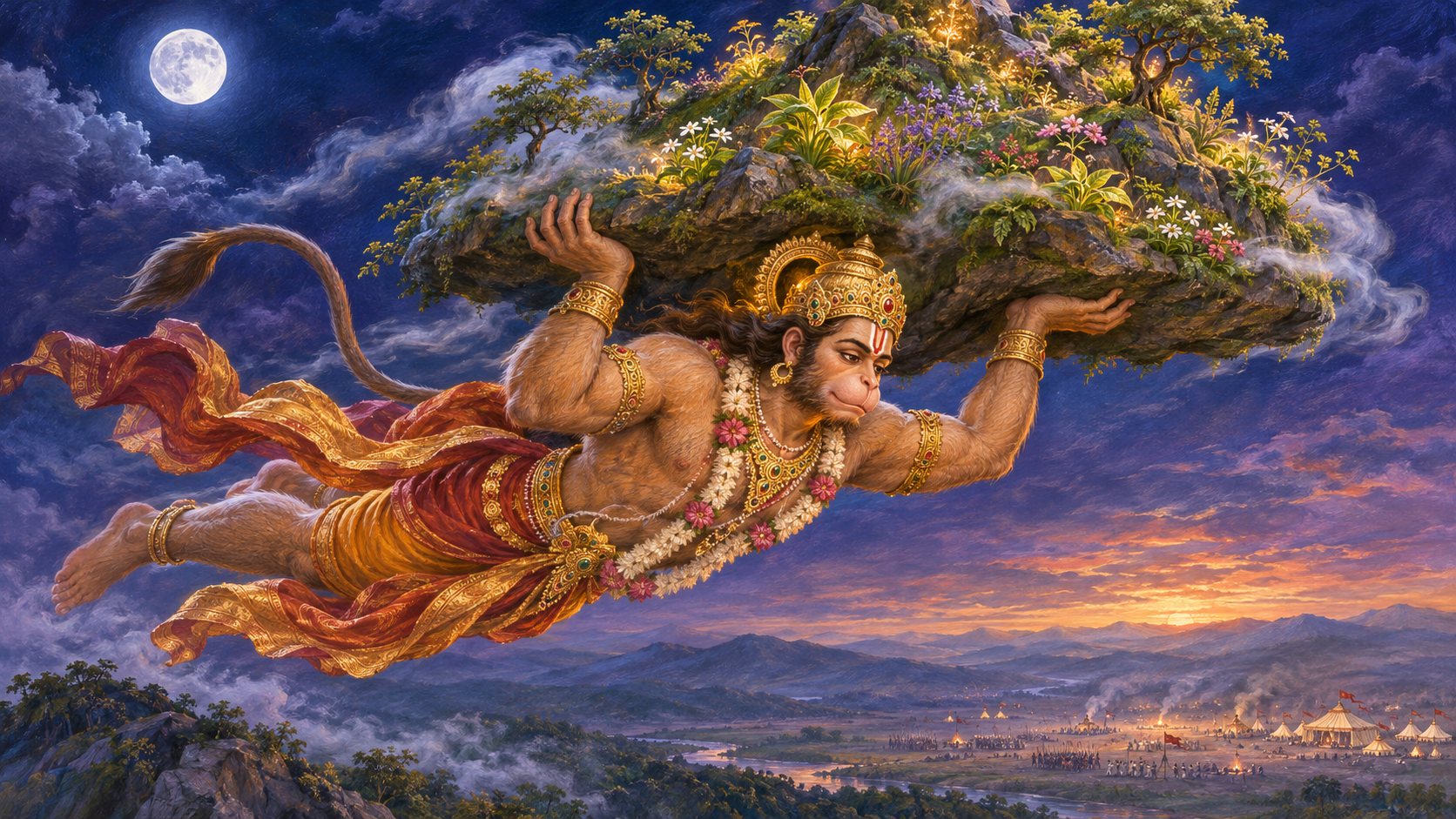
For Hanuman, Shri Rama is not a metaphor for personal productivity. His strength is inseparable from devotion to Rama. This theological centre matters because it explains why his power does not terminate in self-celebration. Bhakti gives his strength direction, and seva gives it form.
The practical consequence is sharp: do not ask only how to become more powerful. Ask what your power is for. A talent without direction can scatter into display, rivalry, or restless activity. A talent placed under dharma becomes available for the work that genuinely needs it.
Before acting, put the proposed use of your strength through a dharmic check:
- Duty: Is this actually yours to do, or are you intruding because you want to feel indispensable?
- Means: Are you pursuing a good end through truthful and proportionate conduct?
- Beneficiary: Who is helped by the action, and who may bear its cost?
- Recognition: Would you still do the work if someone else received the praise?
- Correction: Can you accept guidance without treating disagreement as disrespect?
- Release: Can you give full effort without claiming ownership over every outcome?
If the answers reveal vanity, haste, or trespass, the remedy may be to become smaller: listen, assist, learn, or remain unseen. If the answers reveal avoidance of a legitimate duty, the remedy may be to become larger: speak clearly, accept responsibility, or endure discomfort. Hanuman’s changing form gives us a useful image for this discernment. Inner power includes knowing when not to occupy the centre.
Seva also changes how you relate to fear. When attention remains fixed on protecting your image, every imperfect action threatens the self. When attention turns toward the person or duty being served, fear may remain, but it no longer has the only vote. Courage then becomes less theatrical. It is simply the willingness to let dharma outrank discomfort.
A Hanuman practice for the task you are avoiding

Use this practice for one real duty, not for a vague ambition to transform your whole life. Choose something you have delayed even though it is legitimate and within your sphere of responsibility.
- Name the ocean. Write the avoided task as a verb and an object: make the necessary call, complete the application, apologise for the false statement, begin the assigned study, or ask for qualified help. Do not write become successful or fix everything. A named crossing can be approached; a cloud of anxiety cannot.
- Separate fact from verdict. List the actual constraints. Then list the statements that judge your identity, such as I always fail or people like me cannot do this. Constraints belong in the plan. Identity verdicts must be tested, not obeyed automatically.
- Remember evidence. Recall several occasions when you used a capacity relevant to the present task. The circumstances need not be identical. Look for the underlying quality: steadiness, endurance, honesty, concentration, courage, or willingness to learn.
- Place the capacity before Rama. If it belongs to your practice, recite the Hanuman Chalisa, remember a name of Hanuman, or offer a simple prayer using the devotional discipline you have received. Do not treat a mantra as a technique for controlling results. Let remembrance reorder your intention: May this strength serve dharma rather than vanity.
- Choose the right size. Decide whether the next step requires expansion or restraint. Expansion may mean taking responsibility or speaking the necessary truth. Restraint may mean listening, seeking instruction, or limiting the promise to what you can actually deliver.
- Complete one meaningful unit. Take an action that changes the state of the task. Thinking about the call is not the same as placing it. Rearranging notes is not the same as beginning the assigned work. Choose a step that leaves visible evidence of movement.
- Review without self-drama. After acting, ask what worked, what needs correction, and what duty follows. Do not turn a mistake into a verdict of worthlessness or a success into proof of superiority. Learn, offer the result, and continue.
Repeat this sequence whenever hesitation returns. The aim is not to manufacture an intense feeling of power. Feelings vary. The aim is to build a reliable movement from remembrance to discernment, and from discernment to service.
There will also be duties for which remembrance is not enough. You may need a teacher, professional expertise, community support, physical recovery, or formal authority. Seeking those things can itself be the courageous action. Hanuman’s example does not abolish dependence; devotion and service place individual capacity inside a larger relationship.
Key takeaways
- Self-doubt is not always proof of incapacity. Sometimes it is a failure to remember and apply capacities already demonstrated.
- Real constraints, forgotten strength, and ethical restraint require different responses. Do not collapse all three into I cannot.
- Humility does not mean denying your gifts. It means using them without making yourself the final purpose.
- Hanuman’s power is governed by devotion to Shri Rama, directed through seva, and adjusted to the needs of dharma.
- Confidence should rest on evidence, preparation, and accountable action rather than slogans about unlimited potential.
- Remembrance becomes spiritually meaningful when it leads to the next rightful act.
Choose one avoided duty today. Name it plainly, identify one capacity you have evidence for, and decide whether dharma requires you to become larger or smaller before it. Then take the first honest step and offer the work to Shri Rama. You do not have to feel limitless. You have to stop abandoning the strength that service is asking you to use.
References

Leave a Reply
You must be logged in to post a comment.