

If you are trying to help a child, sibling or younger member of the sangat inherit Sikh identity, attending the occasional programme is not enough. The real test comes after everyone leaves the gurdwara: can the person explain what the practice means, recognise when Sikh principles are being misused, and carry those principles into ordinary choices?
This has become harder in an environment where heritage can be reduced to appearance, politics can overwhelm spiritual formation, and short online clips can sound more authoritative than careful learning. You do not have to solve all of that at once. You need a clear order of work: restore meaning to practice, make participation real, teach history carefully, and build habits of judgement.
Protect a living discipline, not just a visible identity

Sikh heritage is not a collection of objects, ceremonies or historical memories. It is a way of forming a person. Visible identity, remembrance of the Gurus, engagement with Guru Granth Sahib, kirtan, sangat, seva, langar and ethical conduct belong to the same moral world. Separating them makes each part easier to display but harder to understand.
The relationship among Sikh identity, Sikhi and the wider world should therefore be taught through three connected questions:
- What do we practise? Name the repeated action: prayer, listening, service, shared food, study or care for another person.
- What does the practice train? Explain the quality it is meant to cultivate, such as humility, truthful conduct, courage, remembrance or responsibility.
- What should change because of it? Identify the decision, relationship or habit in which that quality should become visible.
This simple sequence exposes a common weakness. A family may insist on participation without explaining meaning. A programme may offer explanation without giving anyone responsibility. A person may know the correct vocabulary while behaving as if the teaching has no claim on daily life.
Take langar. Do not stop at telling a young person that it is free food served at a gurdwara. Let the person help prepare, serve and clean up under appropriate supervision. Explain how the shared meal challenges claims of superiority. Then ask a harder question: where do status, caste, wealth or social connections quietly return despite the principle being celebrated? That final question turns heritage from praise of the past into examination of the present.
Use the same method with kirtan. Before listening to a selected shabad, read its meaning in language the learner understands. Afterwards, ask whether its central line functions as instruction, diagnosis, remembrance or prayer. The answer need not be polished. The purpose is to make listening active and to prevent sacred sound from becoming background music.
Do not demand from the next generation what adults are unwilling to explain or embody. When conduct contradicts teaching, acknowledge the contradiction plainly. Honest admission protects trust better than pretending that every inherited custom is automatically an expression of Sikhi.
Use language and the gurdwara as bridges into understanding
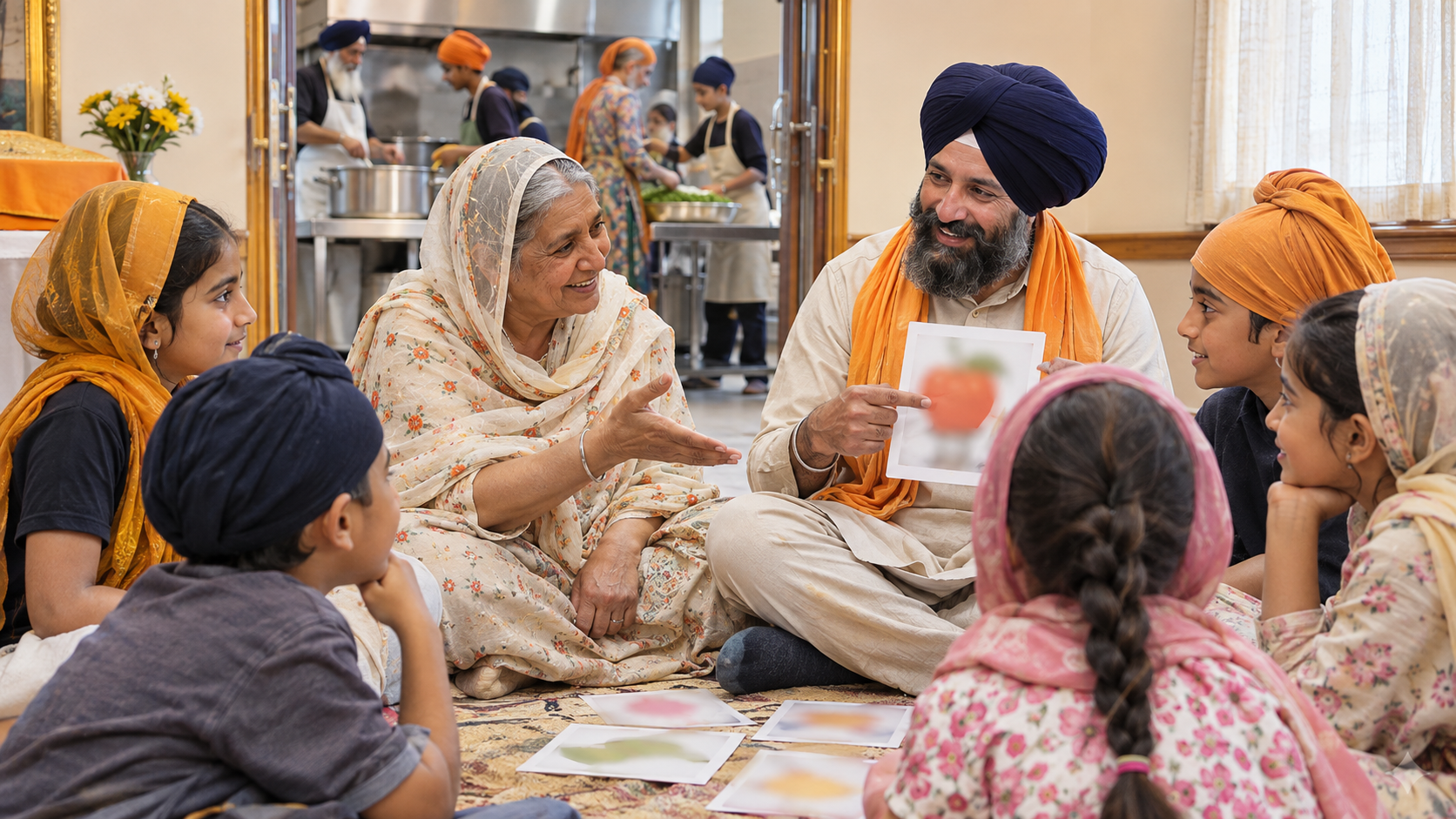
Language carries memory, sound and shades of meaning that translation cannot fully preserve. But language can also become a gate when adults treat fluency as proof of devotion or belonging. Punjabi is a language; Gurmukhi is a script used to write it. A learner may be familiar with one, both or neither. Find out which difficulty the person actually has before prescribing more recitation.
For any passage being taught, place four things together: the original script, a transliteration where needed, a careful translation, and a plain explanation of how the teaching applies. Transliteration helps a learner participate in sound, while translation opens meaning. Neither should be mistaken for the final stage. The goal is growing engagement with the original, not permanent dependence on a phonetic copy or a simplified paraphrase.
Avoid turning pronunciation mistakes into public embarrassment. Correct patiently and privately when possible. Shame may produce silence rather than learning, especially for diaspora children or adults who were never taught systematically. At the same time, do not declare the original language unimportant merely because translation is easier. A bridge is useful because it leads somewhere.
The gurdwara becomes educational when a newcomer has both a role and a person who can explain it. Attendance alone can leave someone physically present but intellectually outside. Give the learner a suitable responsibility, repeat it long enough for competence to develop, and connect it to the principle behind it.
- When welcoming people, discuss hospitality toward strangers rather than treating greeting as crowd management.
- When helping with shoes or cleaning, connect the task to dignity of labour without romanticising work that only the same volunteers perform.
- When serving langar, explain why equal regard matters and notice whether informal hierarchies remain.
- When listening to kirtan or a reading, provide enough meaning beforehand for the learner to follow the central thought.
- When hearing a family or community memory, distinguish personal recollection from a claim that still needs historical verification.
Questions must also be safe to ask. A young person who asks why a practice exists is not necessarily rejecting it. The question may show that inherited participation is becoming conscious commitment. If you do not know the answer, say so, identify someone qualified to ask, and return to the question. An invented answer delivered with confidence does more damage than an honest pause.
Teach history without handing politics control of Sikhi
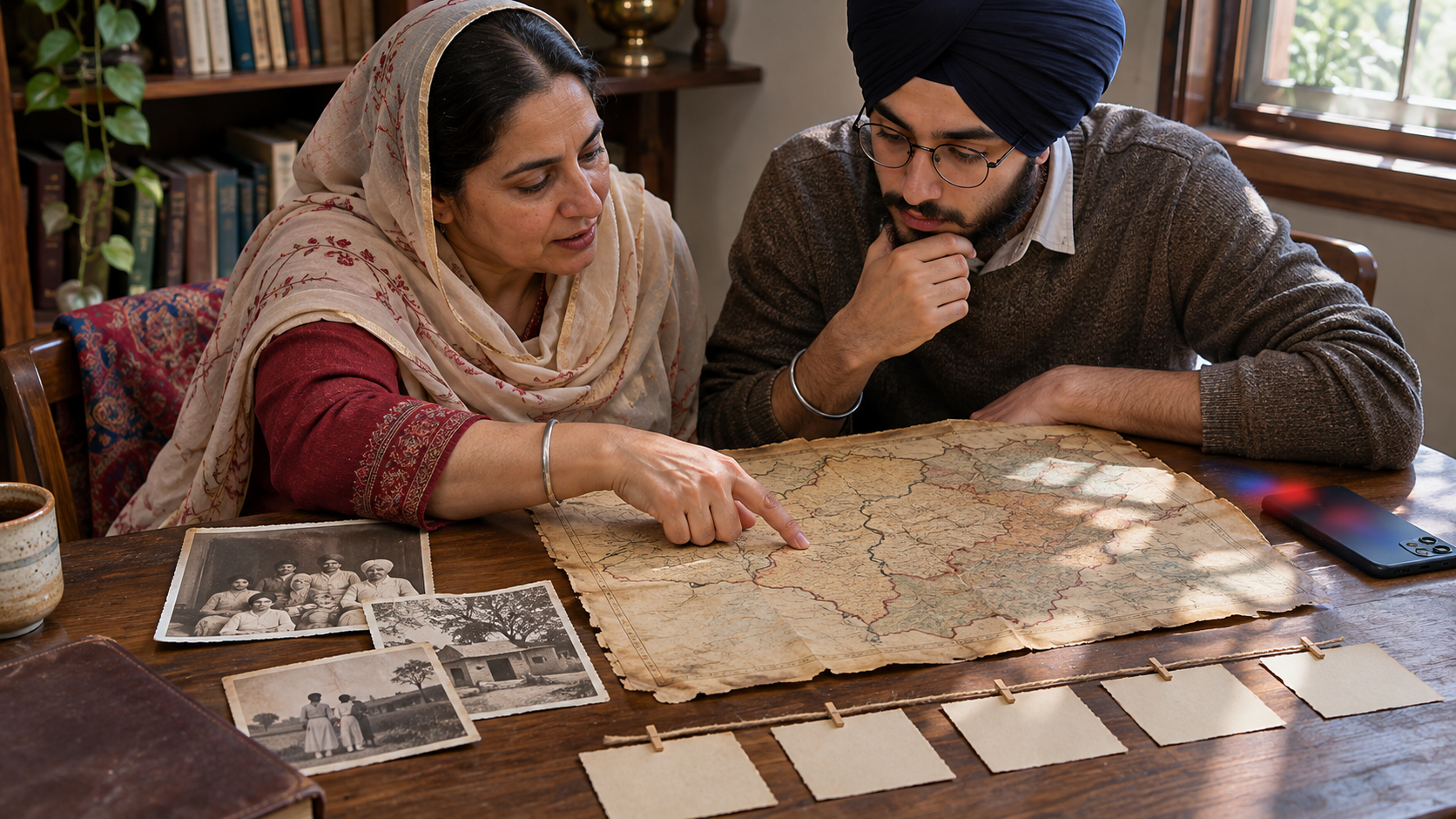
Sikh history contains courage, sacrifice, institution-building, persecution, service and difficult encounters with political power. That history should not be softened into harmless folklore. Nor should it be compressed into a permanent instruction to distrust another community, country or neighbour.
This distinction matters for Sikhs living in Punjab, elsewhere in Bharat and across the diaspora. A Sikh can care deeply about the Panth, Punjab, Bharat, a country of residence and humanity without accepting every slogan attached to those loyalties. Commitment to justice need not be recruited into hostility toward Bharat. Love of Bharat should not be used to silence Sikh pain, historical memory or legitimate questions about justice. A mature heritage can hold belonging and accountability together.
When a political claim enters a family conversation, classroom, gurdwara discussion or social feed, separate its layers before deciding whether to accept it:
- Fact: What event, statement or text is being claimed, and can it be verified?
- Interpretation: What explanation is being placed on that fact? Could the same evidence support a narrower conclusion?
- Prescription: What action does the speaker want from you?
- Identity test: Are you being told that a good Sikh must accept the speaker’s political conclusion without question?
The last layer deserves special attention. Political movements often turn disagreement into betrayal because loyalty tests are easier to enforce than reasoned arguments. Do not ask a young Sikh to inherit an accusation before learning the evidence. Teach the person to resist contempt even when discussing real injustice.
Apply the same moral standard to every camp. Ask whether a claim preserves human dignity, whether the speaker provides full context, and whether the proposed action would be acceptable if used against one’s own community. Refuse collective blame. A wrong committed by an institution, faction or individual does not make every member of a religion, region or nation guilty.
Also distinguish scripture, historical scholarship, family memory and campaign messaging. They do not carry the same kind of authority. A passage from Guru Granth Sahib should not be treated as a detachable slogan. A remembered story may be precious without settling every historical question. A political video may express genuine concern while still editing out context. Making these distinctions does not weaken commitment; it protects commitment from manipulation.
Build habits strong enough for the digital world

Online, confidence often travels faster than context. A dramatic clip can pass through a family or community group before anyone finds the complete speech, checks the translation or asks when it was recorded. The answer is not withdrawal from public discussion. It is a forwarding discipline.
- Locate the full recording, passage or statement rather than relying on a clipped extract.
- Check who is speaking, where the words appeared and whether the date or setting changes their meaning.
- Keep original text, transliteration, translation and commentary visibly separate.
- When scripture is invoked, read the surrounding passage and consult a qualified teacher if the interpretation carries serious consequences.
- State uncertainty honestly. Do not convert an unverified allegation into a fact by adding devotional or patriotic language.
- Do not forward material that humiliates ordinary people merely to score a political point.
Pair that digital discipline with a repeatable household or community rhythm. Choose a short passage and explore its meaning in the learner’s strongest language. Give the person a sustained seva responsibility rather than a ceremonial appearance. Preserve an elder’s memory with permission, labelling it as recollection where verification is unavailable. Undertake service beyond the Sikh community so that identity remains outward-looking. Revisit a disputed claim after emotions have cooled and examine how it was framed.
Measure progress by capability, not attendance alone. Can the learner explain why a practice matters without reciting a slogan? Can the person distinguish the Gurus’ teaching from a commentator’s opinion? Can they serve without needing public credit, ask a difficult question respectfully, and disagree without dehumanising anyone? Those abilities show that heritage is becoming judgement and character rather than mere familiarity.
Community leaders should use the same test on programmes. A crowded event may create belonging, but it does not automatically create understanding. After a programme, ask what participants can now explain, perform, question or apply. If the only answer is that they attended, the educational design is incomplete.
Key takeaways
- Connect every inherited practice to the quality it trains and the conduct it should change.
- Use transliteration and translation as bridges toward understanding, not as substitutes for deeper engagement.
- Give learners meaningful roles in the gurdwara and explain the principles behind those responsibilities.
- Separate verified facts, interpretations, political demands and identity-based loyalty tests.
- Check full context before sharing religious or political content online.
- Judge transmission by a person’s ability to understand, serve, question and act with dignity.
Begin with the practice in your home or gurdwara that everyone repeats but few people can explain. Restore its meaning, give someone a real responsibility within it, and leave room for an honest question. Sikh heritage becomes durable when the next generation can inhabit it, examine it and carry it forward without borrowing someone else’s anger.
References

Leave a Reply
You must be logged in to post a comment.