
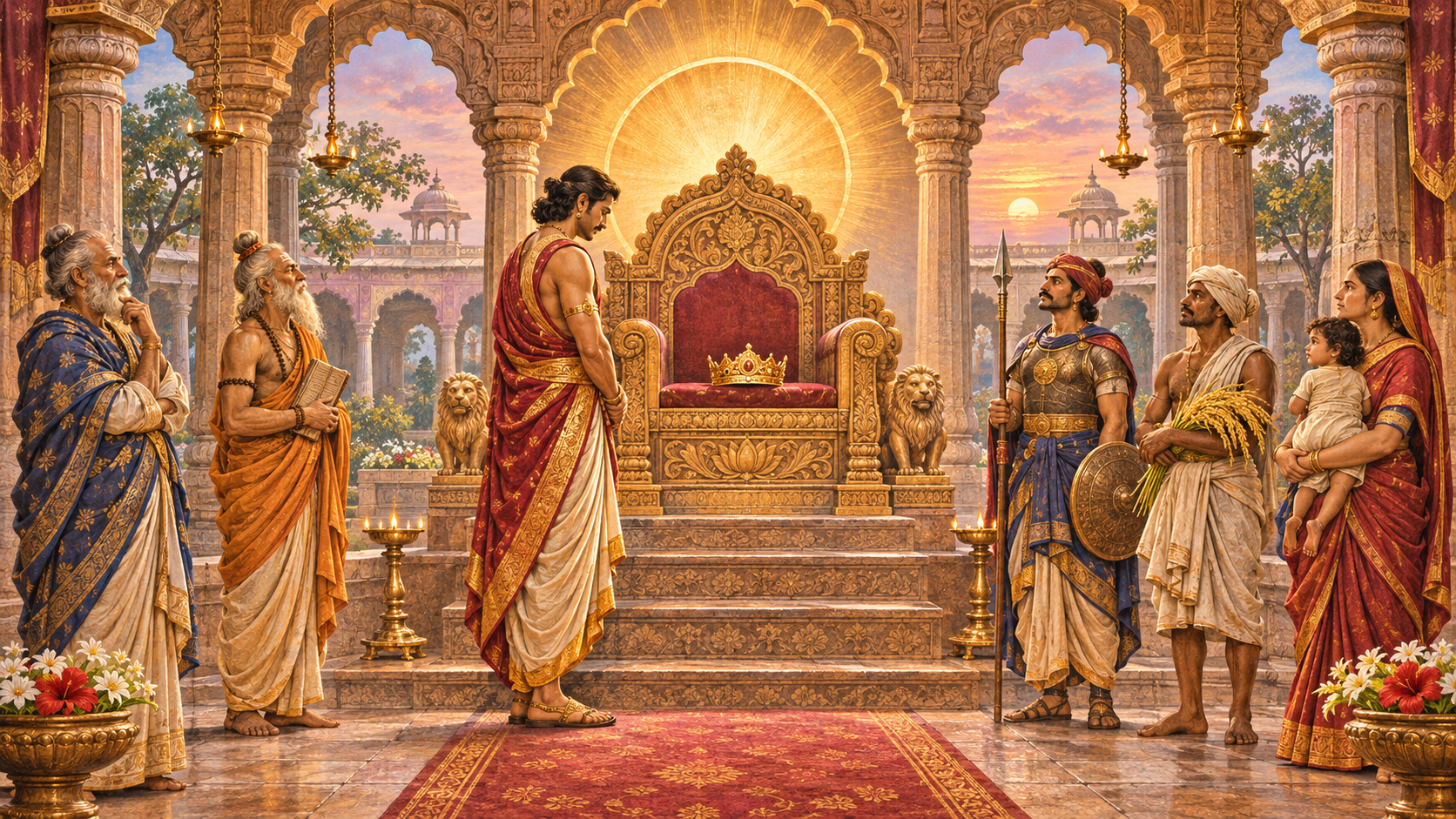
You may come to the Brahma Purana wanting a clear answer to a difficult question: what makes a ruler worthy of obedience? Its royal tales do not let birth, title, or ceremony settle the matter. They place righteous fathers beside wayward sons, rulers beside advisers, and human sovereignty beneath a larger moral order.
That pattern gives you a practical way to examine power. Separate the claim to rule from fitness to rule, and then judge the person by conduct, openness to correction, and the duties attached to the office. This is as useful when reading a Purana as it is when hearing sacred language used in praise of a leader.
Dharma stands above the person who wears the crown
Kingship in these narratives is not ownership of a realm. It is an office evaluated by a standard that the ruler does not invent. The decisive question is therefore not simply, “Is he the king?” It is, “Does he act as kingship requires?”
This is the heart of rajadharma. Dharma gives authority its purpose, boundaries, and obligations. A ruler may possess the throne while failing the ethical test of the throne. Conversely, criticism of a ruler’s conduct is not necessarily hostility to order; it may be an attempt to preserve the order that royal misconduct endangers.
Keep three claims separate whenever you read a royal tale:
- Succession concerns how a person receives an office.
- Dharmic fitness concerns how that person behaves after receiving it.
- Consecration concerns how the office and its obligations are publicly or sacredly acknowledged.
None of these automatically proves the other two. Inheritance does not certify character. A ceremony does not make every subsequent act righteous. Good conduct cannot be inferred merely from a grand title.
A simple reading practice will stop you from collapsing these distinctions. In the margin, mark each statement about inheritance with “I,” each statement about conduct with “D” for dharma, and each act of recognition with “R.” You will quickly see whether a character possesses all three, only one, or a disputed combination.
Righteousness is not inherited with the kingdom

The Trishanku narrative establishes its kingship problem through a sharp father-son contrast. King Trayaruni is portrayed as righteous and observant of religious duties, while his son Satyavrata refuses the righteous path. The royal line continues, but its moral character does not pass automatically from one generation to the next.
The line of Dhruva presents the same problem through another pair. Anga follows the righteous path, yet his son Vena does not inherit his father’s good qualities. Once again, genealogy can explain who follows whom without proving who is worthy.
That distinction is easy to miss because royal genealogies can look like decorative lists of names. Here, genealogy performs ethical work. A righteous father and an unrighteous son belong to the same house, so ancestry is held constant while conduct changes. The contrast makes personal responsibility impossible to avoid.
When you evaluate a hereditary or family-based claim to leadership, ask four concrete questions:
- What has this person actually done, apart from possessing a respected name?
- Which duties does the person accept as binding, even when those duties are inconvenient?
- How does the person respond when conduct is questioned?
- Are supporters defending observable actions, or substituting ancestry for evidence?
The tales do not require you to deny the importance of lineage. Lineage carries memory, responsibility, and continuity. They do require you to refuse a common shortcut: the prestige of an ancestor cannot be spent as moral credit by a descendant. Each ruler must embody dharma anew.
Counsel and consecration test power from two directions
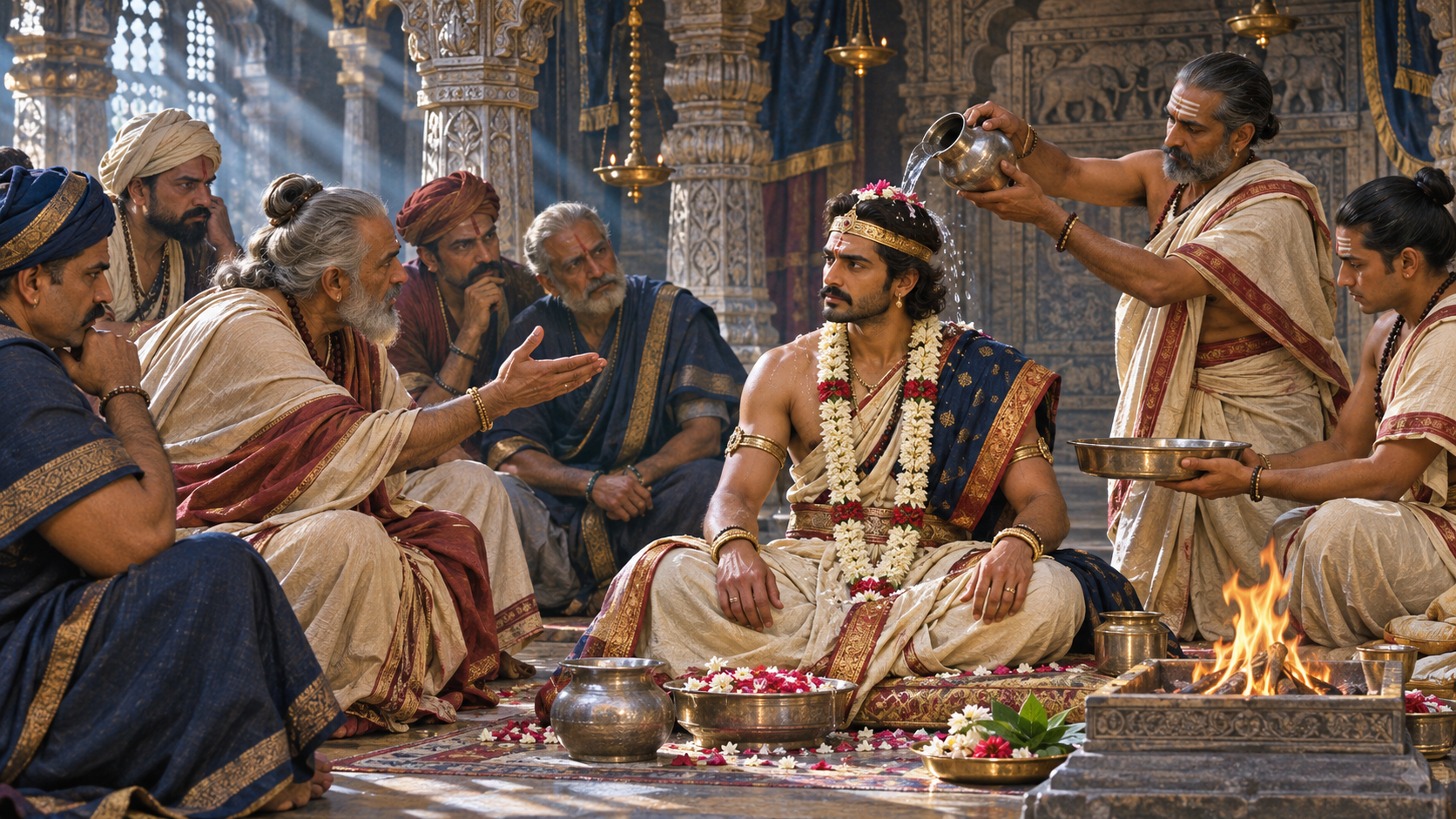
Counsel tests whether a ruler can be corrected
Vashishtha serves as Trayaruni’s chief priest and advises the king. Even without turning every detail of that relationship into a theory of government, the placement of a sage beside the throne matters. The ruler is not depicted as morally self-sufficient.
Advice has a different function from praise. Praise confirms a ruler’s self-image; counsel can expose the distance between conduct and duty. A court filled only with approval may still look orderly, but it has lost a mechanism by which authority can be recalled to dharma.
When you encounter an adviser in a kingship tale, do not ask only whether the adviser is wise. Notice what the relationship reveals about the ruler. Can unwelcome counsel be spoken? Is correction treated as service or disloyalty? Does authority become more disciplined after advice, or more defensive?
This principle applies beyond monarchies. A community leader, temple administrator, teacher, political figure, or head of a family may all claim to welcome guidance. The meaningful test is whether disagreement remains possible when status is at stake.
Consecration places the crown inside a larger order
In the royal sequence involving Anga and Vena, the scale of consecration becomes extraordinary: rivers and oceans arrive to anoint a king. At the level of sacred narrative, this imagery carries royal authority beyond a private family transfer or a palace ceremony. The natural and cosmic order participates in the recognition of kingship.
Such imagery magnifies the office, but it also magnifies the obligation. If the waters of the realm are symbolically present at a consecration, the king cannot be understood as responsible only to his household or personal ambition. Authority is situated within an order larger than the person who exercises it.
This gives you a disciplined way to interpret sacred ceremony. Do not stop at the splendour of the rite. Ask what duties the rite imposes. What must the ruler protect? What appetites must be restrained? Which wider relationships does the ceremony declare? If an interpretation enlarges the ruler but produces no corresponding obligation, it has read only half the symbol.
What these royal tales do not give you permission to claim
Puranic kingship can be misused when a moral narrative is reduced to a political label. Calling a contemporary opponent “Vena,” for example, proves nothing by itself. A responsible analogy must identify the conduct at issue, the duty allegedly violated, and the standard by which the judgment is being made. Without those steps, the name becomes an insult rather than an argument.
The presence of Vashishtha also does not establish that every religious intermediary possesses unlimited political authority. The relevant lesson is narrower and more defensible: kingship needs counsel, and power must remain open to correction. The wisdom and integrity of a purported adviser still have to be judged.
Nor should the magnificent anointing imagery be treated as a blank cheque for whoever can reproduce the appearance of sacred legitimacy. Consecration expresses the dignity and obligations of an office. It cannot remove the need to examine conduct, especially when the same body of royal narrative distinguishes so carefully between righteous and unrighteous heirs.
Finally, an ancient monarchy is not a ready-made constitutional manual for a modern state. The institutional forms differ. What travels across that distance is the diagnostic principle: authority is never its own moral proof. You can apply that principle without pretending that every ancient office has a direct modern equivalent.
A five-step method for reading kingship stories responsibly
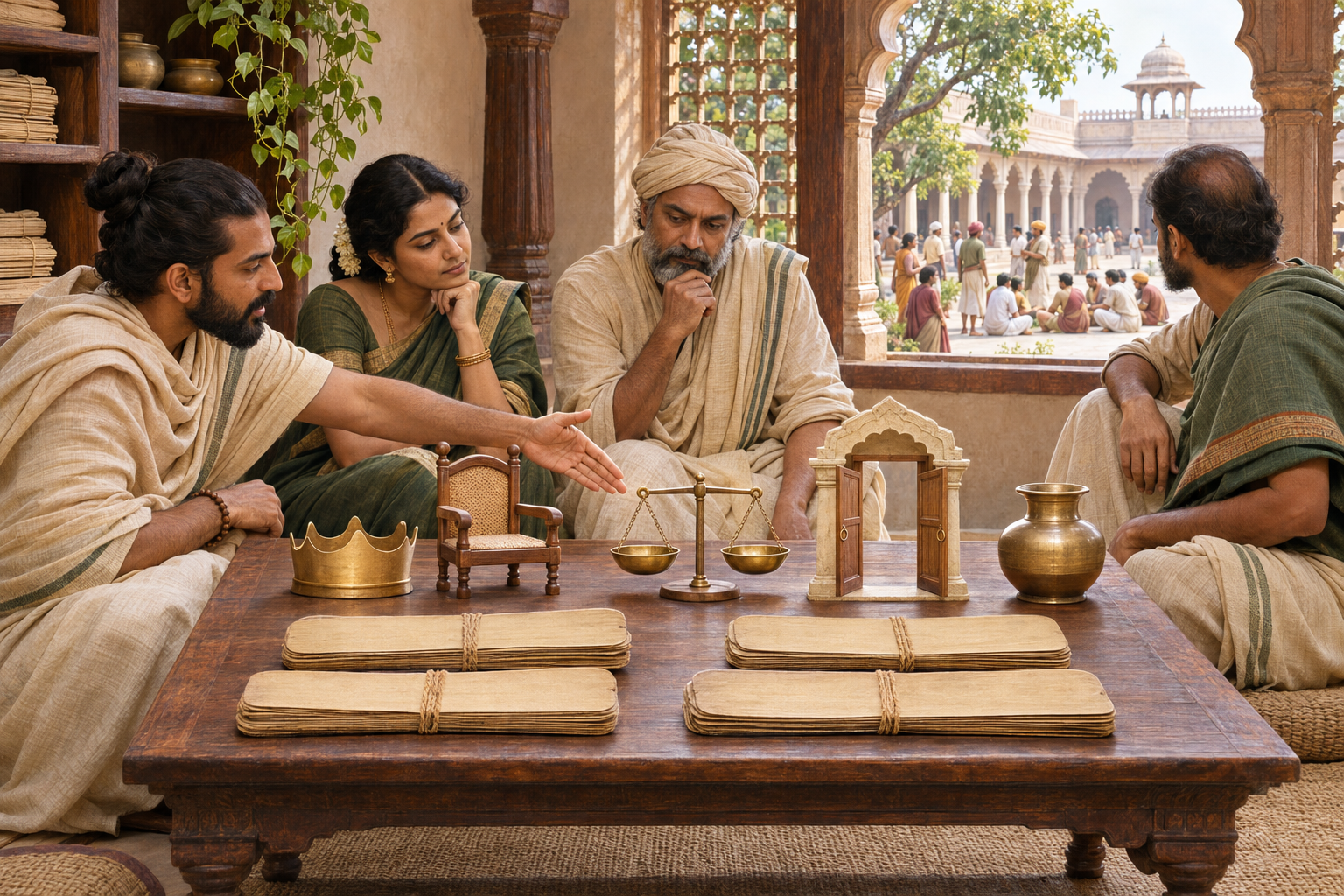
You can use the following method whenever a Purana presents a king, an heir, an adviser, or a consecration. It keeps the narrative’s moral distinctions intact while helping you apply them to leadership in your own world.
- Identify the contrast. Write down the paired figures, such as Trayaruni and Satyavrata or Anga and Vena. State the difference in conduct without adding motives the narrative has not supplied.
- Separate office from fitness. Record how the person is connected to the throne, then make a second entry for the qualities or actions attributed to that person. Do not allow the first entry to answer the second.
- Locate the source of restraint. Look for advisers, duties, vows, customs, or other standards that limit personal will. Then notice whether the ruler accepts or resists correction.
- Translate ceremony into obligation. When the kingship is honoured, ask what larger order is being acknowledged. Treat sacred recognition as a statement of responsibility, not as an exemption from scrutiny.
- Form a conduct-based judgment. Complete this sentence: “The claim to authority rests on _____, but dharmic fitness depends on _____.” Fill the second blank with observable conduct, accepted duty, restraint, and response to counsel.
This method is especially useful when political or community rhetoric invokes ancestry, civilisation, divine favour, or tradition. Those claims may deserve attention, but they do not complete the argument. Ask what duties follow from them and whether the person claiming the inheritance is actually carrying those duties.
Key takeaways
- A righteous lineage does not guarantee a righteous successor; Trayaruni and Anga are each followed by a son of different moral character.
- Dharma judges the ruler. The ruler does not make every personal choice dharmic merely by holding office.
- Wise counsel is not an insult to sovereignty. It is one way sovereignty remains answerable to a standard beyond personal will.
- Consecration enlarges responsibility as well as status. Sacred recognition cannot replace ethical scrutiny.
- Use the tales as diagnostic frameworks, not as labels for opponents or one-to-one blueprints for modern government.
On your next reading, keep a page with two columns: “claim to rule” and “fitness to rule.” Put genealogy, succession, title, and ceremony in the first. Put conduct, restraint, response to counsel, and accepted duties in the second. The Brahma Purana’s kingship narratives become clearer when those columns are not collapsed. So does the leadership in front of you.
References
- Hindu Pad – Trishanku Katha | Story of King Trishanku
- Hindu Pad – When all Rivers & Oceans arrived to anoint a King?

Leave a Reply
You must be logged in to post a comment.