
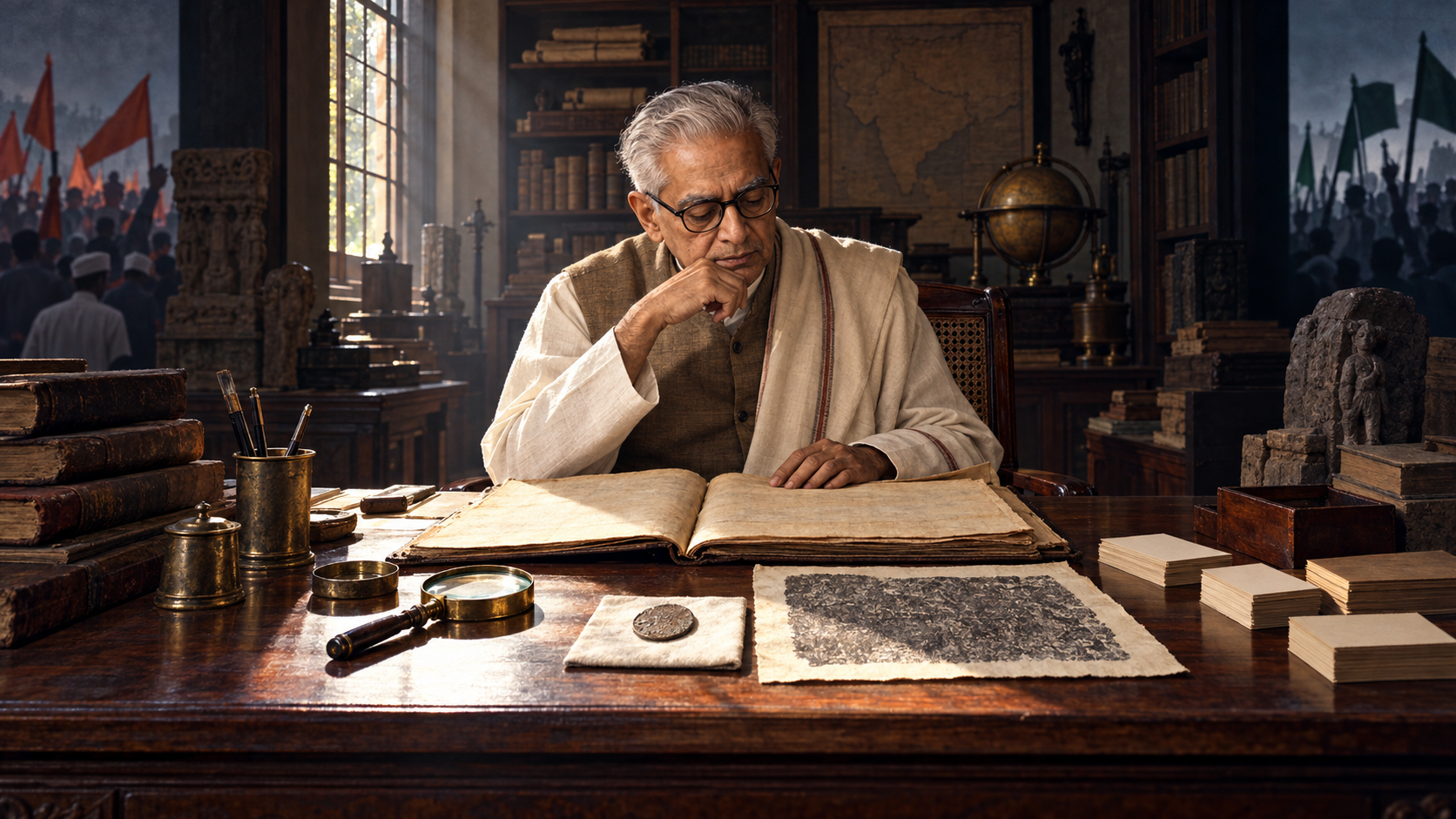
You read one account of Indian history and find a civilisational wound omitted. You read another and find every uncertainty converted into an accusation. The useful question is not which account sounds more patriotic. It is which claims can survive evidence, qualification and honest disagreement.
R. C. Majumdar gives you a demanding standard for making that judgment. Love of Bharat need not require a sanitised past, and criticism of distortion need not license counter-propaganda. The historian’s first obligation is to establish what happened as faithfully as the available evidence permits. Politics must answer to that work, not dictate its conclusion.
Majumdar’s dividing line: truth or political usefulness
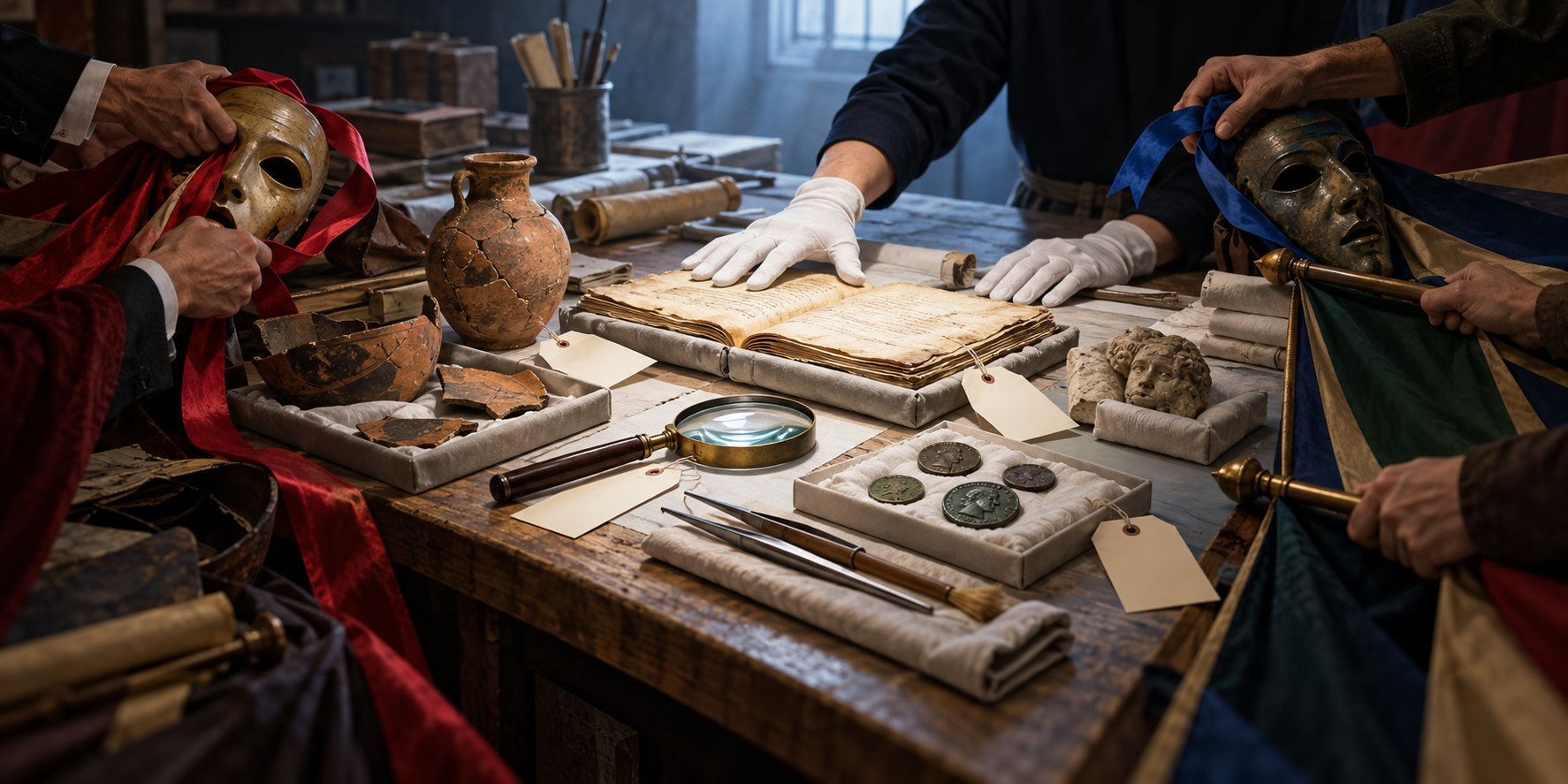
In his 1968 presidential address to the Institute of Historical Studies, Majumdar confronted a question that remains basic to Indian historiography: should the past be reconstructed from evidence, or arranged to serve the political needs of the present?
He placed the historian’s duty within a demanding intellectual lineage. Leopold von Ranke and Barthold Georg Niebuhr represented the disciplined establishment of historical fact; Kalhana and Sir Jadunath Sarkar demonstrated that truthfulness in history was not foreign to India’s own scholarly inheritance. The common principle was independence from fear, favour and prescribed conclusions.
This does not mean that historians must agree about every cause, motive or consequence. Evidence can be incomplete. Two careful scholars can assign different weight to the same material. The dividing line appears when an interpretation becomes immune to correction: the desired conclusion is fixed first, and evidence is admitted, softened or excluded according to whether it helps.
You can test a historical claim with one preliminary question: what evidence would cause its advocate to revise it? If the honest answer is none, you are probably dealing with an identity-protecting argument rather than an open historical inquiry.
How politics enters the writing of history
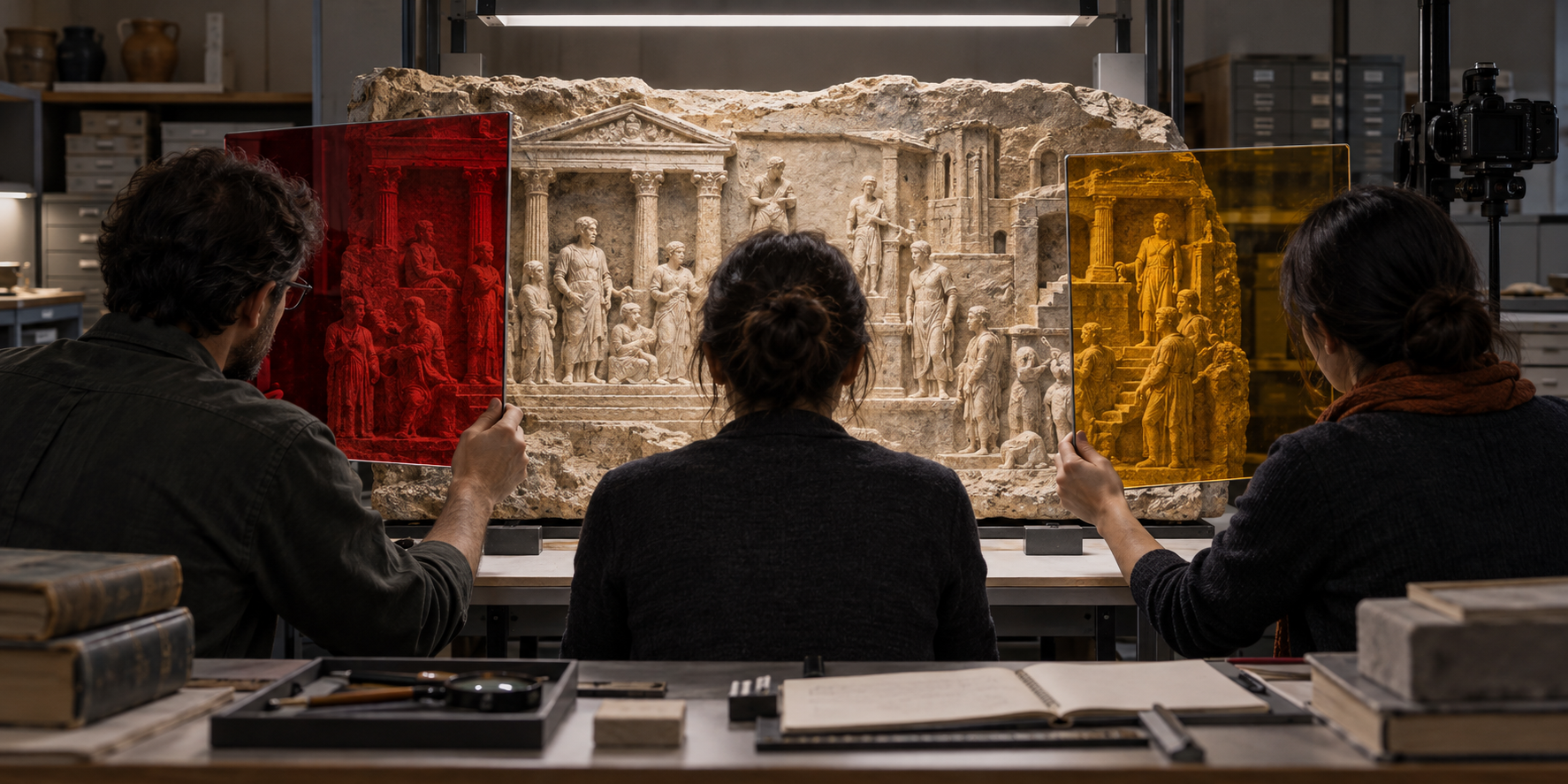
Political control over history does not always arrive as an explicit order to lie. It can operate through selection, language, institutional approval and the boundaries of respectable debate. Majumdar criticised the influence of government policy, ideological conformity and national sentiment on Indian historical writing. That wider mechanism matters because every individual sentence may look defensible while the assembled narrative remains misleading.
- The conclusion comes first. The past is expected to validate national integration, a party doctrine or a preferred theory of cultural development.
- Selection replaces open denial. Convenient facts receive detail and repetition; inconvenient ones disappear from the syllabus or are reduced to a passing phrase.
- Language distributes moral weight. Similar conduct may be described as cruelty in one case, administrative necessity in another and regrettable misunderstanding in a third.
- Scepticism becomes selective. Evidence against a preferred figure is treated as unreliable, while equally difficult evidence against an opponent is accepted without examination.
- Institutions close the argument. Textbooks, academic appointments and official policy can turn one interpretation into orthodoxy before the underlying dispute has been settled.
None of these signs proves that a conclusion is false. A politically useful statement can also be historically true. The problem is methodological: political usefulness cannot be the test by which truth is admitted. Ask whether inconvenient evidence is confronted in the same detail as convenient evidence. Symmetry is often more revealing than tone.
It is also important to distinguish politicisation from ordinary disagreement. A historian who weighs evidence differently is not necessarily dishonest. Look for the harder failures: omitted counter-evidence, conclusions stronger than the record permits, moral labels substituted for explanation, and claims that cannot in principle be revised.
National integration is a goal, not a rule of evidence
Majumdar directly examined the tension between historical truth and the political ideal of national integration. He also objected to selective presentations of India’s past made in the name of non-violence and national unity. His challenge was not to national cohesion itself. It was to the belief that cohesion must be purchased by removing troublesome facts.
That bargain fails even on its own terms. A narrative protected from evidence becomes fragile. Once a concealed fact emerges, readers do not merely reconsider that fact; they begin to distrust the institution that concealed it. Sanitisation therefore transfers conflict from the past into the present and adds a fresh grievance about deception.
A better approach keeps three questions separate:
- What happened? Establish the act, actor, setting and evidence before assigning a larger meaning.
- What does it explain? Decide whether the event reveals an individual decision, a state policy, a recurrent pattern or something narrower.
- What follows for people now? Historical responsibility belongs to historical actors. Present-day collective blame does not automatically follow from an accurate account of earlier conflict.
This separation blocks two common evasions. Fear that a fact may be misused is not a reason to suppress it. Anger about a fact is not permission to expand its meaning beyond the evidence. You can acknowledge conquest, persecution, accommodation, patronage or resistance wherever the record supports them without turning descendants into defendants.
The same discipline applies to claims about Indian non-violence. A civilisation may esteem non-violence without every episode in its history being non-violent. A moral ideal and a descriptive account perform different jobs. Protecting the ideal by editing the account weakens both.
Medieval history requires precision, not euphemism or rage

Majumdar used Mahmud of Ghazni, Aurangzeb and Hindu-Muslim relations to address disputes in which state power, religious identity and collective memory meet. These subjects remain difficult precisely because a single episode is often made to carry an entire political verdict.
When you encounter a strong claim about the medieval period, slow the argument down. Work through it in this order:
- Define the event. Replace broad labels with the specific action being alleged or denied.
- Identify the actor. Distinguish a ruler, commander, court, institution, local group and population. These are not interchangeable subjects.
- Locate the evidence. Ask what kind of record supports the claim and whether the conclusion goes beyond what that record can establish.
- Separate action from motive. Evidence that something occurred does not always prove why it occurred. Mark motive as explicit, inferred, mixed or uncertain.
- Test the scale. Determine whether the example establishes a single decision, a continuing policy or a general pattern. One cannot be silently enlarged into another.
- State the limit. A trustworthy account tells you not only what is supported but also what remains unproved.
This sequence prevents both sanitisation and indiscriminate indictment. Euphemism can erase the experience of Hindu communities from the record. Overgeneralisation can collapse different centuries, rulers and populations into one timeless enemy. Neither method produces history worthy of civilisational memory.
Watch especially for changes in the grammatical subject. A claim may begin with a named ruler, shift unnoticed to a dynasty, and end by accusing an entire religious population. The evidence offered for the first claim cannot automatically support the last. The reverse manoeuvre is equally misleading: invoking peaceful relations among communities does not by itself disprove a particular ruler’s coercive act.
A pro-Hindu history must be strong enough to correct itself
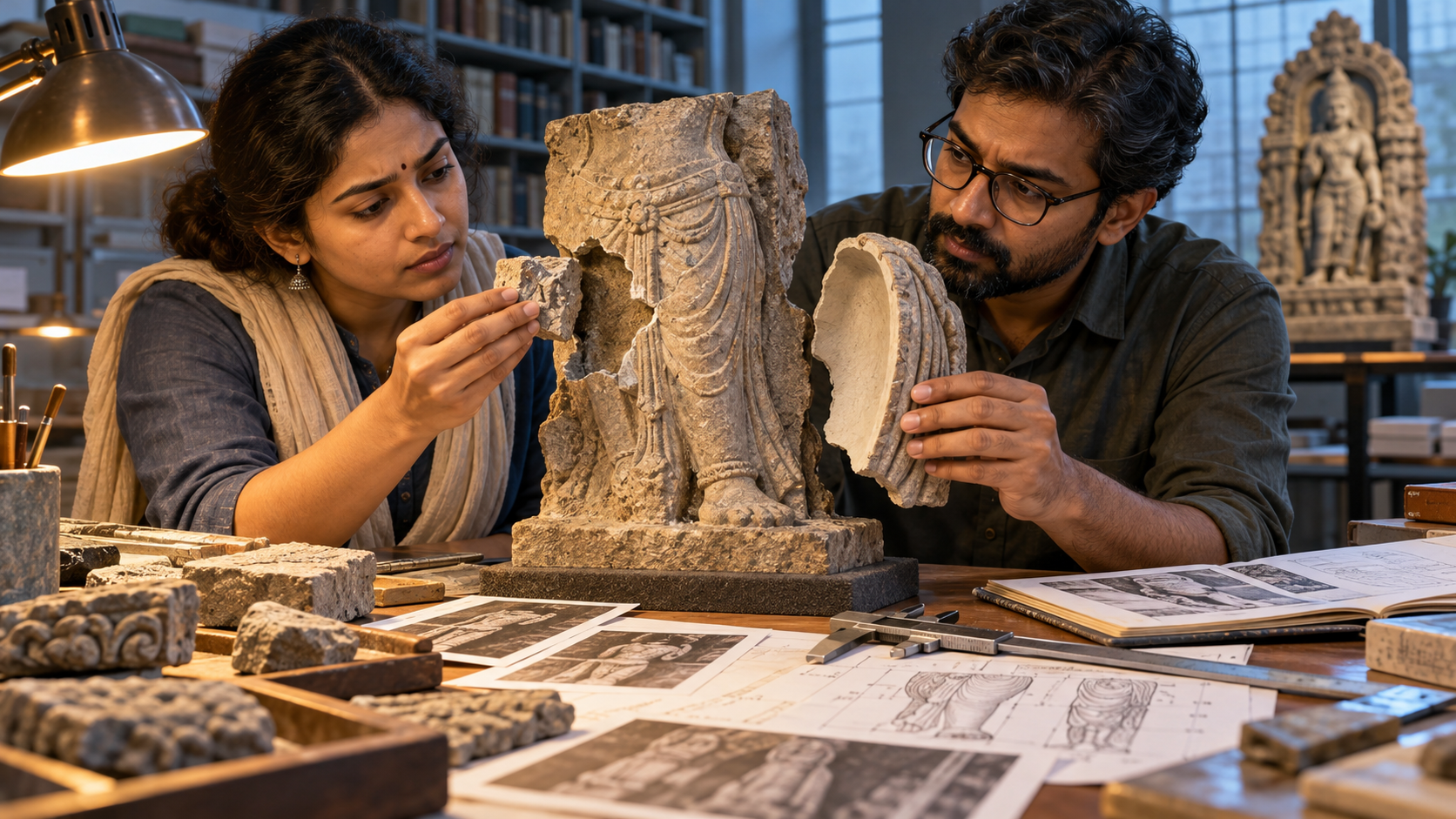
Majumdar’s standard cuts in every direction. It challenges schools that minimise uncomfortable episodes, but it also challenges any Hindu corrective that treats a desired civilisational conclusion as self-validating. Reversing the approved heroes and villains while preserving the same selective method merely changes the beneficiary of the distortion.
A pro-Hindu account earns confidence when it restores excluded evidence, names injury plainly and still refuses claims that the evidence cannot carry. It should be able to recognise the achievement of an unfavoured actor, the failure of a favoured ruler and uncertainty where the record is incomplete. That is not timidity. It is what makes correction durable.
For a Dharmic reader, the principle is especially clear: a commitment to satya cannot become conditional when truth complicates group pride. Civilisational self-respect is not the belief that one’s ancestors were always right. It is the confidence to recover their world without asking them to perform present-day politics.
This also gives you a practical way to judge accusations of bias. Do not stop at the writer’s identity or presumed ideology. Examine the work:
- Are major claims tied to identifiable evidence?
- Are facts, inferences and moral judgments kept distinct?
- Does the wording remain equally precise for favoured and unfavoured actors?
- Are serious counterarguments answered rather than ignored?
- Is uncertainty stated where certainty is unavailable?
- Can an error be corrected without the whole political identity of the account collapsing?
An account that passes these tests deserves attention even when its conclusion is unwelcome. One that fails them deserves scrutiny even when it confirms everything you already believe.
Use Majumdar’s method when you read, teach or share history
The struggle over historiography does not occur only in universities. It reaches you through schoolbooks, public commemorations, videos, political speeches and social media excerpts. Before sharing a dramatic historical claim, perform a short audit.
- Rewrite the claim in one precise sentence. If you cannot, it may be rhetoric rather than a testable proposition.
- List the factual assertions separately from the interpretation placed upon them.
- Check whether the named actor and the group blamed are actually the same subject.
- Look for omitted facts that would narrow, complicate or contradict the conclusion.
- Reduce the conclusion to the strongest wording the evidence securely supports.
- Share the uncertainty with the claim. Do not preserve confidence that the evidence itself does not contain.
Key takeaways
- Political usefulness cannot decide whether a historical claim is true.
- Selection, euphemism and unequal standards can distort a narrative without an explicit falsehood.
- National integration is compatible with honest history; it is not a licence to edit the past.
- Accurate accounts of historical conflict do not justify collective blame against people living now.
- A pro-Hindu historiography becomes more credible, not less, when it states uncertainty and corrects its own side.
- The most revealing test is whether a conclusion could change when contrary evidence appears.
Majumdar ultimately placed responsibility on historians, including younger scholars, to defend the integrity of their discipline against official and ideological pressure. You need not be a professional historian to honour that responsibility. The next time a claim about Bharat confirms your politics perfectly, pause before you repeat it. Define it, test it and narrow it to what can actually be shown. That small act is how historical truth remains stronger than the power trying to recruit it.
References

Leave a Reply
You must be logged in to post a comment.