
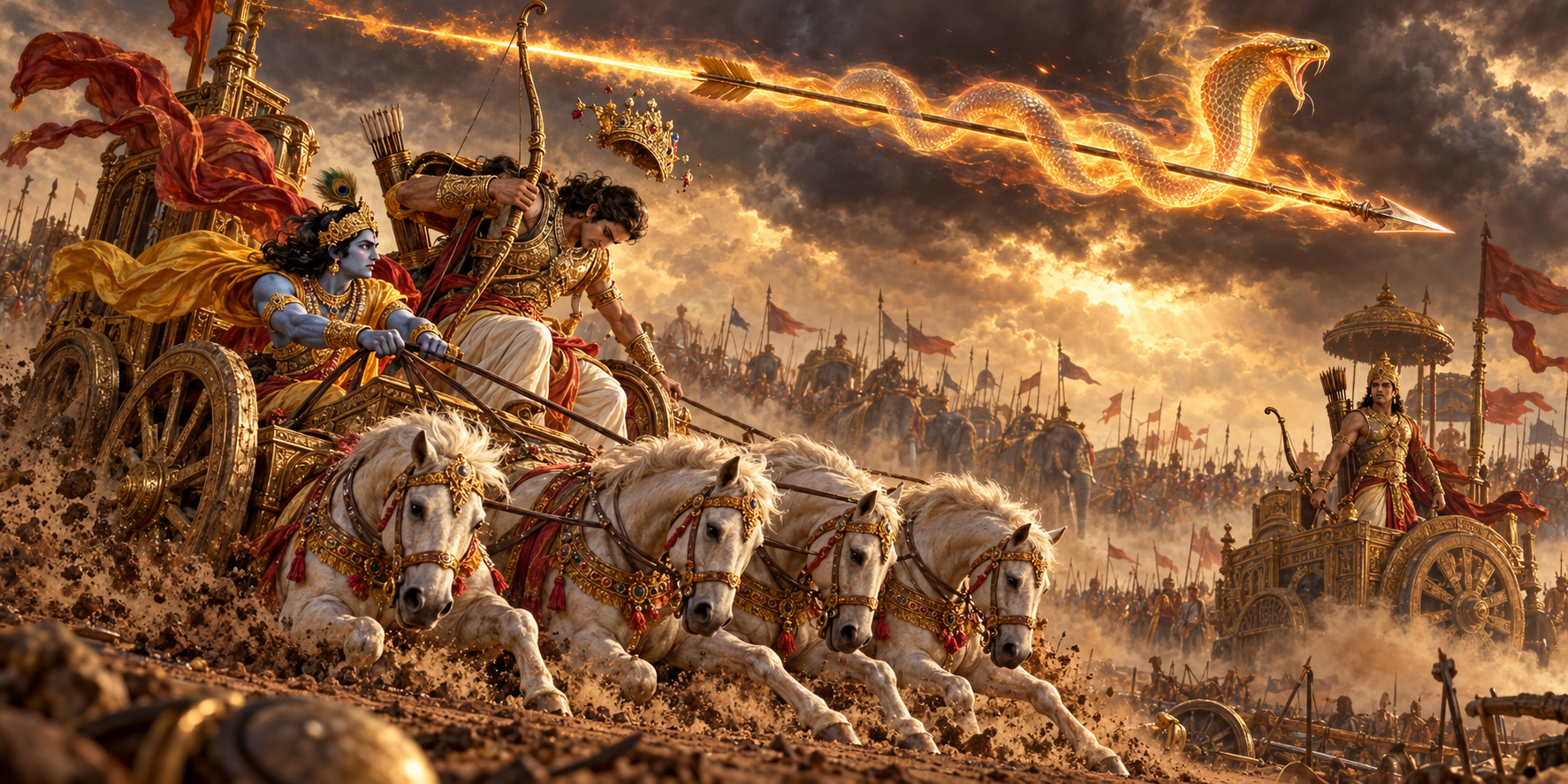
If you reached the Karna-Arjuna duel and wondered why a serpent suddenly intervenes, you haven’t encountered a random supernatural interruption. You have reached the end of a grievance that began much earlier, in the burning of the Khandava forest.
Ashvasena’s attempt to kill Arjuna is easy to miss amid the duel’s larger drama. Yet it contains one of the Mahabharata’s sharpest lessons: suffering can explain revenge without making revenge righteous, and a person consumed by an old injury can surrender his own agency while believing he is finally exercising it.
The Khandava fire creates a survivor with a grievance
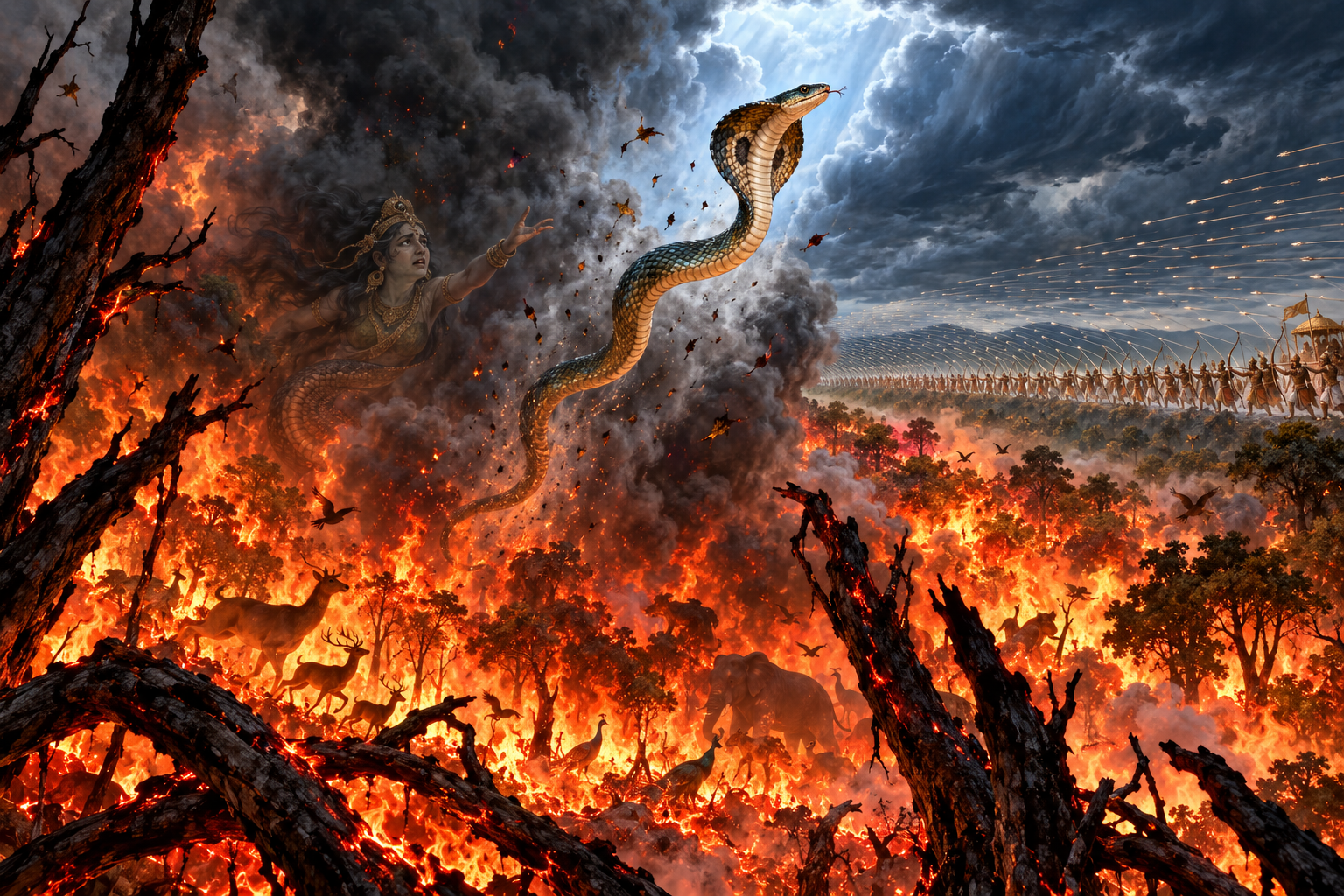
Ashvasena is a naga and a son of Takshaka, the king of the serpents. His story begins in the Adi Parva and returns in the Karna Parva. That long separation matters. The epic first shows you the wound; only much later does it show you what the survivor has done with it.
During the burning of the Khandava forest, Ashvasena’s mother attempts to save him. Arjuna kills her, but Ashvasena escapes. He therefore enters the later story with a real loss, a named enemy, and a memory that has not faded. His anger is not invented merely to make the battlefield more exciting. It grows from an earlier act whose consequences have remained alive beyond the scene in which it occurred.
This prevents a comfortable reading of the Khandava episode as a completed victory. Arjuna may have moved on, but one of those harmed by the conflagration has not. When you follow the narrative from the Adi Parva to the Karna Parva, the forest ceases to be background. It becomes unfinished moral history.
Ashvasena’s grievance deserves to be understood before it is judged. His mother is dead, her killer lives, and no reconciliation has occurred. But understanding the cause of his anger is not the same as declaring every act born from that anger dharmic. The Mahabharata repeatedly asks you to hold those two truths together.
How Ashvasena makes Karna’s arrow carry a private war
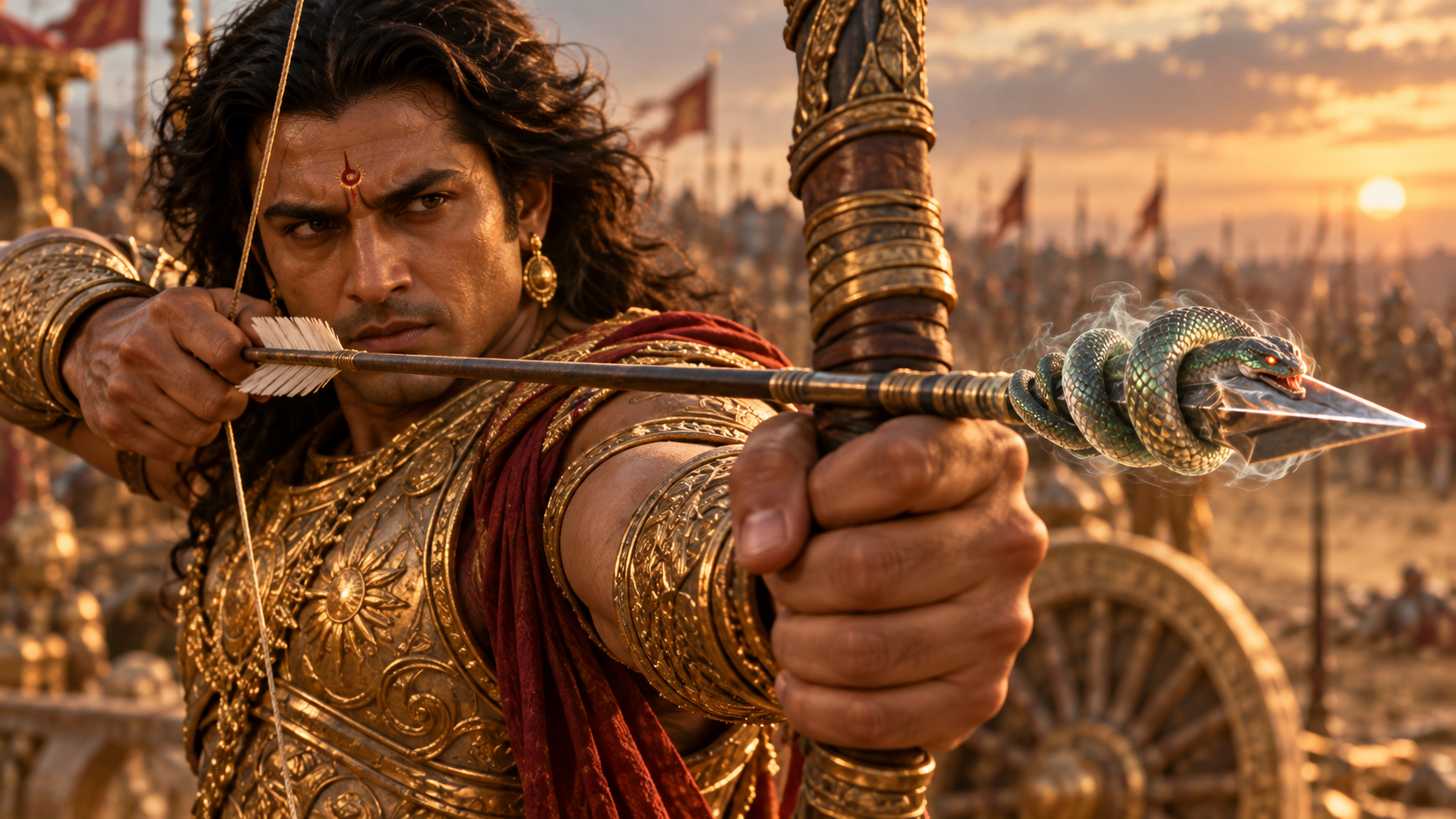
Ashvasena finally sees his opportunity during the decisive combat between Karna and Arjuna. He enters Karna’s arrow and turns it into the vehicle of his revenge. Karna is fighting his own battle, but Ashvasena secretly places another battle inside it: the unresolved conflict of Khandava.
That distinction is essential. Karna and Ashvasena happen to want the same immediate result, but they do not share the same purpose. Karna seeks to defeat his great martial rival in the war before him. Ashvasena wants to avenge his mother. Their aims overlap only at the point of Arjuna’s death.
Ashvasena also acts without first securing Karna’s consent. He hides within another warrior’s weapon and tries to use Karna’s skill, reputation, and combat as cover for his own design. His revenge therefore involves more than an attack on Arjuna. It makes Karna an unwitting instrument of a grievance that is not his.
This is the episode’s most revealing image. Ashvasena believes he has found the perfect means of acting, yet he has literally reduced himself to someone else’s ammunition. Revenge promises control, but his method requires concealment, dependence, and the borrowing of another person’s hand.
Why the serpent-assisted arrow fails to kill Arjuna
Karna releases the deadly arrow toward Arjuna. Krishna, serving as Arjuna’s charioteer, lowers the chariot at the critical instant. The missile that was meant to take Arjuna’s head instead strikes his crown. Ashvasena comes extraordinarily close to completing his revenge, but closeness is not completion.
The crown is an important detail. The attack removes an emblem of rank and splendour, not the life beneath it. What looks like an irresistible union of Karna’s martial power and Ashvasena’s hatred is defeated by Krishna’s alert intervention. The outcome turns on awareness: Ashvasena relies upon concealment, while Krishna perceives the danger in time to answer it.
After the failed strike, Ashvasena reveals himself and asks Karna for another chance. Karna refuses to depend upon the naga’s hidden assistance or to send him again. Whatever one thinks of Karna’s pride elsewhere in the epic, he draws a boundary here. He will not allow another being’s private vengeance to become the secret power behind his own claim to martial achievement.
Karna’s refusal should not be turned into a sweeping acquittal of every choice he makes. It is a specific decision in a specific moment. That is precisely why it is worth noticing. The Mahabharata rarely requires a person to be wholly righteous before allowing him to make one honourable choice, or wholly fallen before allowing him to make a destructive one.
Ashvasena then attempts to attack Arjuna directly. Krishna identifies the danger, and Arjuna kills the naga. The revenge that survived from the Adi Parva into the Karna Parva ends without achieving its object. Ashvasena preserves the injury for years, finds the weapon he needs, reaches his enemy, and still cannot command the result.
What the episode teaches about revenge, karma, and agency
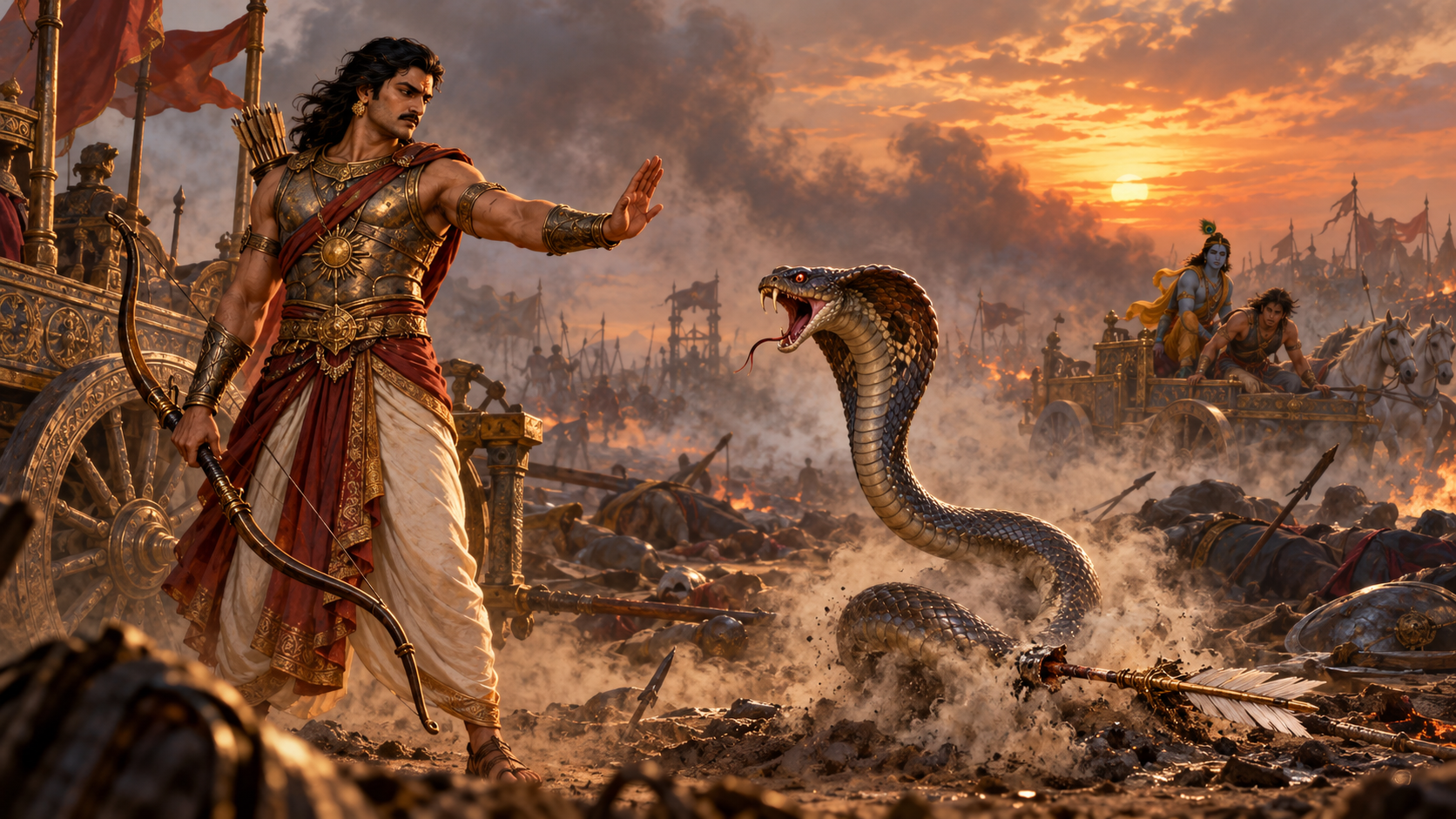
The simplest moral would be that revenge always fails. That is too neat for the Mahabharata. Revenge can plainly injure people, rearrange loyalties, and shape events long after the original wrong. Ashvasena’s attempt fails, but it comes close enough to force Krishna’s intervention and strip away Arjuna’s crown. An old grievance can become dangerous even when it does not reach its final aim.
The deeper lesson concerns the difference between memory and mastery. Ashvasena remembers his mother and the circumstances of her death. That memory is not itself condemned. The trouble begins when remembrance narrows into a single purpose: Arjuna must die, and any available vehicle may be used to make it happen.
If you read the scene through the language of karma, avoid treating karma as instant scorekeeping. Arjuna’s earlier action creates a consequence: a survivor returns to confront him. But that consequence does not automatically make Ashvasena the authorised agent of cosmic justice. Arjuna is protected, the revenge fails, and Ashvasena dies. Causation, moral legitimacy, and final outcome are three different questions.
The same distinction helps outside the epic. A person may have been genuinely wronged and may accurately identify who caused the harm. Those facts establish a claim to moral attention; they do not make every retaliatory method just. Before supporting an act of vengeance, ask three separate questions: What happened? What response is proportionate? Who else is being turned into a tool?
Ashvasena fails that final test. His quarrel is with Arjuna, but he tries to make Karna prosecute it without informed agreement. Karna’s later refusal restores the distinction between their purposes. He may still seek Arjuna’s death, but he will not pretend that Ashvasena’s concealed intervention is simply his own prowess.
The episode also warns against confusing patience with freedom from anger. Ashvasena waits a long time, but waiting does not transform his motive. Time has preserved the grievance rather than clarified it. When the opportunity arrives, he acts from the same wound with which he escaped Khandava.
Key takeaways for reading Ashvasena’s revenge
- Ashvasena is not an incidental serpent. He is Takshaka’s son and a survivor whose mother was killed during the burning of Khandava.
- The Adi Parva supplies the injury; the Karna Parva supplies the attempted revenge. You need both episodes to understand his intervention.
- Ashvasena enters Karna’s arrow to kill Arjuna, joining his private grievance to a duel that already has its own causes.
- Krishna saves Arjuna by lowering the chariot, so the arrow strikes Arjuna’s crown rather than killing him.
- Karna refuses Ashvasena’s request for another attempt, separating his own combat from the naga’s concealed vengeance.
- The episode distinguishes sympathy for a victim from approval of retaliation. A genuine wrong does not automatically sanctify every response to it.
- A karmic consequence is not necessarily a moral endorsement. The return of Arjuna’s past explains the danger; it does not prove that Ashvasena’s chosen means are dharmic.
When you next read the Karna-Arjuna duel, don’t begin Ashvasena’s story at the moment the arrow is released. Begin with the survivor who left Khandava carrying an unspent grievance. Then watch what that grievance requires him to become. The practical question the episode leaves with you is not whether painful memories should be erased, but whether you can remember a wrong without allowing it to choose your methods, recruit your instruments, and consume your remaining agency.
References

Leave a Reply
You must be logged in to post a comment.