
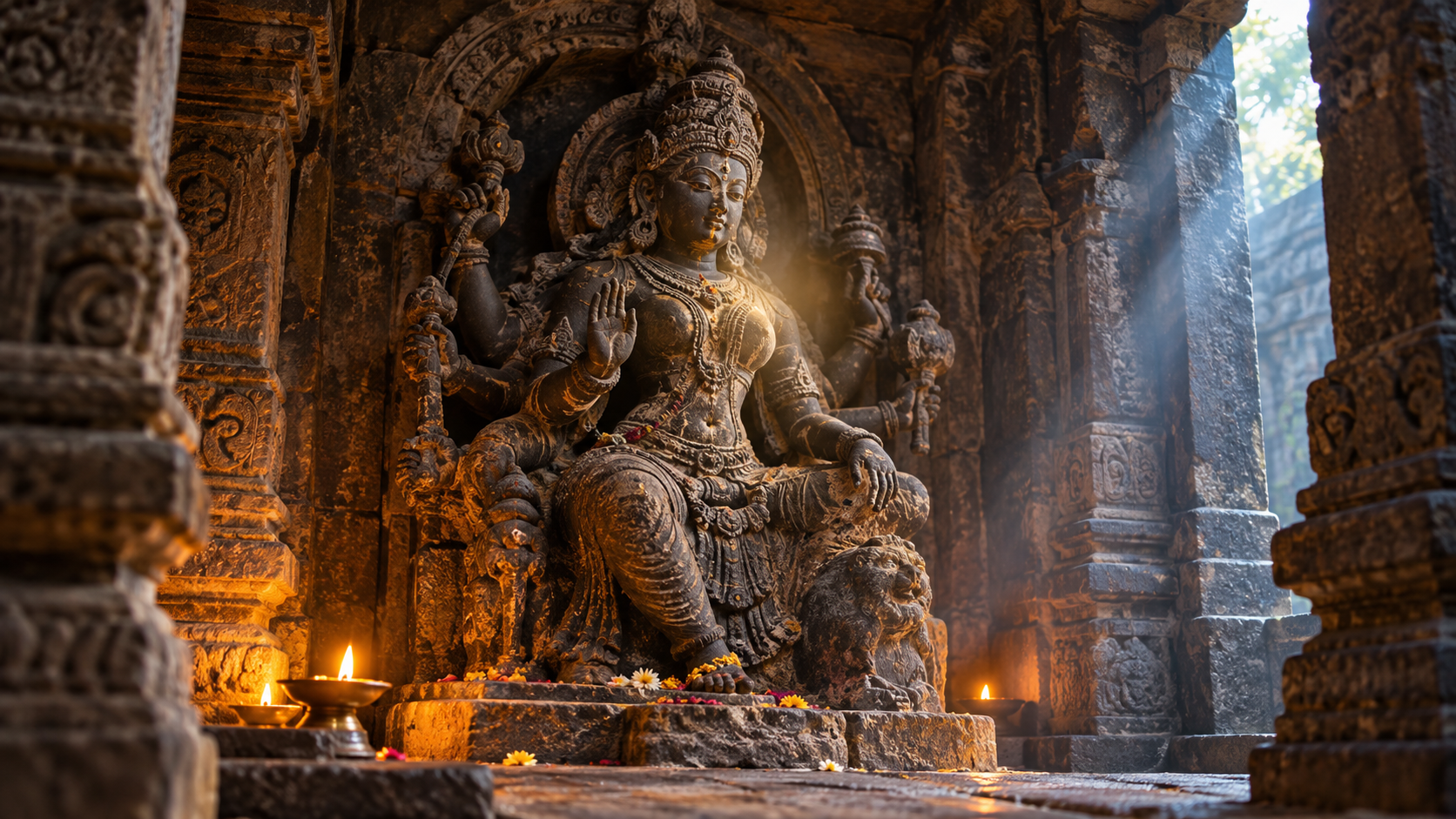
If you have encountered a carving, murti, or image labelled Pranashakti Devi, resist the urge to identify it from one weapon, colour, hand gesture, or online resemblance. Because this form is uncommon, the familiar shortcuts used for widely represented deities can produce a confident but mistaken answer.
You can still read the image intelligently. Begin with what the name reveals, document what is actually visible, and then test the identification against the temple, lineage, region, and ritual setting from which the form comes.
The name gives you a theological key, not a visual checklist
Prana is the vital principle associated with living, breathing existence. It should not be reduced to oxygen or the mechanical act of inhalation. Breath is one of its most immediate expressions, but prana carries the broader sense of animating vitality within Hindu thought.
Shakti is power: the active capacity through which divine reality manifests, sustains, and transforms. Devi presents that power in divine feminine form. The name Pranashakti Devi therefore directs you toward a particular theological idea—the Goddess approached as the sacred power of life itself.
That meaning is the safest starting point. It does not, by itself, establish the number of arms, the objects held in them, the posture, the vehicle, the attendants, or the details of dress. Those belong to the iconographic form preserved by a particular tradition. Supplying them from expectation would turn interpretation into invention.
Pranashakti Devi is far less familiar than Durga, Lakshmi, or Saraswati and is associated especially with a limited number of temple communities, tantric lineages, and regional iconographic schools. That rarity does not make her marginal or inauthentic. It means that popular calendar art and generic image searches are less likely to preserve the decisive details.
Use this five-step method to examine a possible image
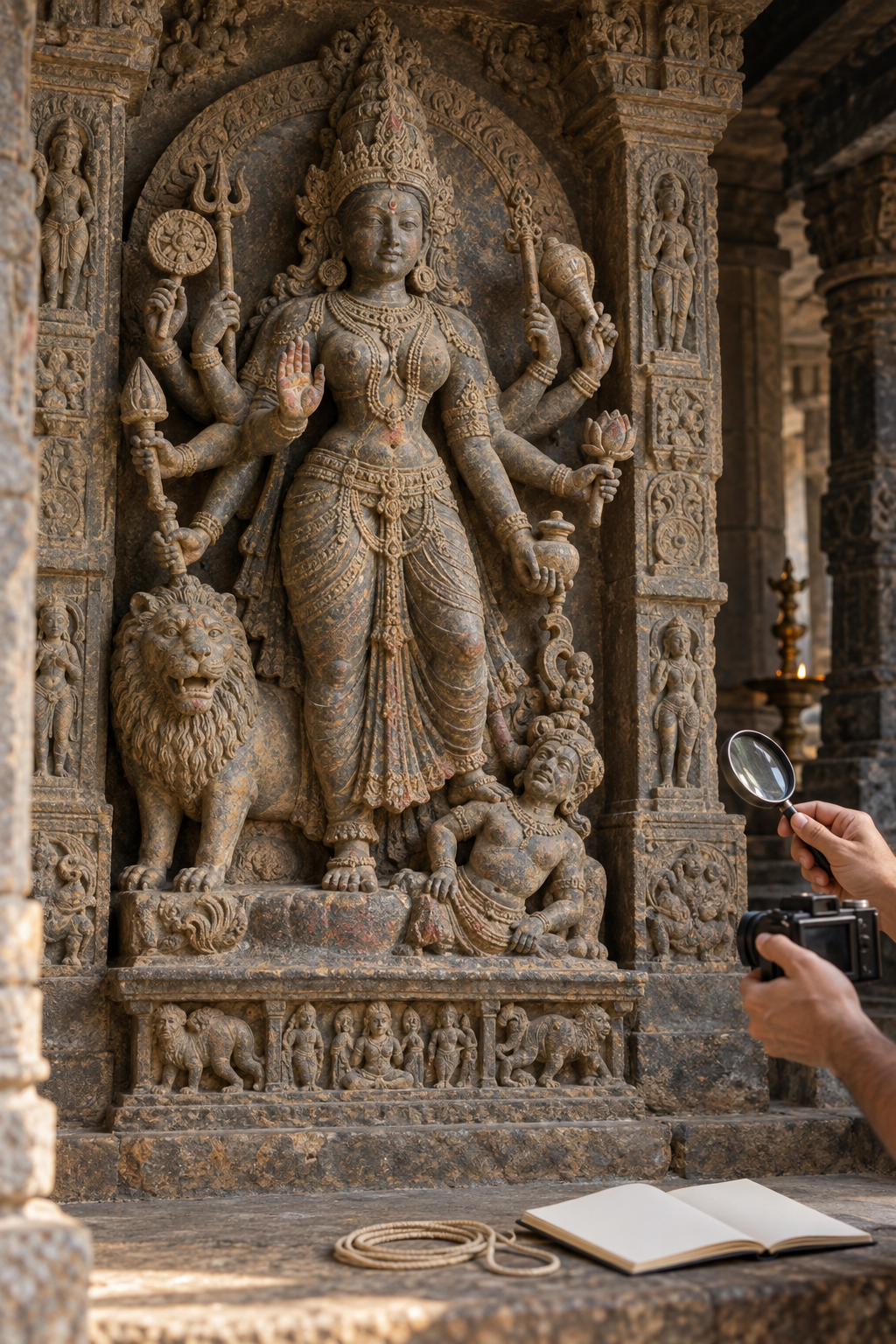
- Record before interpreting. Note the posture, seat or pedestal, visible hands, held objects, hand gestures, crown, ornaments, halo, vehicle, attendants, and surrounding figures. Photograph every side only where photography is permitted. If an element is broken or obscured, mark it as unknown rather than mentally reconstructing it.
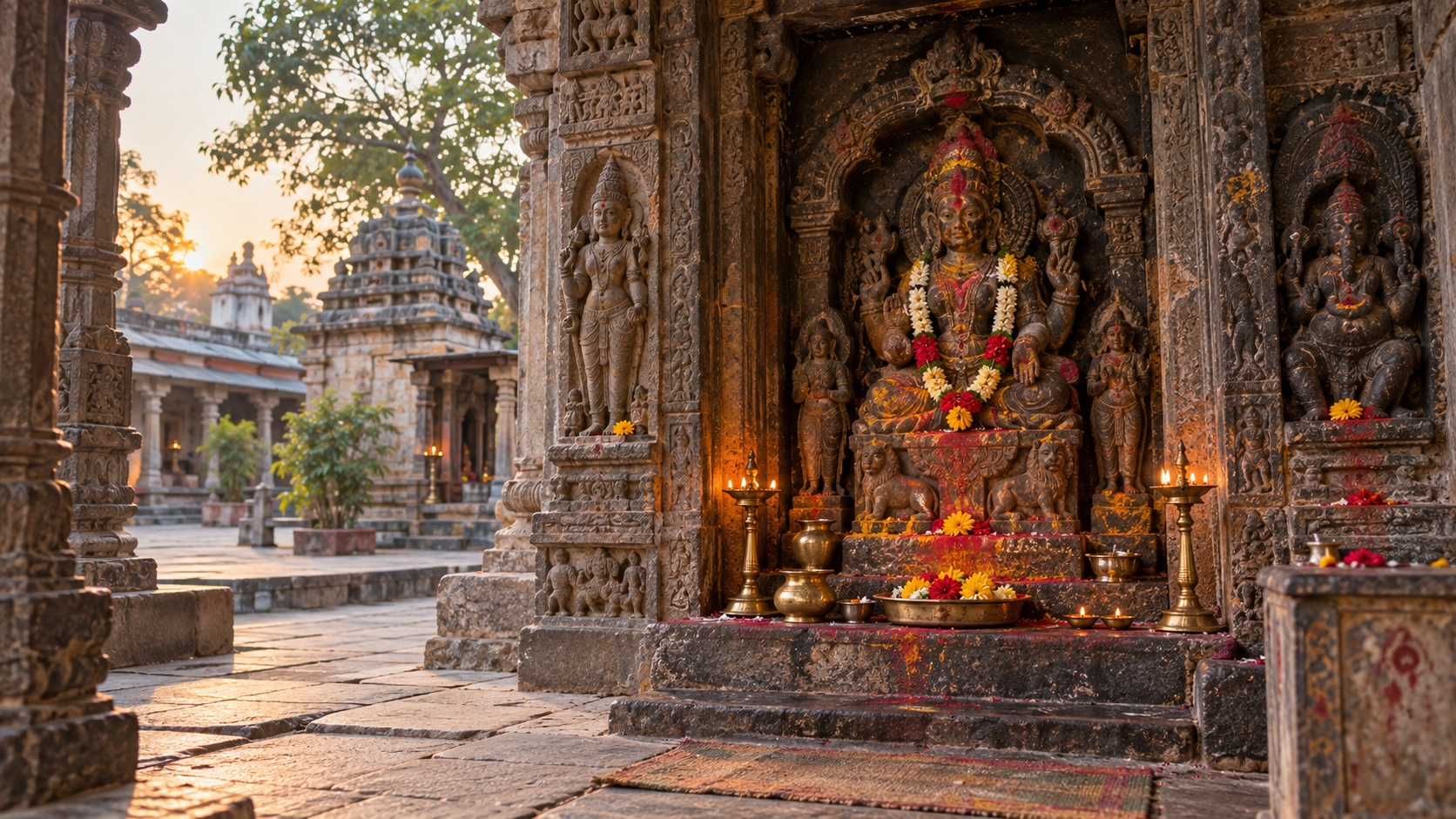
- Document the setting. Record the shrine, temple, town, region, present location, and—when known—the earlier location of the image. An identification inherited within a functioning shrine carries a different kind of evidence from a label attached to an object after it entered a private collection or marketplace.
- Look for a direct name. Check inscriptions on the pedestal, shrine labels, temple records, ritual manuals, festival notices, and names used during worship. Copy the wording exactly. A familiar-looking translation can conceal a distinct local or lineage name.
- Ask custodians precise questions. Instead of asking only, “Who is this?”, ask for the exact ritual name, its pronunciation, whether the name has local variants, which visible features distinguish the form, and whether the identification belongs to a particular lineage. These questions produce information that can be checked rather than a vague resemblance.
- Compare the whole configuration. Only after collecting the contextual evidence should you compare the arrangement of attributes, posture, companions, and setting with another representation. A match based on the complete pattern is more useful than a match based on one emblem.
Many Hindu deities share gestures, ornaments, weapons, lotuses, seats, or other visual elements. No single shared feature proves an identity. The meaningful unit is the organised combination, together with the name and ritual context.
Do not “complete” Pranashakti Devi by borrowing details from a better-known Goddess simply because both are forms of Shakti. That approach makes a rare icon look more familiar, but it also erases the very distinctions you are trying to understand.
Weigh the evidence according to what it can establish
| Kind of evidence | What it can establish | What to check |
|---|---|---|
| A naming inscription, inherited temple identification, or lineage manual | The deity’s recognised name within that community or tradition | Confirm that the inscription or record belongs to the same image, preserve the original spelling, and respect restrictions on private ritual material. |
| Shrine placement, attendants, neighbouring deities, and festival use | The religious setting in which the form functions | Determine whether the arrangement is old, recently reorganised, or assembled from displaced images. |
| The complete cluster of posture, gestures, held objects, vehicle, ornaments, and companions | Whether the visible form is consistent with a proposed identification | Allow for damage, replacement parts, repainting, and restoration. |
| One colour, one object, an unattributed caption, or a visual-search result | A lead for further inquiry | Do not treat it as proof without contextual confirmation. |
For a rare form, several kinds of evidence should converge. A stable temple name supported by the complete visual arrangement is stronger than an isolated resemblance found online. Conversely, the absence of a close internet match does not disprove a name preserved within a regional community or tantric lineage.
Keep three questions separate. Theology asks what divine reality the name expresses. Iconography asks how that reality is represented visually. Ritual asks how a community invokes and worships the form. Pranashakti Devi’s name supports a theological reading centred on sacred vitality; the exact image and mode of worship require evidence from the tradition that preserves them.
Avoid four common misreadings
- Do not treat “Pranashakti” as a generic caption for any image of Devi. Every Goddess embodies Shakti, but that does not make every Goddess Pranashakti Devi.
- Do not reduce prana to respiration. The name concerns animating life power, not merely the lungs or a breathing technique.
- Do not turn the icon into a medical claim. Sacred imagery may guide worship, contemplation, and philosophical reflection, but an identification of Pranashakti Devi does not establish a cure or replace medical care.
- Do not mistake rarity for recent invention. A form can remain little known outside the temple community, regional school, or lineage that has preserved it.
- Do not universalise one local representation. A carefully verified image can establish how Pranashakti Devi appears in that context; it cannot automatically prove that every tradition uses an identical form.
The tantric association also deserves restraint. Here, “tantric” points to a ritual and lineage context. It is not permission to add sensational claims that the image, temple community, or transmitted practice does not support.
Key takeaways
- Read the name first: Pranashakti Devi presents divine feminine power as the vitality that animates life.
- Treat the name as a theological clue, not as a complete inventory of visual attributes.
- Identify the form through converging evidence: exact name, provenance, ritual setting, and the full iconographic configuration.
- Give temple, regional, and lineage knowledge its proper weight; public unfamiliarity is not evidence of inauthenticity.
- Leave damaged, undocumented, or conflicting features unresolved until better evidence appears.
If an image is in front of you now, write down its exact local name and location before searching for comparisons. Then record every visible feature without assigning meaning to it. Those two pages of disciplined notes will bring you closer to a responsible identification than a folder of loosely similar images.
References

Leave a Reply
You must be logged in to post a comment.