
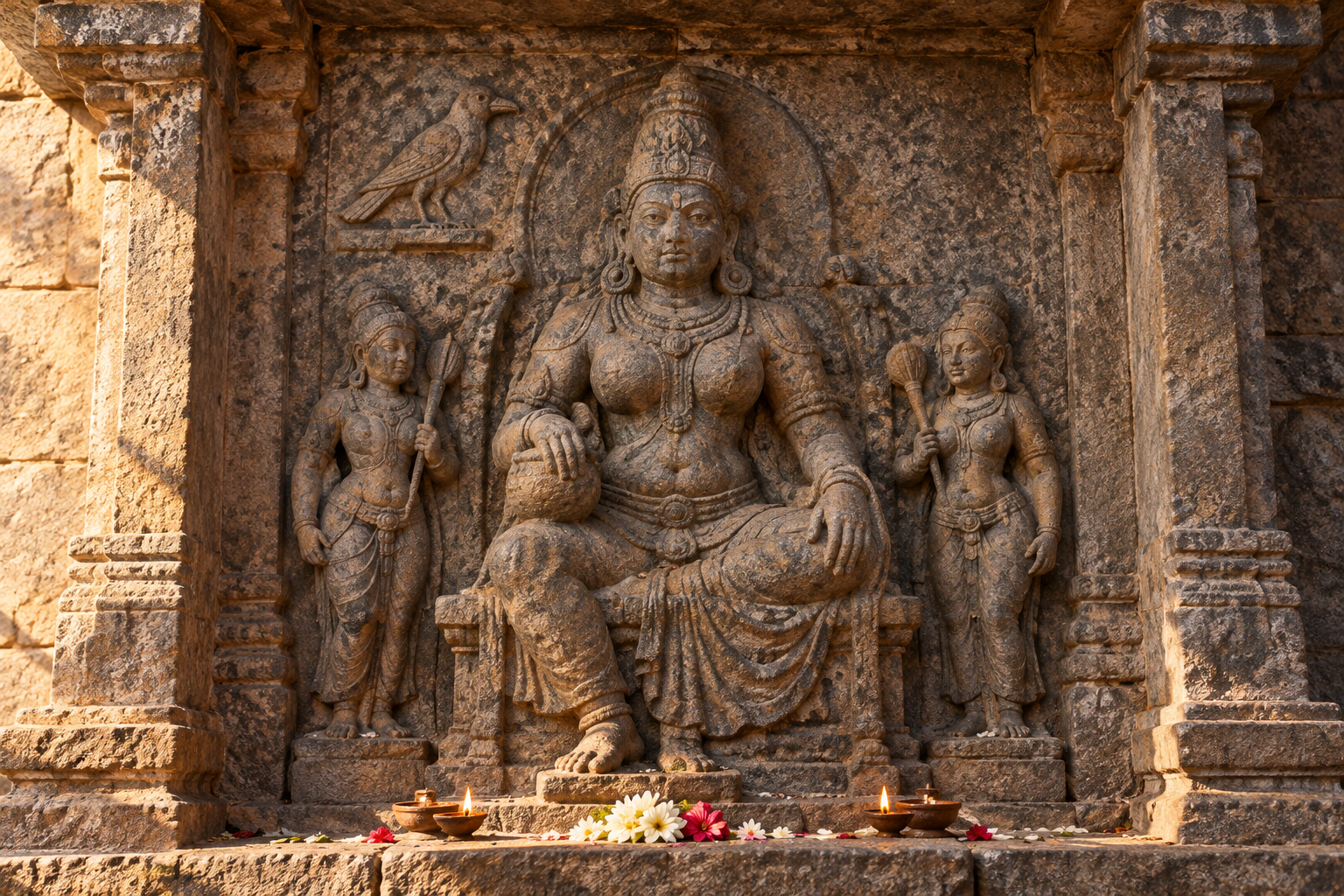
If you encountered the name Thavvai in a temple note, museum catalogue, or discussion of Tamil religion, you may have wondered whether she was a minor local deity or the goddess Jyeshta under another name. The first correction is decisive: in this historical context, Thavvai and Jyeshta refer to the same goddess, and her present obscurity is a poor measure of her former place in religious life.
Her worship was once widespread in the Tamil region and flourished during the Pallava period. That fact changes how you should read early South Indian Hinduism. The familiar devotional map inherited from later centuries does not contain every deity who mattered to earlier communities.
Key takeaways
- Thavvai and Jyeshta should not be treated as two unrelated goddesses in this historical discussion.
- The strongest chronological anchor is the Pallava period, conventionally placed between the sixth and ninth centuries CE.
- Her cult extended across much of South India, with particular prominence in the region corresponding to present-day Tamil Nadu.
- Being unfamiliar to many worshippers now does not mean that she was marginal in her own time.
- The later prominence of Bhakti traditions helps explain why our religious map changed, but it does not by itself prove a coordinated suppression of Thavvai worship.
- Any claim about a particular shrine, image, ritual, or line of continuity still needs evidence tied to that place.
Thavvai and Jyeshta are one historical question
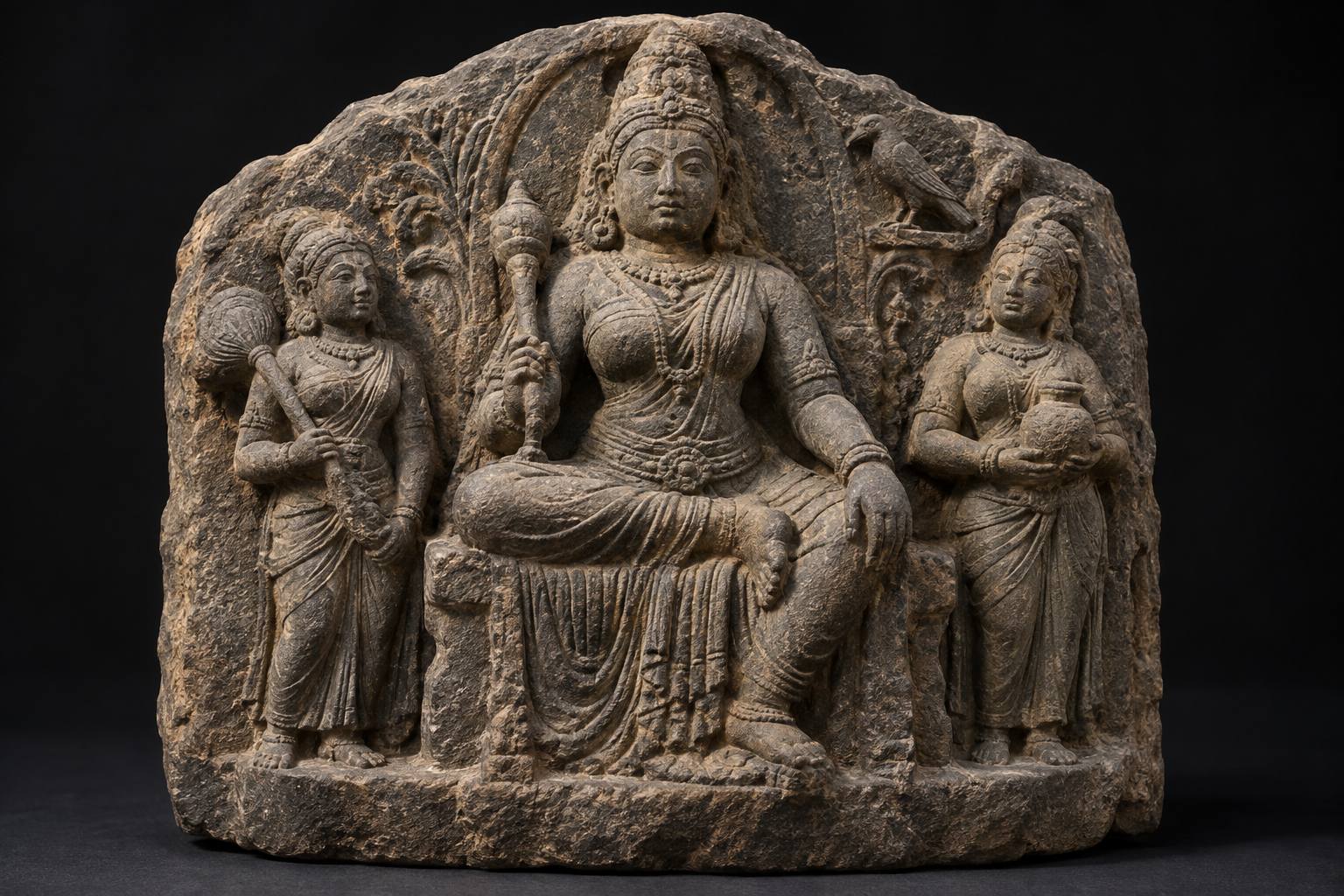
Begin by keeping the names together: Thavvai (Jyeshta). Separating them too quickly can turn one historical problem into two imaginary cults. Treating one name as authentic and the other as a later corruption is equally risky. The equivalence of the names identifies the goddess; it does not, by itself, tell you which designation came first, how usage varied between communities, or whether her meaning remained unchanged over centuries.
This distinction matters when you search catalogues or assess a label. Look under both names, but record the name actually used by the object, inscription, community, or catalogue in front of you. A modern caption identifying an image as Jyeshta is not the same kind of evidence as a historical inscription naming the deity. A present-day local name is another category again. Each may be valuable, but they answer different questions.
Ask three things whenever you encounter either name:
- Is the identification based on an inscription, an established local tradition, the object’s appearance, or a modern curatorial decision?
- Does the date belong to the image itself, to the building that now houses it, or merely to the wider site?
- Is Thavvai the name currently used at the location, or a historical identification supplied by a scholar or catalogue?
Those questions prevent a common mistake: turning a plausible identification into a complete history of worship before the evidence can support it.
The Pallava centuries change the religious map
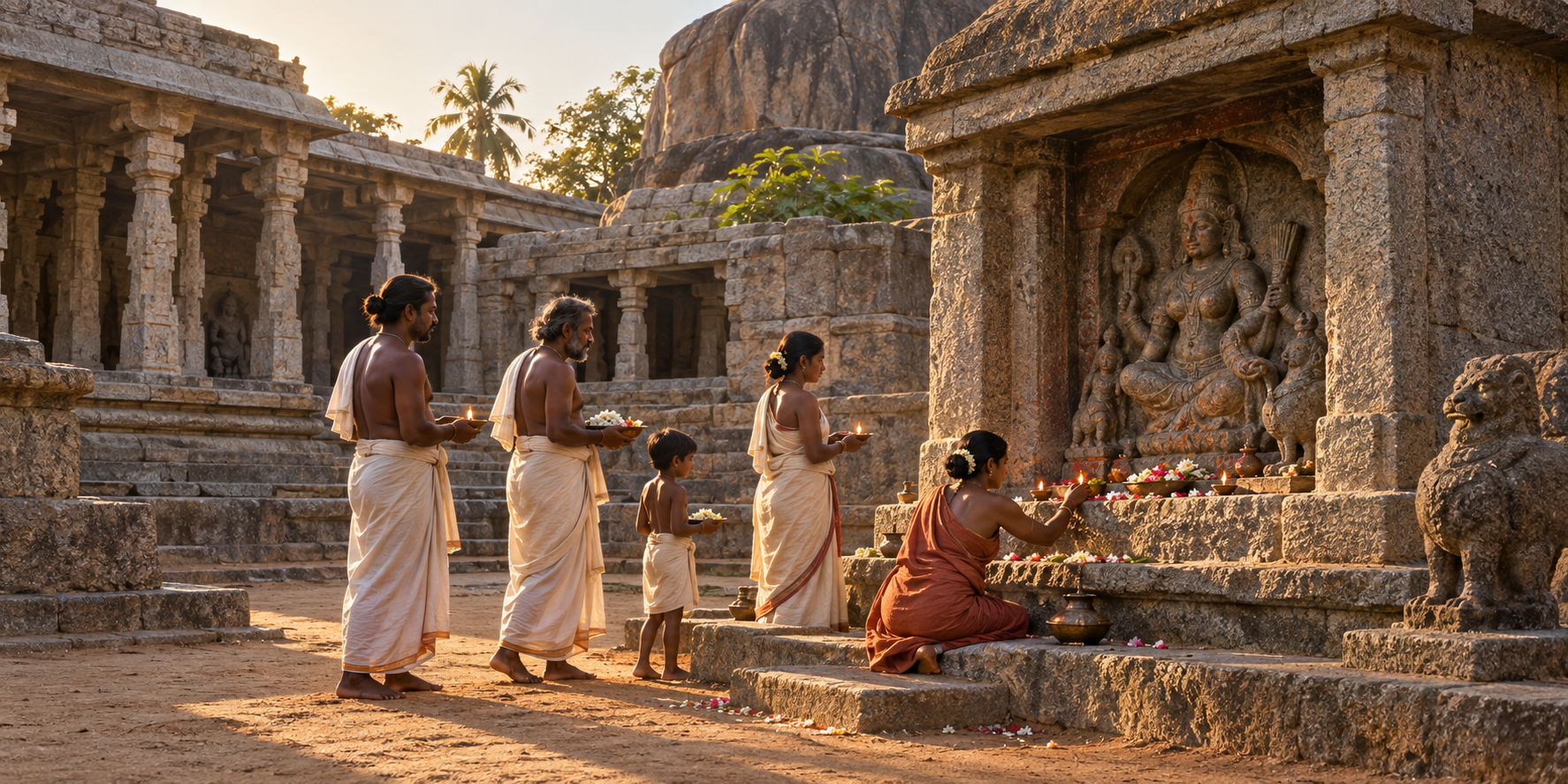
The most useful chronological fact is that Thavvai worship flourished during the Pallava period, from the sixth through the ninth centuries CE. Its geographical reach covered much of South India and was especially marked in present-day Tamil Nadu. She was therefore not merely an isolated name lingering at the edge of Tamil religious history.
This evidence should alter the question you ask. Instead of asking, “Why did early Tamil people worship an obscure goddess?” ask, “How did a formerly prominent goddess become obscure to many later communities?” The first question projects present familiarity backward. The second respects the historical sequence.
The cautious inference is that early South Indian goddess worship was broader than the selection most people now meet through familiar festivals, household practice, and major pilgrimage traditions. A deity’s absence from a modern devotional routine cannot be used as evidence that she lacked an earlier cult.
Chronology also sets a limit. The Pallava-era evidence gives you a secure period of prominence; it does not automatically prove that every object called Thavvai belongs to those centuries. Nor does it justify pushing her worship into an undefined, timeless antiquity. Date each trace on its own evidence rather than allowing the goddess’s general history to date every individual image.
The rise of Bhakti reshaped South India’s religious landscape, and Thavvai’s earlier prominence must be read across that change. Yet sequence is not the same as cause. Bhakti was a broad religious development, not a single institution carrying out one uniform policy. Without evidence from a particular site, you cannot decide whether Thavvai worship there ended, continued quietly, acquired another identity, or moved into a different ritual setting.
Keep three propositions separate: Thavvai was prominent in an earlier period; she later became far less familiar; and some historical process produced that change. The first two can be stated directly. The third remains a question requiring local evidence. Words such as “forgotten” or “erased” describe the contrast powerfully, but they should not substitute for an explanation of how the change occurred.
How to assess a claimed Thavvai trace
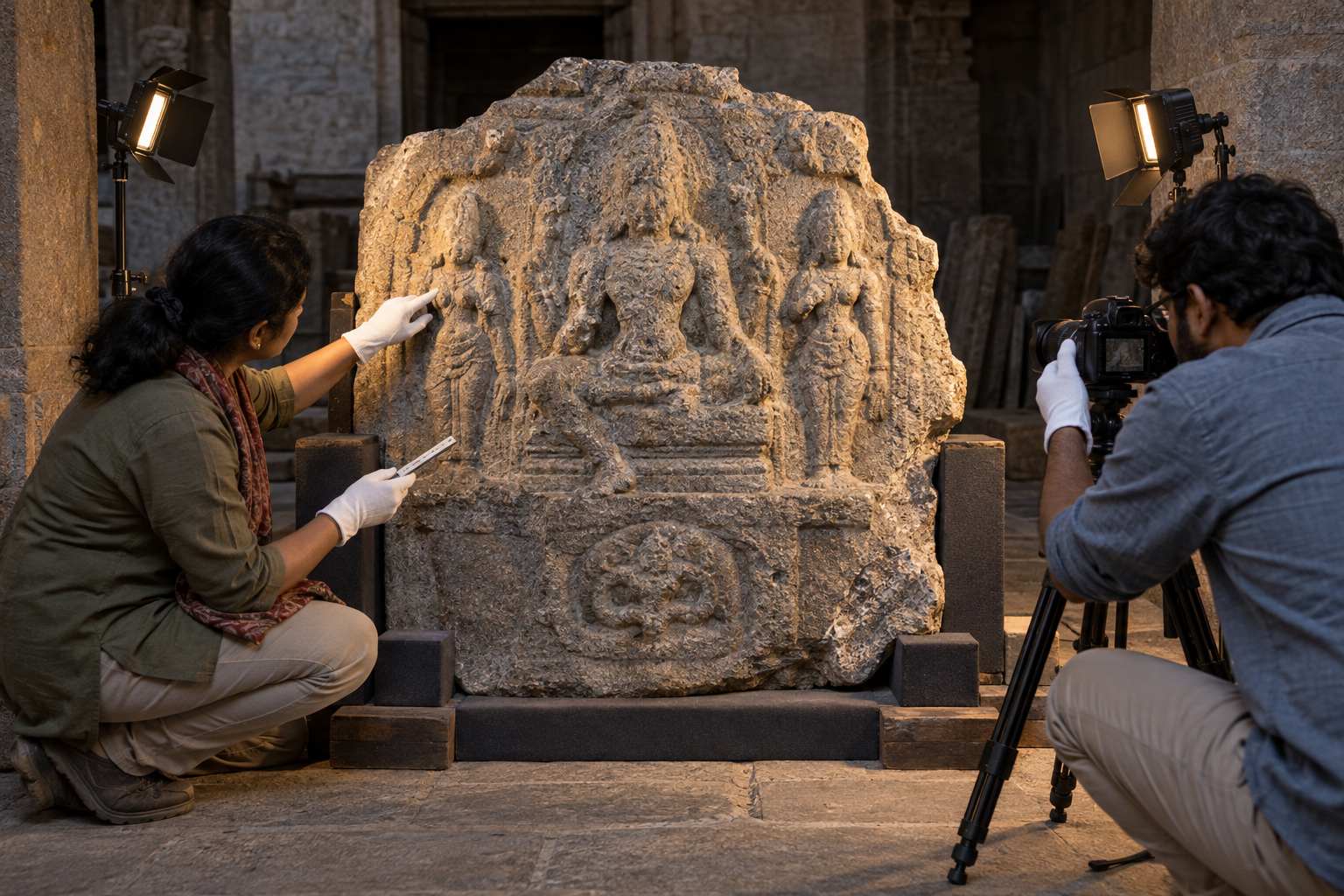
If you are visiting a temple, examining a museum object, or evaluating an online claim, build a small evidence record before accepting a sweeping story. Six checks are enough to expose most unsupported leaps:
- Record the exact name. Preserve the wording of the inscription, caption, catalogue, or local explanation. Do not silently replace Thavvai with Jyeshta, or Jyeshta with Thavvai, in your notes.
- Establish provenance. Find out where the object was discovered and whether it remains in its original setting. Its current location may tell you nothing about where it was worshipped.
- Separate the dates. Record the proposed date of the image, the date of the surrounding structure, and the date of any inscription independently. They may not belong to one phase.
- Ask how identification was made. A named inscription, a continuous local tradition, and a stylistic identification are different kinds of evidence. Do not report them with the same degree of certainty.
- Distinguish representation from worship. An image may establish that a deity was represented at a site. It does not automatically reveal who worshipped her, how often worship occurred, which offerings were made, or whether the practice continued without interruption.
- Document present practice separately. If a community venerates the image now, record its current name and ritual place without assuming that every element has survived unchanged from the Pallava centuries.
This method is especially important for a deity whose earlier prominence and later obscurity tempt people toward dramatic explanations. A confident narrative can travel far beyond the evidence when an image has been moved, relabelled, or dated only approximately. Preserving uncertainty is not evasiveness; it is what keeps a recoverable history from becoming a modern legend.
You should also distinguish the scale of a claim from the scale of its proof. One securely identified image can illuminate one place. It cannot establish the same ritual across the Tamil region. Conversely, the broad fact that Thavvai worship flourished in Pallava-era South India does not tell you the history of every individual site. Regional history and site history support each other, but neither can replace the other.
Recover her place without inventing continuity
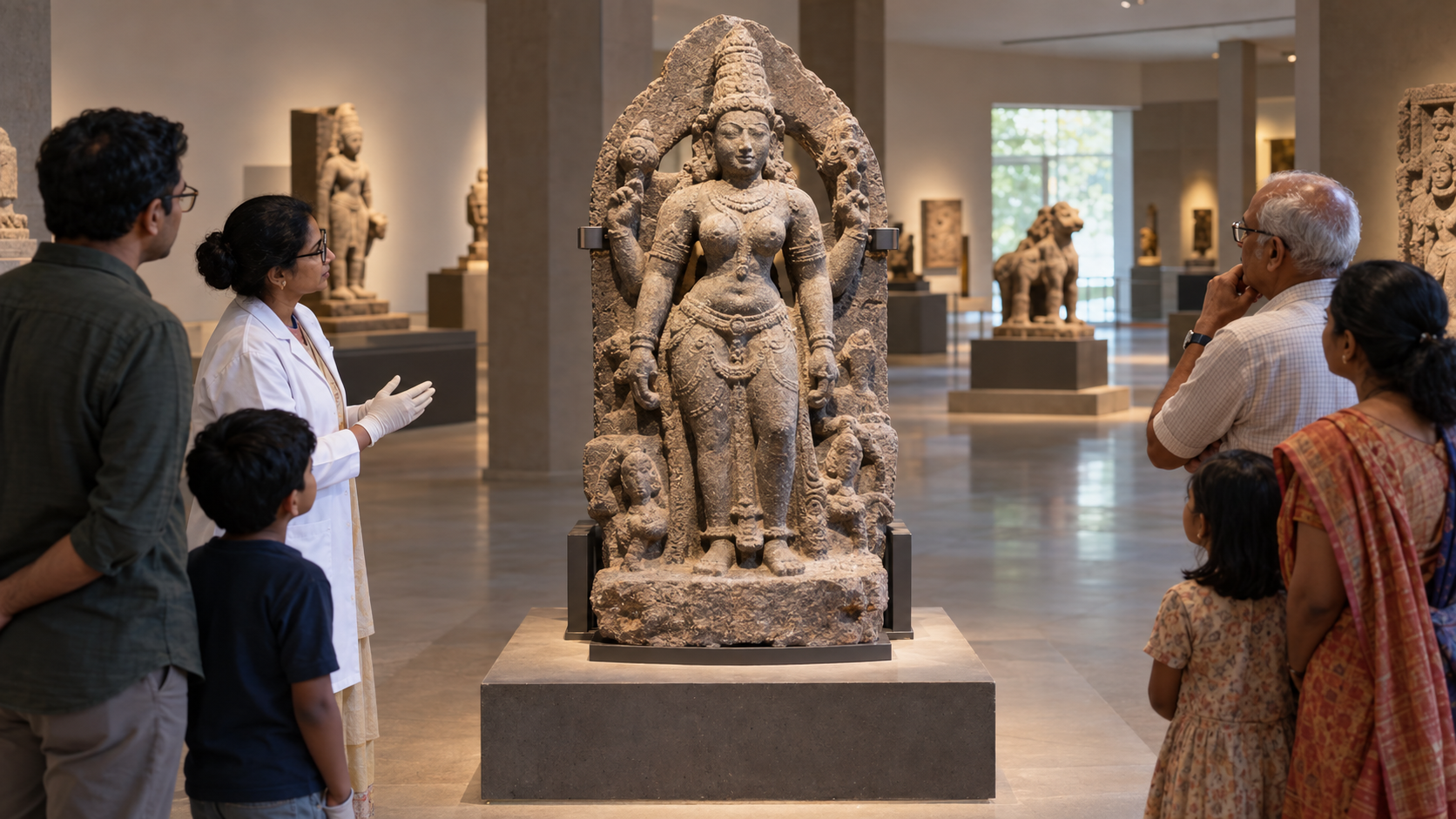
A sound account of Thavvai can be written in layers. Begin with what is secure: Thavvai is identified with Jyeshta; she was widely worshipped in the Tamil region; and her cult flourished in the Pallava period. Add what is probable only when a particular object’s date, provenance, or identification supports it. Leave questions about ritual, social constituency, decline, and continuity open until local evidence answers them.
This layered approach avoids two opposite errors. One is presentism: assuming that a goddess unfamiliar now must always have been peripheral. The other is romantic reconstruction: filling the gaps with an imagined unbroken tradition because her former importance deserves recovery. Thavvai does not need an invented history to matter. Her documented prominence already shows that the religious inheritance of South India is larger than its most visible surviving forms.
If you want to take the next step, choose one claimed Thavvai image or shrine and make a one-page record containing its exact name, location, provenance, proposed date, basis of identification, and current ritual status. Start with that bounded history before proposing a regional theory of disappearance. Recovering a forgotten goddess begins with disciplined attention to what survives.
References

Leave a Reply
You must be logged in to post a comment.