
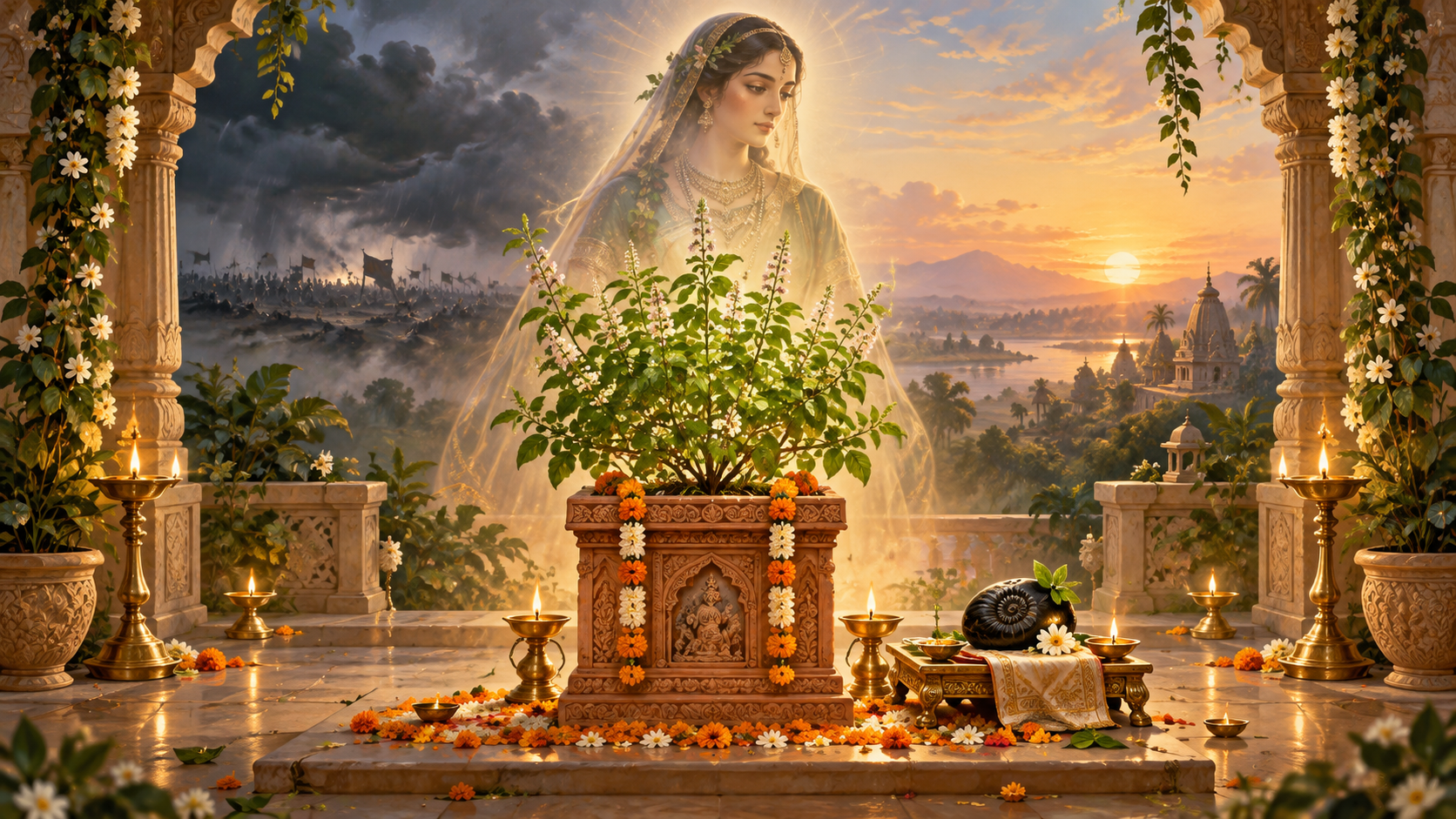
If you have wondered why a joyful marriage ceremony grows out of a story involving war, deception, a curse, and death, you are asking the right question. Tulsi Vivah makes sense only when Vrinda remains at the centre of the story rather than becoming a footnote to the battle between Jalandhara and Shiva.
The legend does not offer a tidy tale in which every divine action is easy to defend. It asks you to hold devotion, power, injury, judgement, and restoration together. That tension is precisely what gives the observance its spiritual weight.
The story from Jalandhara’s birth to Vrinda’s curse

Details differ among regional and devotional retellings, but the central sequence is consistent enough to follow clearly. It begins with Jalandhara emerging from the brilliant radiance of Shiva. He becomes a powerful ruler of the asuras and is associated with the sea. The English word “demon” is often used for him, but “asura king” is more useful here because the story gives him relationships, authority, religious power, and moral agency rather than treating him as a nameless monster.
Jalandhara marries Vrinda, whose disciplined fidelity to her husband carries spiritual efficacy. She is also devoted to Vishnu. That double devotion is not a minor character detail: Vrinda’s commitment to both her husband and Vishnu creates the legend’s central moral conflict.
- Jalandhara rises as a formidable asura ruler whose origin connects him to Shiva’s own radiance.
- Vrinda’s vrata, or sacred discipline of marital fidelity, protects her husband and contributes to his extraordinary strength.
- Jalandhara enters into war against Shiva. His power cannot be understood solely as military power because Vrinda’s spiritual integrity sustains him.
- In the familiar telling, Vishnu assumes Jalandhara’s appearance and approaches Vrinda. The deception breaks the condition on which Jalandhara’s protection depends, allowing Shiva to defeat him.
- Vrinda discovers what has happened and curses Vishnu. Her curse becomes part of the explanation for Vishnu’s association with the Shaligram, while Vrinda becomes associated with the sacred Tulsi plant.
- Tulsi Vivah joins Tulsi and Vishnu in the form of Shaligram, turning the legend’s broken relationship into a ritual of recognition and sacred union.
You may hear additional episodes, different descriptions of the encounter, or a different emphasis on Jalandhara’s boons. Do not let those variations obscure the narrative spine: Jalandhara’s protection depends on Vrinda, that protection is broken through divine intervention, Vrinda pronounces judgement, and Tulsi Vivah gives her an honoured place in household worship.
Vrinda is the moral centre, not a device in a battle story
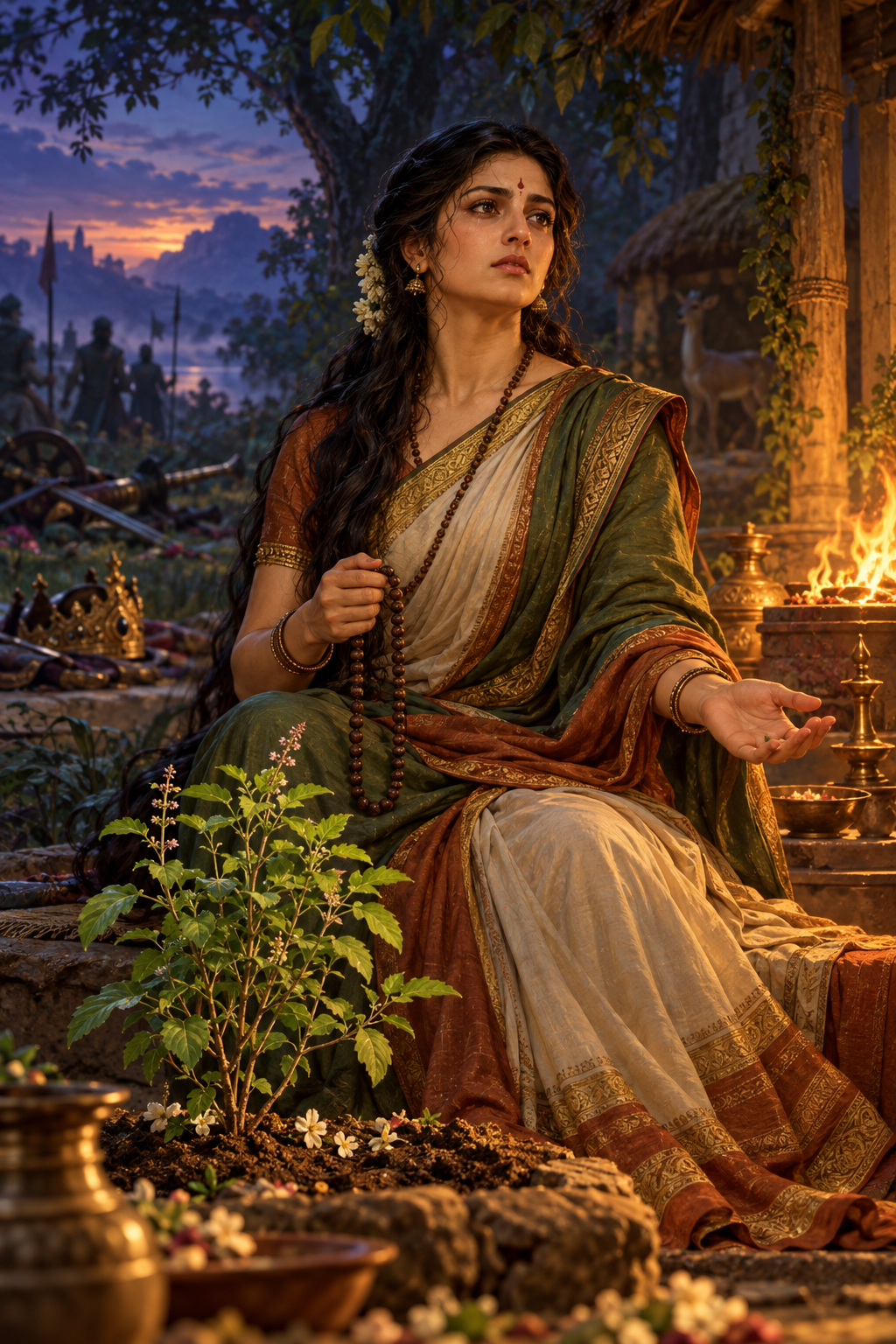
A hurried narration can reduce Vrinda to the “chaste wife” whose power must be removed before the male combatants can finish their war. That reading misses what the katha makes visible. Jalandhara may command an army, and Shiva and Vishnu may possess divine power, but the conflict turns on Vrinda’s vrata. Her interior discipline affects the outer world.
Her devotion should not be confused with approval of everything Jalandhara does. Fidelity gives him protection; it does not automatically make his war dharmic. This distinction matters whenever you hear the story used as a simple lesson that a wife must sustain her husband without moral judgement. Vrinda eventually judges even Vishnu’s conduct. The legend preserves her protest rather than requiring her to accept the deception silently.
Modern readers are also right to notice the question of consent. In the familiar version, Vrinda responds to someone she believes to be her husband. Consent obtained through impersonation is not informed consent. Calling the act a divine strategy does not make the injury disappear. A serious Dharmic reading can revere Vishnu while still acknowledging why Vrinda’s anger has moral force within the story.
Notice the sequence of her agency. Vrinda sustains, recognises, confronts, curses, and is finally honoured. Her curse is not an irrelevant outburst after the real action has ended. It changes the sacred landscape of the narrative by linking Vishnu, Shaligram, Tulsi, and their eventual ceremonial marriage.
Why Tulsi marries Shaligram after such a painful story
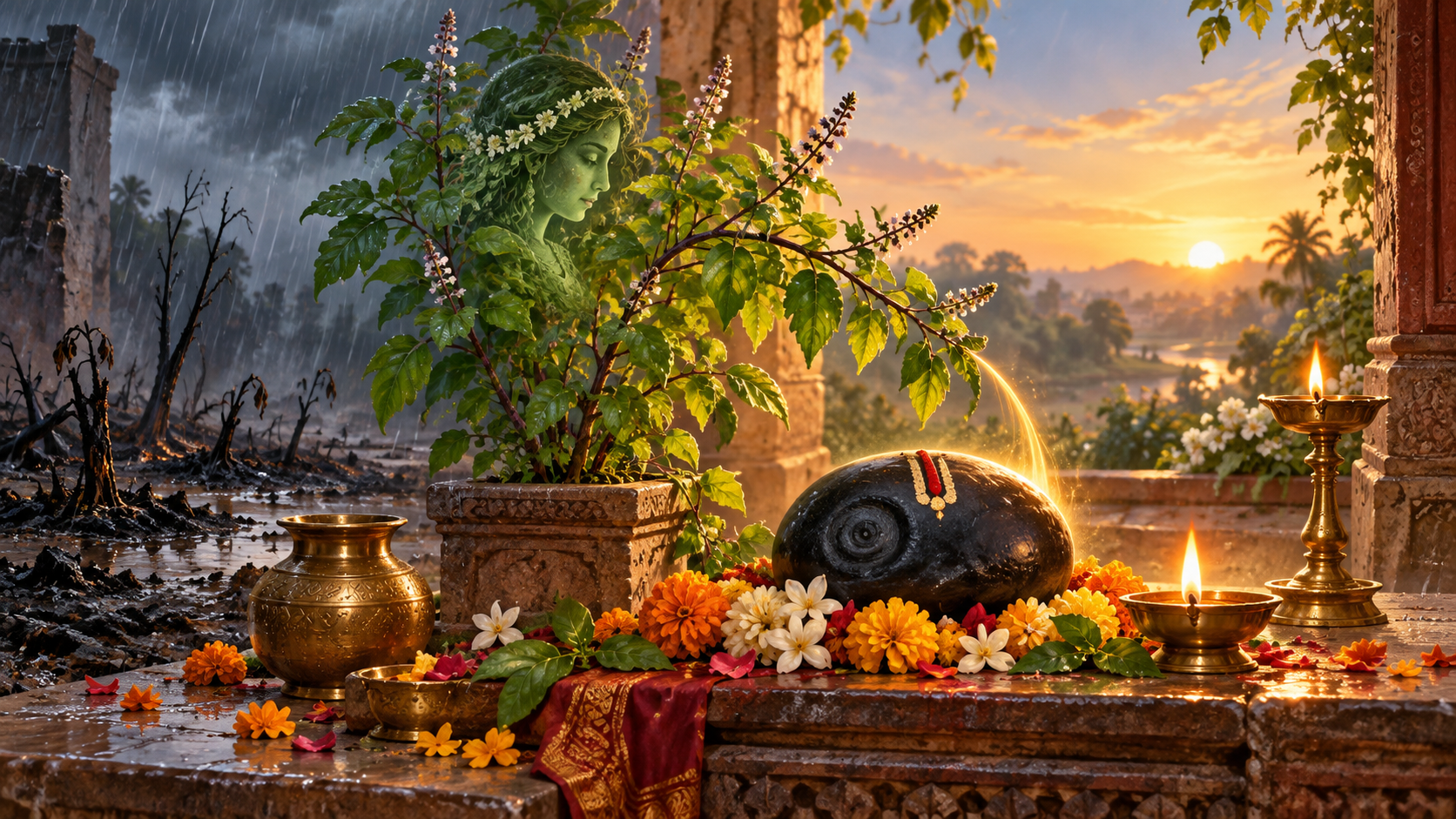
Tulsi Vivah is the ritual answer to the legend’s unresolved wound. Tulsi embodies Vrinda, while Shaligram, also written Saligram, represents Vishnu. Their wedding does not erase the deception or ask you to pretend that Vrinda was never wronged. It gives her a permanent, publicly honoured relationship with the deity to whom she was devoted.
This is why the ceremony should not be described merely as a charming wedding for a household plant. Tulsi is treated as a sacred presence with her own identity. The rite places her opposite Vishnu as a participant in the marriage, not beneath the feet of the warriors whose conflict shaped her fate.
The movement from curse to marriage expresses a recognisably Dharmic pattern. A rupture has consequences; the injured person speaks; the divine must receive that judgement; and relationship is restored through transformed forms rather than through denial. The ending is auspicious, but its auspiciousness has been earned through remembrance of the rupture.
The observance may fall on Kartik Ekadashi, Ksheerabdi Dwadashi, or Kartik Purnima, depending on the tradition being followed. If you are deciding when to observe it, use your family’s sampradaya, a trusted temple calendar, or the panchang used in your locality. The existence of several accepted days is not evidence that one community has misunderstood the festival.
How to observe the katha without losing its meaning
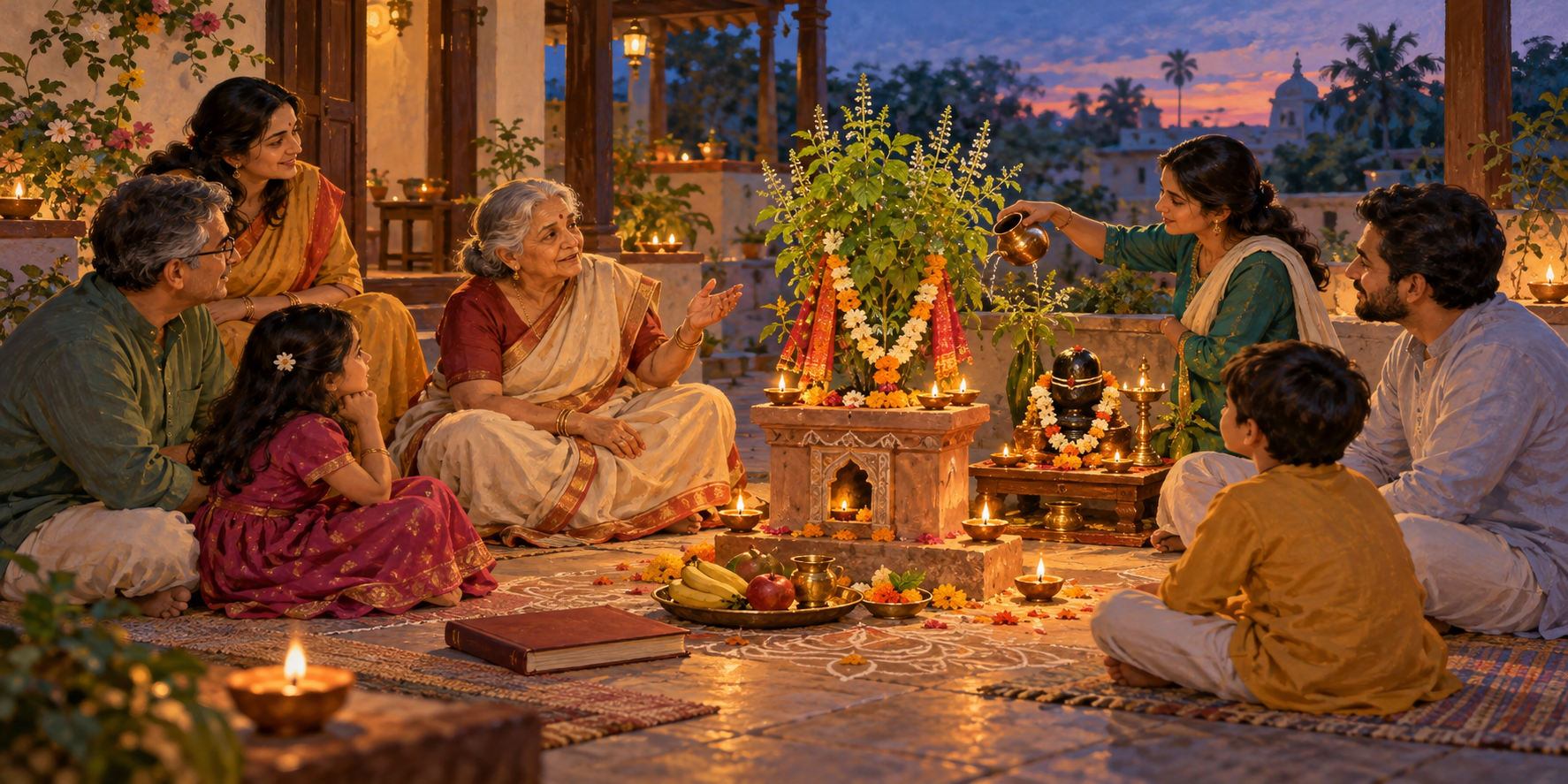
The exact puja procedure can vary, so follow the ritual method of your household or temple. The narrative emphasis, however, is something you can attend to directly. Whether the ceremony is simple or elaborate, these choices keep Vrinda’s meaning present.
- Choose the date through a living tradition. Confirm whether your family or temple follows Kartik Ekadashi, Ksheerabdi Dwadashi, or Kartik Purnima instead of selecting a date from an isolated online calendar.
- Tell the whole sequence. Include Jalandhara’s origin, Vrinda’s protective vrata, the war with Shiva, Vishnu’s intervention, Vrinda’s discovery, and her curse. Omitting the curse turns an ethically demanding katha into a flat victory story.
- Name Vrinda’s two devotions. She is devoted to her husband and to Vishnu. The collision between those commitments explains both the tragedy and the eventual marriage to Shaligram.
- Do not turn pativrata into passive obedience. In this legend, Vrinda’s fidelity has power, yet she also speaks against wrongdoing. Devotion and moral discernment belong in the same reading.
- Let the wedding signify restoration. When Tulsi and Shaligram are brought together, remember that the union follows injury, protest, and transformation. That sequence gives the auspicious ceremony its depth.
If children are hearing the katha, you do not need to hide its difficulty or burden them with every adult implication. You can explain plainly that Vrinda was deceived, that she objected, and that her dignity and devotion came to be honoured through Tulsi. For older listeners, the fuller question is worth asking: can an action intended to defeat adharma still create a moral debt? The legend’s curse-and-restoration structure leaves room for that question.
Key takeaways
- Jalandhara’s story is inseparable from Vrinda’s spiritual discipline; his strength is not his alone.
- Vrinda’s devotion to her husband and Vishnu creates the central conflict of the legend.
- Her curse preserves her agency and shows that divine strategy does not make its consequences morally invisible.
- Tulsi Vivah joins Tulsi, understood as Vrinda, with Vishnu in the form of Shaligram.
- The ceremony may be observed on Kartik Ekadashi, Ksheerabdi Dwadashi, or Kartik Purnima according to community tradition.
- The most faithful way to hear the katha is to retain both sides of it: the defeat of Jalandhara and the restoration of Vrinda’s sacred dignity.
When you next participate in Tulsi Vivah, listen for Vrinda’s voice as carefully as you watch the wedding rite. If the telling includes her devotion, her injury, her judgement, and her honoured transformation, the ceremony becomes more than a seasonal custom. It becomes a practice of remembering that Dharma requires restoration, not convenient forgetting.
References
- Hindu Pad – Jalandhara Katha: Story of demon Jalandhar, battle of Lord Shiva and Jalandhar
- Hindu Pad – Tulsi Vivah Vrat Katha: Legend and story of Tulsi Saligram Vivah Puja

Leave a Reply
You must be logged in to post a comment.