
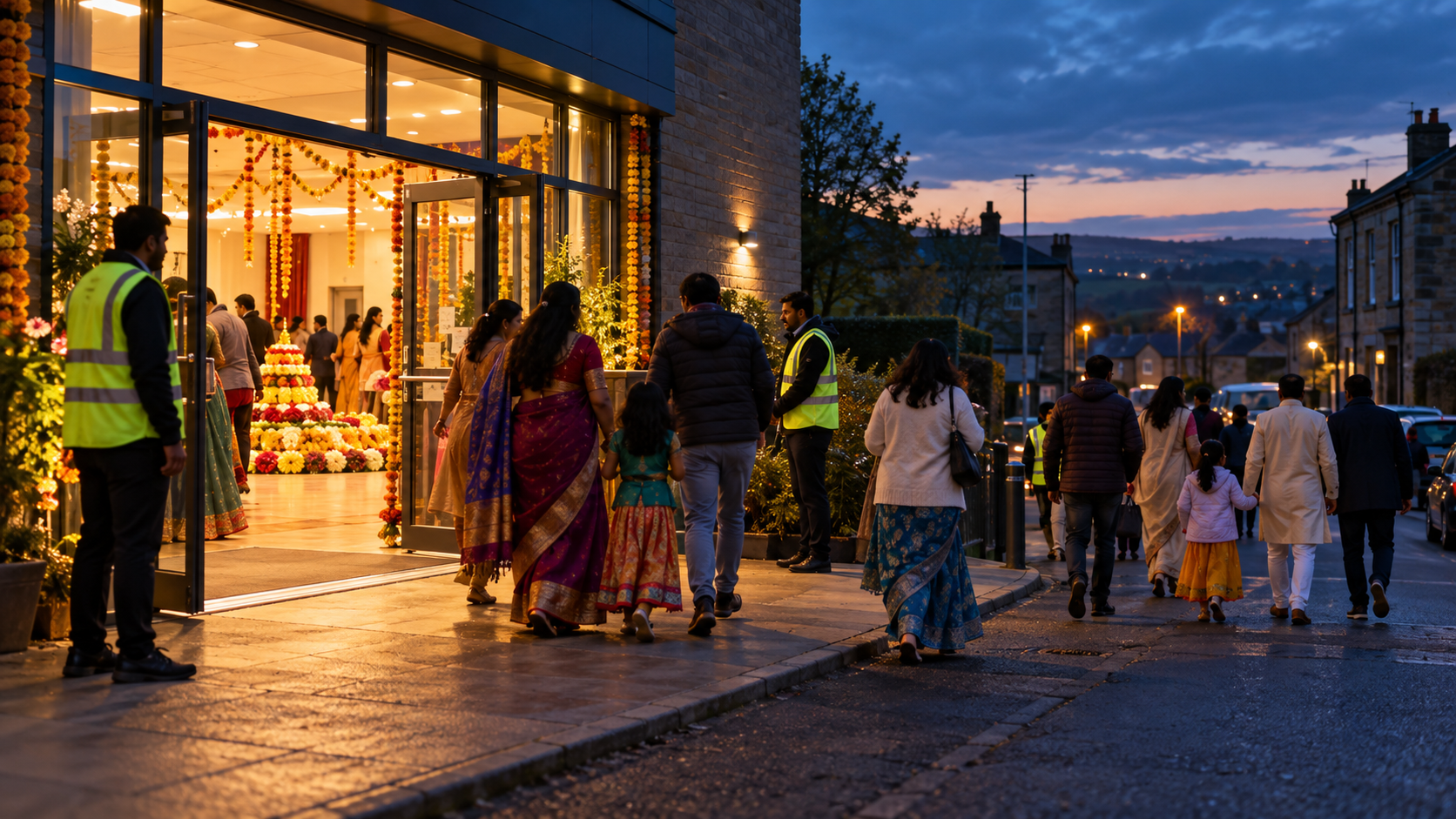
If you help organise Hindu celebrations in Britain, the question after Ossett is not whether your community should become less visible. It is how you keep celebrations open while making departures safer, preserving usable evidence and demanding a serious institutional response.
That work begins with precision. Two British Indian Hindu men say they were assaulted after a Bathukamma and Dasara celebration. Their allegations are grave, but the investigation had not produced an arrest at the point covered by the available account. You can take the incident seriously without turning an allegation, an inference or an online rumour into a settled fact.
What is known about the Ossett assaults

The incident took place outside Ossett Town Hall between 9:15 PM and 10:15 PM on 17 October, as attendees were leaving the Hindu celebration. The two men, who are originally from Telangana, described a group of almost ten people arriving on e-bikes. Some were reportedly wearing balaclavas.
One man said he was verbally abused and struck with a glass bottle, causing a head injury. His friend was reportedly hit with another bottle and punched in the face. One of the men recalled being challenged with the questions, “Why are you here? What are you doing here?” The two escaped back into the town hall.
The danger did not appear to end when they reached the building. People inside remained fearful because the group waited outside, while organisers said its number eventually grew to about twenty. The group dispersed only after police arrived.
There is also a detail that deserves investigation without being overstated. Young men thought to be between 16 and 20 had reportedly asked an organiser about the event and its attendees almost an hour before the assault. That may be relevant to whether the gathering was deliberately selected. It is not, by itself, proof of advance planning or of any particular person’s involvement.
West Yorkshire Police subsequently sought information about young men seen riding Sur-Rons or other e-bikes. Police said the assaults were being treated seriously and recognised the distress caused to attendees and the wider Hindu community. No arrests had been reported at that stage.
Why the language used about the attack matters

This should not be reduced to an ordinary disturbance that happened to occur near a festival. The alleged verbal challenge, the Hindu setting, the reported violence against British Indian attendees and the continued presence outside the venue create a reasonable concern about targeted intimidation.
Jade Botterill, the MP for Ossett and Denby Dale, explicitly condemned what she called racist intimidation, abuse and physical attacks. Her intervention matters because it recognises that residents must be able to use a civic venue for a Hindu celebration without being made to feel that they do not belong.
At the same time, the exact motive remains a matter for investigation. Racism and anti-Hindu hostility can overlap when people of Indian origin are confronted while leaving a Hindu event. The known facts do not yet establish how the alleged attackers understood their targets, whether religion and ethnicity were both factors, or whether every person in the larger group participated in the violence.
You therefore need three distinct descriptions when discussing Ossett:
- The alleged conduct: two men reported bottle attacks, a punch, verbal abuse and resulting injuries.
- The apparent intimidation: masked youths reportedly gathered outside while attendees sheltered inside.
- The suspected motive: the circumstances raise concerns about racist and possibly anti-Hindu targeting, but the investigation must establish that element.
This distinction is not timid language. It protects the credibility of the victims and the community. A precise account is harder to dismiss, less likely to implicate innocent people and more useful to investigators than an embellished one.
Hindu event organisers should close the departure gap

The documented vulnerability in Ossett appeared when attendees were leaving, not while the ceremony was under way. An event can be orderly inside and still expose people at the doorway, in a car park or on the walk to their transport. Your safety plan therefore needs to continue until the final attendee and volunteer have departed.
- Name a closing coordinator. Give one person authority to speak with venue staff, observe conditions outside and delay departures if a threatening group appears. Do not leave this responsibility to whoever happens to be near the door.
- Use accompanied departures. Ask attendees to leave in small groups rather than alone, especially when a problem has already been noticed outside. Establish a well-lit meeting or collection point and keep enough volunteers inside to support anyone who needs to return.
- Agree on a safe retreat. Before the doors open, identify where attendees should go if the exit becomes unsafe. If an assault or immediate threat develops, bring people inside when it is safe to do so, contact emergency services and follow the venue’s security procedures. Do not send an individual volunteer outside to confront or chase a masked group.
- Preserve observations, not guesses. Record times, clothing, bike types, direction of travel, exact words used and which witness observed each detail. In this case, the police request concerning Sur-Rons and other e-bikes shows why apparently ordinary details can matter.
- Secure original recordings. Ask the venue promptly to retain relevant CCTV. Keep original phone images and videos instead of editing, captioning or repeatedly forwarding them. Give investigators the original files and the name of the person who made each recording.
- Route unusual inquiries through one organiser. A public celebration should remain public, but there is no need to disclose attendee names, departure arrangements or other unnecessary personal details. Brief venue staff about the named contact for questions concerning the event.
- Document the response. Keep one incident record containing police contact details, the venue contact, witness names, injuries reported, medical assistance sought and any reference number provided. Store it securely rather than distributing personal information through large messaging groups.
If someone is injured, safety and medical attention come before filming or public messaging. If a suspicious group is present but no attack is under way, observation from a safe place is more useful than provocation. A volunteer with a phone should not be treated as a substitute for trained security or police.
These measures should protect a Hindu event without turning it into a fortress. The point is to control the vulnerable transition between the hall and the street, not to make families feel that their worship and cultural life must take place in hiding.
Turn public concern into specific accountability

Anger can draw attention to an incident, but it does not by itself produce identification, prosecution or safer events. The useful community response is organised, evidence-led and persistent.
Your first public statement should say what was reported, where and when it happened, that police are investigating, and how witnesses can provide information. It should not publish an unverified name, assign guilt to an ethnic or religious population, or present an unclear social-media image as proof. Collective blame repeats the same exclusionary logic that the community is resisting.
A Police and Communities Together meeting was held in Ossett on 20 October with police, residents and representation from the MP’s office. That meeting is a beginning, not a measurable outcome. Residents and Hindu organisations can now ask focused follow-up questions:
- What evidence or witness information is still needed?
- Have all relevant town-centre and venue recordings been identified and retained?
- What policing presence is planned around the arrival and closing periods of future community events?
- Who is the named contact for organisers who report intimidation before an event begins?
- How will the community be updated when investigative information can lawfully be shared?
- How are the possible racial and religious dimensions being recorded and examined?
Keep those questions in writing and record the answers. A general assurance that misconduct will not be tolerated is welcome, but organisers also need operational details they can use at the next booking.
The most helpful public action is equally concrete. Anyone who was present should write an independent recollection while it remains clear. Nearby residents or businesses can check whether they hold relevant footage. People who recognise a bike, item of clothing or movement pattern should pass that information to police rather than testing an accusation online. A witness should distinguish clearly between what they saw, what another person told them and what they later encountered on social media.
Community solidarity also means supporting the people who were inside the venue. Give attendees a single channel for verified updates. Tell them what safety changes will be made before the next event. Do not pressure victims or witnesses to repeat their account publicly when they have already provided it to investigators.
Key takeaways
- Two British Indian Hindu men reported being assaulted after the Bathukamma and Dasara celebration at Ossett Town Hall; the investigation had not produced an announced arrest at the stage described.
- The circumstances justify concern about targeted racist and possibly anti-Hindu intimidation, but the exact motive and individual responsibility still require evidence.
- The vulnerable period was the departure from the venue, so an event plan must cover the doorway, pickup area and final attendee’s exit.
- Original footage, independent witness notes, exact times and identifying details are more valuable than viral speculation.
- Police, elected representatives and venue managers should be asked for named contacts, defined safety measures and follow-up updates.
- British Hindus should not answer intimidation by withdrawing their festivals from public life.
Before your next celebration, put the closing plan on one page, name the people responsible and walk the route from the hall to the pickup point. Then celebrate openly. The proper answer to intimidation is visible Hindu community life backed by preparation, disciplined evidence and an insistence on equal protection.
References

Leave a Reply
You must be logged in to post a comment.