
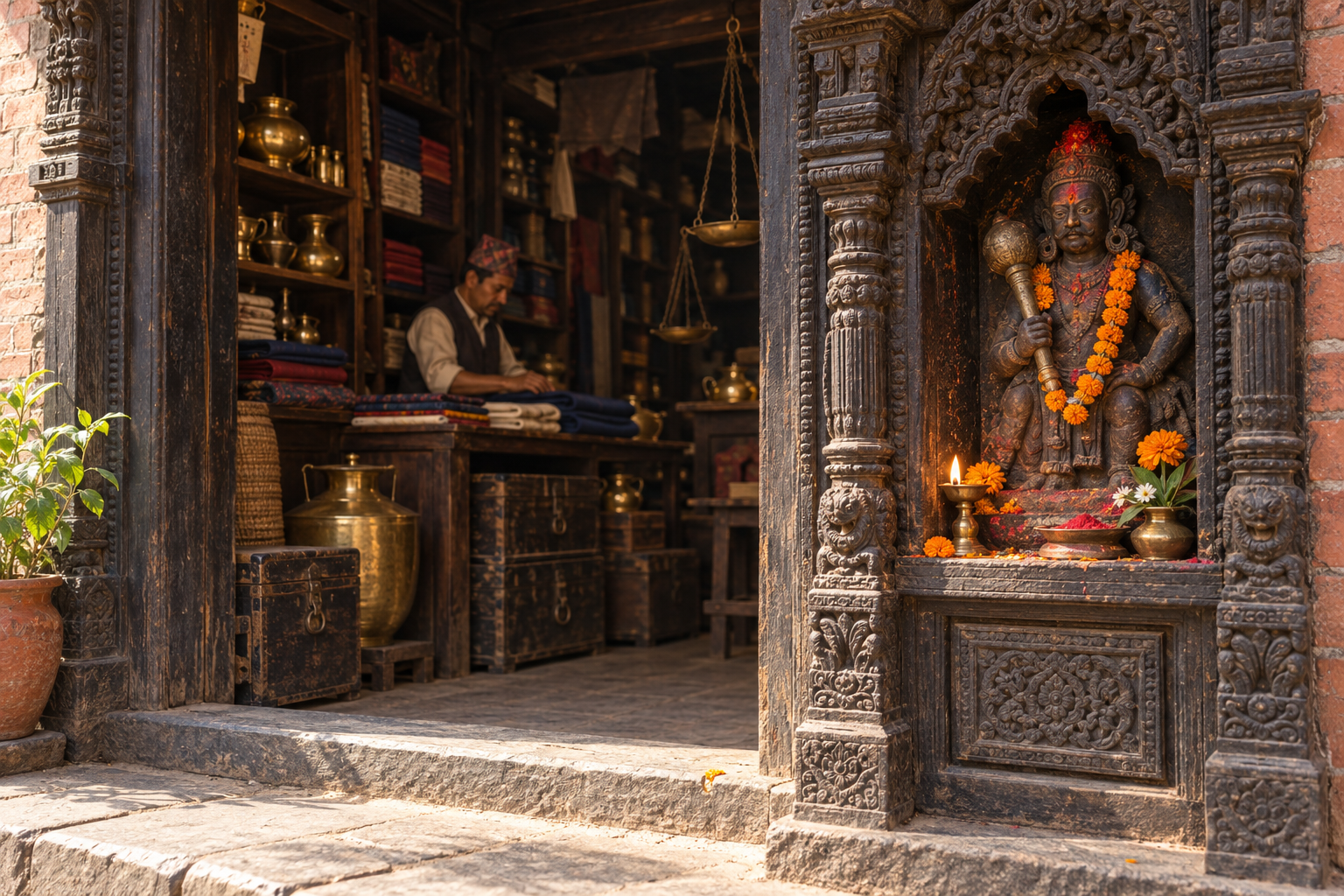
You enter a traditional Newa shop in the Kathmandu Valley and notice a small image of Bhimsen near the entrance. If you know him mainly as the formidable Pandava of the Mahabharata, the setting raises an immediate question: why is a battlefield hero watching over a place of business?
The merchant has not mistaken a warrior for a wealth deity. Newa tradition gives Bhimsen a particular relationship with trade. To understand that relationship, you need to distinguish a deity’s narrative identity from the responsibilities a community entrusts to him.
One Bhimsen, seen through two religious frames
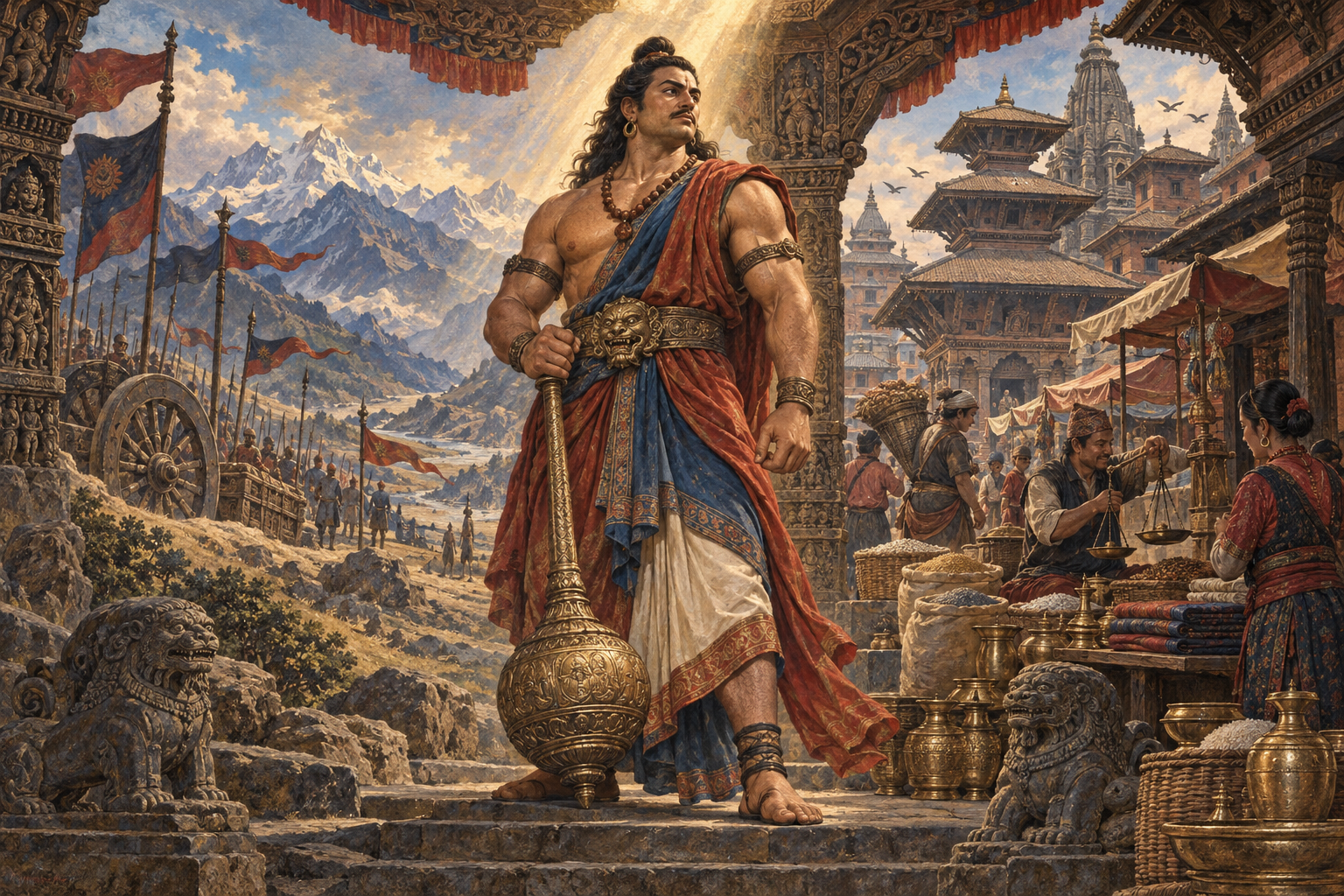
Bhimsen is Bhima, the powerful Pandava warrior. He is Vrikodara, the wolf-bellied son of Vayu, remembered above all for extraordinary physical force. The Mahabharata does not present him as a deity of wealth, commerce, or financial success.
That does not make the Newa understanding a contradiction. The epic tells you who Bhima is within its narrative. Newa religious life tells you what Bhimsen has come to mean within a particular community. These are related questions, but they are not identical.
Local devotion often emphasizes one capacity of a widely known deity. A warrior’s strength may become protective strength. His refusal to retreat may signify endurance. His ability to overcome opposition may speak to people whose livelihoods depend on carrying responsibility through uncertainty. The figure remains recognizable, while the relationship surrounding him develops in response to community life.
You therefore do not have to choose between an “epic Bhima” and a supposedly unrelated “merchant Bhimsen.” It is more accurate to see one sacred personality operating in two frames: the Pandava hero supplied by the shared Mahabharata world and the guardian of trade encountered in Newa practice.
Why strength belongs in the marketplace
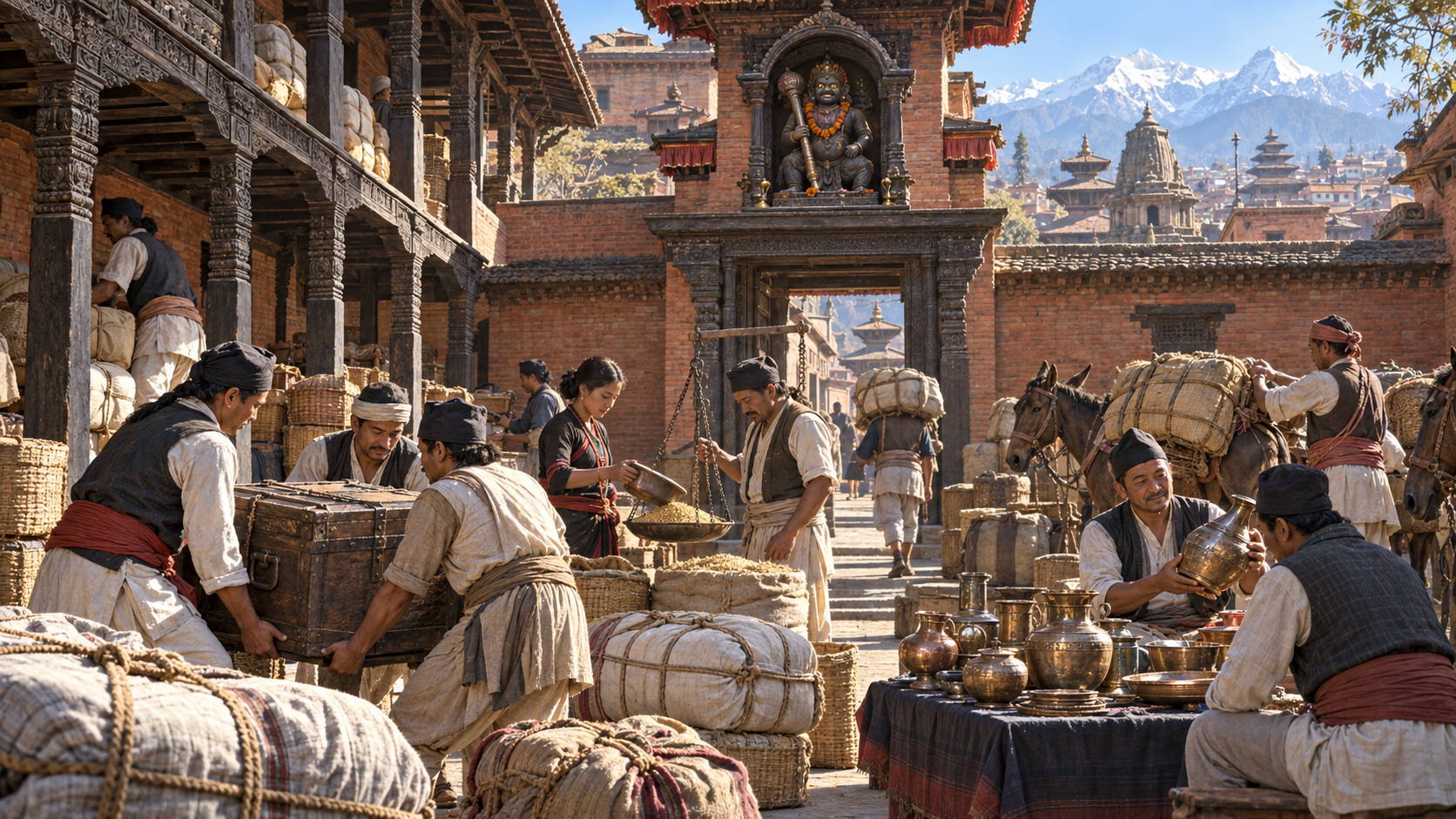
Calling Bhimsen a god of trade can be misleading if you hear only “god of money.” Wealth concerns what someone possesses. Trade concerns exchange: goods move, promises are made, risks are accepted, reputations are tested, and relationships must survive beyond a single transaction.
That distinction makes Bhimsen’s symbolism easier to read. A merchant does not need abundance alone. A merchant also needs steadiness under pressure, the capacity to carry obligations, protection from disorder, and the resolve to continue when an undertaking becomes difficult. These qualities belong naturally to the moral vocabulary of strength.
This does not prove that every Newa devotee explains Bhimsen in precisely those terms. It gives you a sound way to understand why a powerful warrior can become meaningful in commercial life without being transformed into a generic dispenser of riches. His strength is not merely admired; it is placed in service of a demanding social activity.
The location of the shrine reinforces that reading. In traditional Newa shops in Kathmandu, Patan, and Bhaktapur, a shrine to Bhimsen commonly stands near the entrance. The doorway is where the private world of the merchant meets the public world of exchange. Customers, goods, obligations, and uncertainty all cross that boundary. Bhimsen’s presence there can be read as guardianship over the activity entering and leaving the shop, not simply as a request for more money.
This is the practical distinction to retain: prosperity is an outcome, but trade is a discipline. Bhimsen’s Newa role directs attention toward the strength required to conduct that discipline.
How to read a Bhimsen shrine without flattening it
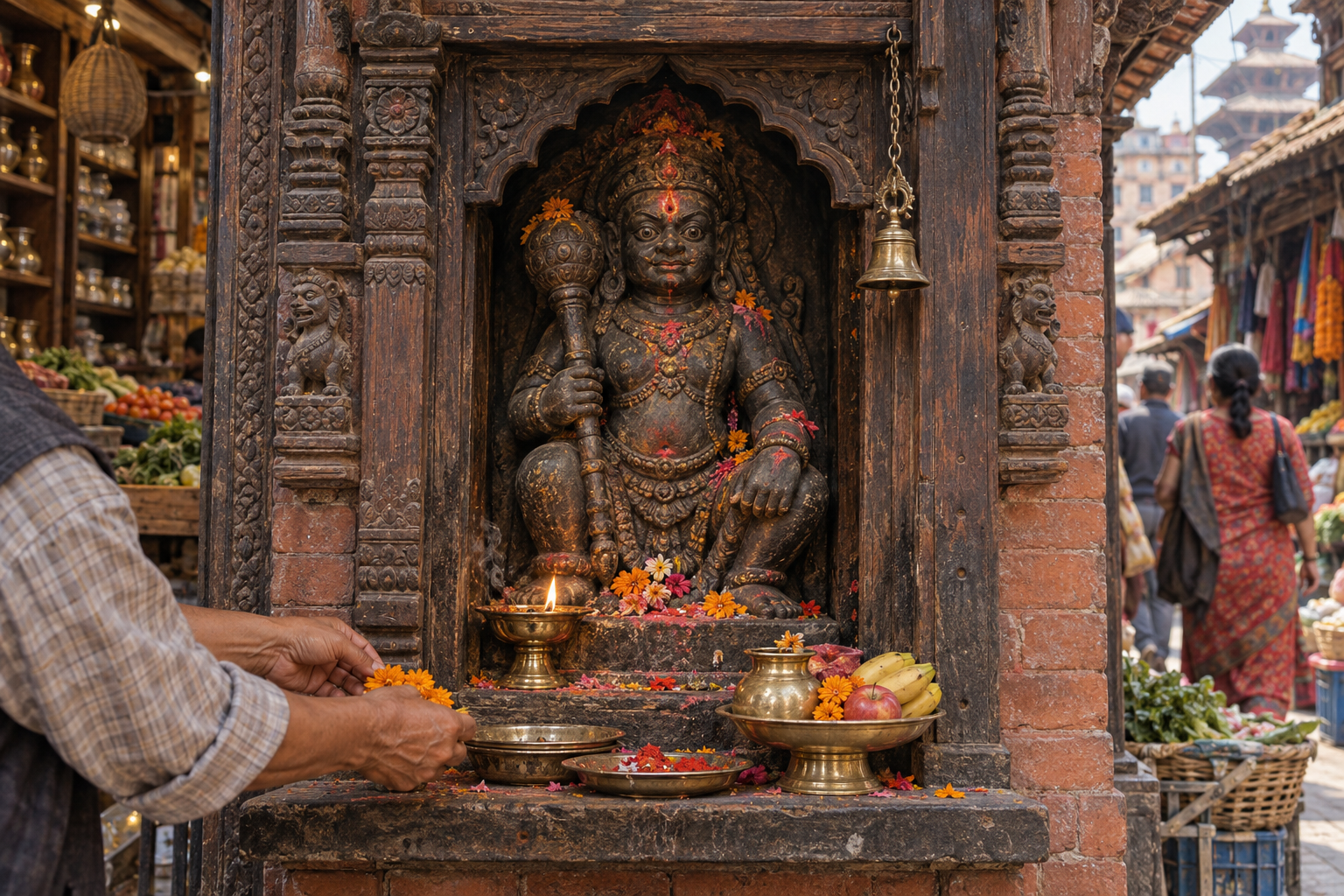
If you encounter one of these shrines as a visitor, researcher, customer, or member of the wider Dharmic diaspora, a few habits will help you understand what you are seeing.
- Begin with the local name and setting. “Bhimsen” inside a Newa shop already tells you more than the broad label “Bhima statue.” The placement connects the deity to the life of the establishment.
- Keep identity and function together. Recognize the Pandava warrior, but do not use his epic role to dismiss his commercial guardianship. The local function grows from the inherited figure rather than erasing him.
- Do not equate trade with greed. A sacred presence in a shop can place commerce under moral attention. Exchange creates duties between people; it is not only a mechanism for accumulating possessions.
- Separate observation from interpretation. You can observe that the shrine stands near the entrance and that Bhimsen is associated with trade. A particular shopkeeper’s family history, vows, or understanding should not be guessed. Ask if that detail matters to your purpose.
- Request permission before photographing, touching, or participating. A shrine inside a commercial space is still a shrine. Its accessibility does not make it a museum display.
If conversation is welcome, ask a concrete question such as, “What does Bhimsen protect in this business?” That invites the custodian’s own explanation. Questions framed as challenges – “But isn’t Bhima only a warrior?” – impose an outside category before the local meaning has been heard.
You should also treat “god of trade” as a useful description, not an exhaustive definition. It identifies Bhimsen’s distinctive Newa responsibility. It does not mean that trade is his only meaning, that every merchant follows an identical practice, or that the whole Mahabharata tradition assigns him the same role.
Key takeaways
- Newa tradition reveres the Mahabharata warrior Bhimsen as a guardian and deity of trade.
- The Mahabharata itself does not identify Bhima as a god of wealth.
- The Newa role is best understood as a localized development of Bhimsen’s protective strength, not as confusion about his epic identity.
- A shop shrine near the entrance connects sacred guardianship with the boundary where commercial exchange takes place.
- When visiting, observe the setting, ask before photographing or touching the shrine, and let its custodian explain any family-specific meaning.
What Bhimsen reveals about a living Dharma
Bhimsen’s place in Newa commerce offers a useful method for approaching Hindu traditions beyond this one case. Do not assume that a deity’s legitimate meaning must be exhausted by one text, one region, or one theological label. At the same time, do not call every local association ancient or universal. Continuity and adaptation must both be seen.
Here the continuity is clear: the deity remains the mighty Pandava, son of Vayu. The adaptation is equally clear: Newa merchants relate that strength to the world of exchange. Community recognition, repeated placement in commercial settings, and a coherent connection to the deity’s known character give the practice its intelligibility.
This is neither a frozen uniformity nor an anything-goes invention. It is a recognizable Dharmic pattern in which a shared sacred figure becomes intimate through local responsibility. The Mahabharata supplies a civilizational language; Newa tradition speaks that language in its own social world.
The next time you see Bhimsen at a shop entrance, resist asking why the “wrong” deity is there. Notice what the placement says: trade requires protection, endurance, and accountability as much as it seeks prosperity. Pause, acknowledge the shrine respectfully, and ask what responsibility this community has placed in the hands of its strongest Pandava.
References

Leave a Reply
You must be logged in to post a comment.