
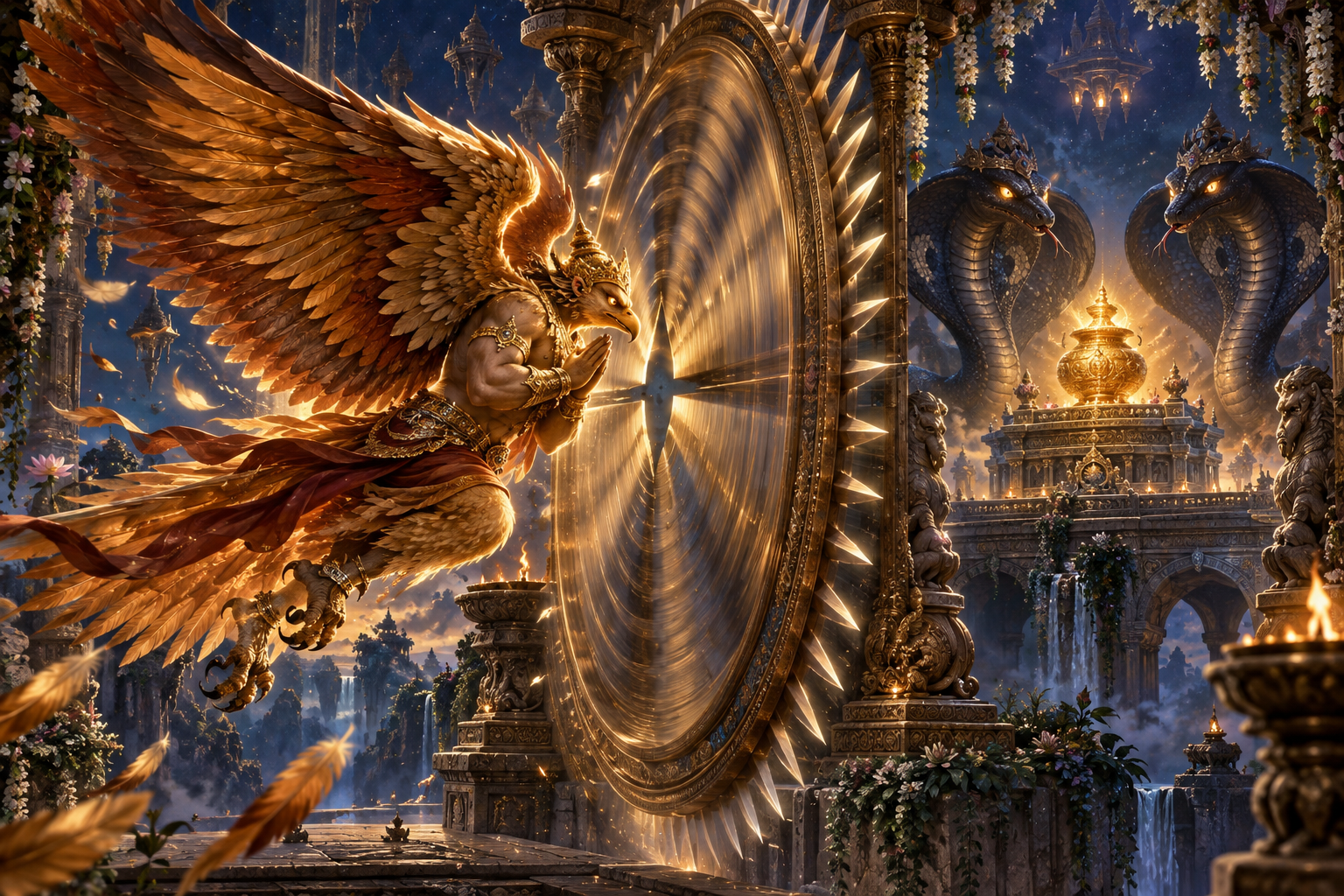
If you reached this episode wondering why Garuda still faces a test after defeating the Devas, the answer changes how the scene should be read. Raw power gets him near Amrita; it does not get him through the last barrier.
The final approach places a spinning wheel and two snakes between Garuda and the nectar. To pass them, he must match his form to the obstacle and remember why he came. His true objective is not personal possession of immortality, but the liberation of his mother, Vinata.
The final obstacle changes the kind of strength required
Garuda’s mission begins with a specific obligation. Vinata is enslaved to Kadru and the snakes, and Amrita is demanded as the price of her release. In the Astika Parva of the Mahabharata’s Adi Parva, Garuda fights the Devas and defeats them before encountering the wheel and its serpentine guardians.
Yet the conflict is not a simple contest between a righteous hero and wicked opponents. The Devas have a duty to protect Amrita. Garuda has a duty to free his mother. Each side acts from a claim of dharma, even though those claims bring them into battle.
This distinction matters whenever you apply the episode to your own decisions. An opponent is not necessarily adharmic merely because that person obstructs you. A parent can protect a child while the child seeks independence. A temple committee can protect an institution while a devotee asks for reform. Two duties may collide without either side beginning from malice.
Before treating resistance as hostility, separate four questions:
- What obligation are you trying to fulfil?
- What legitimate responsibility may the other side be protecting?
- What result do you actually need, as distinct from defeating the person in front of you?
- What would become excessive once that result is secured?
That last question is especially important. Garuda’s objective is Vinata’s freedom. Defeating every possible adversary is not the objective. When you define success by the duty that sent you forward, you are less likely to turn a necessary conflict into a permanent identity.
The spinning wheel rewards right measure and right timing
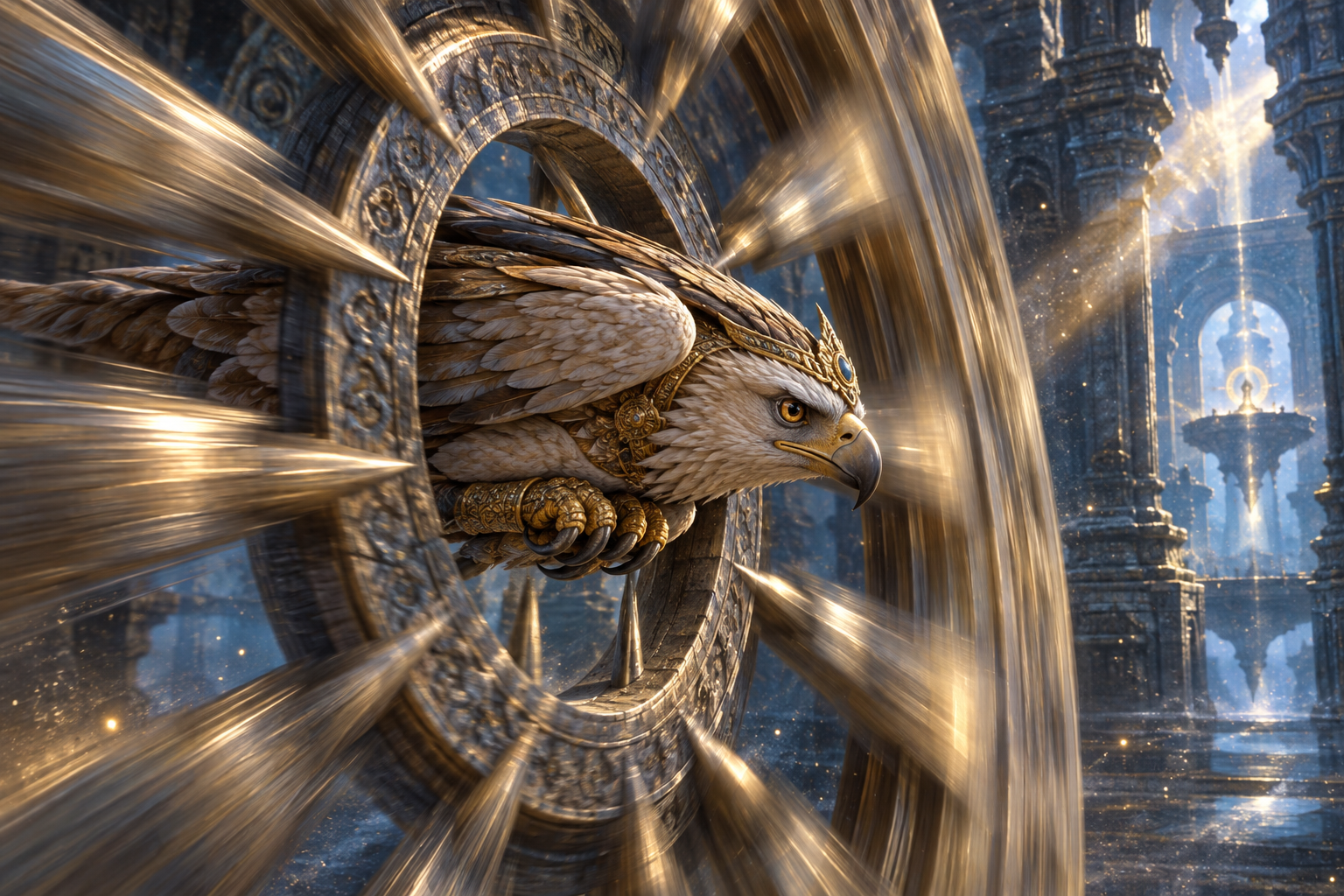
The spinning wheel presents a fundamentally different problem from an army. It cannot be frightened, persuaded or exhausted. Its danger comes from continuous movement. More aggression does not solve such an obstacle; accurate observation does.
Garuda answers by becoming small enough to pass through the available opening. The change of size is not a surrender of power. It is mastery over power. He can be vast when vastness is useful and small when smallness is required.
This is one of the episode’s most practical lessons. We often assume that a harder barrier requires a larger response: more argument, more effort, more people, more money or more visible force. A moving obstacle may instead demand a smaller footprint and a better-chosen moment.
You can use the wheel as a diagnostic image:
- Identify what is moving. Is the real difficulty a deadline, an emotional reaction, a changing rule, a recurring habit or a dependency you do not control?
- Find the opening. Look for the moment or condition in which the obstacle is least able to block the required action.
- Reduce your footprint. Carry only what the immediate passage requires. Do not drag every grievance, ambition or secondary demand through the same narrow opening.
- Preserve the purpose. Make the method smaller without making the duty negotiable.
Suppose you need to repair a strained relationship. The oversized approach is to settle the entire history in one conversation. The smaller form is one truthful acknowledgement, one clear request and enough silence to hear the answer. If you are trying to restore a neglected spiritual discipline, the oversized approach is an elaborate routine that collapses within days. The smaller form is a fixed daily act that can survive an ordinary schedule.
Right timing is not passivity. Garuda does not abandon the quest while waiting for the wheel to stop. He studies the obstacle and moves through it in the form the moment permits. Patience serves action; it does not replace action.
The two snakes turn the outer quest inward
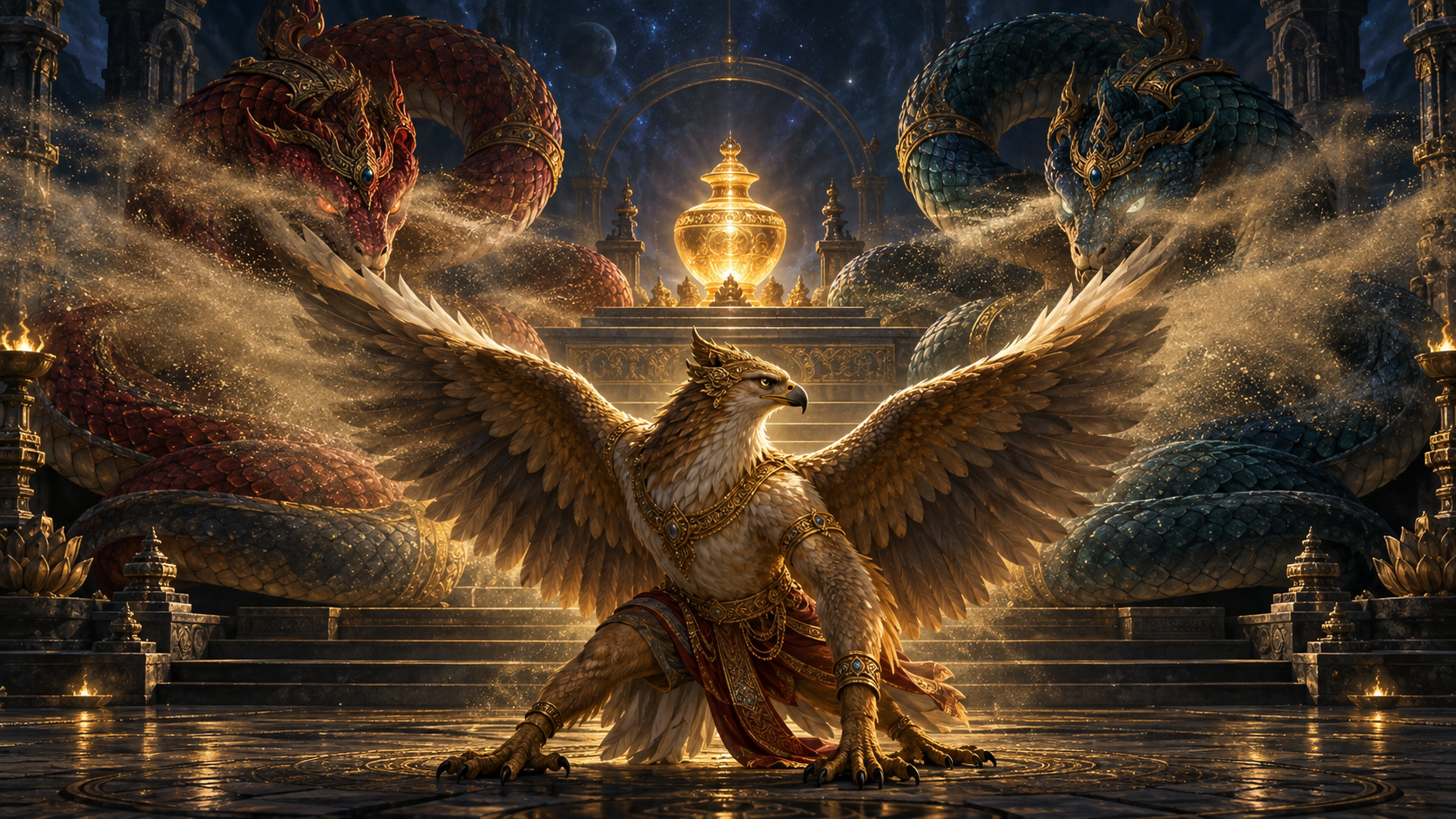
After the impersonal motion of the wheel come two living guardians. Within the narrative, they are real defenders that Garuda must overcome. Symbolically, their presence also returns him to the conflict at the heart of his mission: his mother’s bondage is bound up with Kadru and the snakes, and snakes now stand at the threshold of the object demanded for her release.
A symbol does not have to be reduced to one rigid equation. The pair can nevertheless help you notice two reactions that commonly intensify near a desired object: fear that you will lose it and craving to possess it. Fear says that failure will destroy everything. Craving says that success will justify anything. Both reactions narrow judgement at precisely the moment when judgement matters most.
When your own goal is close, write down three short answers before acting:
- The fear: What outcome am I treating as unbearable?
- The craving: What reward am I beginning to treat as an entitlement?
- The dharmic limit: What action would violate the purpose that brought me here?
This exercise is useful because final-stage temptation rarely announces itself as temptation. It often sounds like urgency: after all the effort already spent, surely one more compromise is permissible. The snakes at the threshold remind you that proximity to the prize is not proof that every means of taking it has become right.
The sequence also matters. Garuda first confronts force, then movement, then guardianship. An obstacle can change its nature as you advance. If you keep applying yesterday’s successful method, strength becomes rigidity. After every major breakthrough, ask again: what kind of problem is in front of me now?
Amrita is the means; Vinata’s freedom is the end

The most important distinction in the quest is easy to miss because Amrita is so magnificent. The nectar is the object Garuda must obtain, but it is not the ultimate reason for his journey. Vinata’s liberation is the end; Amrita is the required means.
Long struggles create goal drift. A person begins by seeking justice, service or freedom, but repeated conflict gradually makes victory itself the goal. The contested object acquires a significance it did not have at the beginning. Winning, owning or humiliating the opposition starts to feel more important than the duty that first justified the effort.
Garuda’s restraint corrects that drift. Reaching Amrita does not erase the purpose governing his approach to it. Access is not the same as ownership, and the power to take something is not by itself a moral permission to consume it. His greatness lies not only in overcoming resistance, but in remaining larger than the appetite the nectar could awaken.
This gives you a clean test for any difficult pursuit. Complete the sentence, “I need this so that…” Then examine the words after “so that.” If the means has displaced the end, stop and restate the duty. You may still need to proceed, but you will proceed with a boundary.
A five-minute practice before your own final hurdle
- Name the true end. Use one sentence. If you need several paragraphs, you probably have not isolated it yet.
- Name the duty behind it. Specify whom or what you are serving: a promise, a family responsibility, truth, justice, learning or spiritual discipline.
- Recognise the other duty. State the legitimate concern the opposing side may be protecting, even if you disagree with its decision.
- Classify the present obstacle. Decide whether it calls for force, timing, reduced scale, negotiation or restraint. Do not assume the method that brought you this far is still the right one.
- Set the limit before acting. Write one thing you will not do, even if doing it would make the prize easier to obtain.
This practice does not guarantee an easy passage. It does something more useful: it prevents pressure from choosing your purpose and methods for you.
Key takeaways
- Garuda’s last trial is not another test of maximum force; it is a test of adaptable power.
- The spinning wheel represents a problem solved through proportion, observation and timing.
- The two snakes can help you examine the fear and craving that intensify near a coveted result.
- The Devas and Garuda embody competing duties, so opposition should not automatically be mistaken for adharma.
- Amrita remains a means to Vinata’s freedom; keeping means and ends distinct protects action from appetite.
When your own final hurdle appears, do not ask only how much strength you can apply. Ask what kind of strength the obstacle requires, what duty brought you there and what you must refuse to become while passing it. Then make your form fit the opening and move.
References

Leave a Reply
You must be logged in to post a comment.