

If you learned Indian history mainly as a procession of invasions and ruling powers, you may have noticed a peculiar absence. Indians appear inside the narrative, yet Indian scholars who interpreted their own civilisation seldom appear as serious intellectual interlocutors.
You do not have to choose between accepting that absence and embracing a sweeping conspiracy theory. You can examine how a historical tradition becomes marginal, what was lost when particular scholars left common reading lists, and whether an ideological explanation fits the evidence. That approach gives you something more useful than outrage: a way to repair your own understanding.
How scholarship disappears without being formally banned

Marginalisation is not the same as destruction. A book can remain in a library while ceasing to shape the questions students ask. A scholar can still be cited occasionally while being excluded from introductory courses, public histories and the intellectual genealogy taught to new researchers.
One useful hypothesis traces a five-stage movement from intellectual flourishing and continuity to dismissal, marginalisation and active discouragement. Treat those as distinct stages, because each requires different evidence:
- Flourishing: scholars produce substantial work, develop methods and sustain debate across disciplines.
- Continuity: later scholars teach, revise and challenge that work. A living tradition does not merely preserve books; it argues with them.
- Dismissal: labels begin to replace engagement. Before accepting a dismissal, ask whether the critic has answered the scholar’s evidence or merely classified the scholar.
- Marginalisation: the work no longer appears where newcomers would normally encounter it. Look at syllabi, bibliographies, textbooks, collected histories and new editions rather than relying on reputation alone.
- Discouragement: younger researchers learn that some questions, methods or civilisational perspectives carry an intellectual cost. This is the hardest stage to demonstrate because it requires more than showing that a name is absent.
This distinction prevents two common errors. An omission does not automatically prove organised suppression; editors and teachers must always select. But repeated omission across the places where a canon is reproduced cannot be dismissed merely by noting that the neglected books still exist. The important questions are where the absence occurs, how consistently it occurs and whether competing work received a fair hearing.
What Munshi and Majumdar were trying to recover
K. M. Munshi’s involvement in the reconstruction of the Somanath Temple stood alongside a larger ambition: an Indian history that conveyed the civilisation as Indians understood it. His standard was not a flattering chronicle. It was a history capacious enough to include the people of the land, their achievements, institutions, values, struggles and resistance instead of reducing India to the foreign powers that entered it.
“catch a glimpse of her soul as Indians see it.”
K. M. Munshi
With historian R. C. Majumdar, that ambition produced the eleven-volume History and Culture of the Indian People. The scale matters because it reveals what was being attempted: not a single corrective essay, but a broad civilisational synthesis in which political events belonged beside culture, institutions and intellectual life.
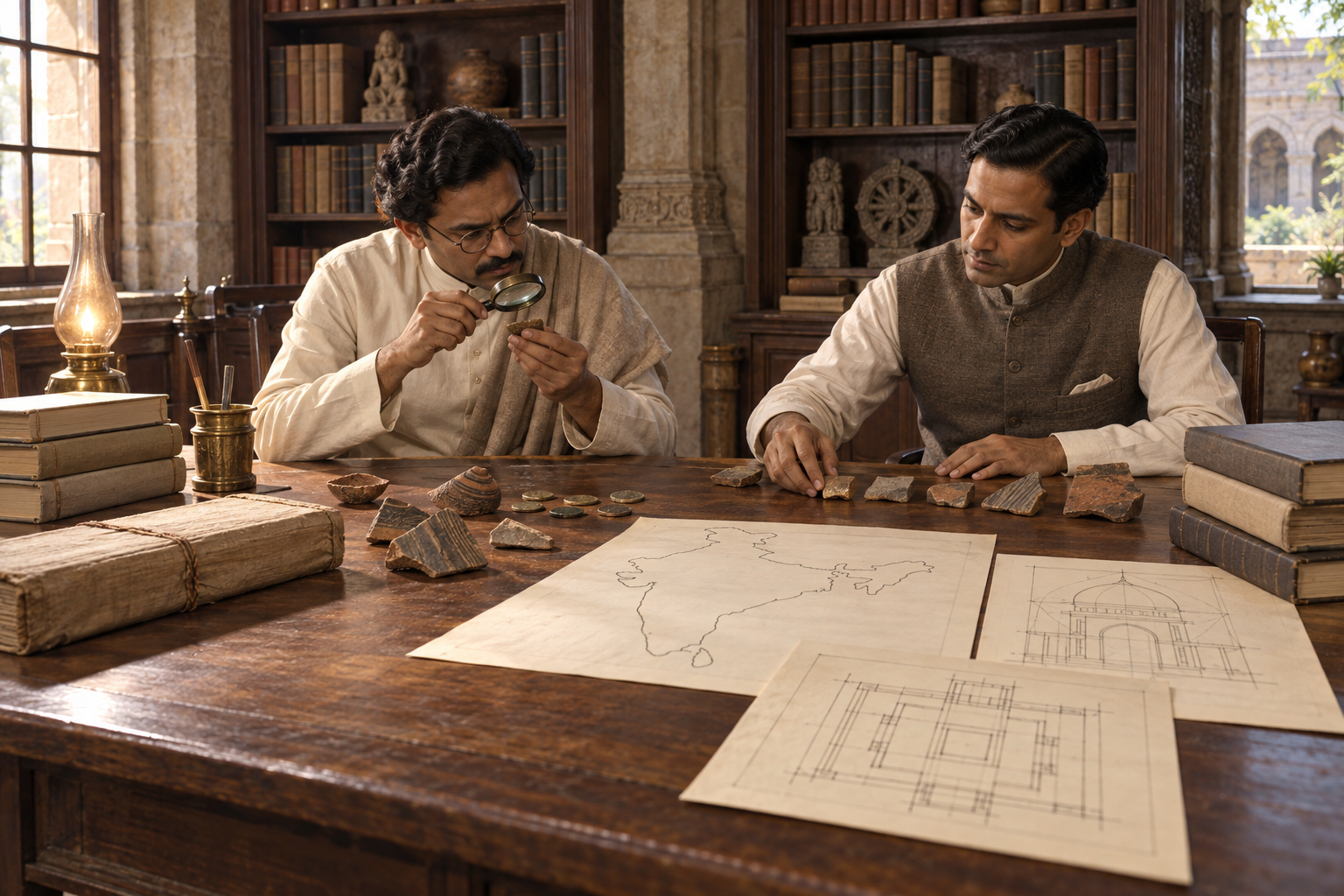
Nor was this an isolated partnership. The wider inheritance included P. V. Kane, Jadunath Sarkar, Ananda Coomaraswamy, Ganganath Jha, Radha Kumud Mukherji, S. Srikanta Sastri and Govind Chandra Pande. Collectively, such scholars worked across languages, inscriptions, manuscripts, literature, philosophy, archaeology and numismatics. They were not interchangeable, and recovering them should not mean pretending that they formed a uniform school.
That range gives you a practical test for any account of Indian history. When you read a chapter, watch a lecture or examine a museum narrative, ask:
- What kinds of evidence are allowed to speak: inscriptions, archaeological remains, coins, manuscripts, literature and philosophical works, or only a narrow selection?
- Are institutions, ideas and cultural achievements treated as historical realities, or does the account become almost entirely a sequence of rulers and conflicts?
- Does resistance receive the same analytical seriousness as conquest?
- Do Indian scholars enter the bibliography as thinkers whose arguments must be tested, or only as names from an obsolete past?
- When a scholar is rejected, can you identify the disputed claim and the contrary evidence?
No chapter can contain every kind of evidence or every historian. The warning sign is a pattern: the same evidence repeatedly narrowed, the same questions repeatedly excluded and criticism repeatedly replaced by silence. That is how you distinguish an editorial choice from a historiographical habit.
Make the ideological charge precise enough to test

Describing this process as a Marxist theft of Indian history is a polemical thesis, not a self-proving fact. It may direct attention towards real patterns of selection and exclusion, but the label cannot do the evidentiary work. A serious case must separate at least four propositions:
- Canonical displacement: once-significant Indian historians became less visible in teaching, publishing and public memory.
- Methodological narrowing: some kinds of evidence or civilisational questions received less legitimacy than others.
- Institutional gatekeeping: positions, curricula or professional incentives made alternative approaches harder to pursue.
- Civilisational consequence: the resulting narrative weakened awareness of India’s intellectual inheritance and historical continuity.
The first proposition can be investigated through reading lists, textbook bibliographies, publication histories and citation patterns. The second requires comparison of methods: what evidence was considered, what was excluded and why. The third needs direct institutional evidence, not an inference from disagreement. The fourth requires careful analysis of what readers were taught to notice or overlook.
A list of neglected names, however distinguished, does not by itself measure their exclusion or identify its cause. Conversely, an appeal to academic consensus does not answer evidence of systematic omission. Both shortcuts protect a preferred conclusion from examination.
You should apply the same standard to the scholars being recovered. Older Indian scholarship need not be treated as infallible, final or beyond revision. Its arguments may contain limitations, and later evidence may require correction. Restoration means returning those arguments to live debate: reading them, identifying their evidence, testing their conclusions and preserving what survives scrutiny. Replacing one unquestionable canon with another would reproduce the very failure under criticism.
A six-step audit for any Indian history chapter

You can begin without trying to settle the whole history of Indian academia. Choose one textbook chapter, lecture series, museum display or course bibliography on a period you already care about. A bounded audit produces clearer results than a general search for bias.
- Define the object. Record the title, edition or version, author and exact chapter. Conclusions about one chapter should not silently become conclusions about an entire discipline.
- Write down its governing question. Is the chapter organised around conquest, administration, economy, institutions, religious life, philosophy, cultural production or resistance? What a narrative asks often determines what it can see.
- Map the evidence it uses. Make columns for inscriptions, archaeology, numismatics, manuscripts, literature and philosophy. Mark only what is actually used in the argument, not what appears decoratively in a footnote.
- Build an omission ledger. Note which Indian historians are cited, which are criticised and which relevant lines of inquiry never arise. Keep absence separate from refutation: an uncited scholar has not thereby been answered.
- Test one omission directly. Select one relevant scholar, locate the actual work and compare a specific claim with the chapter before you. Do not use a quotation card, social-media thread or second-hand slogan as a substitute for the argument.
- Grade your conclusion. Mark the suspected marginalisation as demonstrated, plausible, disputed or unsupported. Also identify whether you found simple omission, explicit dismissal or evidence of active discouragement. Those are not equivalent findings.
Keep a two-column note while you work. In the first column, write the claim being made. In the second, write the evidence that would prove or weaken it. This small discipline stops a strong emotional reaction from turning into a conclusion before the comparison has been made.
Key takeaways
- Marginalisation is a process to be demonstrated, not a synonym for disagreement.
- A surviving book can still be absent from the living canon that shapes students and public memory.
- The breadth of evidence matters as much as the political conclusion drawn from it.
- Ideological explanations become credible only when they are broken into claims that can be checked.
- Recover neglected scholars as participants in debate, not as mascots who must never be questioned.
The most useful repair is deliberately small. On the next period of Indian history you study, add one of these neglected scholars to your reading and compare an actual argument rather than a reputation. If the work has been fairly superseded, you will know why. If it has merely disappeared from view, you will have restored one broken link in India’s intellectual memory.
A civilisation recovers its historiography when its inherited scholarship becomes readable, debatable and consequential again. Start with one name, one claim and one honest comparison.
References

Leave a Reply
You must be logged in to post a comment.