
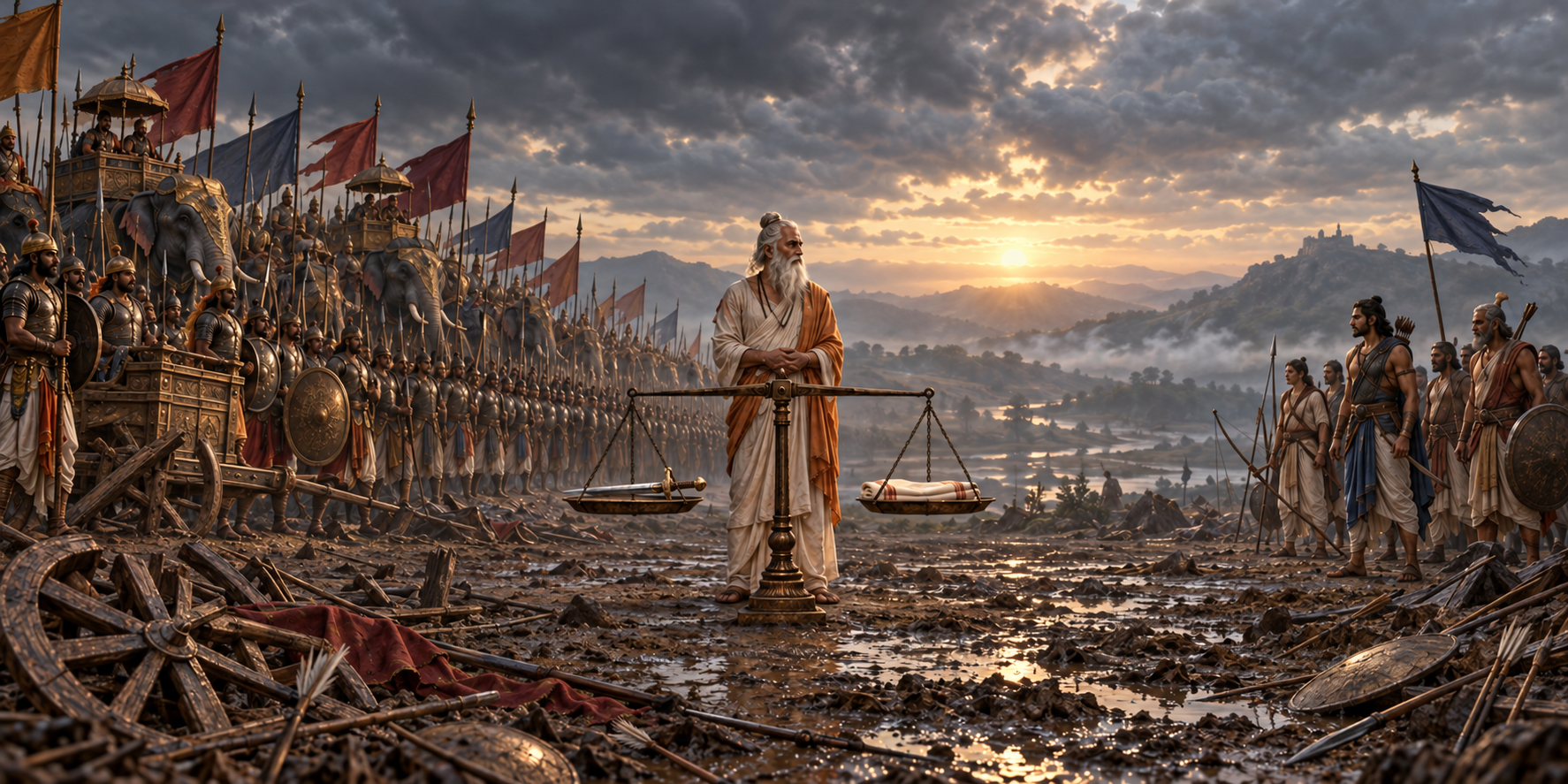
When one side in a conflict is visibly stronger, you may feel that the moral decision has already been made for you. The stronger side looks guilty; the weaker side looks innocent. Mahabharata narratives warn against that shortcut without asking you to become indifferent to suffering.
A sound dharmic judgment separates three questions: Who acted wrongly? Who is vulnerable now? What does each party’s present power permit or forbid? Keeping those questions separate lets you protect the weak without romanticising weakness, and restrain the powerful without treating power itself as proof of adharma.
Power and moral worth answer different questions
Strength tells you what a person or group can do. It does not tell you whether their cause is just. Weakness tells you how easily they can be harmed. It does not tell you how they behaved before becoming vulnerable.
This distinction matters because power is morally relevant. A person with weapons, office, wealth, numbers, institutional authority, or control over information can inflict greater damage and close more avenues of appeal. Greater capacity therefore brings a greater duty of restraint. But that duty does not retroactively determine who initiated a wrong or whose stated grievance is truthful.
Weakness is morally relevant for a different reason. It increases the urgency of protection. A defeated enemy, an unpopular dissenter, a captive, a child, or a civilian caught inside a hostile camp may be unable to resist abuse. Their vulnerability places limits on what others may do to them. It does not automatically vindicate every act committed by their leaders or faction.
You therefore need three findings rather than one:
- Culpability: What did each actor choose, initiate, assist, or knowingly permit?
- Vulnerability: Who can now be harmed, silenced, expelled, or destroyed without an effective means of defence?
- Obligation: Given its present capacity, what restraint, protection, restitution, or accountability does each party owe?
These findings can point in different directions. A weak aggressor may remain culpable while also deserving protection from indiscriminate retaliation. A strong defender may have a just cause while choosing adharmic means. A community may deserve protection even when some of its representatives do not deserve political support.
Protection is not exoneration. Condemnation is not permission for cruelty. Compassion sets a floor beneath which our conduct must not fall; it does not decide every question of allegiance.
Barbarik turns automatic support for the underdog into a paradox

Barbarik is often discussed as though he stood directly within the critical text of the Mahabharata. Precision matters here: he does not appear in the critical edition and belongs to the Skanda Purana and the folk tradition of Rajasthan. He is a Kurukshetra-linked figure from the wider narrative world around the epic, not evidence for a verse or episode in the critical edition.
That distinction does not diminish the force of his dilemma. It prevents us from acquiring a genuine moral insight by making a false textual claim.
Barbarik approaches the battlefield with three extraordinary arrows and a promise to support whichever side is weaker. His weapons can mark what will be destroyed, mark what will be spared, and strike everything that qualifies. Krishna tests the promise by following its logic rather than questioning Barbarik’s compassion or courage.
The difficulty is structural. Once Barbarik joins the weaker army, his decisive power makes that army stronger. His promise then requires him to change sides. His intervention reverses the balance again, so the same rule sends him back. A vow meant to save the weaker side can continue until both armies are destroyed.
The problem is not mercy toward the weak. The problem is using relative weakness as a complete moral algorithm. Such a rule has no stable account of conduct. It cannot tell you who began an injury, which methods are forbidden, or what the newly empowered party may do after victory. Its verdict changes when the balance changes, even if every relevant past action remains the same.
You can expose this error with three questions:
- If the balance of power reversed tomorrow, but the parties’ conduct remained unchanged, would your moral verdict reverse too?
- Can you name an act that would remain wrong whether committed by the stronger or the weaker party?
- Does your principle place limits on the underdog after your support helps it acquire power?
If you cannot answer the second and third questions, you do not yet have a standard of justice. You have a balancing instinct. That instinct can alert you to danger, but it cannot decide whom or what you should endorse.
Garuda reveals the danger of seeing people only as a group

The Garuda narrative presents a different failure of judgment. Garuda learns that his mother Vinata is enslaved to Kadru and asks the serpents how he can secure her freedom. His purpose is personal and intelligible: he wants to release his mother from bondage.
A good purpose, however, does not make every available means good. Filial duty can explain urgency without becoming a blank cheque. Whenever a narrative gives its powerful figure an understandable grievance, you should still ask who bears the cost of his response and whether those people caused the original wrong.
Garuda’s hunger is later directed toward people described collectively as Nishadas or forest dwellers. The presence of a swallowed Brahmana complicates an act directed at a population as a category. Suddenly, an individual inside the mass becomes visible because he carries an identity that demands recognition.
A contemporary reader should neither erase the hierarchy in that exception nor pretend that an epic social designation transfers automatically onto a present-day community. Historical identities require historical argument. The moral problem visible in the scene is narrower and enduring: once people have been compressed into a collective label, the powerful actor can stop asking what any particular person did.
This is how collective judgment becomes collective punishment. A ruler, faction, institution, or warrior commits a wrong; everyone sharing its name is then treated as an extension of that wrong. Dependants become accomplices. Dissenters disappear. The coerced are treated like decision-makers. Individuals are noticed only when they possess a specially protected identity.
You can resist this collapse by replacing group nouns with specific verbs. Do not stop at statements such as a community attacked, a movement resisted, or a kingdom retaliated. Ask:
- Who ordered the act?
- Who carried it out knowingly?
- Who supported it materially?
- Who was coerced, dependent, captive, dissenting, or merely nearby?
- Which people are being made to pay for decisions they did not control?
This does not make responsibility impossible. It makes responsibility more exact. Dharma is not served when precision about agency is dismissed as softness, because imprecision gives the strongest actor permission to punish an identity rather than answer an act.
Use a seven-question dharmic audit before choosing a side
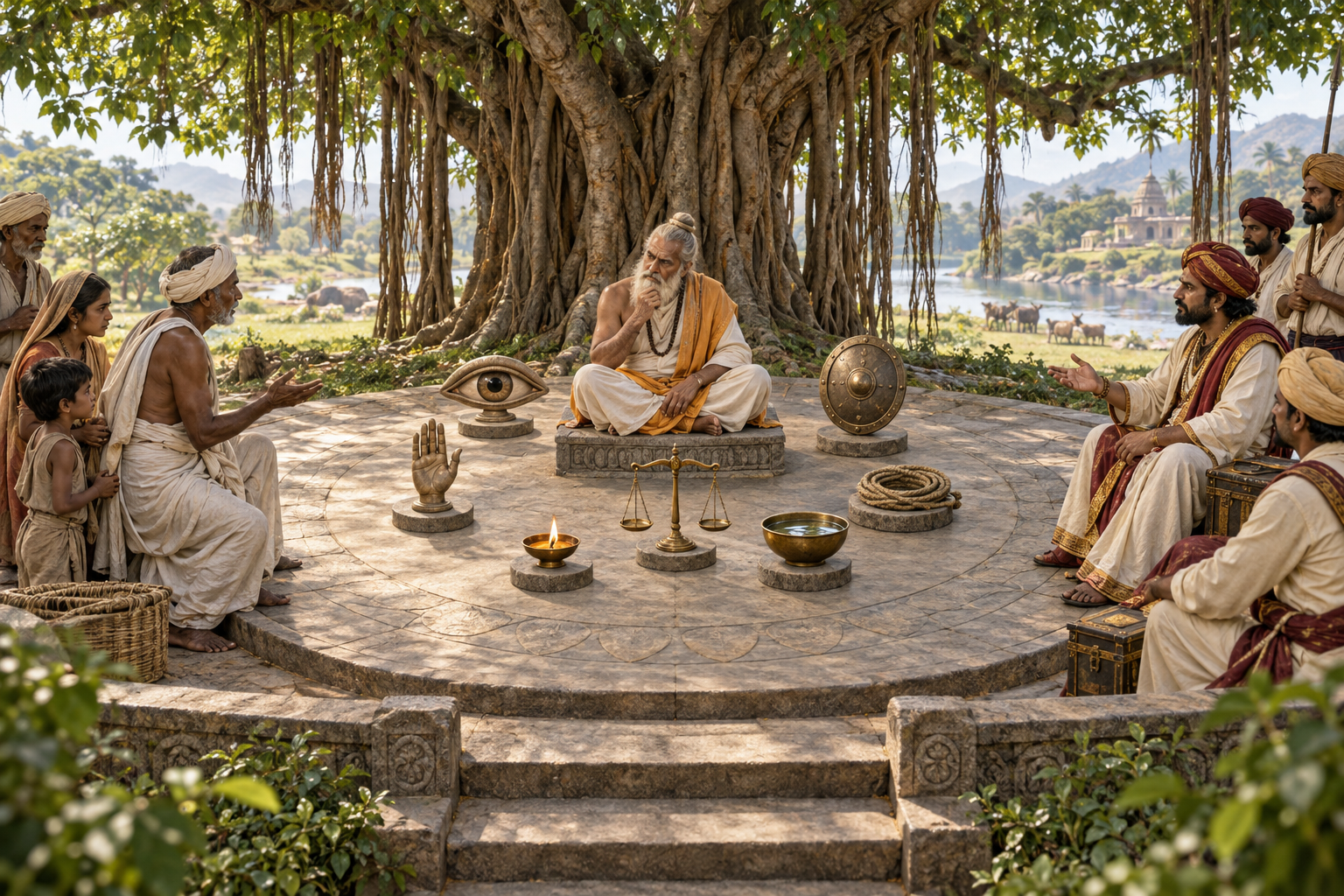
The following audit is a practical reading discipline, not a canonical formula or a verse from the Mahabharata. Its purpose is to stop one emotionally powerful fact – victory, defeat, grievance, suffering, status, or identity – from swallowing the rest of the moral field.
| Question | Distinction it protects | What you should do |
|---|---|---|
| 1. What conduct began the relevant chain, and what happened next? | Causation versus the latest visible image | Write the initiating acts and later responses separately. Do not let retaliation erase provocation or provocation excuse everything that followed. |
| 2. Who actually chose, ordered, executed, resisted, or endured each act? | Agency versus membership | Separate leaders, willing participants, coerced participants, dissenters, dependants, and bystanders. |
| 3. Who is vulnerable now, and to which kind of power? | Protection versus endorsement | Map military, political, economic, social, and informational power separately. Protect those who cannot exit, resist, or appeal. |
| 4. Are the means directed at responsible actors? | Accountability versus collective punishment | Reject methods that knowingly treat an entire population as interchangeable with its rulers or fighters. |
| 5. What is the stopping condition? | Necessary remedy versus limitless vengeance | State what repair or protection would be enough. A demand with no possible point of completion is a warning sign. |
| 6. What order would victory create? | A declared grievance versus an intended future | Ask how the victor would treat innocents, minorities, dissenters, former opponents, and restraints on its own authority. |
| 7. Would the rule survive a reversal of identities and power? | Principle versus partisanship | Swap the names while keeping the actions fixed. If your judgment changes, identify the hidden preference doing the work. |
Do not turn the audit into a points system. Five acceptable answers do not cancel one grave wrong, and equal wrongdoing does not have to be invented for the sake of visual symmetry. The questions serve different purposes. Conduct identifies responsibility. Vulnerability identifies immediate protective duties. Capacity identifies how much restraint can reasonably be demanded.
Your final judgment may therefore be mixed, and that is often a sign of greater clarity. You may support a population’s safety while rejecting its leaders. You may recognise a legitimate grievance while condemning the chosen remedy. You may defend a party’s right to resist while placing strict limits on whom it may target. You may conclude that one side committed the original wrong while the other later committed a different wrong.
Dharma does not require you to manufacture moral equivalence. It requires you to judge each act at the scale where agency actually exists.
From epic reasoning to your next moral judgment
Public conflict tries to recruit you before it informs you. A photograph can establish that someone suffered, but not by itself who initiated the larger conflict. An old injustice can explain present anger, but not authorise every present act. A dramatic imbalance can reveal who faces the greatest immediate danger, but not who would use power justly if the imbalance disappeared.
When you meet a dispute in politics, community life, work, or family, use this short sequence:
- State the disputed claim with verbs. Write who is alleged to have done what to whom. If you can only repeat labels, you do not yet know enough to judge responsibility.
- Map the nested parties. Separate an institution from its officials, a movement from its factions, leaders from followers, and combatants from the people living around them. The weaker party at one scale may exercise overwhelming power over people inside it.
- Issue two findings. State whose conduct you judge wrongful, then separately state who needs protection. Do not force those answers to name the same party.
- Name the red line before victory. Decide which conduct you would condemn even if your preferred side used it. Also decide what restraint that side would owe after gaining power.
- Revise when facts or power change. New evidence may alter culpability, while a change in power may alter protective duties. Updating one does not require pretending that the other never existed.
If the facts remain incomplete, you can still reach a limited conclusion. You can oppose collective punishment, protect non-participants, demand evidence for allegations, reject cruelty, and postpone allegiance. Moral seriousness sometimes means refusing a verdict broader than the facts support.
Key takeaways
- Weakness strengthens a claim to protection; it does not prove innocence.
- Power increases responsibility for restraint; it does not prove guilt.
- A just cause does not cleanse indiscriminate or unlimited means.
- Group identity cannot substitute for identifying individual agency.
- A moral rule must still work after the balance of power reverses.
- You can protect people without endorsing their leaders, ideology, or past conduct.
The next time a conflict demands instant allegiance, draw three lines on a page: conduct, vulnerability, and capacity. Place each fact under the line it actually answers. Then write two sentences – what wrongdoing you condemn and whom you would protect from abuse. If you cannot yet write both precisely, withhold the sweeping verdict. Dharma asks for compassion, but it also asks that compassion see clearly.
References
- Hindu Blog – The Story of Garuda Feeding on the Forest Dwellers
- Pragyata – The Underdog Reflex: What Barbarik Can Teach Us about Power and Justice

Leave a Reply
You must be logged in to post a comment.