
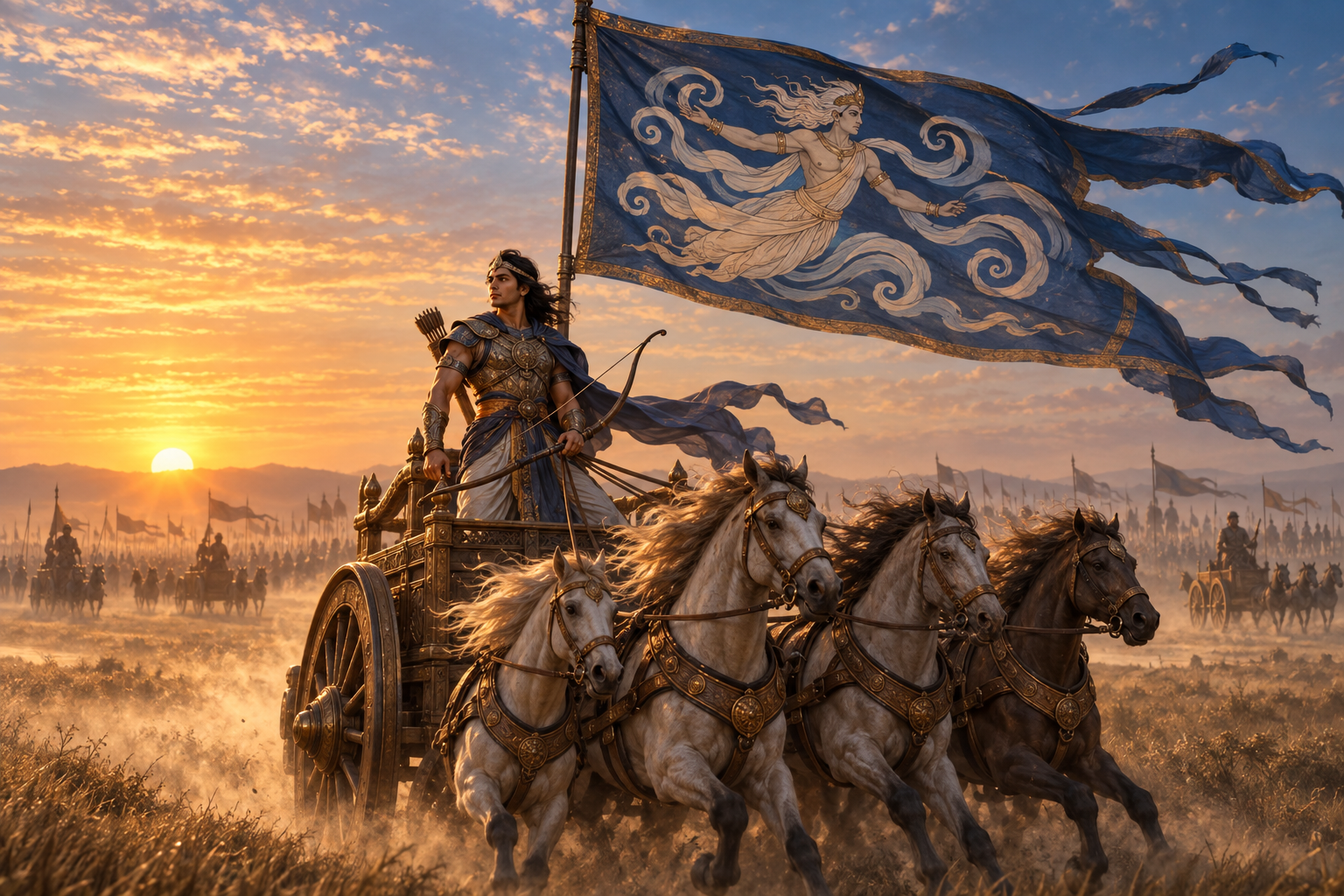
If you have encountered a passing reference to Vayu on Sutasoma’s war banner, you may wonder whether it is merely decorative or whether it identifies a deeper connection. The emblem is best read as a compact statement of lineage: it links Sutasoma to his father Bhima and, through Bhima, to Vayu.
That connection also gives you a useful method for reading other Mahabharata banners. Begin with the warrior who carries the emblem, trace the nearest family association, and only then consider the qualities suggested by the symbol. This prevents a meaningful detail from becoming either trivia or free-floating speculation.
The emblem makes Sutasoma’s lineage visible
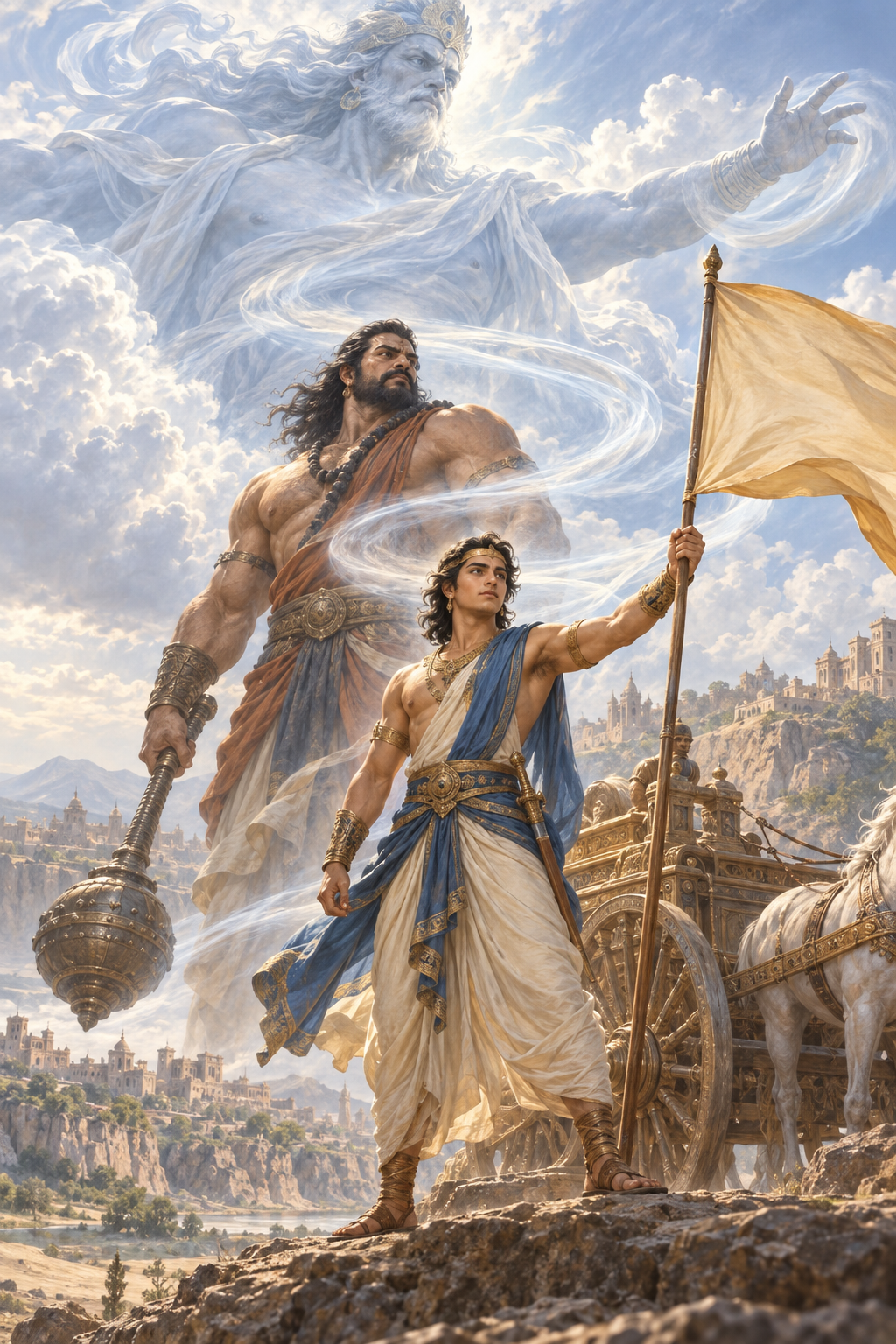
Sutasoma was one of the five Upapandavas and the son of Bhima and Draupadi. The name Upapandavas refers collectively to Draupadi’s five sons, each born to one of the five Pandava brothers. Sutasoma’s particular paternal line is therefore essential to understanding his banner.
Bhima is traditionally connected with Vayu. Once that relationship is kept in view, the emblem becomes readable in three steps: Vayu is associated with Bhima, Bhima is Sutasoma’s father, and Sutasoma carries Vayu’s symbol into battle. Vayu is not an unrelated divine figure selected simply because wind appears powerful. The emblem places the son within the inherited identity of his father’s line.
There is an important precision here. It is misleading to collapse the lineage and call Sutasoma the son of Vayu. His immediate parents are Bhima and Draupadi. Vayu belongs to the divine ancestry associated with Bhima. The banner preserves that distinction while showing continuity across generations.
This is especially valuable because Sutasoma occupies less narrative space than the most prominent warriors of the Kurukshetra War. When a character’s individual story is brief, an emblem can carry information that the narrative does not repeatedly explain. The banner tells you where to place him before it tells you how to interpret him.
Wind expresses inherited energy, not just speed
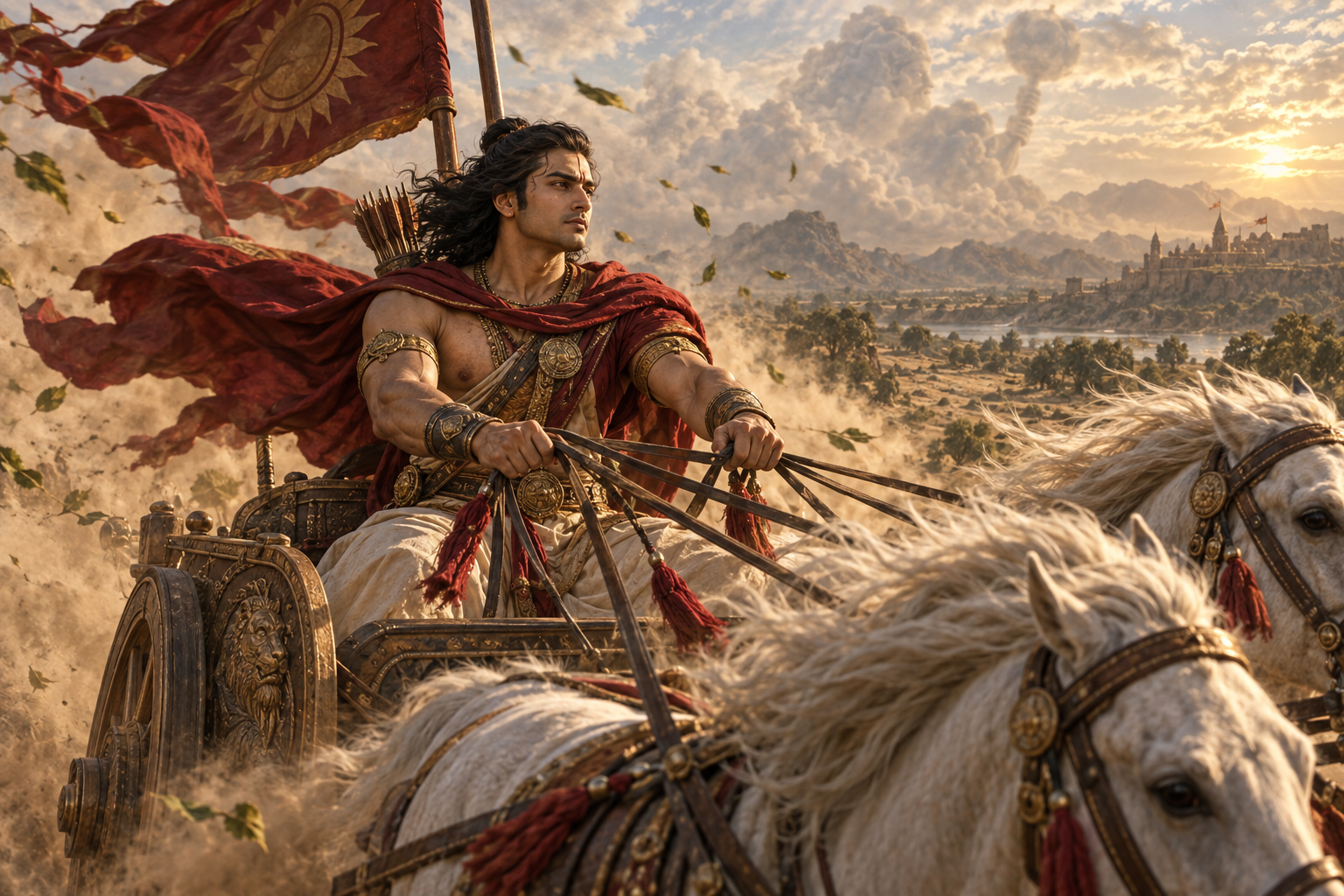
Vayu is both the deity associated with wind and the divine personification of a force known through movement. Reducing the emblem to speed alone misses much of its symbolic range. Wind moves, presses, changes direction, and becomes apparent through its effects even when it cannot be held in the hand.
Three connected meanings are useful when reading Sutasoma’s banner:
- Movement: Wind never presents itself as a static object. On a battlefield, that quality suggests readiness, momentum, and the ability to act.
- Force: Wind is invisible, but its consequences are visible. This makes it an apt sign for the vigorous power traditionally associated with Bhima’s line.
- Vitality: Air, breath, and life are closely related in Dharmic thought. The emblem can therefore evoke living energy as well as martial motion, although Vayu and prana should not be treated as interchangeable terms in every philosophical context.
The physical banner sharpens this symbolism. A flag remains slack until wind moves through it; Vayu’s own element makes Vayu’s sign visible. Symbol and object reinforce one another. The bearer displays the emblem, while the wind animates its display.
This does not require us to assign every quality of Vayu directly to Sutasoma. A war emblem can announce ancestry and aspiration without functioning as a complete psychological description of its bearer. The strongest interpretation is therefore inherited identity energized by wind, not a claim that Sutasoma is simply Vayu in human form.
What the banner does not establish
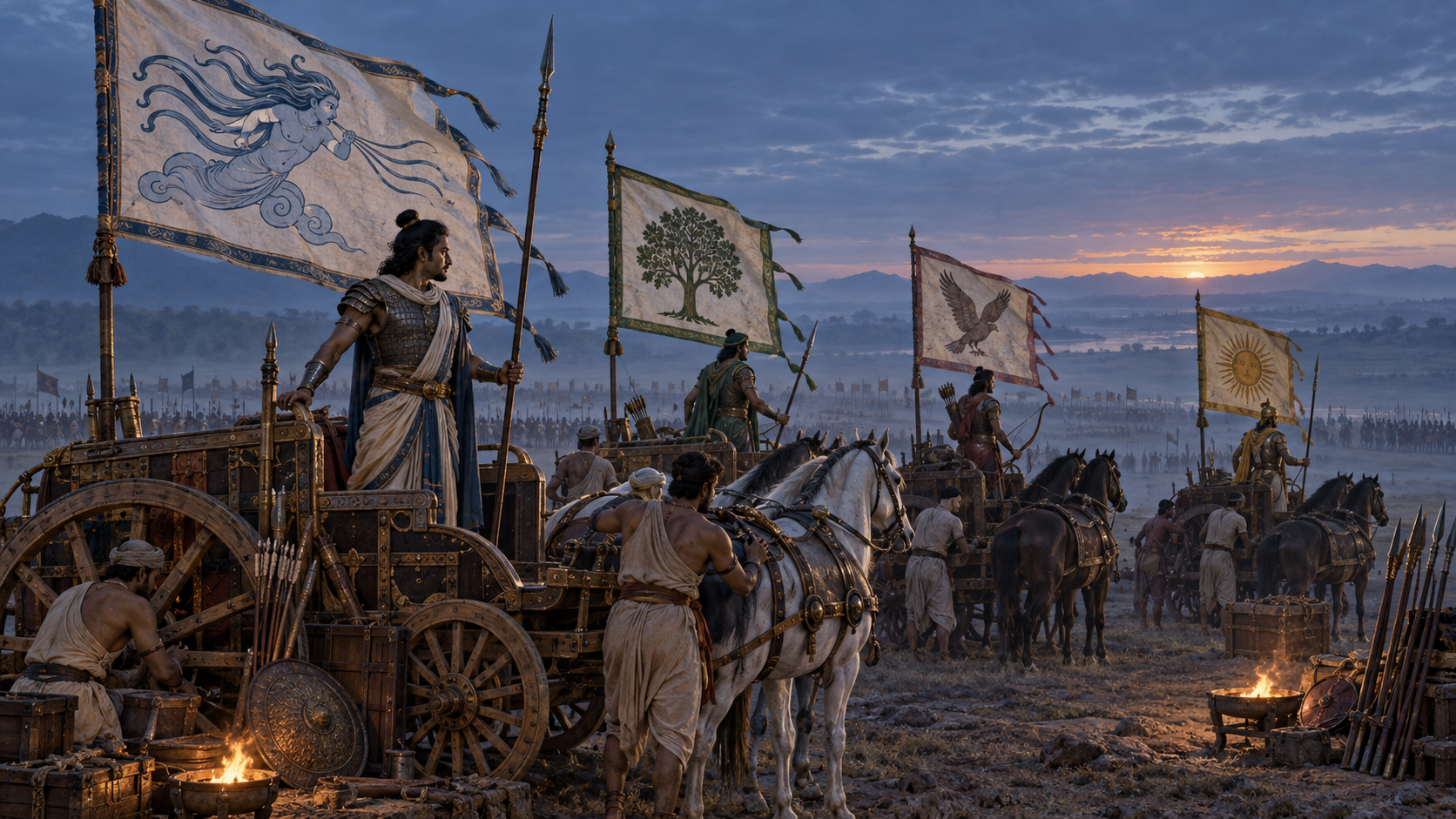
Symbolic readings become unreliable when they claim more than the detail can carry. Vayu’s presence on the banner does not, by itself, establish Sutasoma’s personal theology, a separate cult devoted to him, or a complete doctrine about his fate. Nor should the emblem automatically be treated as a hereditary coat of arms in the later formal sense of heraldry.
You should also distinguish the identity of an emblem from its visual reconstruction. Knowing that a banner represents Vayu does not automatically tell you its exact color, shape, artistic style, or arrangement. Unless a description supplies those features, any modern illustration remains an interpretation rather than a recovered design.
The safest boundary is simple: use the emblem to illuminate relationships already present in the narrative, but do not make it supply an unsupported biography. In Sutasoma’s case, the relationship to Bhima is firm enough to guide the reading. More elaborate claims should remain provisional.
A four-step method for reading epic banners
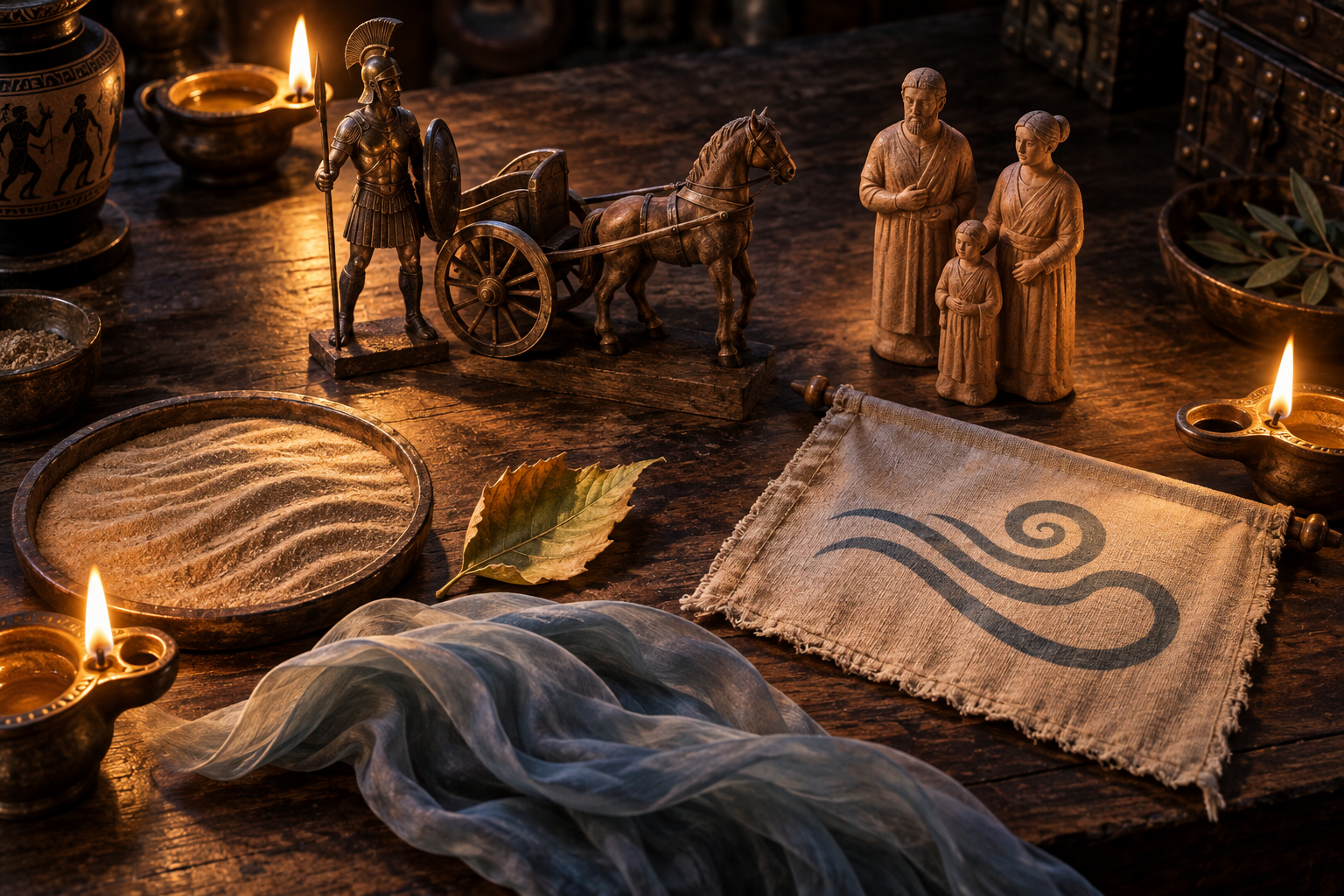
You can use Sutasoma’s banner as a model whenever a weapon, vehicle, animal, deity, or natural force appears on an epic warrior’s standard.
- Identify the bearer precisely. Do not begin with a general meaning for the symbol. First establish which warrior carries it and avoid confusing similarly placed characters.
- Trace the nearest narrative relationship. Look first for parentage, divine association, teacher, vow, or defining allegiance. Sutasoma’s connection runs through Bhima to Vayu.
- Separate three levels of meaning. Ask what the word names, what the divine figure represents, and how the physical object behaves. Here, Vayu names wind, identifies a deity, and describes the force that visibly moves a banner.
- Rank interpretations by evidence. Give priority to meanings anchored in genealogy or narrative context. Treat psychological, sectarian, predictive, and artistic conclusions as weaker unless the text independently supports them.
Applied to Sutasoma, this method produces a restrained but substantial answer. The bearer is Bhima’s son. The divine referent is Vayu. The natural force is moving air. The strongest combined meaning is continuity with Bhima’s wind-linked power and identity. Claims about an exclusive religious affiliation or an exact historical flag design go beyond what the emblem alone can establish.
Key takeaways
- Vayu on Sutasoma’s banner is primarily a lineage symbol connecting Sutasoma to Bhima and Bhima to Vayu.
- The emblem can suggest motion, force, and vitality, but it should not be reduced to a single idea such as speed.
- Sutasoma remains the son of Bhima and Draupadi; Vayu belongs to the divine ancestry associated with Bhima.
- The symbol identifies a relationship more securely than it describes Sutasoma’s entire character, theology, or fate.
- A sound reading begins with the bearer and narrative context before moving to broader symbolic associations.
When you next meet an unfamiliar emblem in the Mahabharata, resist the urge to start with a universal symbol dictionary. Trace the bearer, family line, and immediate narrative setting first. That small discipline often turns a decorative-looking detail into a precise clue about identity.
References

Leave a Reply
You must be logged in to post a comment.