
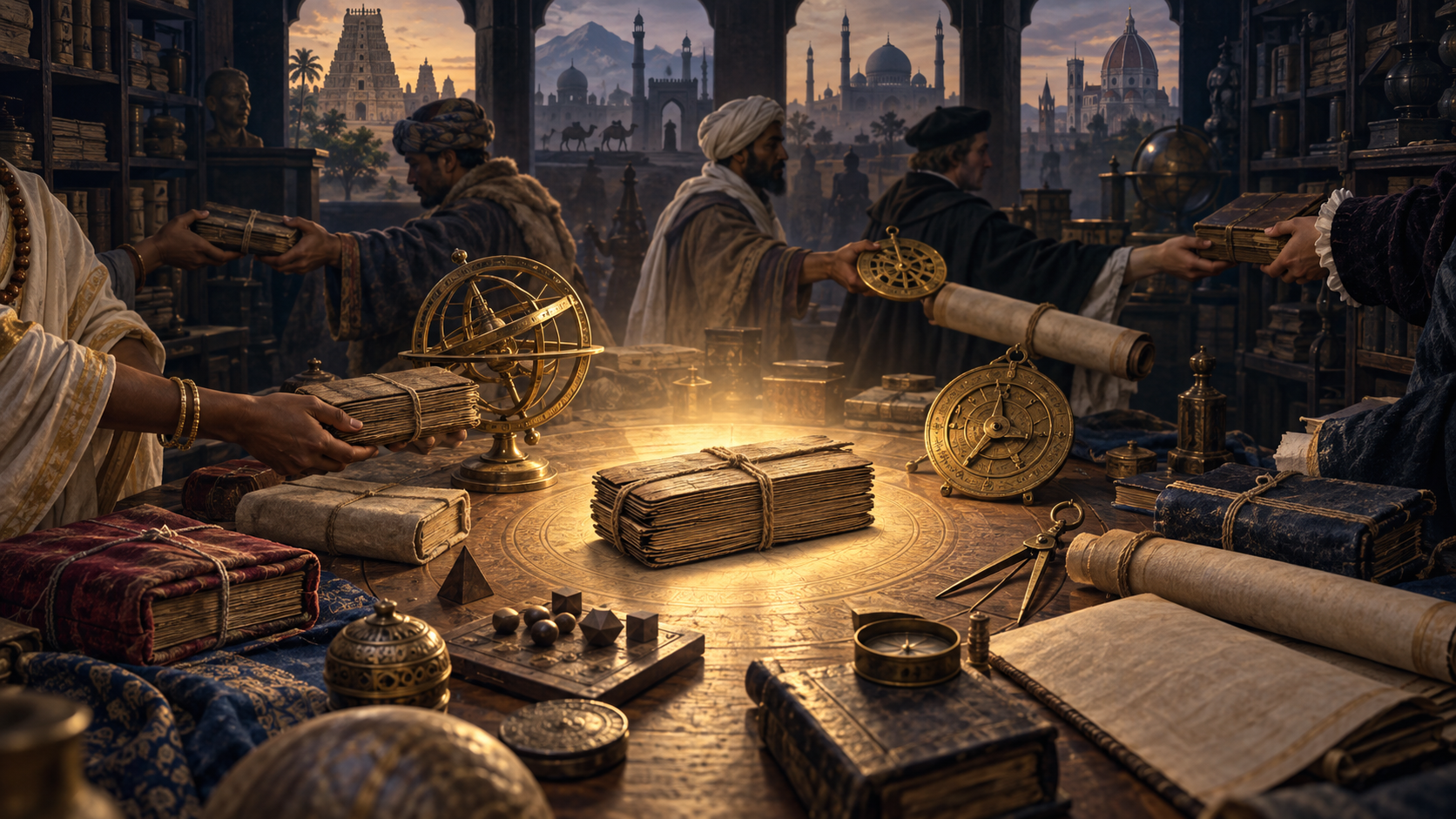
If your schoolbook presented Sanskrit mainly as the liturgical language of Hinduism, you were shown one surviving function, not its historical range. The harder question is why the same language can remain audible in ritual while becoming nearly invisible in familiar histories of mathematics, astronomy and intellectual exchange.
You don’t have to choose between dismissing historical erasure and accepting every civilizational claim made in response to it. Follow the provenance instead: identify the achievement, date the evidence, trace the intermediaries and ask whether later histories preserved or removed the original attribution.
Key takeaways
- Sanskrit was not confined to priestly ritual. It functioned for centuries as a transregional language of sacred, literary, political and technical knowledge.
- Historical erasure does not require manuscripts to disappear. It can occur when origins are omitted, dates are manipulated or intermediaries receive all the credit.
- Contemporary and near-contemporary witnesses in Syria, the Islamic world and Europe explicitly associated important mathematical and astronomical knowledge with India.
- Specific nineteenth- and early twentieth-century disputes reveal ideological distortion, but they do not justify treating every European scholar or every Indian priority claim alike.
- Recovery requires preservation, cataloguing, translation and accurate attribution. Civilizational pride cannot substitute for those disciplines.
Erasure can preserve the knowledge while deleting its credit
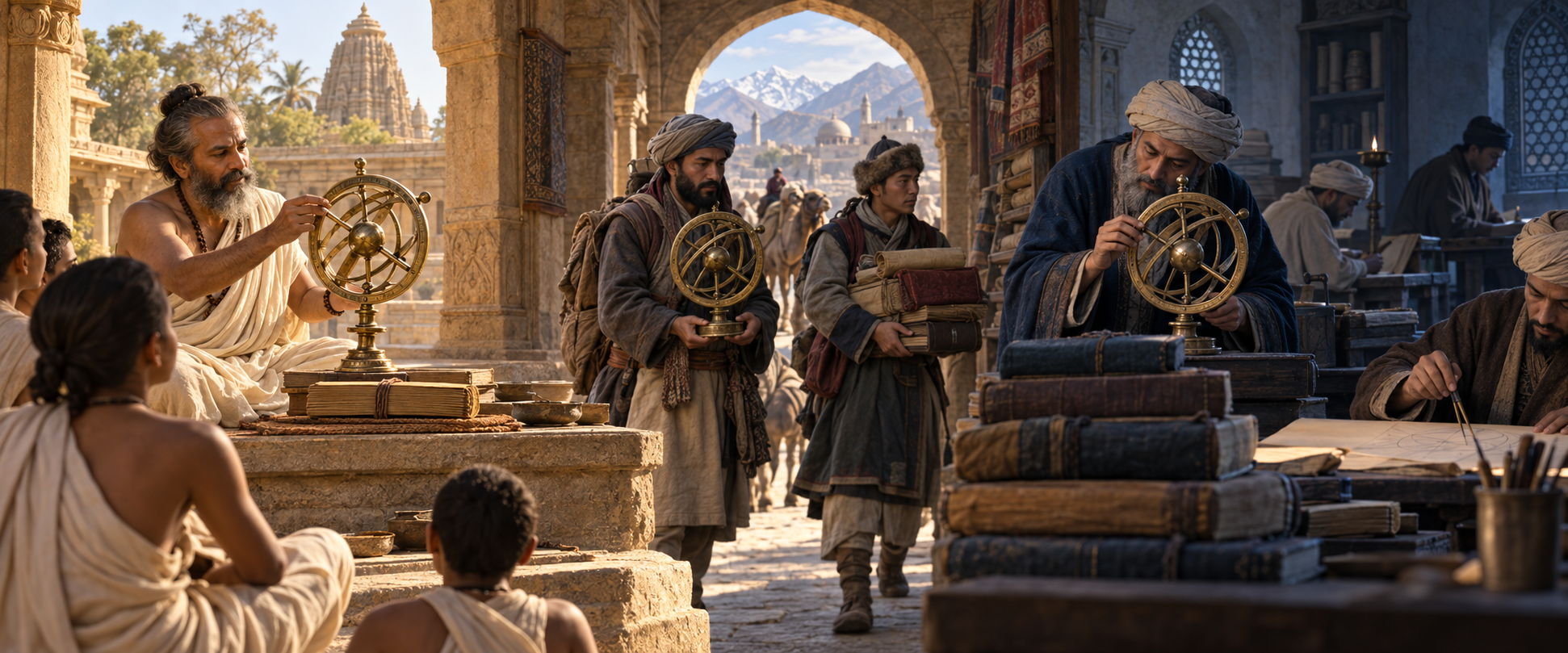
People often imagine erasure as physical destruction: a library burns, an inscription is broken or a language stops being spoken. Intellectual erasure can be quieter. A theorem survives but loses its place of origin. A transmission route is shortened so that the intermediary becomes the inventor. An inconvenient date is moved. A contribution is described as derivative without evidence, then that description is repeated until it looks like common knowledge.
This distinction matters because Sanskrit was never erased in the first sense. Texts, inscriptions, ritual formulas and scholarly traditions survived. What narrowed was the modern account of what Sanskrit had carried and where that knowledge had travelled.
The provenance of Indian mathematical and astronomical knowledge was not a secret waiting for modern nationalism to invent it. Three witnesses separated by geography, religion and several centuries identified India as an important intellectual origin:
| Witness | When | What the testimony establishes |
|---|---|---|
| Severus Sebokht, a Syrian bishop | 662 CE | He rebuked the fixation on Greece and praised Indian astronomical discoveries above those of the Greeks and Babylonians. |
| Al-Biruni | About five centuries later | In discussing Arab astronomy during the Barmakid era, he placed learning from Brahmagupta before the later turn to Ptolemy. |
| Fibonacci | 1202 | When presenting decimal calculation to Christian Europe, he called it modus Indorum, the method of the Indians, and judged it superior to the alternatives he knew. |
None of these statements proves that every element of mathematics originated in India. They establish something more precise: informed observers outside India knew that particular knowledge had an Indian provenance. A later history that describes Europe as receiving decimal numerals only from the Arabs is therefore incomplete. Arabic-speaking scholars and translators were essential transmitters, but transmission does not cancel origin.
That distinction gives you a practical test. Whenever a history credits the last culture in a chain, ask who supplied the material to that culture. The question does not diminish translators or mediators. It restores the whole route.
Follow Sanskrit through people, inscriptions and buildings

Modern political borders make ancient intellectual geography harder to see. If you look only inside the boundaries of present-day India, Sanskrit’s wider history appears smaller than it was. The better map follows inscriptions, travellers, teachers, monasteries and ritual practices.
In fourth-century Borneo, King Mulavarman performed Vedic fire rituals and recorded royal acts in fluent Sanskrit on stone. In tenth-century Cambodia, the royal minister Yajnavaraha expressed a Sanskrit cosmology through a private chapel built in pink sandstone. The Chinese monk Xuanzang travelled roughly six thousand miles to study with Sanskrit scholars, carried manuscripts back to China and had a pagoda built in Xi’an to preserve them. These are points on one trans-Asian intellectual map, not isolated curiosities.
The Borneo example is especially useful because it prevents a common misreading of influence. Sanskrit did not need an Indian occupying army to cross the sea. Rulers, teachers and religious communities outside India adopted it because the language offered access to respected ritual forms, cosmological ideas and learned culture. Local adoption involved agency. It should not be flattened into either Indian military conquest or passive foreign imitation.
The same care is needed when reading monuments. A Cambodian temple is Cambodian, even when its planners use Sanskrit concepts. A Chinese Buddhist translation belongs to Chinese religious history, even when understanding its vocabulary requires Sanskrit. Cultural influence and local creation are not rivals. A receiving society can transform what it receives without making the earlier provenance irrelevant.
When you encounter evidence of Sanskrit outside Bharat, notice four separate things: the language being used, the idea being transmitted, the people choosing to transmit it and the local form that emerged. Keeping those questions separate prevents both denial and exaggeration. An inscription proves the presence and prestige of a language; by itself, it does not prove political control. A translated manuscript proves intellectual contact; by itself, it does not make the receiving culture a copy of India.
How nineteenth-century narratives stripped away provenance

European histories of science increasingly organised the ancient world around a self-contained Greek beginning. This construction, often called the “Greek Miracle,” treated Greek advances as a sudden and substantially independent emergence of rational thought. Knowledge from Asia could then appear peripheral, derivative or relevant only after an Arab or European scholar had adopted it.
Interaction among Greece, India, Persia and other ancient cultures was real. But interaction is not evidence that every Indian achievement was borrowed. Trade proves contact, not dependence. Similarity establishes a question, not a direction of transmission. Chronology, textual evidence and a plausible route are still required.
Some distortions went beyond innocent uncertainty. In 1873, the French historian Sedillot argued before the French Academy of Sciences that Indian numerals were abbreviated Roman numerals, although contrary evidence had already accumulated. John Bentley repeatedly assigned Indian mathematicians later dates, blocking their chronological priority over Greek achievements. G. R. Kaye proposed three different Greek-origin explanations for Aryabhata’s calculation of pi. In 1930, mathematician Saradakanta Ganguli answered those arguments individually in The American Mathematical Monthly, volume 37, number 1, pages 16-22. The sequence shows how a preferred conclusion could survive by changing its rationale.
These cases justify calling particular interventions ideological. They do not prove that every European scholar joined one conspiracy, that all Greek accomplishments came from India or that every disputed Indian date should automatically receive the earliest possible reading. Making any of those leaps would replace one civilizational myth with another.
The stronger conclusion is narrower and harder to dismiss: influential scholars sometimes handled Indian evidence with a presumption of dependence that they did not apply evenly elsewhere. Indian priority became a problem to explain away, while Greek priority could be treated as the default. Once textbooks inherited that arrangement, omission no longer needed an active conspirator in every generation. Repetition made the distorted map look natural.
You can spot this inherited structure in a syllabus or museum label by asking where India first appears. If it enters only after Greece, or only as the recipient of outside ideas, the chronology may already have been arranged around a conclusion. That is the moment to inspect dates and transmission routes rather than arguing from pride.
A disciplined way to recover Sanskrit’s place in history
Use five questions before accepting or rejecting a claim
- What exactly is being claimed? “India influenced mathematics” is too broad to test. A claim about decimal place-value notation, Aryabhata’s value of pi or Brahmagupta’s astronomical transmission can be examined against named texts, dates and witnesses.
- What is the earliest datable evidence? A later copy may preserve an earlier composition, but those are two different dates. Record both instead of selecting whichever one suits the argument.
- What is the transmission chain? Name the originator, translator, intermediary and later adopter whenever the evidence permits. “Arabic numerals” identifies an important route into Europe; modus Indorum preserves the earlier attribution within that route.
- Does contact prove borrowing? No. A convincing borrowing claim needs more than two cultures knowing each other. It needs chronology, meaningful similarity and a plausible mechanism of transfer.
- Does the conclusion exceed the evidence? A Sanskrit inscription in Borneo demonstrates Sanskrit presence and prestige. It does not, without separate evidence, demonstrate rule from India. Precision makes the case stronger.
This method also protects genuine Indian achievements from fragile advocacy. An inflated assertion can be refuted once and then used to dismiss better-supported claims nearby. State only what the evidence can carry. Where scholars disagree about a date, model or direction of influence, preserve the disagreement instead of announcing certainty.
Treat the unread manuscript record as work, not mythology
Fewer than ten percent of surviving Sanskrit scientific manuscripts are estimated to have been catalogued or studied. Many remain in temple archives and are deteriorating. If that estimate is even approximately right, the immediate task is not to announce what the unread material must contain. It is to make the material readable.
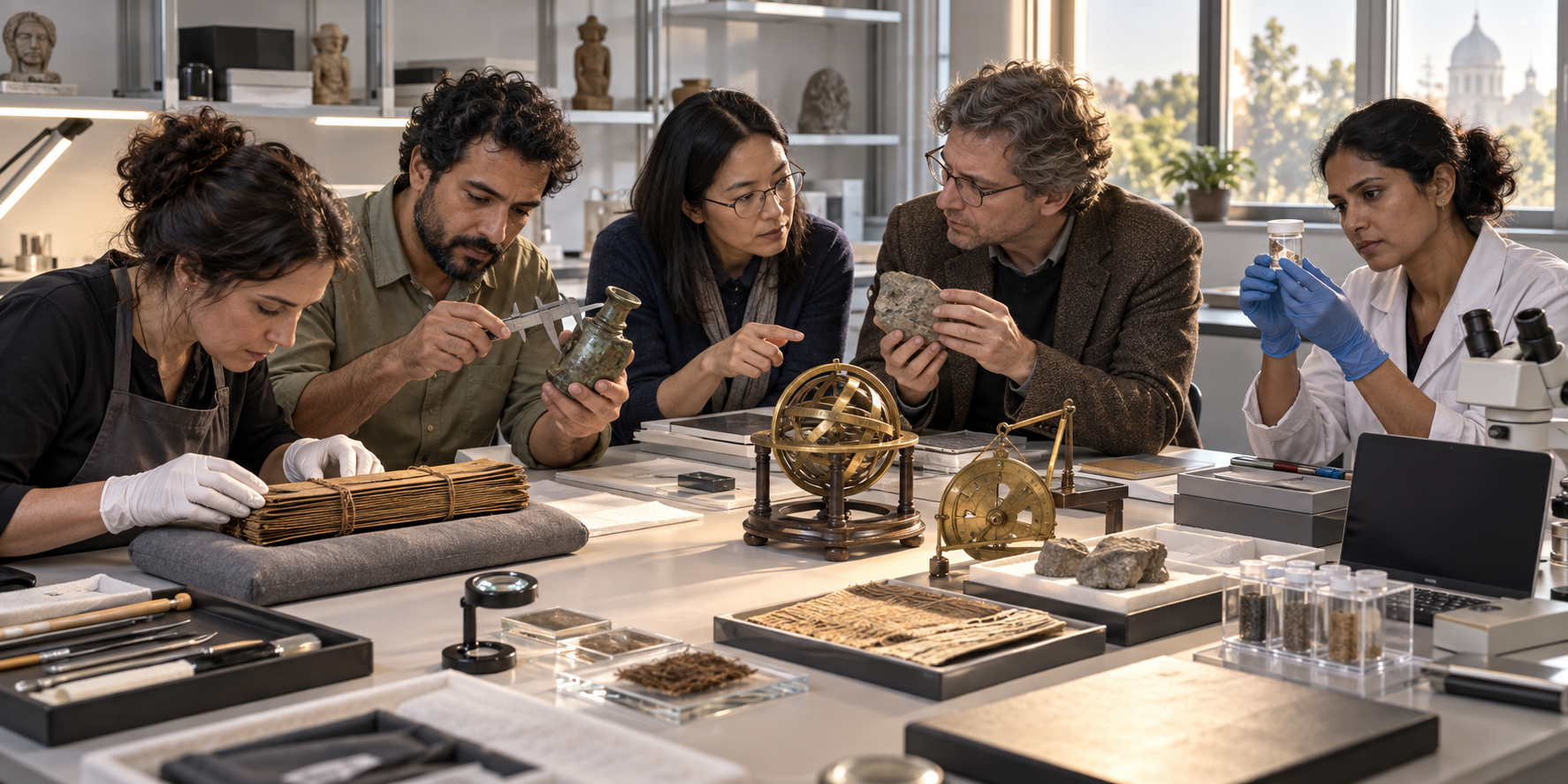
An uncatalogued manuscript is not proof of a hidden scientific revolution. It is an unanswered question. Responsible recovery moves through an exact sequence: locate the object, record its provenance and condition, identify its script and subject, create a stable image, compare multiple witnesses where possible, prepare a critical text, translate it with domain specialists and publish enough metadata for others to check the work.
If you are connected to a temple, monastery, family collection or local library holding manuscripts, begin with a non-invasive inventory. Record where each item is kept and any visible signs of damage. Do not clean, separate, flatten or repair old leaves without a trained conservator; a well-meant intervention can destroy writing, ordering or material evidence. Preservation and digitisation should come before public claims about content.
Living practice belongs in this recovery too, but with the same precision. The Sankalpa recited before Hindu ritual locates the worshipper within an immense cosmological timescale, including the twenty-eighth Kali Yuga and the second half of Brahma’s life. Its continued recitation shows that Sanskrit cosmological memory did not simply vanish. It does not, by itself, establish a particular theorem’s priority. Ritual continuity and technical attribution support different conclusions, and both deserve to be understood on their own terms.
You can help restore the record at the scale available to you. Correct an incomplete transmission chain when you encounter one. Preserve the Indian names attached to ideas rather than replacing them with a vague label such as “ancient wisdom.” Support serious Sanskrit learning, manuscript conservation and open catalogues. In a classroom, article or family conversation, prefer one checkable attribution to ten sweeping boasts.
The next time a history moves cleanly from Greece to Baghdad to Europe, pause at the apparent gaps. Ask who taught the intermediary and what name the intermediary used for that knowledge. Sanskrit’s place in world history will not be restored by reversing old prejudices. It will return when the full route is stated carefully, repeatedly and without apology.
References

Leave a Reply
You must be logged in to post a comment.