
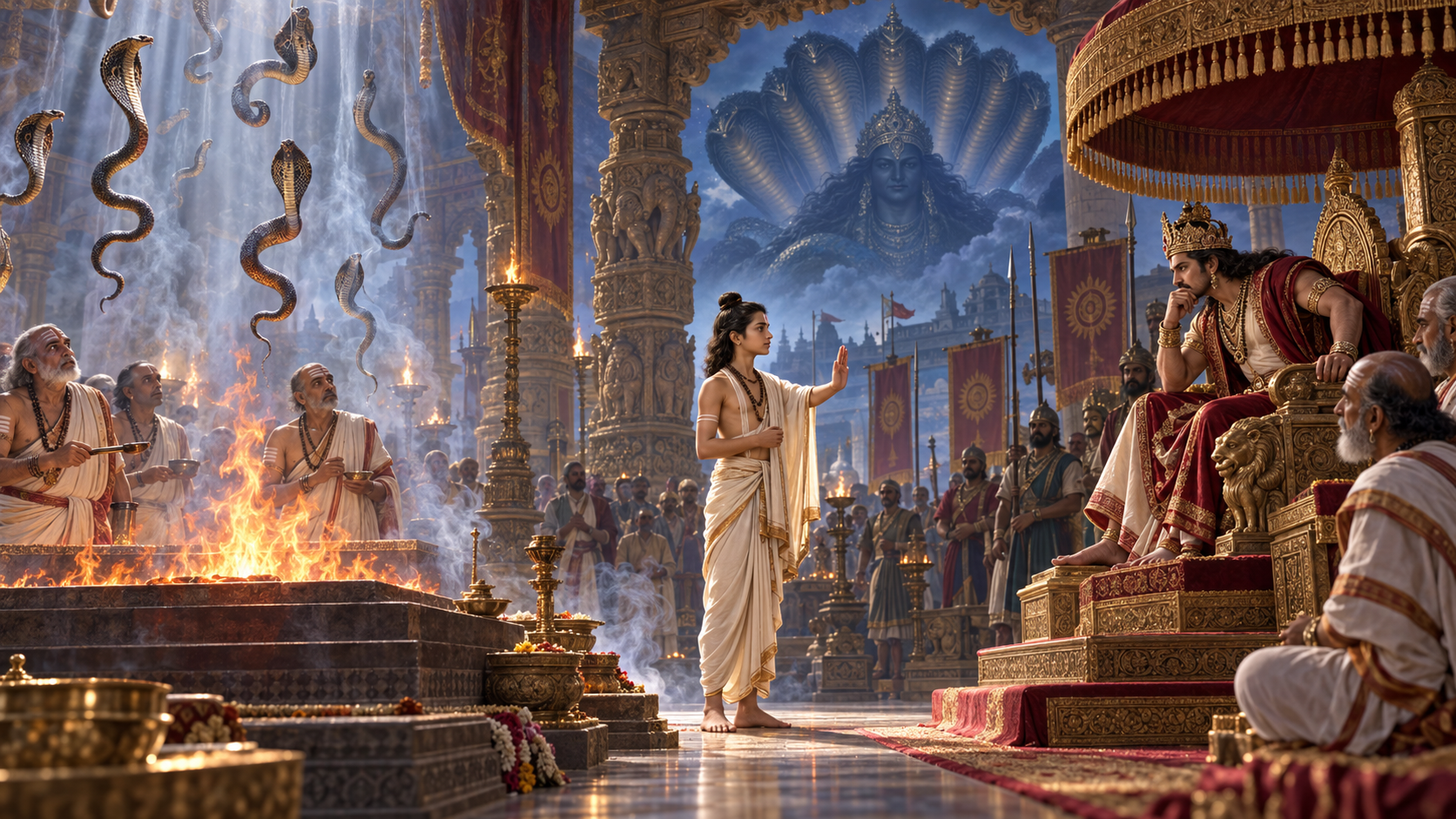
If you arrived wondering whether Vasuki or Astika saved the nagas, the best answer is: both, but at different stages. Astika makes the decisive intervention. Vasuki makes that intervention possible through preparation begun long before the crisis reaches its peak. Janamejaya matters too, because the destruction ends only when the king permits his sacrifice to stop.
That division of responsibility is the key to the episode. It turns a dramatic rescue into a precise lesson about inherited danger, responsible leadership, persuasive speech, and the moral duty to halt an undertaking that has crossed into collective destruction.
Four figures carry four different responsibilities
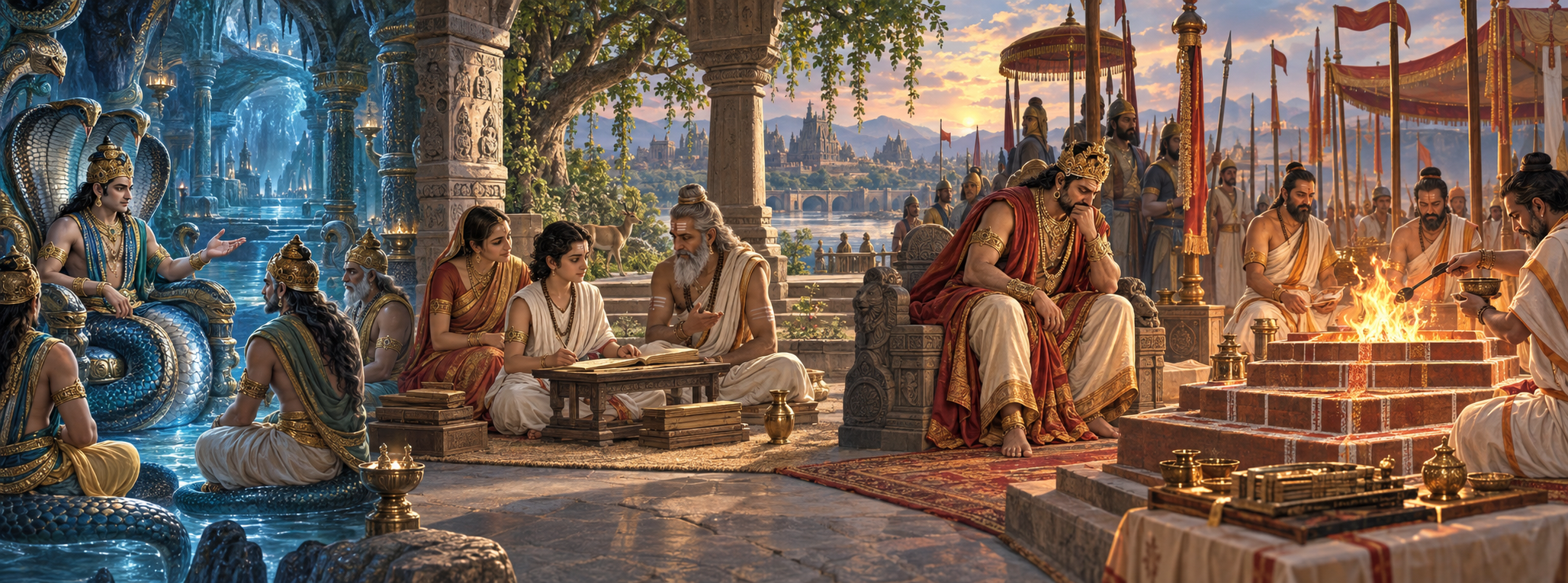
The story becomes easier to follow when you resist treating every character as merely another link in the plot. Each occupies a different moral position:
- Kadru sets the calamity in motion through her curse upon the serpents.
- Vasuki, king of the nagas, recognizes that the danger concerns his people as a whole. His answer is foresight and careful preparation.
- Astika becomes the wise intermediary whose intervention can end the destruction.
- Janamejaya conducts the serpent sacrifice. His power sustains the danger, but it is also the power capable of stopping it.
Do not collapse these roles. Kadru’s curse explains where the threat begins; it does not explain every later choice. Vasuki prepares but does not personally perform the final intervention. Astika speaks at the decisive moment but inherits an opportunity created before him. Janamejaya begins as the author of the sacrifice, yet his eventual restraint remains necessary for the nagas’ survival.
This distinction also answers a common question about who deserves credit. Astika is the immediate saviour, while Vasuki is the guardian whose long-range wisdom makes rescue possible. One acts at the crisis point; the other ensures that somebody capable of acting will be there.
The curse creates danger, but it does not eliminate agency
The episode belongs to the Astika Parva within the Adi Parva of the Mahabharata. Its movement from curse to rescue matters: Vasuki responds to the threatened destruction of his serpent subjects with wisdom and planning begun years in advance.
- Kadru’s curse establishes a grave inherited threat.
- Vasuki refuses to treat that threat as a reason for helplessness.
- Janamejaya’s serpent sacrifice turns the old danger into an active process of destruction.
- Astika intervenes where a human decision can still change the outcome.
- The sacrifice is stopped before the serpent race is destroyed.
The sequence separates three things that are often confused: the background cause, the machinery producing harm, and the decision capable of stopping it. A curse hangs over the nagas, but the sacrifice is the instrument that brings the danger into the present. Astika therefore does not need to erase the past before he can save lives. He must interrupt the mechanism operating now.
Whenever this story appears fatalistic, look again for the points at which agency re-enters. Vasuki chooses preparation. Astika chooses intervention. Janamejaya chooses whether the rite will continue. The Mahabharata preserves the weight of the curse without turning its characters into objects carried passively toward an unavoidable end.
Vasuki’s kingship is measured by preparation
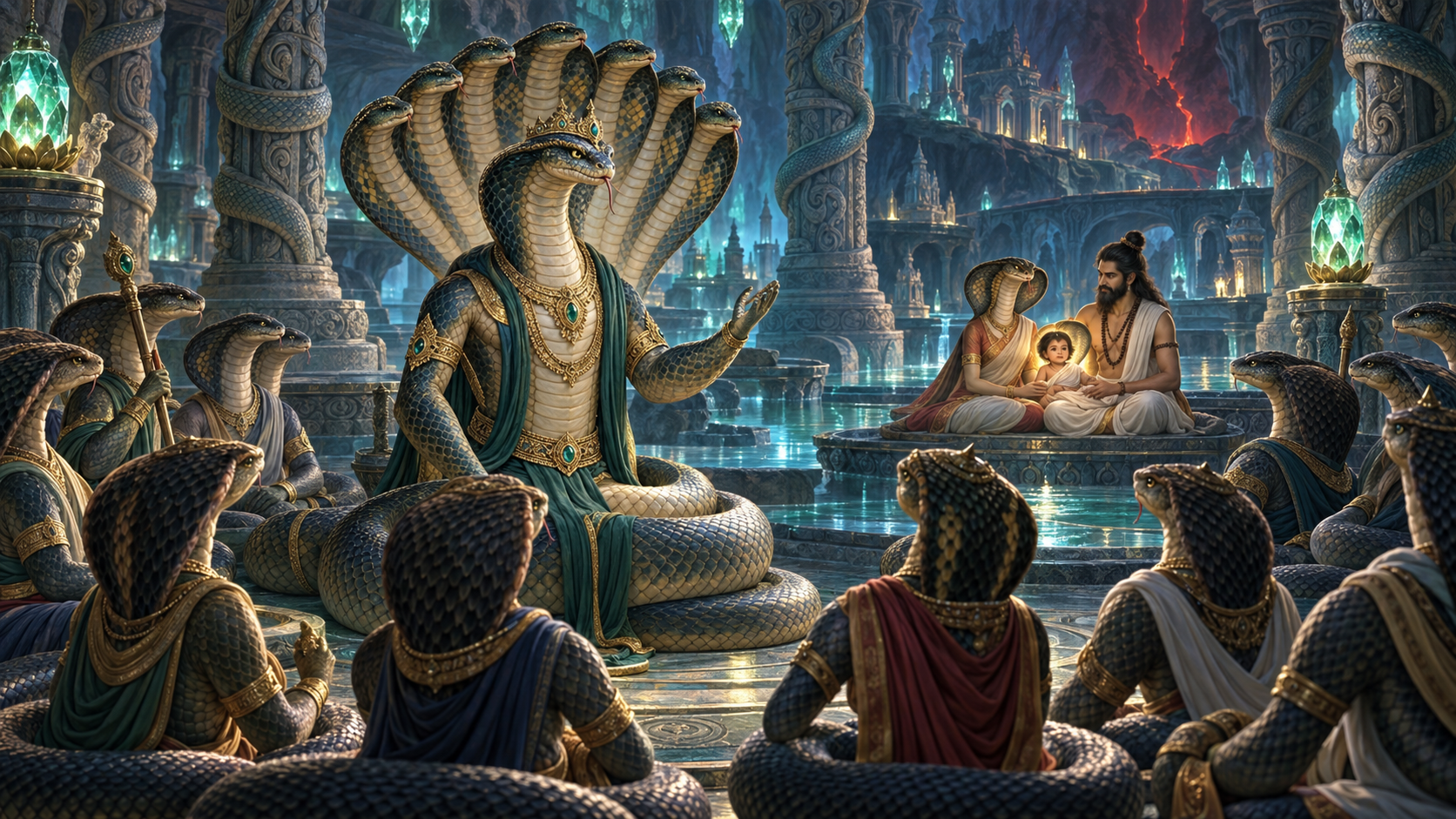
Vasuki does not wait for the sacrificial fire before thinking about survival. That is the defining quality of his leadership. He sees a danger whose full consequences lie in the future and treats it as a present responsibility.
His response offers three tests for protective leadership:
- Recognize a collective danger early. A king of the nagas cannot think only about his own safety when the entire serpent people are threatened.
- Prepare before the final emergency. Once destruction is underway, the available choices narrow rapidly. Vasuki’s advantage is time used well.
- Match the response to the actual decision point. The sacrifice cannot be overcome merely by anxiety about the curse. Someone must be able to reach Janamejaya and bring the rite to an end.
This is why Vasuki’s apparent indirectness should not be mistaken for passivity. His work is architectural. He cannot dictate every later event, but he can preserve the possibility that wisdom will be present when raw power needs to be restrained.
You can use the same distinction when reading other dharmic narratives. Ask whether a leader is merely reacting to visible damage or creating the conditions for a future protector, teacher, negotiator, or truth-speaker to act. Prevention is not always dramatic. Sometimes its success becomes visible only in the person who arrives prepared at the decisive hour.
Astika’s wisdom and Janamejaya’s restraint complete each other
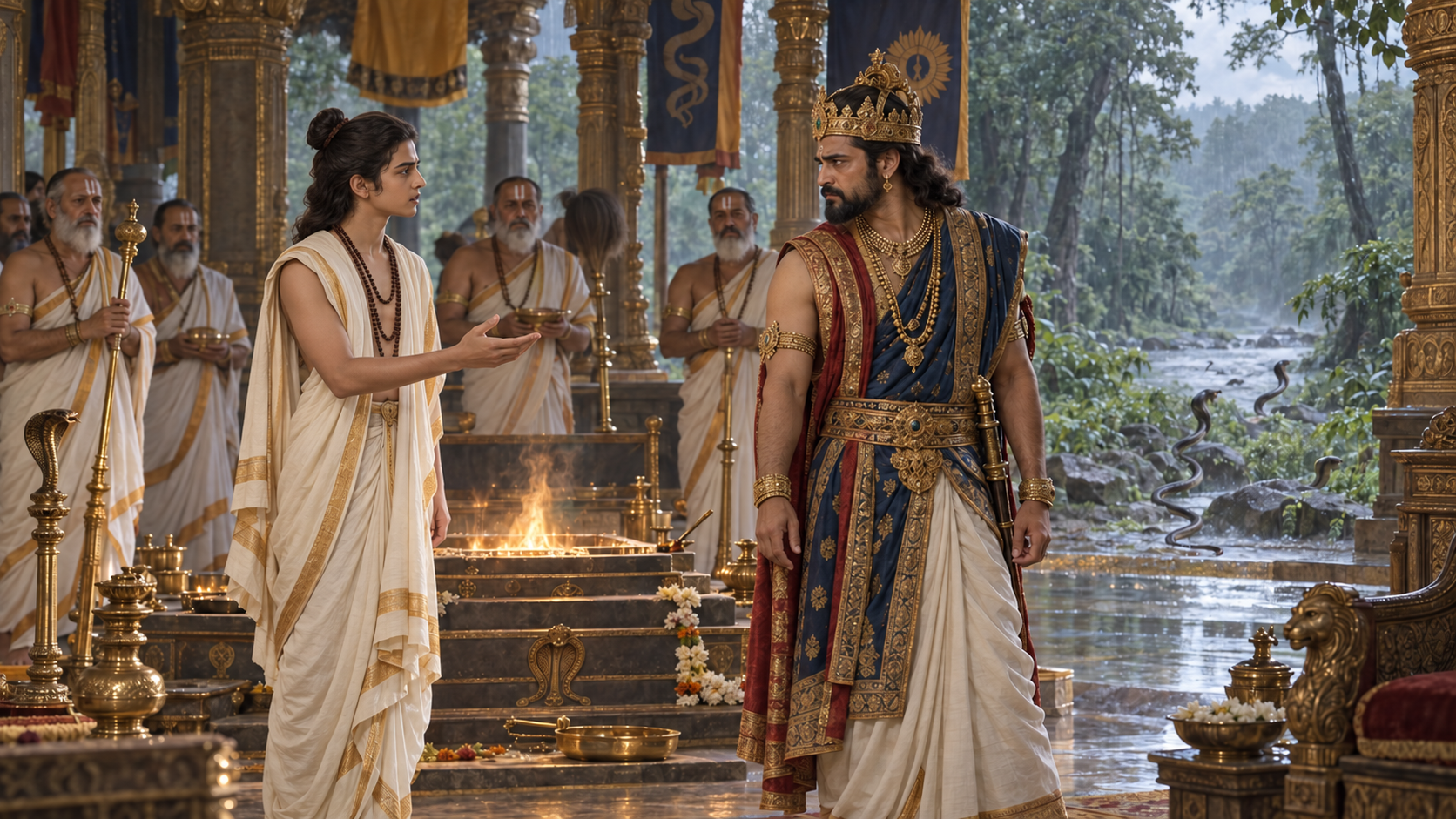
Astika does not save the nagas by launching a rival act of destruction. His instrument is wise intervention directed toward the person who can stop the sacrifice. The episode therefore treats speech as action when speech reaches power, names the needed limit, and changes what happens next.
That does not make Janamejaya’s role secondary. Astika can appeal, but the king must allow the appeal to alter his course. If we portray Janamejaya only as a fixed embodiment of hostility, we lose the moral turn upon which the rescue depends. His willingness to stop matters precisely because the sacrifice is already his undertaking.
The setting also warns against treating ritual form as a moral blank cheque. A yajna may possess solemnity and power, yet human beings still bear responsibility for its purpose and consequences. The question is not only whether a rite can be performed. It is also whether continuing it accords with dharma when its end is the destruction of an entire people.
Three checks will help you assess any retelling of the episode:
- Does it preserve Vasuki’s years of preparation, or does Astika seem to appear without a history?
- Does it show that Astika’s wisdom must reach a ruler capable of changing the outcome?
- Does it distinguish the potency of the sacrifice from the moral legitimacy of pursuing total destruction?
If one of those elements disappears, the story becomes flatter. Without Vasuki, it loses foresight. Without Astika, it loses the power of wisdom expressed at the right moment. Without Janamejaya’s change of course, it loses the responsibility of power to accept a limit.
Key takeaways for reading the episode
- A threatened future is not the same as a completed destiny. The curse creates danger, but later choices still determine how the danger unfolds.
- Rescue begins before the visible crisis. Astika’s intervention succeeds within the possibility preserved by Vasuki’s earlier planning.
- Wisdom must reach the operative centre of power. Astika addresses the king whose sacrifice is producing the destruction.
- Stopping is itself a morally significant act. Janamejaya cannot undo the beginning, but he can refuse to carry the undertaking to its annihilating end.
- Ritual power remains answerable to dharma. Sacred form does not remove the need to judge intention, proportion, and consequence.
On your next reading, follow five verbs rather than memorizing a catalogue of names: curse, foresee, prepare, appeal, stop. Then ask where the story places responsibility at each stage. That approach reveals why the nagas are not saved by a single isolated miracle. They are saved through foresight that prepares an opening, wisdom that enters it, and authority that finally accepts restraint.
References

Leave a Reply
You must be logged in to post a comment.