
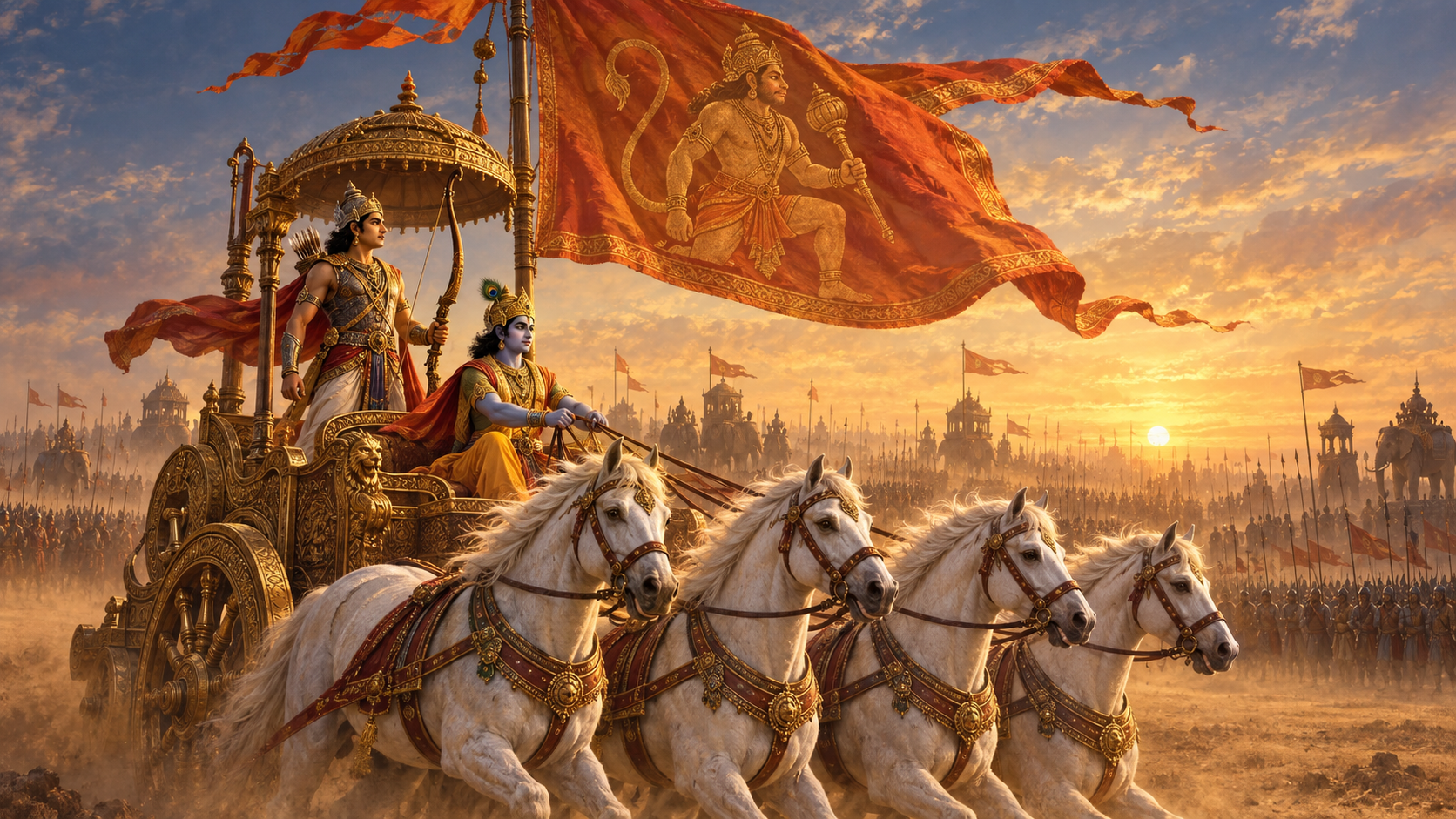
You see Hanuman on Arjuna’s chariot and an immediate question arises: why was the Vanara emblem not on Bhima’s flag instead? The clearest answer is that a battle standard was not a prize awarded to the warrior with the strongest personal claim on its figure. It declared the principle under which its bearer was expected to act.
Hanuman therefore changes how you read Arjuna at Kurukshetra. The banner places strength under dharma, courage under discipline, and heroic action under the spirit of service. This interpretation explains the choice without turning Hanuman’s presence into a contest between Arjuna and Bhima.
The flag identifies a vocation, not a possession
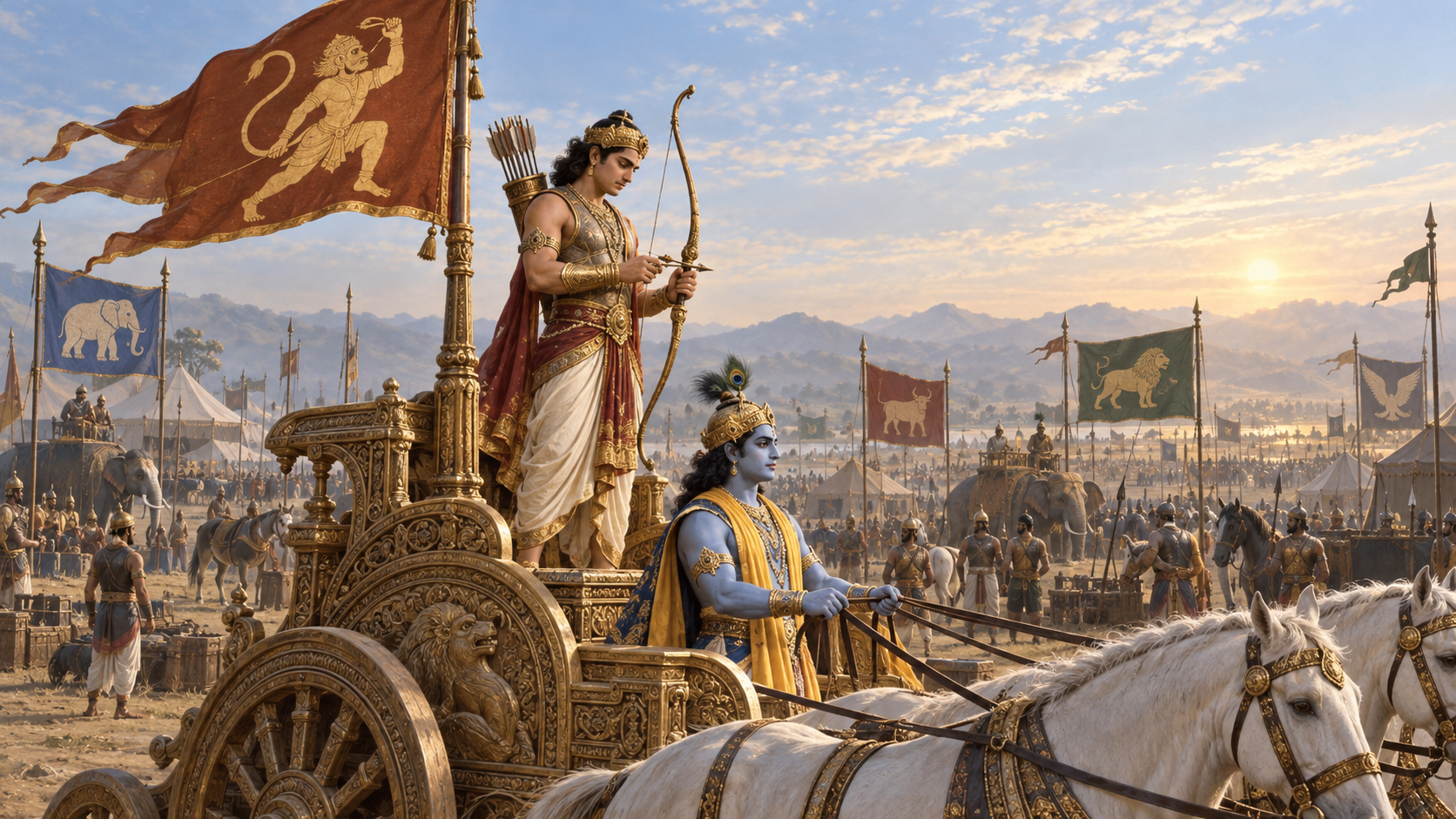
When the Pandava and Kaurava forces assembled at Kurukshetra, their standards were not incidental decorations. Each warrior’s flag communicated identity, strength, and divine connection. A figure placed on a banner consequently told observers how to understand the warrior beneath it.
That function matters. If a banner merely recorded the bearer’s closest relationship, then asking whether Hanuman “belonged” more naturally with Bhima would settle the question. But a sacred emblem can do more than confirm an existing bond. It can announce a responsibility, supply a moral measure, or reveal the ideal that must govern the bearer.
This gives you a better first question. Do not begin with, “Who had the strongest claim to Hanuman?” Ask, “What does Hanuman require us to notice about Arjuna’s role?” The shift from ownership to meaning opens the scene.
We should also separate the narrative detail from its interpretation. Arjuna carrying Hanuman is the detail. The emblem’s complete theological meaning can carry more than one layer. The reading offered here is therefore a disciplined interpretation of the symbol, not a claim that every tradition or retelling must reduce it to one formula.
Why Bhima seems obvious, and why that expectation helps
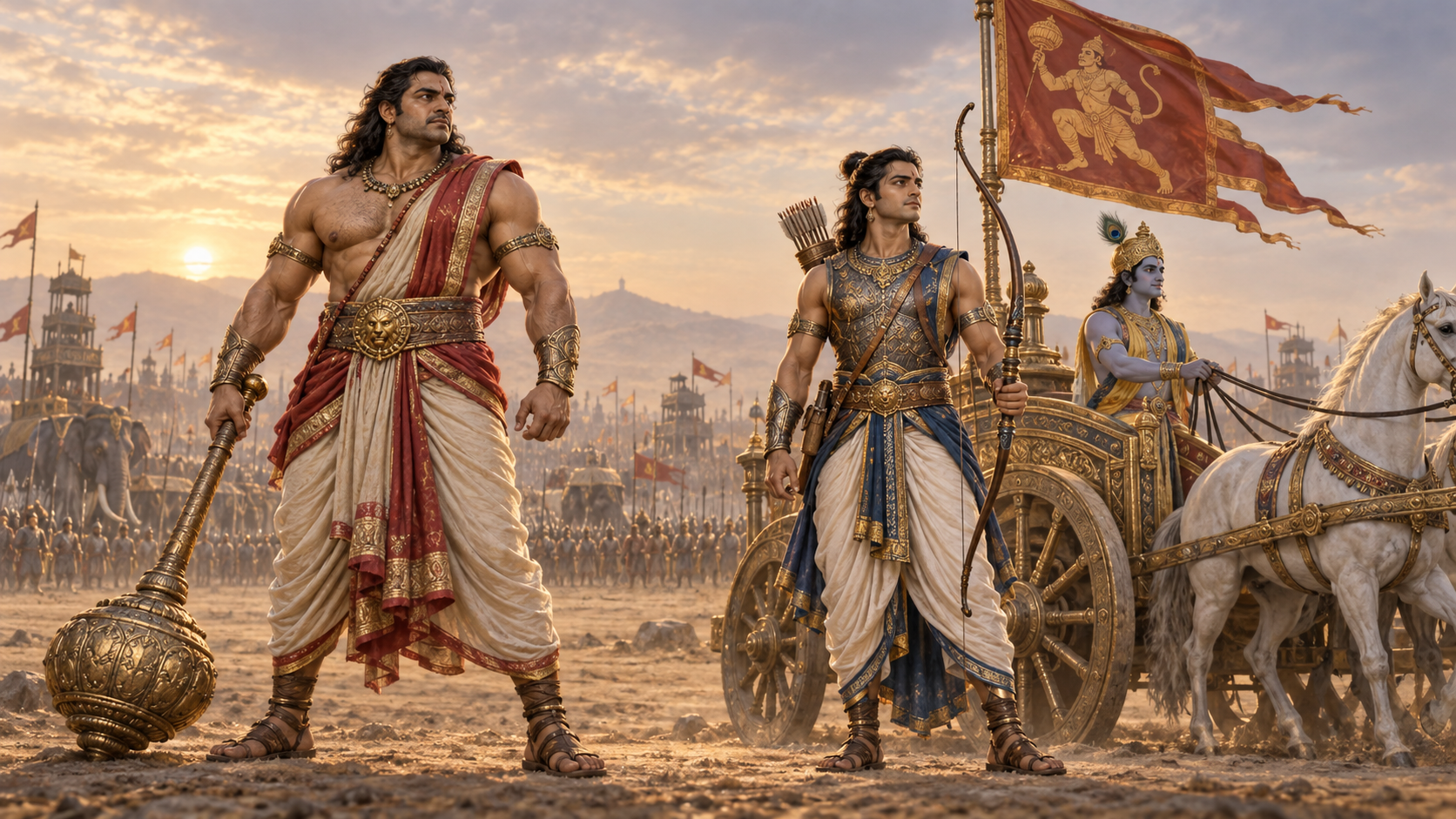
Bhima feels like the intuitive alternative. You do not need to dismiss that instinct to understand Arjuna’s banner. In fact, the expectation is what makes the choice meaningful. A predictable emblem would simply repeat what the audience already associated with its bearer; an unexpected emblem makes the audience ask what it contributes.
Sacred symbolism often works through completion rather than duplication. An emblem may express a quality that must direct the warrior’s power, not merely mirror a quality he already displays. Hanuman above Arjuna can thus be read as a governing standard: strength is present, but strength alone is not the final measure. It must be disciplined by devotion, humility, and service to a righteous purpose.
Nothing in that logic diminishes Bhima. The absence of Hanuman from Bhima’s flag does not imply the absence of a meaningful connection, a lower spiritual standing, or divine rejection. Nor does Hanuman’s presence on Arjuna’s banner establish that Hanuman “preferred” one Pandava over another. Those conclusions turn a public symbol into a private competition that the symbol does not require.
When you encounter similar questions in the Mahabharata, watch for this mistake: visibility is not the same as exclusivity. One warrior publicly carrying an emblem does not exhaust that emblem’s relationships or meanings.
What Hanuman adds to the image of Arjuna
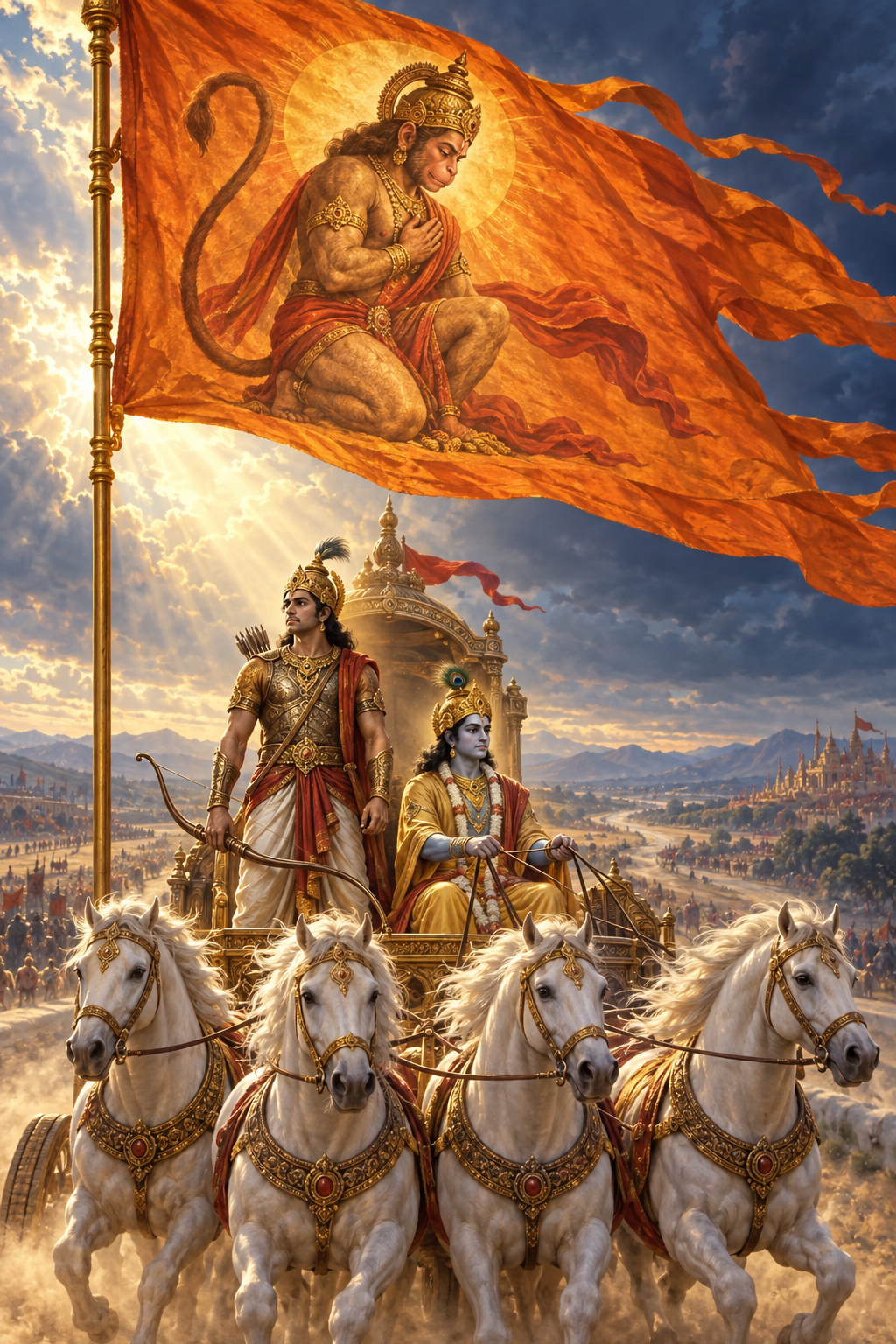
Power placed beneath dharma
A battle banner rises above the warrior who carries it. That physical arrangement produces a moral image: the fighter stands beneath the standard. Arjuna has skill and agency, but the emblem over him declares that neither is self-justifying. The cause, the manner of action, and the discipline governing that action matter.
Hanuman is therefore not merely an advertisement of force. If you read him only as a threat to the opposing army, you lose the more demanding meaning. His strength is inseparable from devotion and purposeful service. On Arjuna’s standard, those qualities become a test applied to martial power: can the warrior act decisively without making himself the highest object of the action?
Service placed before self-display
A heroic warrior can easily be read through achievement, fame, or personal prowess. Hanuman redirects attention from display to service. The emblem does not ask Arjuna to become passive or to abandon excellence. It asks that excellence serve something beyond the ego of the person exercising it.
This distinction is practical for you as a reader. Dharma does not necessarily require less power, less competence, or less resolve. It requires those capacities to accept moral direction. The question is not whether Arjuna can act, but what governs him when he does.
A reminder rather than a substitute for action
The banner should not be treated as a charm that makes Arjuna’s own effort irrelevant. A sacred standard sets an obligation before the bearer. It does not excuse him from discernment, courage, or responsibility.
That is one reason the image remains spiritually useful outside the battlefield. An emblem of dharma is not permission to assume that your side, strength, or intention is automatically righteous. It is a demand to bring conduct into alignment with the ideal you display.
A four-question method for reading the banner
You can use the following method whenever an epic symbol appears to be attached to an unexpected person. It keeps the literal detail, the symbolic interpretation, and your own assumptions from becoming confused.
- Establish the visible fact. Here, the fact is that Arjuna’s chariot bears Hanuman. Do not begin by adding a claim about preference, rank, or exclusion.
- Identify what the object does. A battle standard communicates identity, strength, and divine connection. Its function is public and symbolic, not merely personal.
- Ask whether the emblem mirrors or completes the bearer. Hanuman need not duplicate an obvious trait in Arjuna. He can supply the moral standard under which Arjuna’s abilities must operate.
- Test the interpretation for unnecessary rivalry. If your reading requires Bhima to be rejected, diminished, or deprived, ask whether the narrative detail actually supports that conclusion. In this case, it does not need to.
This method prevents two opposite errors. The first is treating every symbol as a literal badge of ownership. The second is making the symbol so vague that it can mean anything. A sound reading stays anchored to who carries the emblem, what a banner communicates, and what the emblem contributes to that particular scene.
Key takeaways
- Arjuna’s Hanuman banner is better read as a declaration of governing values than as proof of an exclusive personal relationship.
- Bhima’s apparent suitability makes the choice thought-provoking, but it does not establish that Bhima was slighted.
- Hanuman places Arjuna’s martial ability beneath devotion, discipline, humility, and service to dharma.
- The emblem does not replace Arjuna’s agency. It raises the standard by which his agency must be judged.
- An epic symbol can complete its bearer rather than simply repeat the bearer’s most obvious qualities.
The next time you look at Arjuna’s chariot, ask not, “Who owns this symbol?” but, “What discipline does this symbol place over the person carrying it?” Hanuman then becomes more than an ornament of war. He makes a lasting Dharmic principle visible: power becomes worthy when it accepts service, restraint, and a purpose higher than itself.
References

Leave a Reply
You must be logged in to post a comment.