
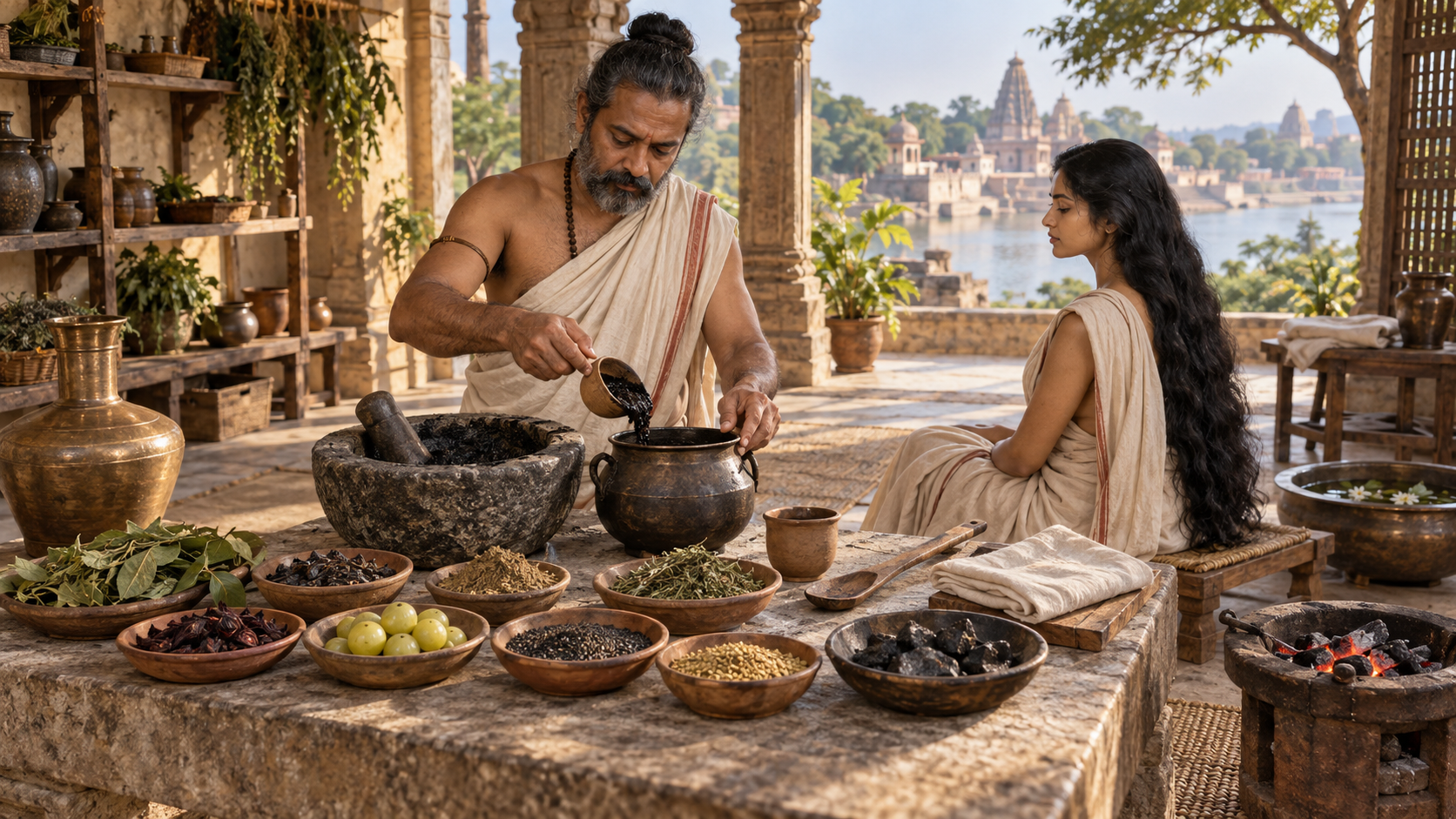
If you are wondering whether hair dye in ancient India amounted to little more than applying one familiar plant, the answer is no. The deeper tradition was a formulated technology: ingredients were selected, combined in measured proportions, processed with particular vessels and temperatures, and applied in a prescribed sequence.
That does not make every ancient claim medically true, and it certainly does not make every preparation safe to reproduce. It does reveal something more useful: Indian formulators understood that a dependable colour could require a whole system rather than a single colouring substance.
The right claim is sophisticated formulation, not modern clinical proof
By the second century CE, Indian knowledge of hair colouring extended across verses 1 through 27 of a chapter devoted to Kesha-Raga in the Ayurvedic work Navanitakam. Kesha-Raga literally means hair-colour. Its principal objective was to make grey hair black or to produce a deep blue-black appearance, sometimes compared with antimony or a large black bee.
You can reasonably call this formulation science in the practical, historical sense. The instructions distinguish raw materials, proportions, carriers, pretreatment, grinding, heating, steeping, vessel choice, application method and duration. They also distinguish substances that supplied colour directly from agents used to help produce the desired colour. That is a technically important distinction.
What you cannot reasonably claim is that these formulations were validated in the modern clinical sense. Detailed instructions demonstrate organised craft knowledge; they do not independently prove safety, lasting efficacy or every therapeutic promise attached to them. Keeping those two conclusions separate lets you appreciate the achievement without turning admiration into credulity.
Kesha-Raga also belonged to a wider cultural frame. Hair colouring was associated with Mangalam, or auspiciousness, and with support for the Purusharthas, the aims of human life. Grooming, health, beauty and auspicious presentation were not treated as sealed compartments. If you read the material only as a primitive version of a modern cosmetic label, you miss that integrated outlook.
Key takeaways
- Kesha-Raga chiefly sought black or blue-black hair, especially where hair had greyed.
- The preparations combined colouring materials, colour-producing agents, carriers and controlled processing.
- Washing, grinding, gentle heating, prolonged standing and the choice of an iron vessel could all be part of the method.
- Cosmetic, therapeutic and auspicious claims appeared together, but they do not carry the same evidentiary weight.
- These are records of technical history, not safe do-it-yourself instructions.
A hair dye was a system, not a hero ingredient
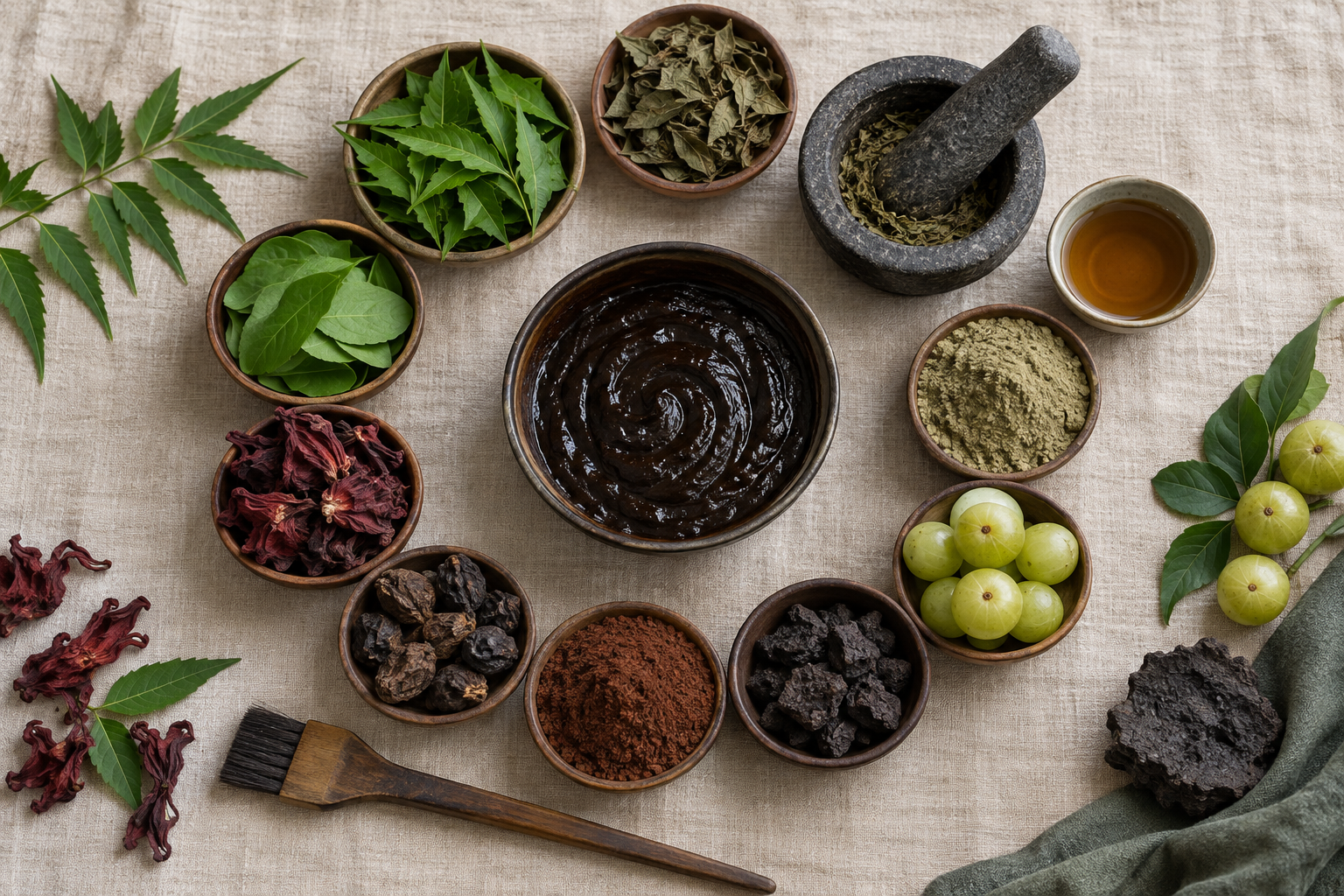
The most useful way to understand Kesha-Raga is to stop asking which single herb dyed the hair. Several formulations distribute the work among multiple functional layers. A botanical material might contribute colour, another substance might help develop or modify it, an oil or liquid might carry the mixture, and a preparatory wash might change the surface receiving it.
| Functional layer | Attested examples | What you should notice |
|---|---|---|
| Pretreatment | A wash using chebulic and emblic myrobalans | The hair and scalp could be prepared before the main paste was applied. |
| Botanical colour or colour-forming phase | Indigo, Bhringaraja, blue lotus, myrobalans and numerous other plants | Not every plant necessarily performed the same function, even when several appeared in one mixture. |
| Mineral or reactive phase | Iron sulphate, copper sulphate, powdered iron and antimony sulphide | Colour formation could involve minerals as well as plant material; the precise chemical role of each ingredient cannot always be recovered. |
| Carrier or vehicle | Water, sesame oil, oil of beleric myrobalan, ghee and milk | The vehicle affected how ingredients could be ground, heated, spread and held in contact. |
| Manufacturing controls | Gentle fire, solar heating, warm application, ten-day standing and iron vessels | Time, temperature and equipment were treated as parts of the formulation. |
| Historical administration | Plasters, ointments, anointing and nasal drops | These routes reflect an older medical system and must not be copied as modern safety guidance. |
One comparatively short combination brought indigo, rock salt and long pepper together with water, followed by grinding into a paste. Another method first washed the head with chebulic and emblic myrobalans, then used a warm paste of Alambusha and indigo. The second arrangement matters because it separates surface preparation from colour application rather than treating them as one undifferentiated act.
More elaborate combinations included copper sulphate, Musta, iron sulphate, turtle bile, powdered iron, Danti, Sahadeva and Bhringaraja, processed with oil of beleric myrobalan. Elsewhere, three myrobalans, indigo, blue lotus, antimony sulphide, long-pepper root, Jamun material and additional botanicals appeared in the same formulation. Complexity by itself does not prove effectiveness, but it does rule out the idea that ancient hair colouring was merely a one-plant household improvisation.
A modern reader may be tempted to label every non-colouring ingredient a mordant. Resist that shortcut. A mordant is an agent that helps a colour bind or develop, but the surviving instructions do not establish that role for every salt, herb or mineral. Classify a function as explicit only when the operation makes it clear; mark the rest as a plausible interpretation.
Heat, sequence, vessels and time were active parts of the process
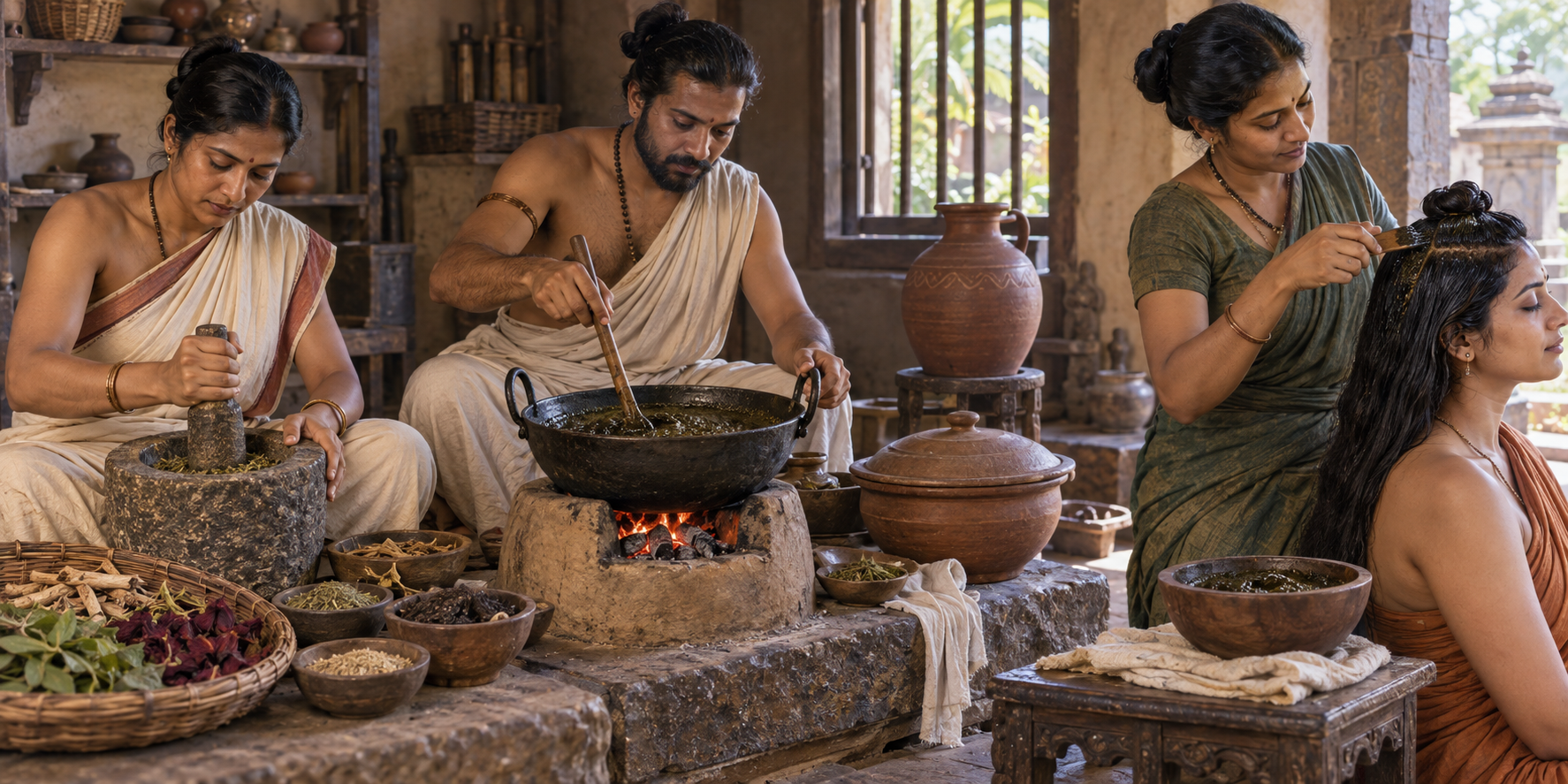
Ingredient lists attract attention, but the manufacturing verbs reveal the technical discipline. Materials were washed, ground, boiled, warmed, steeped, left unboiled or heated by the sun. Some mixtures went over a gentle fire. Others remained in an iron vessel for ten days. One preparation was to be used regularly, while another carried a fifteen-day schedule and promised a result on the sixteenth day.
The distinction between boiling and prolonged unboiled standing is especially revealing. These were not interchangeable ways of saying mix everything together. They describe different processing conditions. Heat can change extraction, evaporation, texture and chemical interaction, while standing allows slower contact among ingredients. We cannot reconstruct every reaction from the directions alone, but we can see that process conditions were deliberately differentiated.
Proportion was also explicit. One preparation called for two pala of the roots of Ramataruni, one pala of liquorice, half a pala of savaraka and ten pala of oil of beleric myrobalan, followed by ten days of solar heating in an iron vessel. Whatever you think of its promised effect, this is a specified ratio and manufacturing schedule, not a vague instruction to use several beneficial herbs.
The iron container deserves separate attention. Iron sulphate and powdered iron also recur among the named materials. It is therefore reasonable to investigate whether iron contact contributed to colour development, but that remains an inference unless the underlying reaction is independently demonstrated. Do not silently convert a suggestive pattern into a proven ancient chemical theory.
If you are analysing one of these formulations, rewrite it as a process map before interpreting it: pretreat, measure, grind, combine, heat or stand, cool or keep warm, apply, wait and repeat. Then mark the vessel beside the relevant stage. This simple exercise prevents a common mistake in discussions of ancient technology: preserving the nouns while discarding the procedure that made them a formula.
Technical detail and extravagant claims must be weighed separately
The narrow cosmetic target is clear. Hair was to become black, deep dark or blue-black, particularly when greying had occurred. The imagery of antimony, the black bee and complete removal of visible white hair gave readers a recognisable standard of appearance. That target is more precise than a general promise of healthier or more beautiful hair.
Some associated promises go much further. Particular preparations were credited with removing wrinkles and grey hair for twelve years or even one hundred years. An emblic-myrobalan, ghee and liquorice preparation was credited not only with blackening grey hair but also with restoring lost sight. Another outcome, attributed to Agastya, promised that no white hair would remain after a fifteen-day course.
You should not give these assertions the same status as the observable manufacturing details. A named ingredient, measured proportion or ten-day processing period is evidence of how a preparation was conceived and made. A promise to restore sight or suppress greying for a century is a claim of efficacy, and no controlled evidence accompanies it here. Historical importance does not turn such a claim into medical advice.
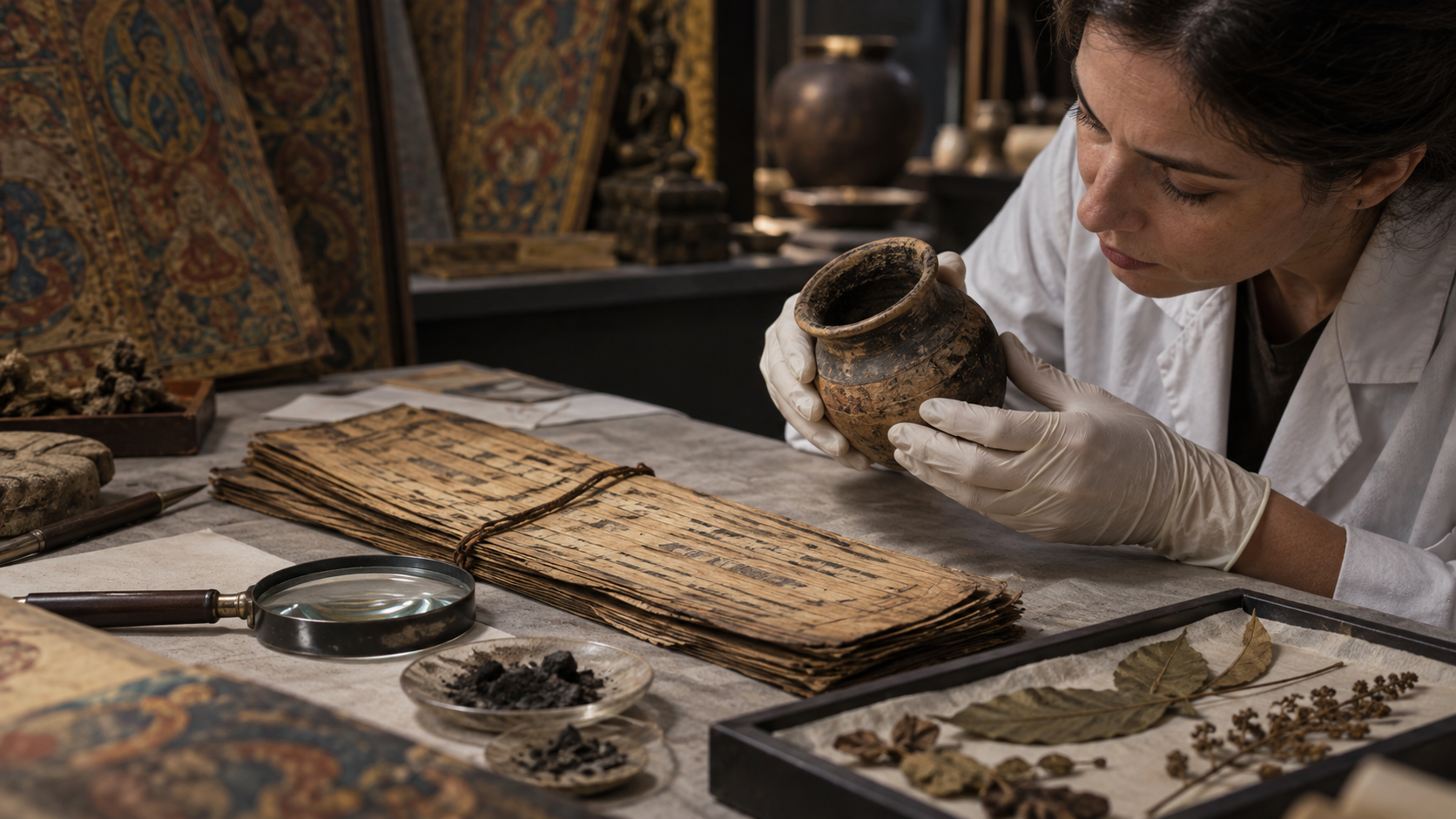
Transmission creates another limit. Words, sentences and whole sections are missing, and at least one complex formula reaches us in incomplete form. You cannot safely guess an omitted ingredient, repair a broken dosage from intuition or assume that a familiar modern plant name identifies the historical material with certainty. A gap must remain a gap unless stronger textual evidence fills it.
The most defensible conclusion is substantial but bounded: ancient Indian specialists possessed a detailed materia medica and a developed language of formulation. They controlled ratios, carriers, sequence, temperature, vessel and time. Those facts deserve attention without requiring you to certify every physiological claim made within the older medical worldview.
Do not turn the historical record into a home recipe
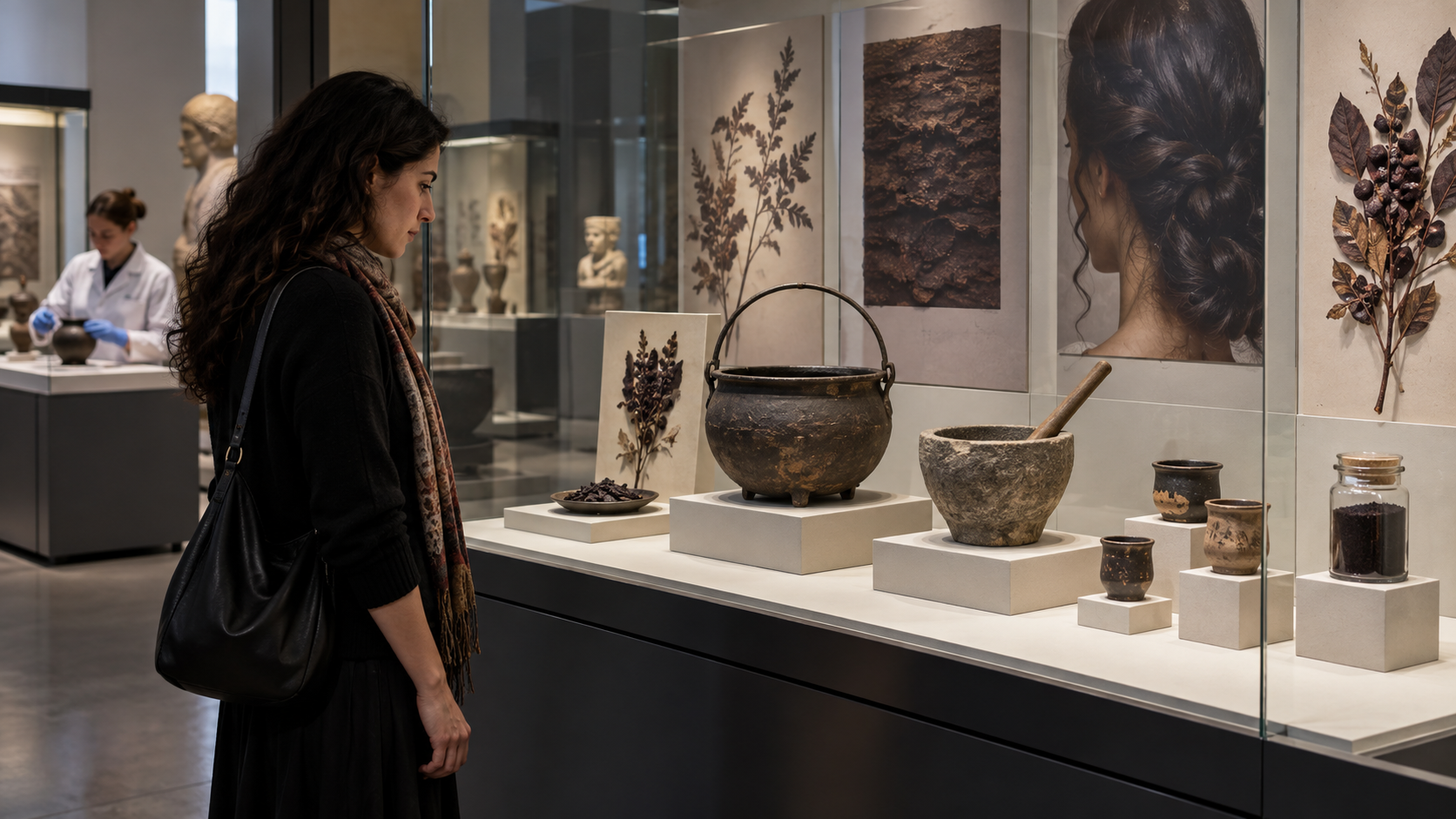
Natural does not mean harmless, and ancient does not mean safe for unsupervised use. The named materials include oleander, copper sulphate, iron sulphate, antimony sulphide, turtle bile and powdered iron. Historical administration sometimes involved nasal drops as well as external ointments and plasters. That combination of uncertain identity, mineral exposure, biological material and an invasive route creates real risk.
Do not place any reconstructed Kesha-Raga preparation in your nose. Do not apply oleander or an improvised mineral mixture to your scalp. Do not replace a missing ingredient with something that has a similar vernacular name. The damaged textual record, historical measurement system and lack of a modern concentration or purity specification make household reconstruction unsafe even before individual allergies or medical conditions are considered.
This caution does not diminish Ayurvedic history. It protects the distinction between studying a technical tradition and experimenting on your body. If your actual concern is sudden greying, hair loss, scalp inflammation or a reaction to a commercial dye, seek an appropriately qualified medical professional rather than using a historical preparation as treatment.
For historians of science, chemists and trained specialists, the safer question is not whether the old mixture should be copied. It is which material performed which function, what the carrier extracted, whether an iron vessel altered the mixture, and how the resulting colour behaved on hair fibres. Those questions can honour the tradition while keeping hazardous experimentation inside a controlled setting.
Use this framework when you encounter an ancient dye claim
You can evaluate a Kesha-Raga claim, museum description or modern marketing reference without either dismissing it or accepting it wholesale. Work through the following checks in order.
- Define the claimed result. Distinguish blackening grey hair from preventing future greying, changing scalp colour, treating wrinkles or restoring sight.
- Separate the functional layers. Mark the likely colouring material, possible colour-producing assistant, carrier, pretreatment and application medium instead of treating every ingredient as an equivalent active.
- Preserve the process. Record the order of washing, grinding, heating, steeping and application, along with the vessel and duration.
- Keep historical quantities intact. Do not manufacture a convenient household conversion when the identification, concentration or textual reading is uncertain.
- Label inference honestly. Repeated iron materials may invite a chemical hypothesis, but a hypothesis is not the same as an explicitly transmitted explanation.
- Grade the evidence. A detailed procedure establishes knowledge of formulation; it does not establish the truth of a promise lasting twelve or one hundred years.
- Apply a safety gate. If the preparation involves toxic plants, mineral compounds, biological material, nasal administration or missing instructions, treat it as an object of study rather than personal use.
- Retain the cultural setting. Mangalam and the Purusharthas help explain why hair colouring mattered, but auspicious meaning is not a toxicological guarantee.
The next time a product or social-media claim invokes an ancient Indian hair dye, ask for the exact formulation, the complete process and the evidence for the promised result. If those three things are collapsed into the word Ayurvedic, you have not been given enough information to judge it.
Ancient India’s achievement is already impressive: Kesha-Raga treated colour as the outcome of materials, proportions and controlled operations. You can respect that sophistication, study it carefully and still refuse unsafe imitation. That is the soundest way to protect both your body and the integrity of the tradition.
References
- DharmaRenaissance Blog — Preparation of Hair-Dyes in Ancient India: Recipes and Processes
