

Your child can earn excellent marks and still be unable to explain a family observance, retell a sacred story, or recognise why a festival matters. If that gap worries you, the answer is not to reject modern schooling or add another pile of worksheets. It is to restore the part of education that a school cannot carry by itself.
A workable Dharmic model joins memory, meaning, conduct, family example, and community participation. It prepares a young person to earn a livelihood, but it refuses to treat livelihood as the complete purpose of learning. You can begin building that model at home without waiting for a new institution, a perfect teacher, or a redesigned national curriculum.
Start with the person you want education to form
Most educational planning begins with subjects: language, mathematics, science, history, and examinations. A Dharmic approach begins one level deeper. It asks what kind of person should emerge from all that learning.
Literacy, professional competence, and economic independence matter. They are not enemies of Dharma. The mistake is to assume that they automatically produce judgement, restraint, cultural confidence, gratitude, courage, or responsibility. A person can possess impressive credentials while remaining unable to receive, interpret, and transmit a civilizational inheritance.
The distinction you need is between information and formation. Information gives a learner material to know. Formation changes how the learner remembers, speaks, chooses, participates, and accepts responsibility. Dharmic education must do both.
DVG used the word Rashtraka for a formed citizen of this kind: someone deeply attached to the nation and its culture, responsive to its unwritten civilizational duties, committed to preserving its inheritance, and courageous enough to defend it. This is not the same as producing a child who repeats slogans on command. Attachment without knowledge becomes sentimentality; knowledge without duty becomes sterile expertise. The desired outcome is informed belonging expressed through conduct.
Before selecting books or classes, write a household statement of purpose in plain language. It might say: “We want our children to know where they come from, understand the practices they inherit, think carefully about them, live their duties, and become capable of passing what is worthy to others.” Use that statement to decide what belongs in your programme and what is merely extra content.
You will know the purpose is becoming real when the learner can do things such as these:
- Recall a prayer, verse, song, or story without depending immediately on a screen or printed page.
- Explain important words and symbols instead of hiding uncertainty behind memorised sounds.
- Connect a festival or household practice with its narrative, ethical, or spiritual meaning.
- Participate willingly in family and community observances rather than remaining a spectator.
- Ask serious questions without treating inherited practices with either blind defensiveness or fashionable contempt.
- Teach a younger person something accurately and patiently.
- Recognise that inherited knowledge carries an obligation to preserve, practise, and transmit it.
Do not force Hindu, Buddhist, Jain, and Sikh teachings into a synthetic syllabus that erases their differences. “Dharmic” can describe the educational architecture, but the actual content should remain rooted in the learner’s tradition. A Hindu household should draw from its sampradaya, family customs, sacred literature, languages, teachers, and forms of worship. Buddhist, Jain, and Sikh households should use their own authoritative texts, practices, exemplars, and institutions within the same broad architecture of disciplined learning and lived transmission.
Build a small household curriculum that can actually be lived

Parents often respond to cultural loss by collecting too much material. They buy translations, subscribe to lectures, save videos, enrol children in several classes, and create a timetable that soon collapses. Accumulation feels like action, but an untouched library does not become a tradition.
Begin with a compact household canon. Choose material that your family can revisit until it enters speech, memory, celebration, and conduct. Depth is more valuable than hurried exposure to a large catalogue.
A balanced household curriculum should contain these strands:
- Sacred narrative: Select an age-appropriate portion of the Ramayana, Mahabharata, Bhagavad Gita, or a Puranic narrative connected to your family’s practice. Stay with it long enough for the learner to know the people, choices, conflicts, and consequences.
- Language and memory: Include prayers, verses, names, songs, Kritis, Devaranamas, or other material carried in the language of the tradition. Teach pronunciation and meaning together, while allowing memory to develop through repetition.
- Household practice: Explain the actions the child already sees at home. Name the objects, sequence, gestures, and purpose. A familiar ritual becomes educational when the learner moves from watching to assisting, from assisting to understanding, and from understanding to responsible participation.
- Festival cycle: Treat celebrations as recurring lessons. Prepare through story and song, participate in the observance, and afterwards ask the learner to retell what happened and why.
- People worth remembering: Introduce saints, seers, poets, artists, freedom fighters, scholars, and spiritual figures whose lives reveal different forms of excellence. Swami Vivekananda and Ramana Maharshi need not be reduced to decorative quotations; their lives can help a learner ask what strength, discipline, renunciation, or clarity looks like.
- Place and pilgrimage: Connect family memory with temples, tirthas, rivers, regions, and journeys. Before a visit, learn the place’s story and customary practice. During it, observe closely. After returning, have the learner narrate the experience without merely scrolling through photographs.
- Duty and service: Give the learner a genuine role in household and community life. Education about responsibility remains abstract if adults perform every meaningful task while children only consume explanations.
Let your family’s actual life determine the entry point. If a festival is approaching, begin there. If a grandparent knows a body of songs, record the lyrics and learn them together. If your child is fascinated by a particular figure in the Mahabharata, use that interest to enter the wider narrative. The curriculum should be coherent, but it does not have to begin at an imaginary “chapter one.”
Parents also need a period of unlearning. Many adults were trained to regard memorisation as unintelligent, ritual as an obstacle to thought, oral knowledge as inferior to print, and inherited stories as material for children alone. Those assumptions will quietly govern the home unless you examine them. You need not accept every inherited claim without scrutiny. You do need to distinguish thoughtful scrutiny from reflexive embarrassment.
Keep a simple household learning record. Note what the learner can recite, retell, explain, perform, and teach. Record questions that remain unresolved. This turns vague intentions into visible continuity without converting the home into another examination centre.
Use memory as a foundation, then require meaning and effort

Memorisation is often dismissed as “rote learning,” while explanation is treated as inherently superior. That opposition is too crude. Mechanical repetition without understanding is incomplete, but explanation without retained material is fragile. A learner cannot reflect deeply on words, rhythms, stories, and concepts that never became available to memory.
Oral learning asks the whole person to attend. The learner listens, reproduces sound, notices error, corrects it, and repeats until the material can be summoned without an external prompt. A printed text remains useful, but it should serve as a reference rather than becoming a permanent substitute for attention and recall.
Use a learning sequence that moves from reception to transmission:
- Hear: Let the learner first encounter the passage, song, or story through a competent human voice whenever possible. Sound, pacing, and emphasis are part of what is being taught.
- Repeat: Practise a manageable portion until the learner can reproduce it steadily. Correct errors precisely, but do not turn correction into humiliation.
- Parse: Work through word division, literal meaning, compounds, word order, and syntax where the learner’s level permits. Asking the student to do some of this work is part of the education.
- Interpret: Ask what choice a character faced, what a symbol discloses, why a practice takes its particular form, or what tension remains unresolved. Avoid questions whose only acceptable answer is a slogan.
- Embody: Connect the lesson with an action: participation in worship, help with a festival, respectful speech, care of a shared place, service to an elder, or fulfilment of a household duty.
- Transmit: Ask the learner to recite, narrate, demonstrate, or explain the material to someone else. Teaching exposes gaps that passive familiarity conceals.
The teacher’s task is not to make every difficulty disappear. A well-judged difficulty forces concentration and gives the learner ownership of the result. When a child hesitates over a word, searches for the connection between events, or tries to reconstruct a sequence from memory, do not answer immediately. Give a useful prompt and allow the learner to complete the movement.
This is the practical meaning of drawing knowledge out rather than shoving information in. It does not imply that the learner already possesses every fact. It means the teacher removes obstructions, supplies disciplined material, directs attention, corrects error, and leaves enough intellectual work for understanding to become the learner’s own.
A short daily practice usually fits family life better than an occasional burst of enthusiasm. Attach it to an existing household rhythm so that it does not depend on repeated negotiation. The practice may involve recitation, listening, retelling, or explaining a term. Reserve a recurring family period for the longer story, discussion, or preparation that cannot fit into the daily rhythm.
For a child who cannot yet read, use voice, gesture, image, song, and participation. Once reading becomes available, add the written form without abandoning oral recall. With an older learner, require comparison, interpretation, and responsibility for teaching. The method should mature with the learner; it should not become either perpetual entertainment or a childhood recital preserved after its meaning has gone.
Recover the teachers already present in family and community
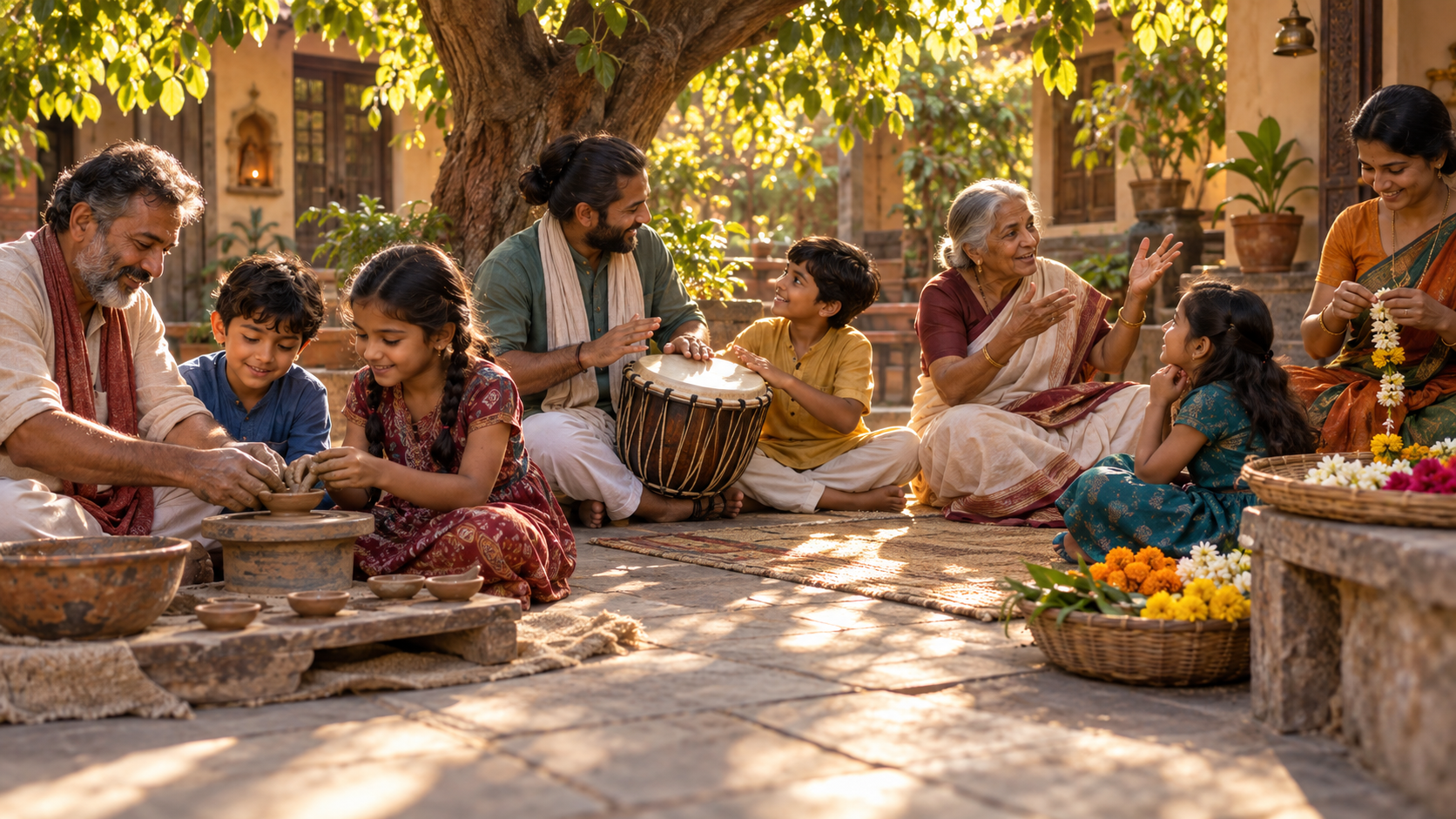
The home is the first school because children encounter the conduct of adults before they can evaluate adult explanations. If a parent demands recitation but never studies, speaks of reverence while treating elders or teachers carelessly, or celebrates a festival mainly as decoration, the lived lesson will defeat the verbal one.
Begin with an adult practice that the child can observe. Learn the passage before requiring it. Ask a knowledgeable person when you do not know. Admit uncertainty without turning ignorance into cynicism. Children need to see that inherited knowledge is worthy of adult effort, not merely a cultural activity assigned to the young.
For many families, transmission through a joint household can no longer be assumed. Distance, urban life, fragmented schedules, and screens have changed who holds a child’s attention. That makes deliberate organisation necessary, but it does not require parents to pretend they know everything.
Map the knowledge around you. A grandparent may remember household customs. A singer may carry Kritis or Devaranamas. A storyteller may know Ram Katha, Harikatha, Puranic narratives, or the Mahabharata in a form that no worksheet can reproduce. A language teacher may help with pronunciation and grammar. A practising member of your sampradaya may explain ritual sequence and discipline. Each can hold part of the educational trust.
Do not confuse literacy with culture when choosing a teacher. Someone who cannot present polished academic credentials may possess a formidable oral treasury, artistic discipline, and power of narration. Judge the person by accuracy, character, depth, ability to teach, and fidelity to the tradition being transmitted. At the same time, do not romanticise every inherited claim. Verify what you can through competent teachers and recognised texts, especially when interpretations differ.
Create a modest circle of transmission:
- Ask relatives what they know well enough to teach, rather than making a general request for “culture.”
- Invite the child to learn directly from a singer, storyteller, language teacher, or ritual practitioner.
- Give the learner a role during festivals and community observances instead of providing only explanations beforehand.
- Treat a tirthayatra as study, participation, and recollection, not merely travel.
- Ask the learner to carry something forward by teaching a sibling, cousin, friend, or younger participant.
Technology can support this circle, but it should not become its centre. Use a recording to preserve a relative’s song, locate a competent recitation, or revisit a lesson. Then close the device and ask the learner to reproduce, explain, or perform what was encountered. If the activity ends when the video ends, it has remained consumption.
The adult responsible for continuity becomes an Acharya in the functional sense: not someone claiming spiritual status, but someone who teaches through conduct and accepts responsibility for transmission. Nature can make you a parent; sustained practice makes you capable of becoming a trustworthy teacher within the limits of what you genuinely know.
Key takeaways for your household
- Do not ask formal schooling to perform every educational task. Let it provide the learning it can provide while the family and community take responsibility for civilizational formation.
- Choose a bounded body of material. A sacred narrative, a small repertoire of recitation and song, family observances, exemplars, pilgrimage memory, and real duties are enough to establish continuity.
- Join memory with meaning. Require accurate recall, then examine words, choices, symbols, and consequences. Neither mechanical repetition nor ungrounded discussion is sufficient by itself.
- Preserve productive effort. Prompt the learner, correct errors, and remove genuine obstacles, but leave enough work for attention and understanding to develop.
- Teach through participation. Festivals, worship, pilgrimage, storytelling, song, household duty, and community service are educational settings, not decorative additions to a textbook syllabus.
- Use the knowledge holders around you. A grandparent, bard, singer, practitioner, or language teacher may preserve forms of learning that formal credentials do not measure.
- Assess what can be carried forward. Look for the ability to recall, explain, participate, judge, and teach. Do not reduce devotion or character to a score.
Begin with material already alive in your family. Choose a short passage, song, story, or approaching observance. Learn it yourself, teach it through voice and example, uncover its meaning, and give the learner a way to participate. Then return to it until it can be carried without your prompting.
That repeated movement—from receiving to understanding, from understanding to conduct, and from conduct to transmission—is how a household stops outsourcing its memory. It is also how education becomes more than preparation for the next examination: it becomes preparation to inherit responsibly and hand forward what should not die with us.
References
- DharmaRenaissance Blog — Real Education is Removing the Walls that Block the Light Within us
- DharmaRenaissance Blog — Dharmic Education in an Age of Deliberate De-Hinduisation of Bharata
