
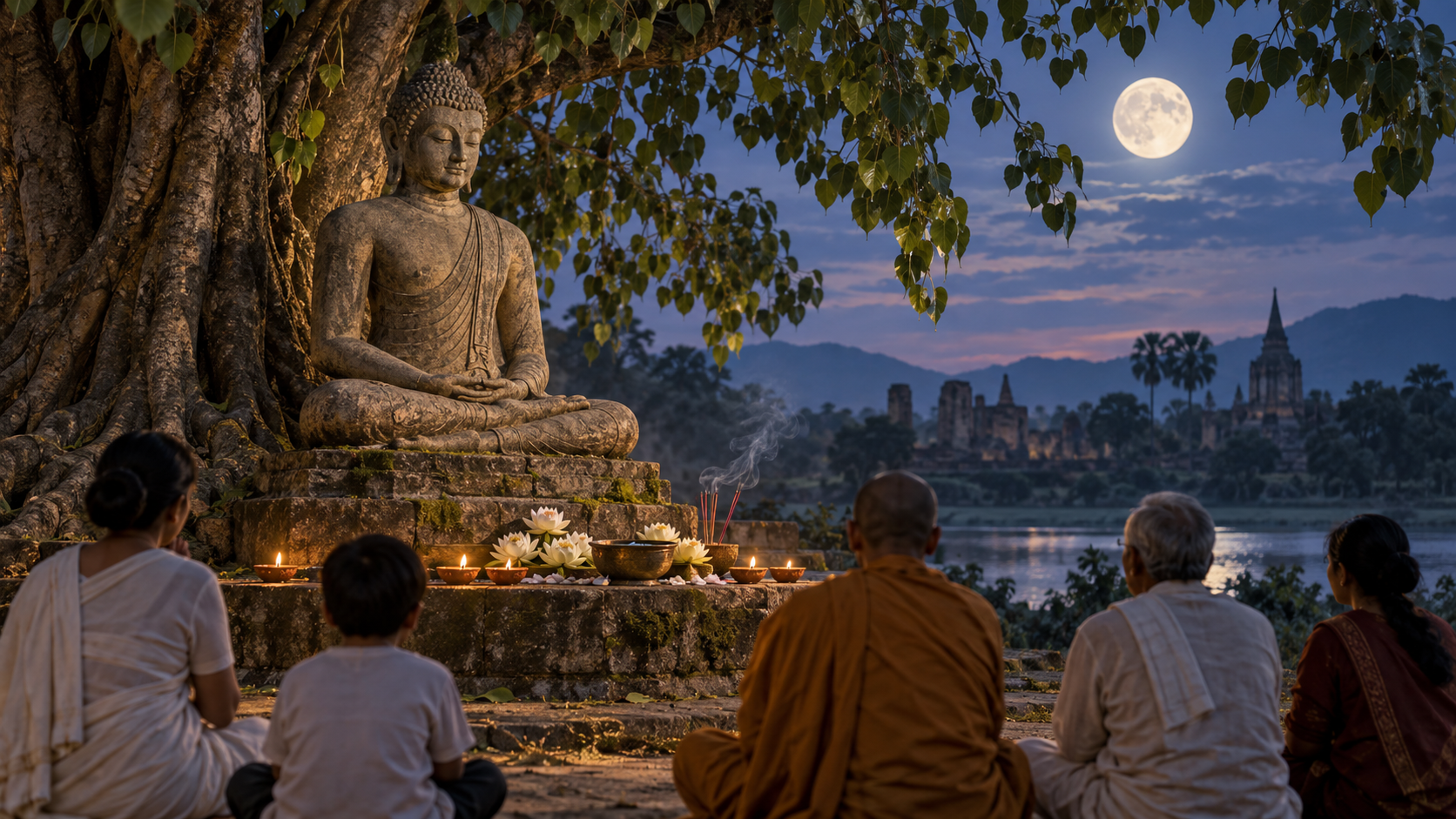
You may come to Buddha Purnima wondering what the day should mean beyond lamps, flowers and a familiar image of the Buddha in meditation. The clearest answer is also the most demanding: this full-moon observance asks you to remember an extraordinary life by examining your own.
You do not need an elaborate ceremony to begin. You need to understand the three events held together on Buddha Purnima, choose a practice that reflects the Buddha’s teaching, and carry one deliberate change beyond the festival itself.
One full moon holds three turning points
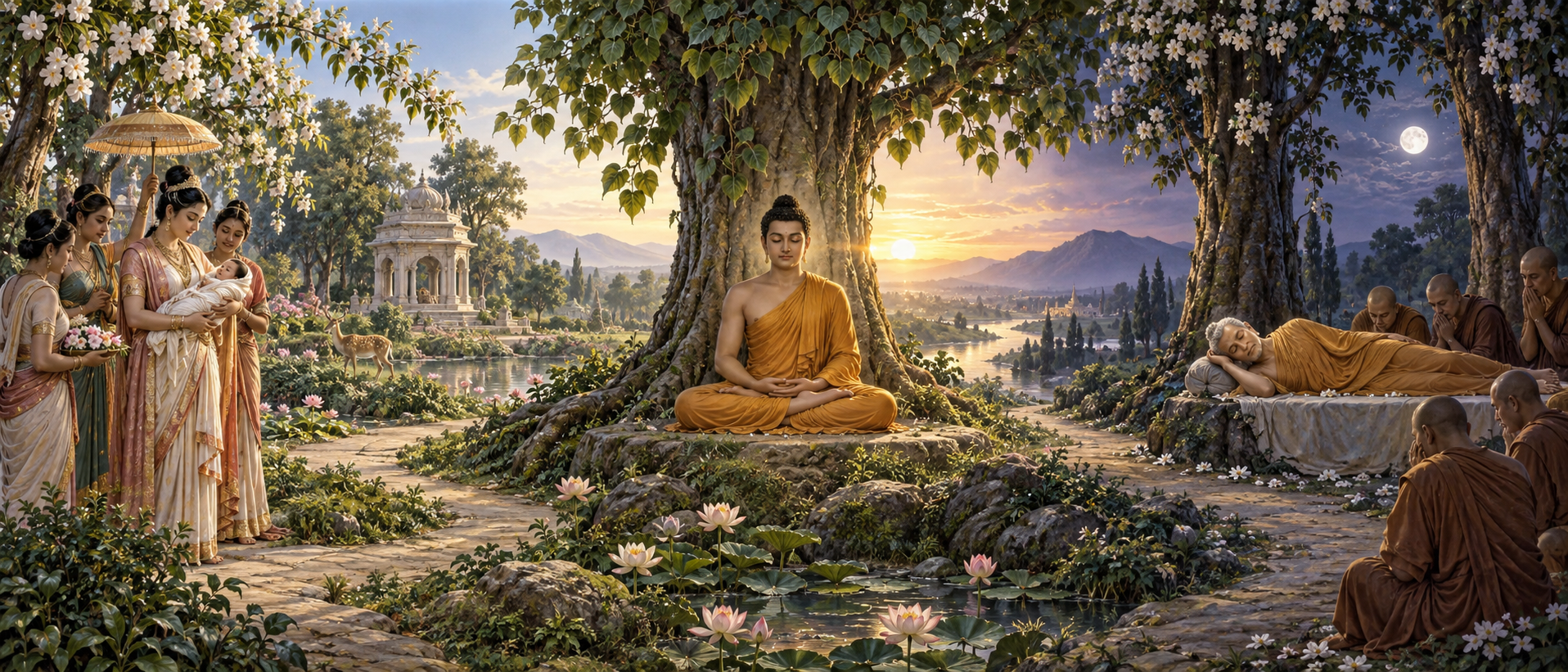
Buddha Purnima, also called Buddha Jayanti or Vesak, falls on the full-moon day of Vaisakha, generally in April or May. Buddhist tradition brings three decisive moments into this single observance: the Buddha’s birth, enlightenment and passing away. Remembering all three prevents the celebration from becoming merely a birthday or a historical anniversary. It presents an entire spiritual movement: human birth, awakening through disciplined inquiry, and release from attachment to what cannot endure.
Birth: awakening begins within human life
Buddhist tradition places Siddhartha Gautama’s birth at Lumbini, in present-day Nepal, on the Vaisakha full moon in 563 BCE. His mother, Queen Maya, died seven days later, and Mahaprajapati Gautami, his maternal aunt, raised him. Although he was born into royalty, privilege did not settle his deepest questions about suffering, change and the meaning of human existence.
That beginning matters because the Buddha is not remembered as someone protected from the realities of life. He confronted them. His story therefore turns a question back toward you: which discomfort, loss or contradiction have you been trying to avoid because it disturbs an otherwise comfortable life? On Buddha Purnima, name it without dramatizing it and without looking away.
Enlightenment: insight requires disciplined practice
At the age of 35, after six years of meditation and ascetic discipline, Siddhartha attained enlightenment beneath the Bodhi tree at Bodh Gaya in India. He became the Buddha, the Awakened One. The decisive point is not that he acquired another belief. He came to understand the nature of suffering, its causes, its cessation and the path by which liberation can be cultivated.
This is why the Four Noble Truths and the Noble Eightfold Path belong at the centre of the day. They direct attention away from passive admiration and toward investigation. If a recurring anger, craving or fear is causing suffering, do not stop at condemning the feeling. Notice what feeds it, what weakens it, and which choices allow it to return. That movement from reaction to clear observation is already a meaningful way to honour awakening.
Passing away: impermanence makes practice urgent
The Buddha passed away at the age of 80 in Kushinagar, India. His final emphasis is remembered as a teaching on impermanence: conditioned things arise, change and pass away. Buddha Purnima therefore joins celebration to sobriety. Birth does not remain birth, youth does not remain youth, and even a great teacher’s physical presence does not remain.
Impermanence is not an invitation to indifference. It makes attention more valuable. When you remember that a relationship, possession, status or painful circumstance will change, you can hold it with greater care and less desperation. Choose one attachment that is making you act fearfully or possessively. Ask what responsible care would look like if you stopped demanding permanence from it.
Turn the Buddha’s teaching into an examination of life
The Buddha’s legacy is often reduced to a general message of peace. Peace is part of it, but the teaching is more exacting. The Noble Eightfold Path names eight connected areas of practice: right view, right intention, right speech, right action, right livelihood, right effort, right mindfulness and right concentration. Together they test how you understand, intend, speak, act, work and train the mind.
You can use the path as a practical audit on Buddha Purnima:
- Right view: Identify one situation you are seeing only through preference, resentment or fear. Separate what happened from the story you have built around it.
- Right intention: Before making an important choice, ask whether your motive is compassion, clarity and non-harm, or whether it is revenge, vanity or grasping.
- Right speech: Refrain from one statement that is false, needlessly cruel or intended to inflame conflict. Silence is useful when speech would only multiply harm.
- Right action: Repair one avoidable harm within your control. An apology matters only when conduct changes with it.
- Right livelihood: Examine whether the way you earn, manage or spend resources depends on deception or injury to others. Do not isolate spiritual values from economic conduct.
- Right effort: Stop feeding one unwholesome pattern and deliberately strengthen its healthier opposite. Replace resentment with goodwill, distraction with attention, or excess with restraint.
- Right mindfulness: Observe a thought or emotion as an event in the mind rather than treating it as an unquestionable command.
- Right concentration: Give sustained attention to meditation, prayerful reflection or scriptural contemplation without repeatedly reaching for another stimulus.
Do not turn this audit into a performance of perfection. Pick the point where your conduct and your values are visibly out of alignment. Work there. A smaller commitment that survives the next difficult moment is worth more than a long list of vows abandoned after the festival.
Compassion and non-violence give this practice its moral direction. Loving-kindness is not simply feeling warmly toward beings you already like. It asks you to stop cultivating harm in thought, speech and deed, including when anger feels justified. This does not require approving wrongdoing or abandoning boundaries. It requires refusing to let another person’s conduct determine the quality of your own mind.
Observe Buddha Purnima with purpose, at home or in community
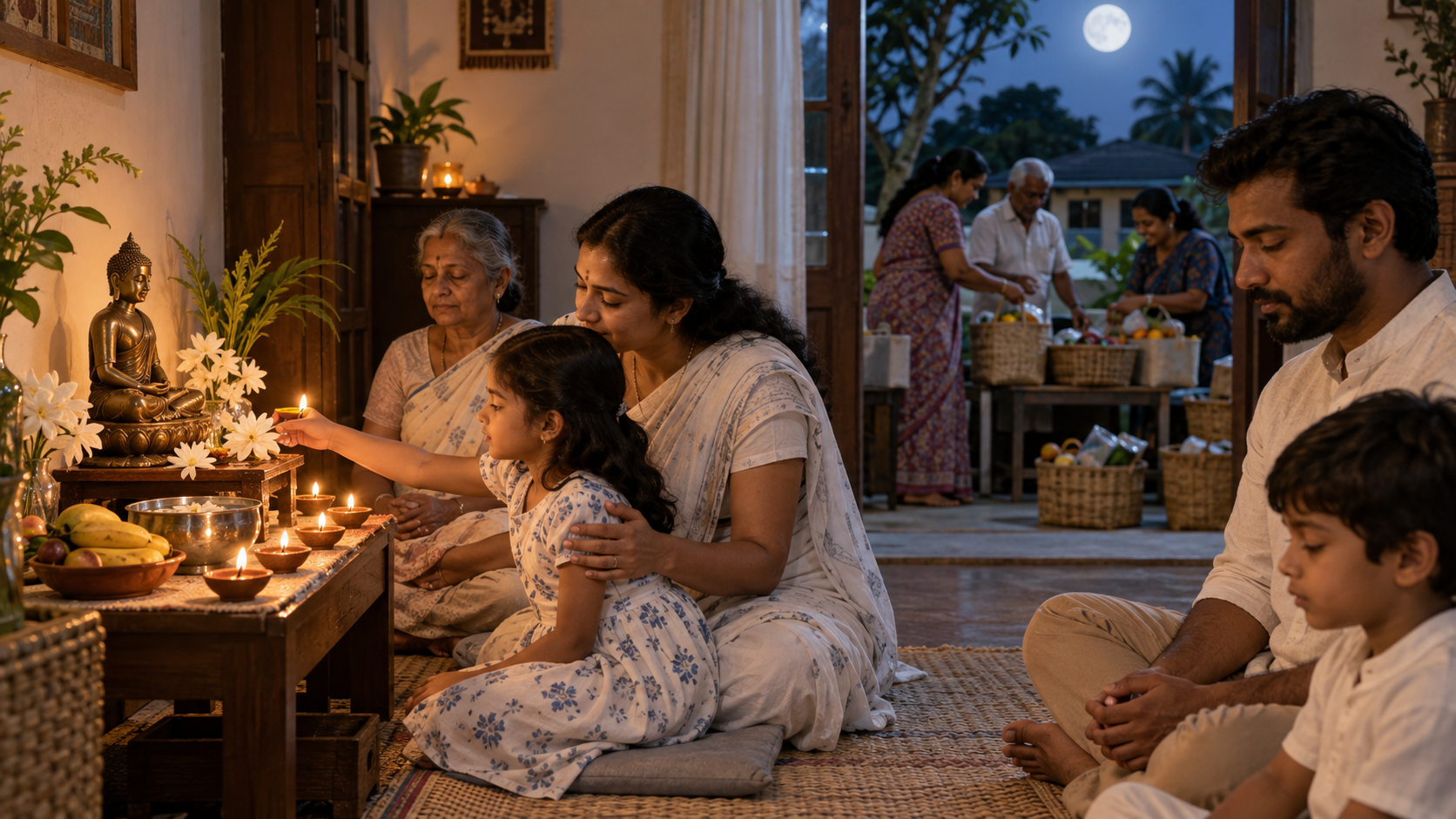
Customs differ across Buddhist communities. Nepal marks the day with temple and monastery observances and processions. In India, devotees commonly light lamps, chant scriptures, and offer food and flowers. Sri Lankan Vesak celebrations are known for lanterns and flags, while Thai Visakha Bucha observances include temple offerings and candlelight processions. These forms are culturally distinctive, but they repeatedly bring together devotion, ethical restraint, meditation and generosity.
If you are attending a temple or monastery, follow the local community’s guidance. Dress respectfully, keep your phone from interrupting the observance, and do not treat worshippers or rituals as scenery. If you are observing at home, use a simple sequence:
- Begin with a clear intention. Dedicate the day to understanding suffering, reducing harm and strengthening compassion. This gives every later ritual a purpose.
- Prepare a clean, quiet place. If it belongs to your tradition, place an image of the Buddha with a lamp, flowers or another modest offering. The aim is collected attention, not display.
- Read or chant a Buddhist teaching. Choose a passage connected to the Four Noble Truths, the Noble Eightfold Path, loving-kindness or impermanence. Afterward, state in your own words what it asks you to change.
- Sit in meditation. Attend to the body, breath and movement of the mind. When distraction appears, notice it and return without hostility. The returning is part of the discipline.
- Practise dana, or giving. Offer food, clothing or money to someone in need or support a monastery. Give something genuinely useful, without turning the recipient into a prop for your virtue.
- Strengthen sila, or ethical conduct. Common observances include refraining from meat and alcohol. More fundamentally, guard conduct against harm, falsehood and heedlessness. Follow your lineage or community’s discipline without policing people who observe differently.
- Close with a commitment that continues. Choose one form of right speech, mindful attention, generosity or restraint that you will practise after Buddha Purnima.
Some communities bathe an image of the Buddha by pouring water over it. The act symbolizes purification and renewal. If you perform it, connect the outer gesture to a specific inner cleansing: resentment to be released, dishonesty to be corrected, or heedlessness to be interrupted. If you do not have an image or the ritual is not part of your practice, there is no need to imitate it. Ethical renewal is the point.
The sangha, the community of practitioners, is also central to the Buddha’s legacy. Spiritual discipline becomes fragile when it exists only as a private mood. Practising with others creates instruction, encouragement and accountability. If you have access to a Buddhist community, use the festival to listen and learn. If you do not, share the day through an act of service or a serious conversation about one teaching rather than letting the observance remain solitary and abstract.
Honour a shared Dharmic inheritance without erasing differences
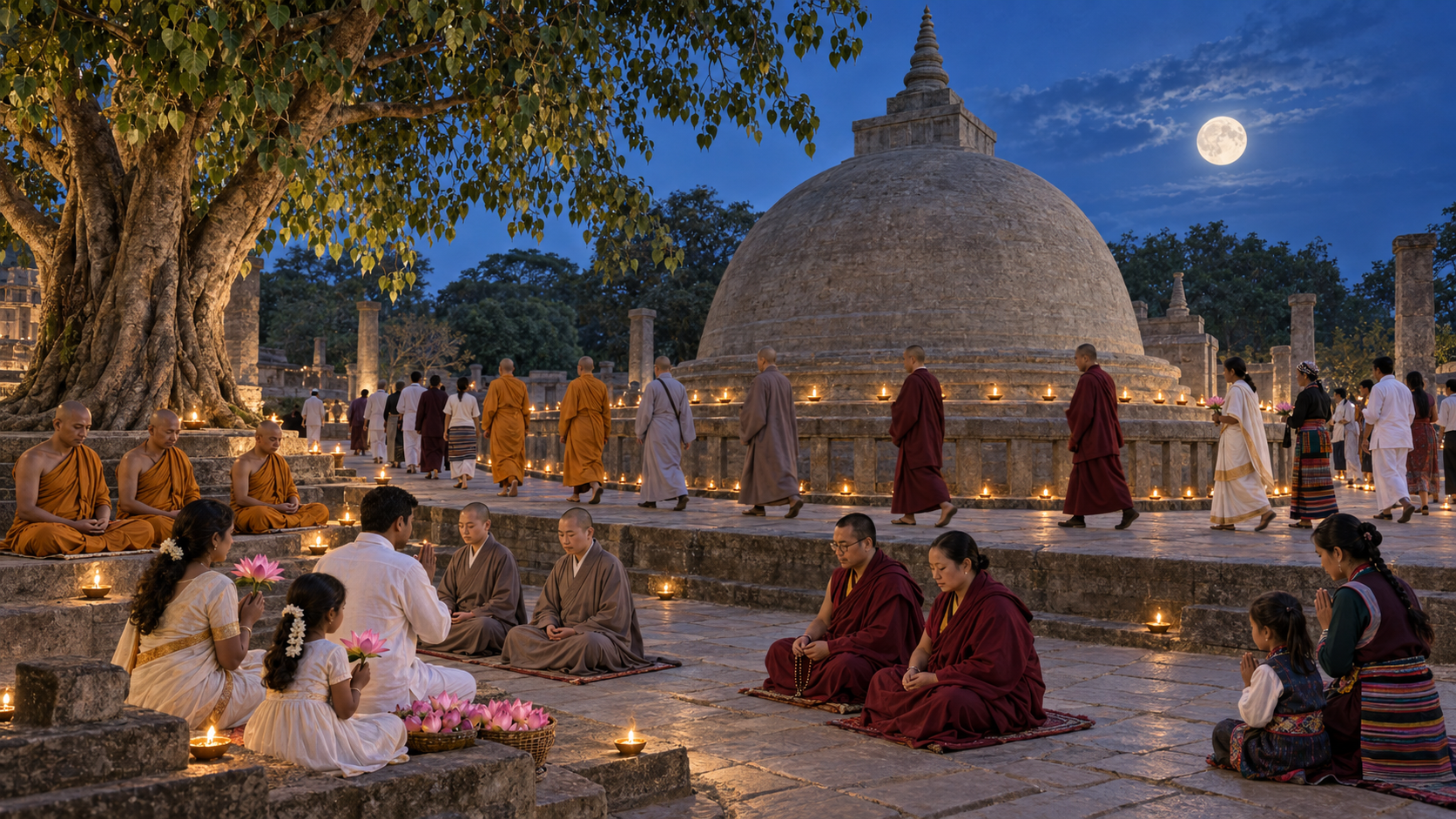
The sacred geography of the Buddha’s life connects present-day Nepal and Bharat: Lumbini is remembered as his birthplace, Bodh Gaya as the place of enlightenment, and Kushinagar as the place of his passing. His teaching then travelled far beyond its place of origin. Vesak and related observances across Sri Lanka, Thailand, Myanmar, Cambodia, Laos, Vietnam, Indonesia and China reveal the reach of an awakening rooted in the wider civilization of ancient India.
For a Dharmic audience, this legacy should invite both kinship and precision. Hinduism, Buddhism, Jainism and Sikhism developed within or in conversation with the civilizational world of Bharat, and they share important ethical resonances. Yet they are not interchangeable systems, and respect does not require pretending otherwise.
- Within Hindu traditions, Gautama Buddha is regarded by many as an avatar of Vishnu. The Bhagavata Purana presents Buddha within an avatar framework, and Hindu interpretations often associate him with compassion and non-violence. Not every Hindu interprets his place or teaching in the same way, so this view should not be presented as the only Hindu understanding.
- Within Buddhism, Gautama Buddha is the central teacher, also called the Tathagata. His awakening and teaching form the foundation of the Buddhist path to freedom from suffering.
- Within Jain thought, the Buddha can be recognized as a spiritual teacher and a contemporary of Mahavira, but major doctrinal differences remain. Jainism affirms a permanent soul, while the Buddhist teaching of anatta rejects a permanent self.
- Within Sikhism, Gautama Buddha does not occupy the explicitly central scriptural role that he holds in Buddhism. Ethical resonances should not be converted into a claim that the traditions have identical authorities or doctrines.
This distinction gives you a better way to speak about Dharmic unity. Say where traditions meet: self-discipline, compassion, non-violence, spiritual inquiry and freedom from destructive attachment. Then say where they differ: the nature of the self, the status of particular teachers, scriptural authority and the path to liberation. A confident civilizational outlook can acknowledge a family resemblance without erasing each member’s face.
Buddha Purnima also offers an antidote to a narrow understanding of heritage. Bharat’s influence on the world is not measured only by territory, wealth or political power. It is also visible when ideas born within its civilizational sphere become practices of generosity, meditation and ethical restraint across many cultures. To honour that influence responsibly, preserve its origins while respecting the distinctive forms it acquired elsewhere.
Key takeaways
- Buddha Purnima unites the Buddha’s birth, enlightenment and passing away, allowing you to contemplate the whole movement from human questioning to awakening and impermanence.
- The Buddha’s legacy is practical: examine suffering, notice what sustains it, and use the Noble Eightfold Path to correct view, intention, speech, action, livelihood and mental discipline.
- A purposeful observance can combine meditation, scriptural reflection, dana, ethical restraint and participation in a sangha.
- Lamps, flowers, chanting and bathing an image have value when their outer form leads to inner attention, purification and changed conduct.
- The Buddha belongs to the wider history of Dharmic civilization, but Hindu, Buddhist, Jain and Sikh relationships to him should be described without flattening real doctrinal differences.
Before the full moon passes, choose one place where your life needs greater clarity or less harm. Make the commitment concrete enough to test the next time anger, craving or distraction appears. Buddha Purnima becomes a living inheritance when remembrance changes what you do on the following day.
References
- DharmaRenaissance Blog — Buddha Purnima: Celebrating the Life and Teachings of the Buddha
