
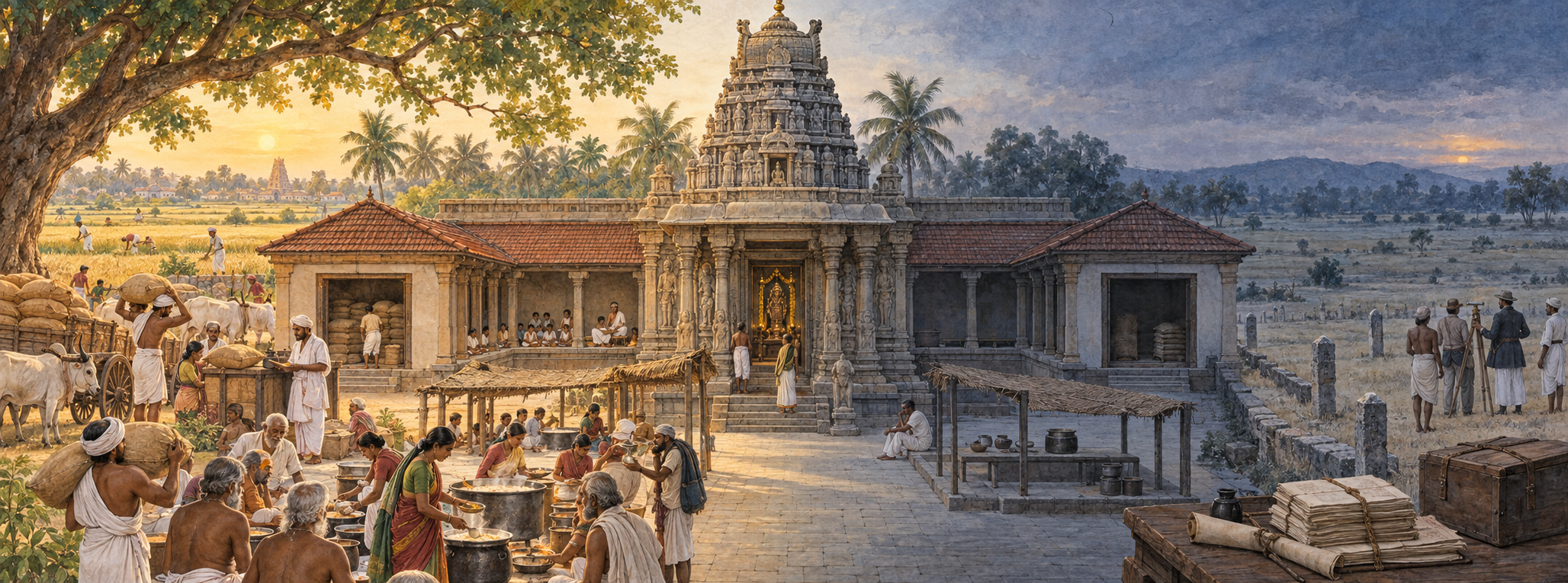
If you have heard that British rule destroyed Hindu charity but aren’t sure what that statement means, don’t begin with the largest economic estimate or the most dramatic episode. Begin with an institution near you. Ask what sustained it, whom it served, who guarded its resources, and which duties the community expected it to fulfil.
Those questions make the colonial rupture visible. A shrine, trust, festival, feeding tradition, or school can retain its name while losing the economic base, governing memory, and social confidence that once made its service dependable. The same questions also show you what meaningful recovery requires.
Daana depends on a chain, not a moment of generosity
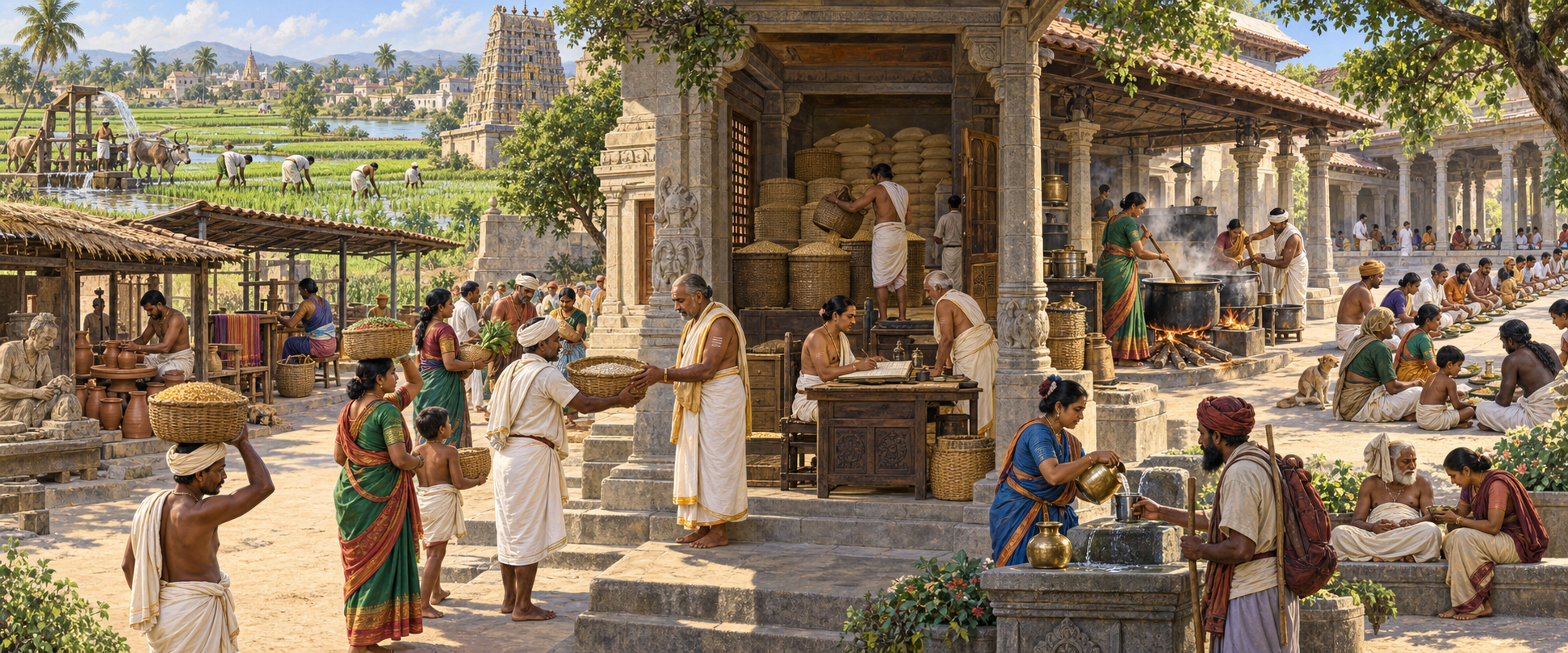
Modern discussions often treat charity as an optional transfer from someone who has money to someone who needs it. In many Hindu traditions, daana carries a deeper moral meaning. The gift is connected to dharma: the giver accepts an obligation, the custodian protects its purpose, and the community remembers why the gift was made.
That relationship becomes an institution when it outlives the original donor. A permanent asset may support recurring worship, food, education, shelter, water, care for pilgrims, or another public purpose. Rules determine who may use the resource. Custodians preserve it. Successors learn both the procedure and the sacred intention behind it.
This is why the destruction of charitable capacity cannot be measured only by counting demolished buildings or prohibited ceremonies. The impulse to give can survive while the machinery that turns giving into dependable service becomes fragile. If income stops recurring, ownership becomes uncertain, custodians lose authority, or the founding purpose is forgotten, an institution may continue ceremonially while serving far fewer people.
The colonial rupture operated in both material and cultural life. Economic extraction weakened the surroundings from which families and communities gave. Interference with inherited customs weakened confidence in the obligations that made giving meaningful. These pressures reinforced each other: a poorer community had less capacity to sustain an endowment, while a devalued tradition had greater difficulty persuading future generations to protect it.
What institutional destruction looks like when a building survives

When you investigate a Hindu charitable institution, look beyond its physical site. Five connected layers determine whether it is alive as an institution:
- Resource base: the land, income, produce, gifts, labour, or other assets that make recurring service possible.
- Custodial authority: the people or bodies empowered to preserve the assets, apply the rules, and resolve disputes.
- Dharmic purpose: the obligation the resource was meant to fulfil, including the intended beneficiaries and any ritual conditions attached to the gift.
- Transmission: the records, practices, oral memory, and succession through which one generation teaches the next how and why the institution operates.
- Social legitimacy: the community’s confidence that supporting the institution is honourable, effective, and consistent with dharma.
A break in one layer spreads into the others. If an endowment no longer produces income, the service contracts. When the service contracts, community participation falls. As participation falls, knowledge is not passed on. Once the knowledge disappears, later generations may see only an old building and fail to recognise the social system it once housed.
The reverse mistake is also possible. A damaged building does not, by itself, prove that every function associated with it disappeared. Families may have moved a practice into homes, established a replacement institution, or maintained service on a smaller scale. Survival and adaptation belong in the history alongside dispossession and decline.
A figure frequently used in discussions of the colonial drain estimates that $45 trillion was extracted from India over roughly 175 years. Treat that as a macroeconomic estimate, not as an audited ledger of Hindu charitable losses. It cannot tell you which temple lost an endowment, which feeding service stopped, or which custodian was displaced. Its proper use is to frame the scale of the economic environment; a claim about a particular institution still requires particular evidence.
How to test a claim about a particular institution
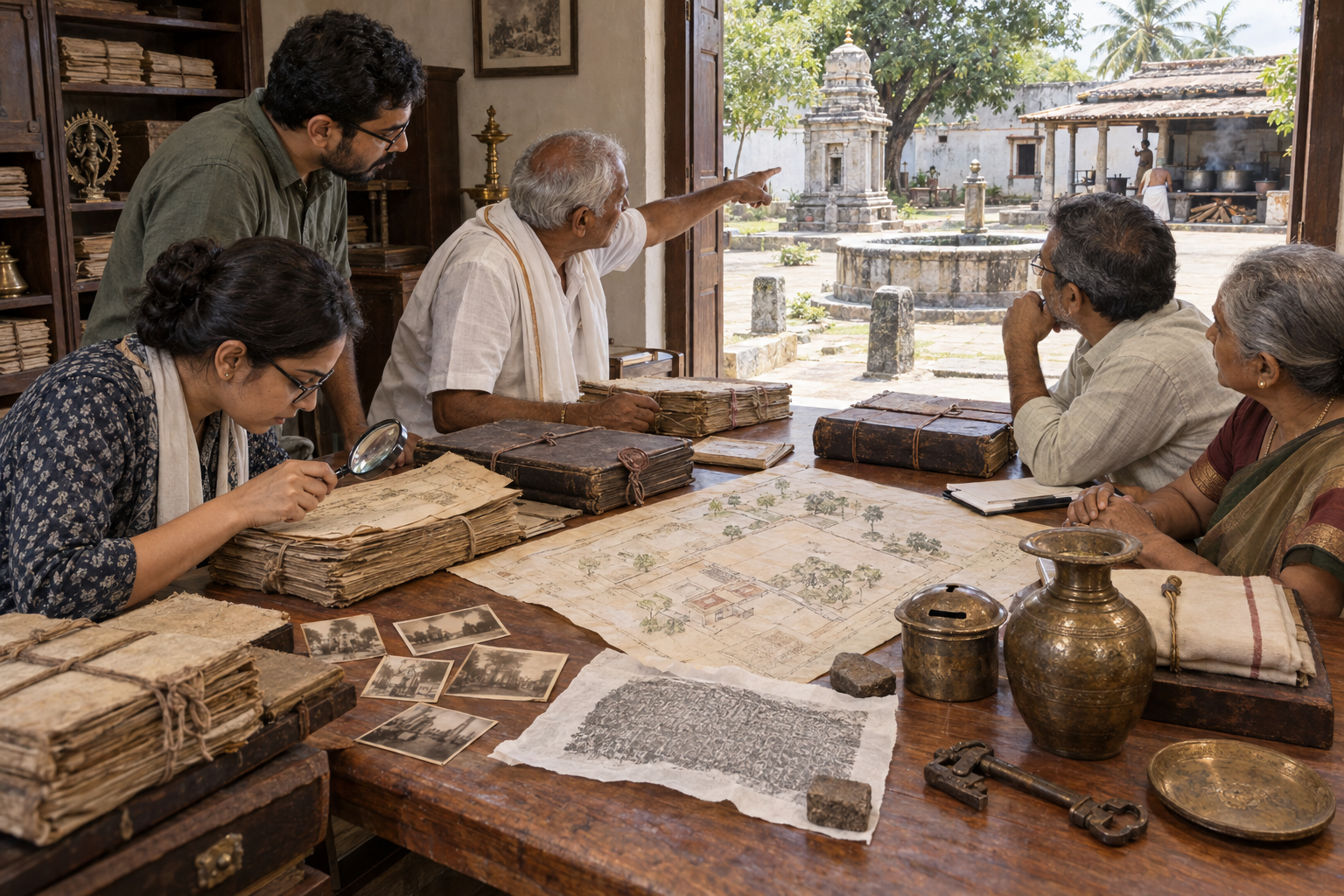
A strong pro-Hindu history does not need loose evidence. Precision makes the civilizational case harder to dismiss and more useful to communities seeking restoration. Work from the named institution outward:
- Define the institution. Identify the temple, matha, pathshala, dharmashala, kitchen, water facility, pilgrimage service, trust, or endowment under examination. Avoid using a whole region as the unit when the evidence concerns one locality.
- State its function before describing its decline. Record what the institution was expected to do, who benefited, how often the service operated, and whether religious conditions governed the gift.
- Reconstruct the resource base. Look for deeds, inscriptions, account books, revenue records, correspondence, court files, family papers, and carefully cross-checked oral memory. Separate evidence of ownership from evidence of income and both from evidence of actual service.
- Locate the break. Look for a change in assessment, control, title, trusteeship, permitted use, access to income, donor capacity, or public status. Record when the change becomes visible rather than assuming that every decline began at the same colonial moment.
- Show the causal chain. A convincing account connects intervention to consequence: a resource changed, recurring income declined, a service contracted, and beneficiaries lost access. Each link needs support.
- Test other explanations. Local conflict, custodial failure, litigation, ecological disruption, or later government action may have compounded the colonial damage. Naming those causes does not absolve colonial power; it prevents one explanation from hiding another problem that still needs repair.
- Record continuity and adaptation. Note which practices survived, who protected them, and what new arrangements emerged. Hindu agency is part of the history, not an inconvenience to a narrative of disruption.
- Label the level of certainty. Distinguish what records establish, what several clues make probable, and what remains community memory awaiting corroboration.
Two shortcuts regularly weaken the argument. The first is using a national tragedy as direct proof of what happened to every local endowment. The second is treating the survival of worship as proof that no institutional damage occurred. Context is not a substitute for a local chain of evidence, and ritual continuity is not the same as undiminished charitable capacity.
If the evidence is incomplete, say so. An honest gap creates a research question: Which record would establish the original purpose? Where might the account book have gone? Which family or custodial lineage may preserve a copy? An exaggerated conclusion closes inquiry just when a community needs to begin it.
Restoration requires three different kinds of work
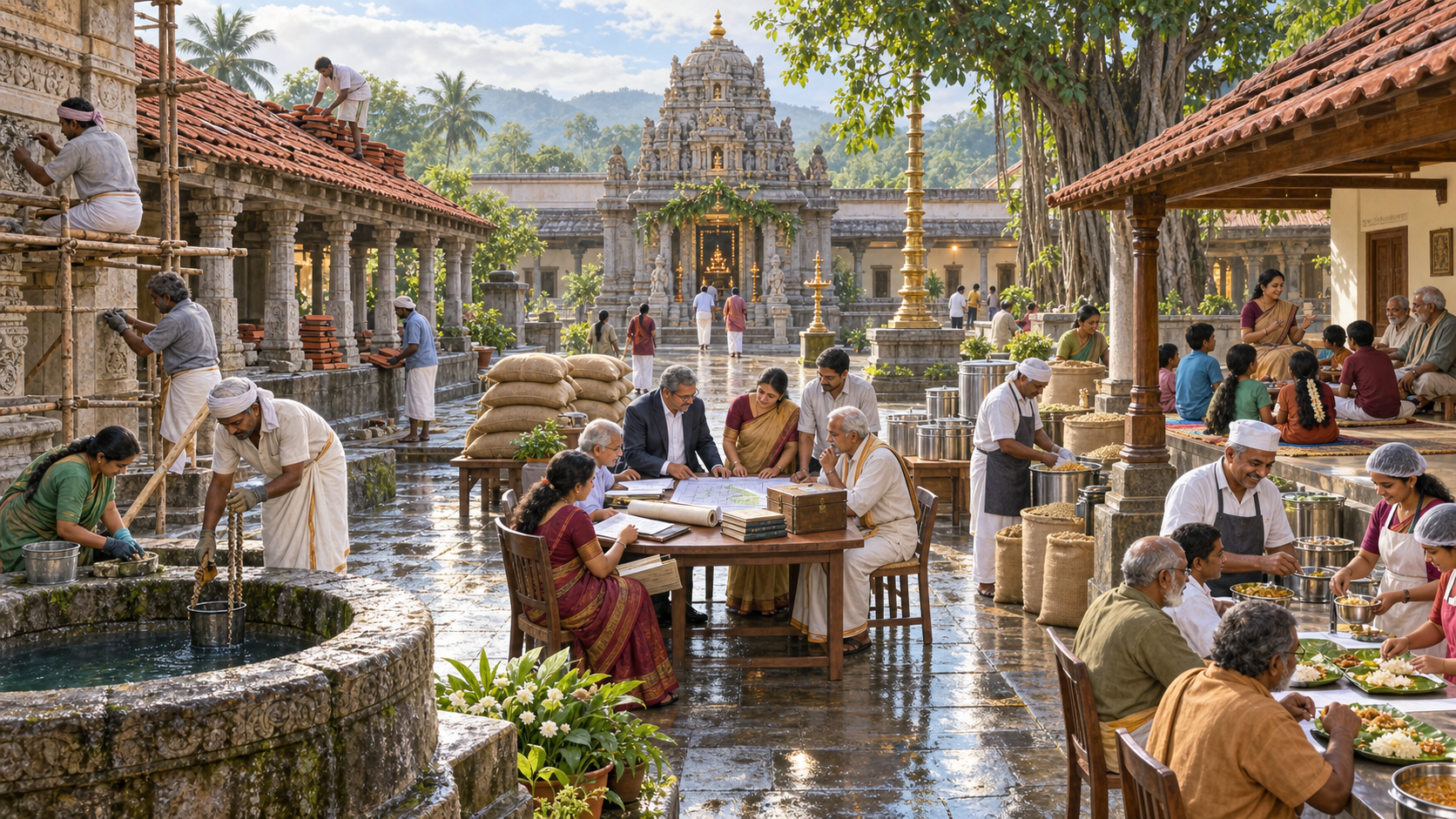
Historical recognition is necessary, but grievance alone cannot feed a pilgrim, educate a child, preserve an archive, or maintain a sacred site. Communities should distinguish restitution, repair, and revival because each has a different goal and standard of proof.
| Kind of work | Immediate question | Evidence or capacity required |
|---|---|---|
| Restitution | Was an asset, right, or income stream unlawfully or improperly removed? | Title records, legal history, continuity of claim, and qualified legal advice |
| Repair | Can the surviving institution govern its resources and fulfil its purpose reliably? | Accounts, asset registers, clear authority, controls, and a workable succession process |
| Revival | Can the community restore the practice and moral culture of daana? | Teaching, participation, recurring support, capable custodians, and visible service |
Do not transfer property, assert control, change trustees, or raise money on the strength of a historical belief alone. A moral claim may be compelling without yet being a legally enforceable claim. Have a lawyer familiar with the relevant jurisdiction examine title, trust documents, endowment rules, and current regulatory obligations before anyone takes an irreversible step.
For repair and revival, you can begin with a disciplined institutional audit:
- Choose one manageable unit. Start with one institution, one endowment, or one recurring service. A bounded inquiry is more likely to produce usable records than an attempt to prove the entire history of colonial India at once.
- Create an asset-to-purpose register. For each asset or income stream, record its claimed origin, evidence, original purpose, present custodian, current use, beneficiaries, and level of confidence. Leave a field blank when you do not know; do not convert uncertainty into fact.
- Write the dharmic purpose in one sentence. A custodian should be able to say exactly what obligation the institution exists to fulfil. If no one can state the purpose, fundraising will drift toward whichever project is most visible rather than the duty the institution inherited.
- Separate restricted gifts from general support. A donation made for food, learning, ritual upkeep, or another defined purpose should be tracked against that purpose. Clear accounts protect the donor’s intention and the custodian from avoidable suspicion.
- Measure service, not publicity. Track the activity that expresses the institution’s purpose: meals provided, students supported, facilities maintained, pilgrims housed, manuscripts preserved, or ceremonies sustained. Choose only measures relevant to the actual institution.
- Preserve the evidence with the practice. Digitise lawful copies of inscriptions, deeds, account pages, photographs, and testimonies. Record provenance and access restrictions. An image without its date, location, owner, and context quickly becomes an orphaned claim.
- Plan succession. Document who can authorise spending, who holds records, how conflicts are handled, and how future custodians are selected. A revival dependent on one energetic person is an event, not yet an institution.
- Report to the community. Publish a concise annual account linking resources to dharmic purpose and actual service. Transparency does not make an institution less sacred; it helps prevent the intention behind daana from being lost again.
This approach avoids two unhelpful extremes. One treats a Hindu institution as if sacred intention excuses poor stewardship. The other copies a generic administrative model until the institution’s religious purpose becomes an embarrassment. Sound recovery needs both: dharmic clarity about why the institution exists and accountable governance that keeps its resources faithful to that purpose.
Key takeaways
- Colonial destruction can mean a broken chain of assets, authority, purpose, transmission, and trust even when a building or ritual survives.
- Large estimates of colonial extraction establish economic context; they do not prove the history of a particular charitable institution.
- The strongest case begins with a named institution and traces a documented before-and-after causal chain.
- Continuity, adaptation, internal failure, and later interventions should be recorded alongside colonial damage.
- Restitution, institutional repair, and cultural revival are related but distinct tasks, each requiring different evidence and expertise.
- Restoring daana means protecting sacred intention through recurring service, accurate records, transparent accounts, and planned succession.
Choose one institution you care about and make the first asset-to-purpose register this month. Even four columns—resource, original duty, present use, and evidence—will reveal what is known, what has been interrupted, and what must be recovered. That modest act turns civilizational memory from a slogan into stewardship.
References
- DharmaRenaissance Blog — How the Colonial British Systematically Destroyed Hindu Charitable Institutions: The Untold Story
