

If someone you love has suddenly adopted an all-consuming religious or political identity, your first impulse may be to challenge the doctrine. Start elsewhere. Ask what the identity is doing for that person that family, friendship and community are no longer doing.
A person who feels unseen can experience a tightly organised group as relief. People remember their name, answer their messages, explain the world, assign meaningful duties and offer a place among others. That does not make the new belief false, and it does not prove manipulation. It means belonging and conviction may be entangled. You will understand neither if you treat disagreement as the whole problem.
The argument may be about belief while the wound is about belonging

Family breakdown is not limited to divorce or open conflict. A family can share a home and still have little common life. Long commutes, unpredictable work demands, school changes, exhausted parents, distant grandparents and device-saturated leisure can leave everyone functioning beside one another rather than with one another.
The reverse is also true. Parents who live separately, work difficult schedules or reside far from relatives can still give a young person durable belonging when care is predictable. The decisive question is not whether the household looks traditional from the outside. It is whether someone inside it is regularly known, needed, corrected with dignity and loved without having to perform.
When those relationships thin out, an organised movement can supply what is missing. It may provide an instant circle of friends, a mentor, a moral vocabulary, admired figures, a daily stream of approval and a clear struggle in which the recruit matters. Even a rigid identity can feel liberating when the alternative is invisibility.
Some Dharmic parents encounter this as anxiety about conversion to Islam. Others encounter it as a sudden embrace of a political culture often described as woke. These are not interchangeable traditions, and collapsing them into one doctrine obscures more than it explains. The practical overlap lies in their possible social role: almost any movement can become unusually attractive when it offers immediate fellowship to someone whose older bonds have weakened.
Loneliness is a vulnerability, not a complete explanation. Some religious conversions arise from sincere conviction. Some political commitments follow serious moral reflection. A family cannot infer coercion merely because a new identity is unfamiliar, inconvenient or painful. If you begin by declaring the person brainwashed, you may confirm the claim that nobody at home is willing to hear them.
For a Dharmic family, the answer cannot be louder ancestral pride alone. Dharma has to be encountered as a living network of practice, responsibility, inquiry, affection and service. A young person who hears that tradition is precious but has no meaningful place within its daily life receives an inheritance in name, not in experience.
Before debating beliefs, map the person’s actual field of belonging:
- Who knows when they are struggling without waiting for a public crisis?
- Which adult can they approach without expecting a lecture, report or punishment?
- What useful responsibility belongs to them at home or in the community?
- Which friendships survive disagreement rather than depend on performance?
- Do grandparents, cousins, teachers, neighbours or mentors have a real presence in their life?
- Are family connections embodied in meals, visits, work and worship, or maintained only through occasional messages?
These questions do not excuse destructive conduct. They identify the part of the problem a family can actually repair.
Test whether the new community permits freedom

The most useful first test is not whether you agree with the new group. It is whether the person remains free inside it. Healthy religious and political communities can make serious demands, but they leave room for conscience, questions and relationships beyond the group. Coercive communities turn belonging into leverage.
Look for patterns rather than treating one awkward interaction as proof. A person may become enthusiastic, change clothing, adopt unfamiliar language or spend more time with new friends without being controlled. Concern rises when several of the following begin to reinforce one another:
- The person is instructed to hide ordinary conversations, meetings, travel, money or relationships from everyone outside the group.
- Questions are treated as betrayal, impurity or evidence that an enemy has taken hold.
- Affection, status or promised salvation depends on escalating obedience.
- Family and old friends are dismissed as morally contaminated before their conduct is considered.
- A leader or inner circle is placed beyond scrutiny while outsiders are held to impossible standards.
- The person is pressured for money, intimate material, unpaid labour, travel, marriage or other commitments they are not free to reconsider.
- Leaving is associated with threats, exposure, social destruction or harm to loved ones.
- Ordinary responsibilities such as study, employment, care for dependants and basic self-care are abandoned because only the movement is said to matter.
No single sign settles the question. Religious discipline can involve sacrifice, and political activism can require sustained work. The distinction is whether the person can make informed choices, retain lawful control of their life, question authority and maintain relationships without fear.
A faith is not a cult merely because a family dislikes a conversion. An activist movement is not coercive merely because its politics are unfamiliar. Judge the conduct. Attacking an entire religion or social group will rarely clarify whether this particular person is safe; it may instead bind their new identity more tightly to the experience of being rejected at home.
If there are credible threats, blackmail, sexual exploitation, plans to disappear, unlawful confinement or talk of self-harm, stop treating the situation as an intellectual dispute. Preserve relevant communications without circulating them publicly. Avoid a dramatic solo confrontation that could increase immediate danger. Seek appropriate local safeguarding, legal, emergency or qualified mental-health help for the specific risk. Family dialogue is valuable, but it is not a substitute for professional intervention when safety is at stake.
Open a conversation that leaves a road back
Your aim is not to win an evening’s argument. It is to keep truth, affection and accountability in the same room. Begin with questions that allow the person to describe an experience rather than defend a label:
- You matter to us more than agreement. Help us understand what you found there.
- What changed in your life before this community became important?
- What do these people give you that you were not receiving elsewhere?
- Which questions are welcomed, and which questions are punished?
- If you changed your mind, what do you think would happen?
- Has anyone asked you to hide money, travel, messages or a relationship?
- What has made home difficult to trust, and what would make honest conversation easier?
Listen for events and relationships before rebutting conclusions. If the person says nobody at home had time for them, a lecture on gratitude will miss the information. If they describe humiliation, ask what happened. If their factual claim is wrong, you can return to it after showing that disclosure will not be punished merely because it is uncomfortable.
Curiosity does not require capitulation. State behavioural boundaries plainly. Family members may disagree about theology or politics; they may not threaten one another, steal family money, expose private information, use degrading abuse or bring coercive actors into the home. Keep the rule attached to conduct rather than using it to suppress every unpopular opinion.
Avoid turning the conversation into a tribunal. Do not assemble relatives to shame the person, demand an immediate renunciation, ridicule sacred language or force them to defend every act committed by strangers who share the new label. Public humiliation makes retreat costly. It can leave the person dependent on the very community you fear has become too powerful.
If the person is an adult, their convictions are theirs to choose. Your influence rests mainly in the quality of the relationship and the integrity of your boundaries. If the person is a minor, caregivers still have a duty to protect them, but protection should not become degradation. Supervision, clear household rules and age-appropriate limits can coexist with respectful listening.
If they refuse to talk, keep contact low-pressure and predictable. Do not make every meal, ride or message a disguised debate. A short assurance is enough: The door is open. We want to understand, and there will be no ambush. Then make that promise true when they eventually test it.
Rebuild the village through ordinary, repeatable acts
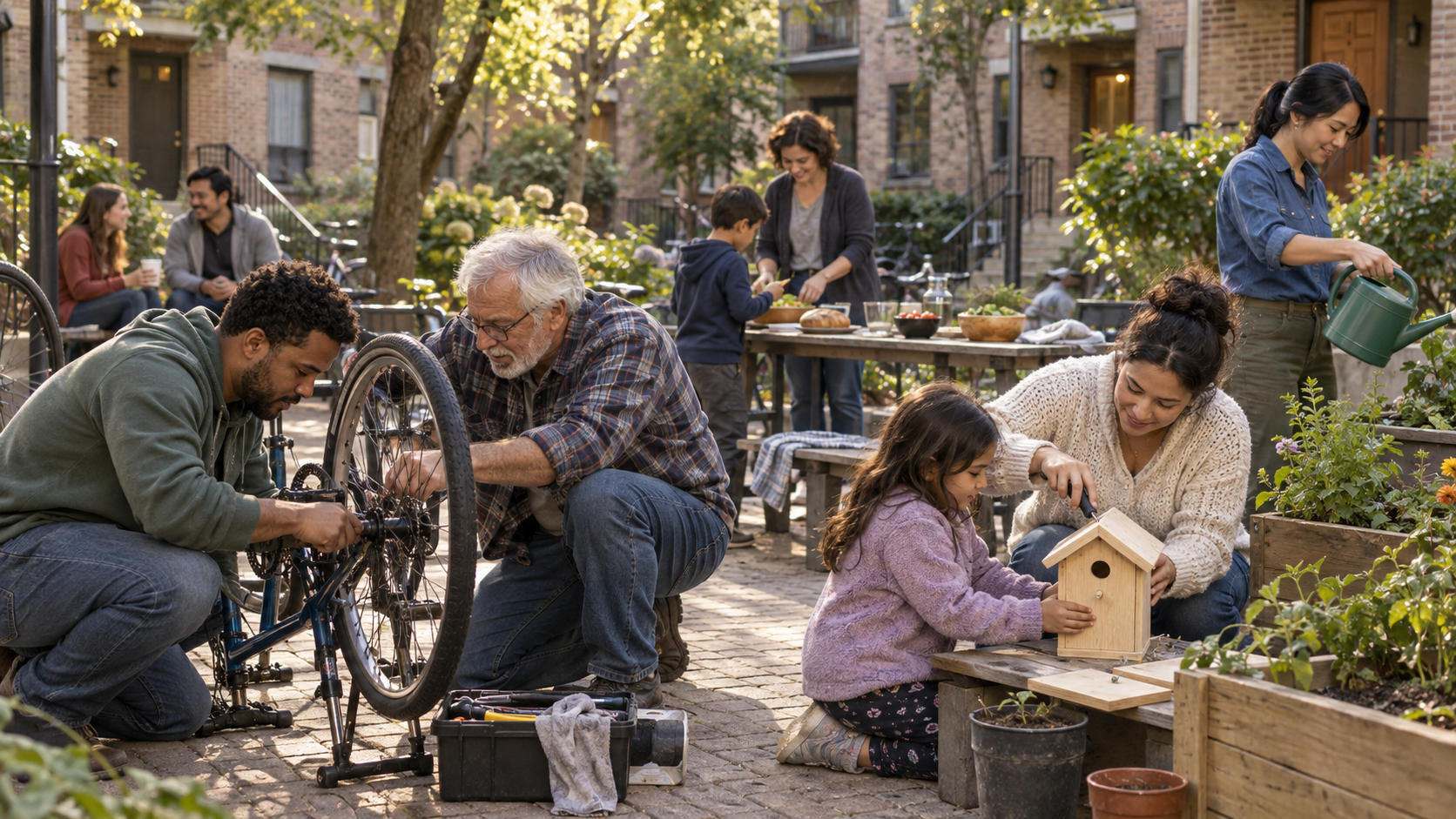
Start with the calendar, not the creed. A family cannot repair chronic disconnection through one emotional confrontation. It needs recurring forms of life that survive busy weeks and imperfect moods.
- Protect a fixed shared rhythm. It might be a meal, walk, puja, meditation period, reading circle or act of seva. Put it on the household calendar and keep work and personal devices from consuming it.
- Give the young person a real responsibility. Cooking, helping an elder, preparing for a festival, maintaining accounts, tutoring a child or organising community service creates a place that passive attendance cannot.
- Reconnect generations around something concrete. Ask a grandparent or elder to teach a recipe, prayer, language, craft or family history. Do not make every contact an inspection of marks, career plans or behaviour.
- Find a trustworthy mentor whom both the family and the young person can respect. The mentor should have transparent boundaries and should not be recruited as a spy.
- Build peer belonging around service, study, sport, music, language, arts or a community project. The role should be specific enough that the person’s presence genuinely matters.
- Repair the adults’ shared life. If parents communicate only through logistics, criticism and contradictory commands, a child sees a household without a common centre. Adults need visible practices of cooperation as much as children need instruction.
Dharmic institutions have work to do as well. A temple, vihara, Jain centre or gurdwara cannot expect festival attendance alone to answer a young person’s need for friendship, guidance and purpose. Worship is central, but continuity also depends on what happens between major observances.
- Keep predictable drop-in hours so that every encounter does not require a ticket, registration or special occasion. A safe community centre need not be open 24×7 to embody the principle of an available door.
- Assign named adults to welcome newcomers, learn their names and follow up without pressuring them.
- Offer question-friendly study in which doubt is answered with patience rather than treated as disloyalty.
- Create visible paths into seva, with tasks suitable for different abilities rather than vague invitations to get involved.
- Use transparent mentoring arrangements, published safeguarding rules and clear procedures for reporting misconduct.
- Make room for age-specific and, where useful, women-led or men-led mentoring while preserving intergenerational community life.
- Provide practical solidarity during family emergencies. Meals, transport, companionship, labour and moral support turn community from a slogan into a dependable relationship.
Do not measure success by whether the person repeats the family’s preferred political vocabulary. Look for more durable signs: they ask for help without panic, bring a friend home, resume neglected responsibilities, disagree without cutting off contact, question leaders without terror and participate without pretending to be someone else.
This is also where Dharmic communities must resist copying the worst features of totalising movements. If we answer loneliness with another loyalty test, we have not restored dharma; we have merely competed for possession of the lonely person. The better community joins belonging to freedom, affection to duty and confidence in tradition to the right of honest inquiry.
Key takeaways
- A sudden religious-political identity may be supplying belonging as well as belief, so examine both.
- Neither conversion nor political disagreement proves coercion. Test whether the person can question, leave, retain outside relationships and control personal decisions without fear.
- Open with curiosity about lived experience. Set firm boundaries around threats, exploitation, secrecy and abuse.
- Reconnection requires predictable rhythms, useful duties, trustworthy mentors and peer relationships built around shared work.
- Dharmic continuity becomes credible when a person is known, needed and loved before being asked to defend the tradition.
Your first move can be modest and exact. Protect the next shared meal, and ask one question whose answer you are genuinely prepared to hear. A durable family does not require uniformity. It requires a road by which disagreement can return to relationship.
References
- DharmaRenaissance Blog – Loneliness & Islamic Conversions and Woke Agenda
