

If Shiva remains absorbed in meditation after marrying Parvati, does Hindu tradition imply that spiritual depth requires distance from your spouse? No. The more useful reading is almost the reverse: marriage does not have to end your inner life, and spiritual practice does not have to diminish love.
This matters whenever you feel forced to choose between closeness and contemplation, household responsibility and sadhana, or devotion to another person and freedom from possessiveness. Shiva’s example does not remove that tension for you. It shows you how to hold it without sacrificing either side.
Marriage does not replace the inner centre
The enduring image is not of Shiva meditating only until Parvati arrives. It is of meditative absorption continuing within his union with Parvati. That distinction carries the central teaching.
A spouse can be your companion, beloved and partner in dharma without becoming the entire ground of your identity. If you expect another person to silence every fear, satisfy every longing and confirm your worth at all times, affection gradually becomes a demand. You stop meeting the person before you and begin measuring how successfully that person regulates your inner world.
Shiva’s meditation points to an awareness that is not manufactured by relationship status. Marriage changes the form of life, but it does not make inward discipline obsolete. Parvati’s presence is therefore not a failure to fill some absence in Shiva, and Shiva’s stillness need not be read as a failure to love Parvati. Their union does not require either person to disappear into the other.
For you, the practical question is not whether you love your spouse deeply. It is whether love has become possession, dependency or constant emotional accounting. Notice the difference between saying, “I choose to share my life with you,” and silently demanding, “You must make me whole.” The first can support commitment. The second places an impossible burden on both people.
Non-attachment is not indifference
This teaching is easily misused because non-attachment can sound like emotional coldness. Yet indifference and non-attachment move in opposite directions. Indifference avoids the other person’s reality. Non-attachment allows you to face that reality without trying to own or control it.
- Indifference says, “Your needs do not concern me.” Non-attachment says, “I will care for you without treating you as my possession.”
- Withdrawal disappears when responsibility becomes inconvenient. Contemplative solitude has a clear boundary and returns you to responsibility.
- Neglect leaves the other person carrying duties alone. Genuine practice should make your conduct more deliberate, truthful and available.
- Emotional suppression refuses to acknowledge pain. Inner steadiness acknowledges pain without allowing every reaction to dictate the next action.
This is why Shiva’s divine condition cannot be copied as a household excuse. A human being cannot imitate the outward posture of Mahadev while ignoring a spouse, evading work or refusing necessary conversation. If your meditation consistently makes life harder for everyone around you, the problem is not that your family lacks spirituality. Your practice has become disconnected from dharma.
Use a simple test: after sitting in silence, are you more capable of listening without immediately defending yourself? Can you complete an ordinary duty without resentment? Can you let your spouse disagree without treating disagreement as betrayal? These are more revealing measures than how serene you appear while sitting alone.
Avoid the two opposite misreadings
The first misreading turns marriage into the end of spiritual discipline. It assumes that inward practice belongs to the unmarried, the renunciant or the socially detached. Under this assumption, every quiet interval appears selfish and every concern must be processed through the relationship. The result is not necessarily intimacy. It can be exhaustion, reactivity and the loss of a stable inner perspective.
The second misreading uses spirituality to escape marriage. Silence becomes a shield against difficult discussion. Detachment becomes a respectable name for withholding affection. A spiritual identity becomes more important than keeping promises. This is not the lesson of meditation continuing after marriage; it is a way of removing marriage from the picture while retaining its comforts.
You can identify which error is closer to your situation by asking what repeatedly gets displaced. If every household demand pushes practice aside, your inner life has no protected place. If practice repeatedly pushes agreed duties aside, your relationship has no protected place. The aim is not to declare one side superior. It is to give both a truthful boundary.
There is another mistake worth noticing: treating a divine marriage as literal domestic surveillance. Shiva and Parvati are not useful because every feature of their sacred life can be mechanically reproduced by a couple. Their image gives you a principle to embody according to your actual responsibilities. The principle is inward freedom joined to committed relationship, not withdrawal disguised as holiness.
Put the teaching into household practice
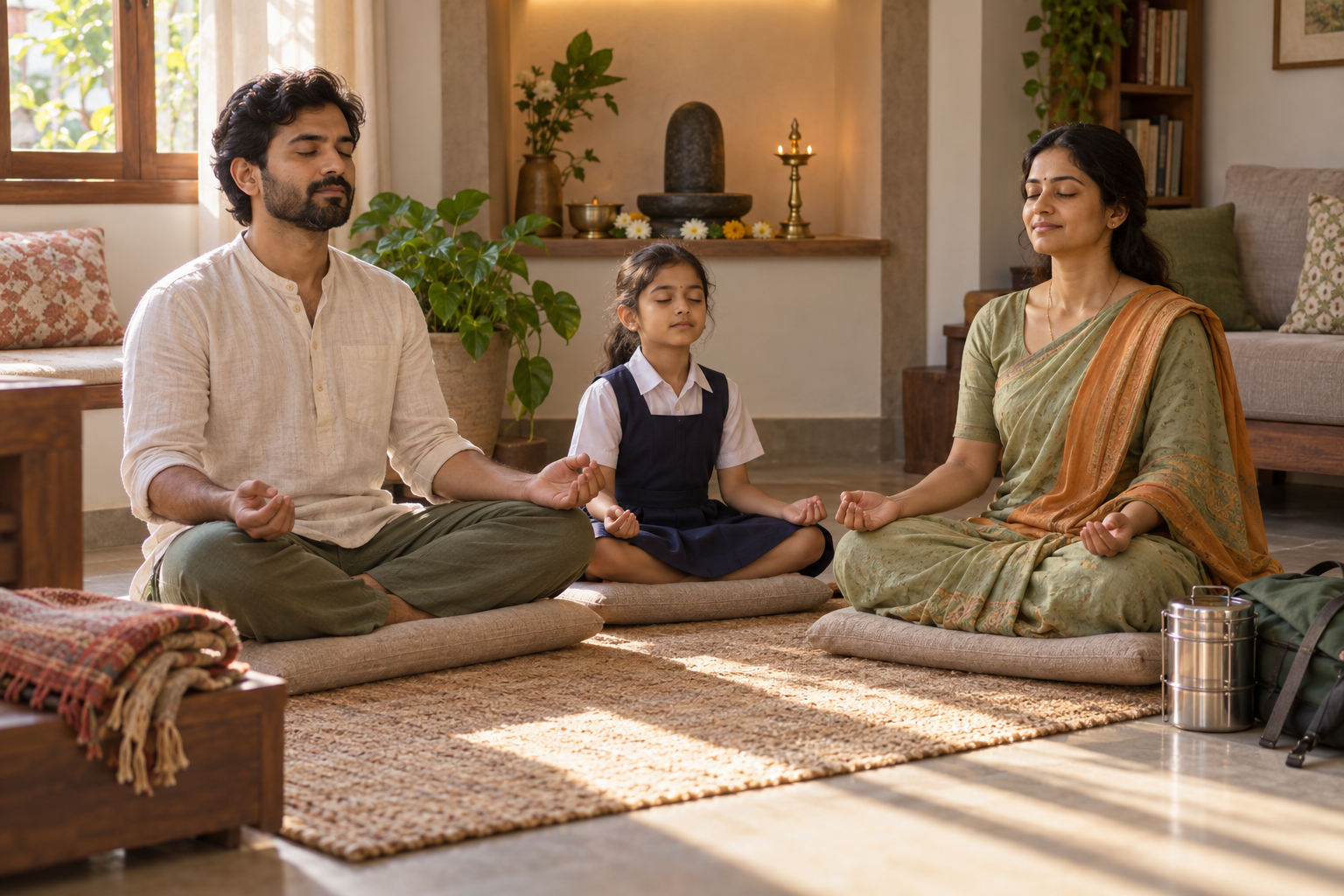
You do not need to recreate Shiva’s outward austerity. You need a form of practice that protects contemplation without making your spouse pay for it. Build that balance openly.
- Choose a modest, repeatable window. Place meditation where it does not routinely collide with a duty you have already accepted. A sustainable period kept regularly is more honest than an ambitious practice that produces conflict and guilt.
- Make the boundary visible. Tell your spouse when you will be unavailable and when you will return. Predictability distinguishes chosen solitude from unexplained disappearance.
- Do not use silence to postpone a necessary conversation. If something must be discussed, agree on when you will discuss it. Meditation may help you enter the conversation with steadiness, but it must not become a method of indefinite avoidance.
- Reconnect through an ordinary act. After practice, return to shared life deliberately: finish a task, listen fully, offer affection or handle a responsibility without being prompted. This prevents meditation from becoming an isolated spiritual performance.
- Review the effect, not merely the schedule. Ask whether the practice is reducing impulsive reactions and increasing truthful presence. Invite your spouse to say if your routine is creating a recurring burden. Adjust the arrangement without abandoning the inward purpose.
If your spouse does not share your practice, agreement on belief is unnecessary. Agreement on conduct is enough. You can explain the practical boundary, keep your commitments and avoid pressuring the other person to validate your sadhana. Respect works in both directions: your practice should not dominate the household, and the household should not automatically treat every period of contemplation as rejection.
If you are unmarried, the same lesson applies before marriage. Do not build an inner discipline that depends entirely on having no competing responsibilities. At the same time, do not enter marriage expecting the relationship to perform the work of self-knowledge for you. Establish a practice that can become simpler or change shape without disappearing when life changes.
Key takeaways
- Shiva’s continuing meditation after marriage rejects the false choice between spiritual depth and committed love.
- Parvati’s presence does not erase Shiva’s inner centre, and Shiva’s stillness need not be interpreted as rejection of Parvati.
- Non-attachment means loving without possession; it does not mean neglecting emotion, duty or communication.
- Meditation becomes avoidance when it repeatedly displaces promises or necessary conversations.
- The household test of practice is not an impressive posture. It is whether you return more truthful, responsible and present.
- Protect both contemplation and relationship by making the time boundary clear and its effects open to review.
The next time you sit, do not use Shiva’s stillness to move away from the person beside you. Use it to loosen the fear, possessiveness and reactivity that prevent you from meeting that person clearly. Then return to one waiting responsibility and perform it with full attention. That movement—from silence back into dharma—is where the teaching becomes yours.



References

Leave a Reply
You must be logged in to post a comment.