
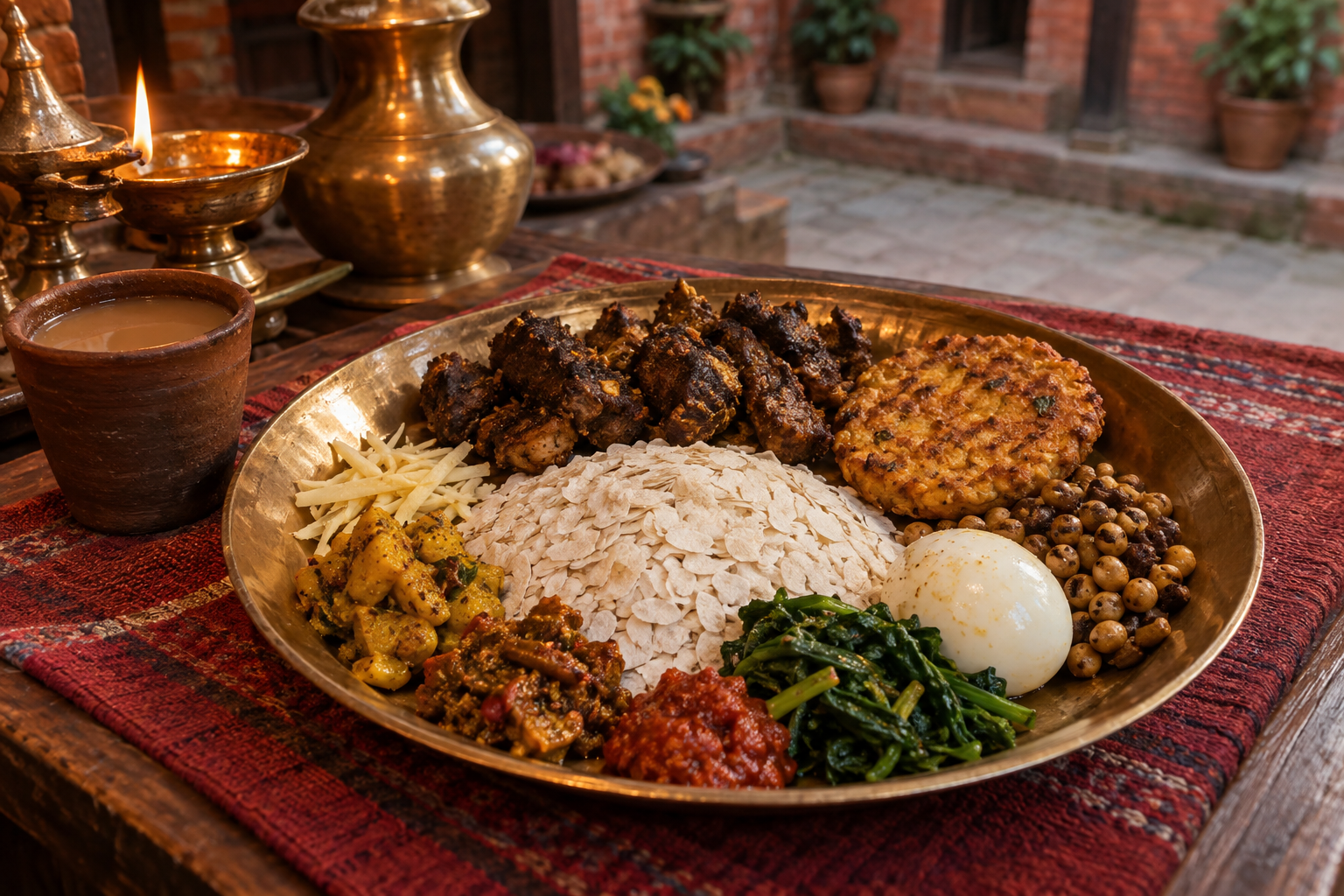
If a Samay Baji platter is placed before you at a Newa gathering, the easiest mistake is to treat it as a tasting plate: identify the foods, sample each one, and move on. That approach registers the flavours but misses the ritual intelligence holding the meal together.
You do not need an elaborate chart of secret correspondences to understand what is happening. Start with a more useful question: how can an arrangement of food make the structure of creation available to sight, touch, taste and digestion?
Begin with the platter, not a decoding chart
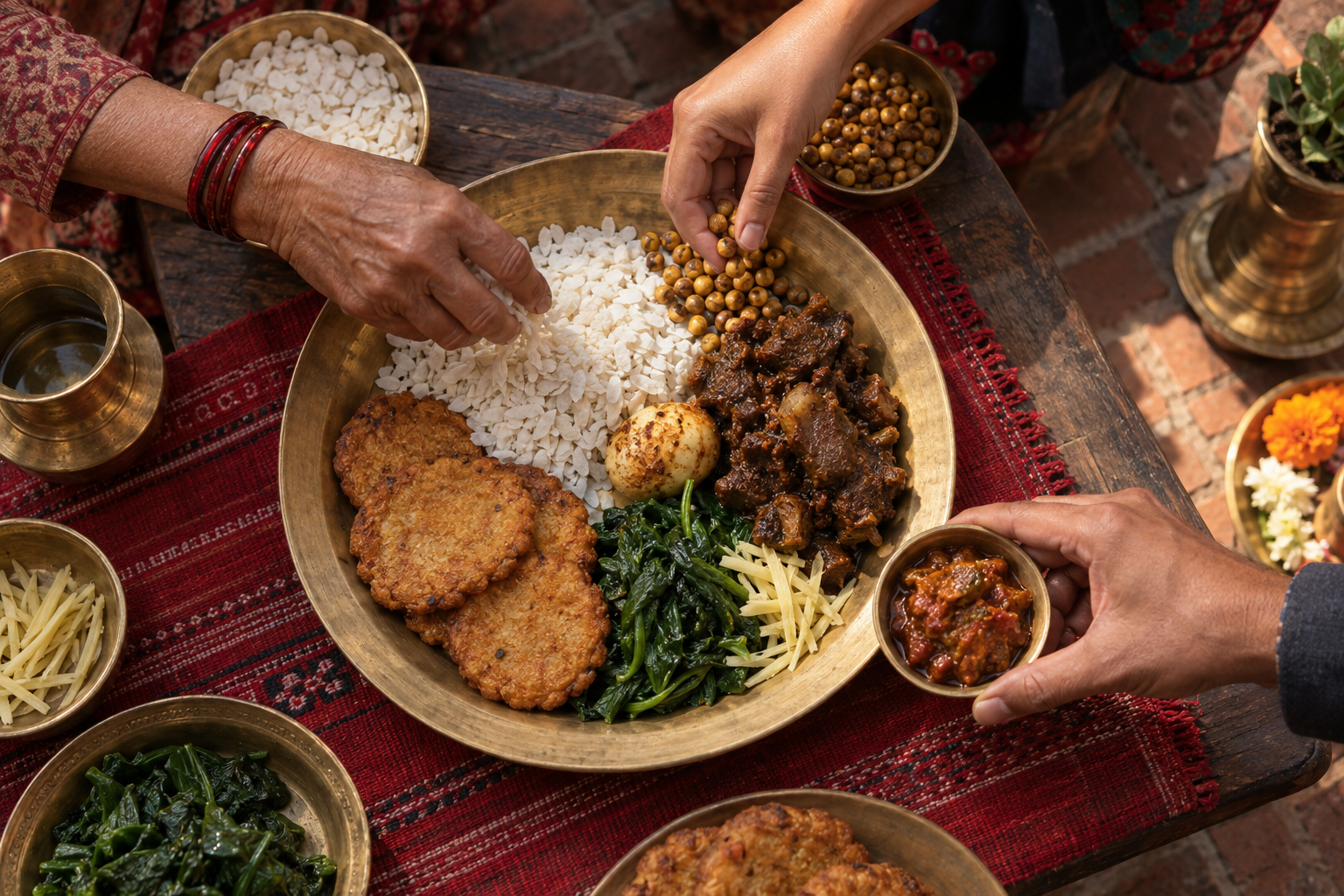
Samay Baji belongs to the festive and ritual life of the Newa people of the Kathmandu Valley. Its foods nourish the gathering, but the platter can also be read as a carefully composed image of an ordered universe. In this Tantric interpretation, the meal embodies the five elements of creation rather than merely illustrating them from a distance.
That distinction matters. A classroom diagram asks you to stand outside a system and inspect it. A ritual meal places you inside the system. You see distinctions among its components, encounter them through several senses, combine them in eating, and allow digestion to transform them. Cosmology becomes participation.
This is also why a rigid ingredient-to-element chart can mislead you. Five elements do not necessarily mean five foods, five piles or five universally fixed correspondences. One ingredient can express several qualities, and one element can become perceptible through preparation, placement, texture, aroma or the act of eating itself. A local ritual explanation may provide a precise mapping, but that mapping should not be assumed to govern every family, festival or lineage.
When you first encounter the platter, pause before rearranging it. Notice what has been placed together, what remains distinct, where contrasts appear, and whether the host treats the presentation as significant. Observation should come before interpretation.
The five elements are processes, not five menu slots
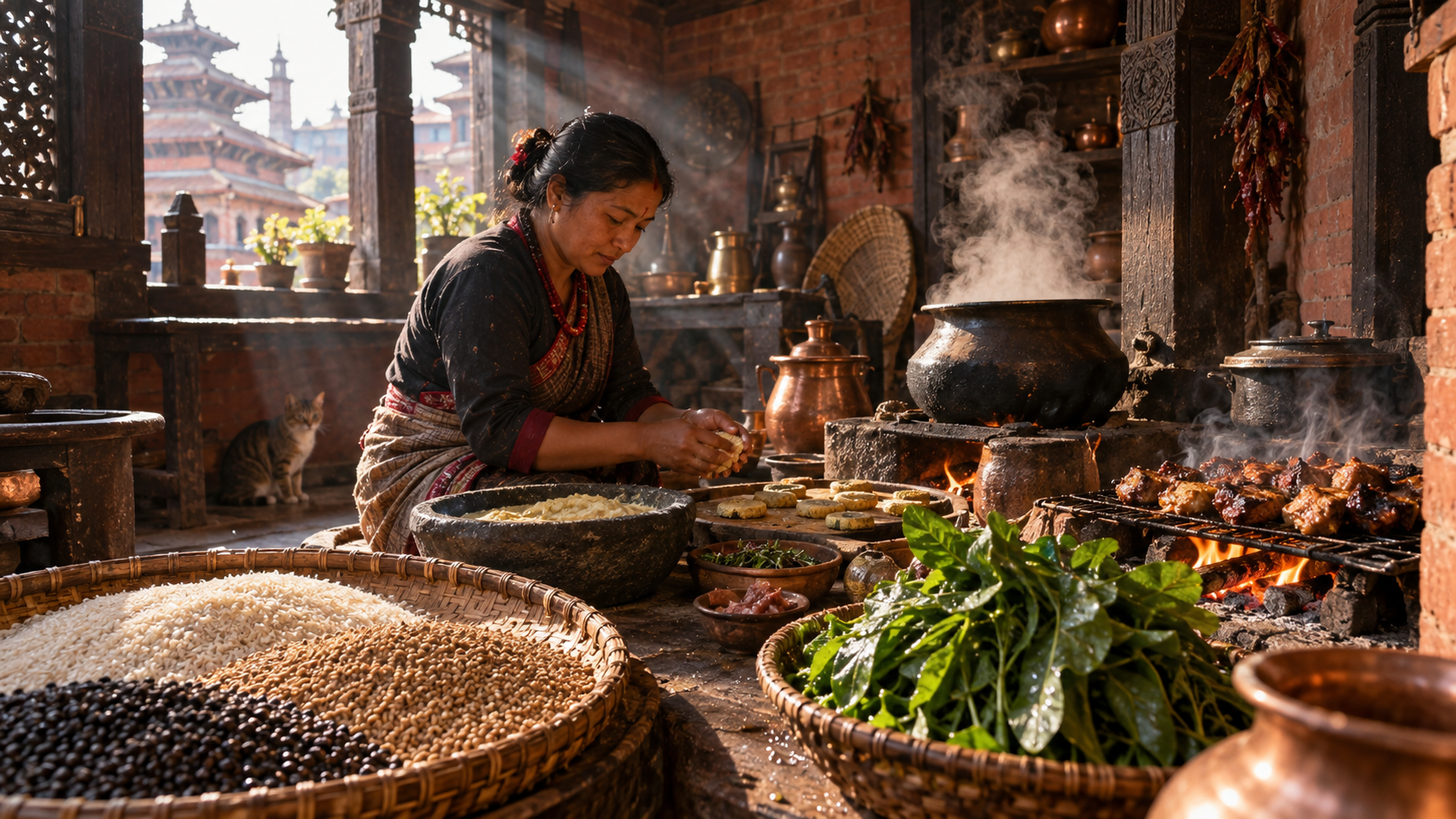
Across many Dharmic cosmologies, the five great elements are commonly named earth, water, fire, air and space. They are not simply modern chemical substances. They are ways of describing how manifest existence acquires stability, cohesion, transformation, movement and room for relationship. Their technical meanings and ritual correspondences can vary, so the following is a reading discipline rather than a claim that every Samay Baji tradition uses one identical code.
- Earth: Look for form, weight, support and substantiality. Earth is what gives an experience a definite presence. Do not reduce it to whichever food looks most solid; ask how the platter establishes groundedness as a whole.
- Water: Notice cohesion, moisture and the capacity of separate things to mingle. Water is not limited to a visible liquid. It is also the principle by which parts become a connected experience.
- Fire: Attend to transformation. Cooking is an obvious expression, but digestion is equally important. Fire therefore cannot be identified only with heat or pungency; it continues its work after the food enters the body.
- Air: Consider movement, circulation, breath and aroma. Air carries sensory contact and helps turn a static arrangement into a living encounter.
- Space: Notice the field within which every component can appear without becoming identical to the others. Space is not merely an empty patch on the plate. It is the condition that permits distinction, placement and relationship.
This process-based reading prevents a common error: treating cosmology as decorative labelling. If you decide that one morsel simply equals earth and another simply equals fire, you may be able to memorise a chart while learning very little about the meal. Instead, ask where stability, cohesion, transformation, movement and accommodation are actually occurring. Some are present in the preparation, some in the arrangement, and some only when you eat.
Use sensory contrasts as prompts, not as proof. Dry and moist, firm and yielding, separate and blended, aromatic and restrained may help you notice elemental qualities. They do not establish an authoritative correspondence by themselves. If you are documenting the tradition, label such observations as your interpretation unless a practitioner has explained them explicitly.
Eating completes the cosmological idea
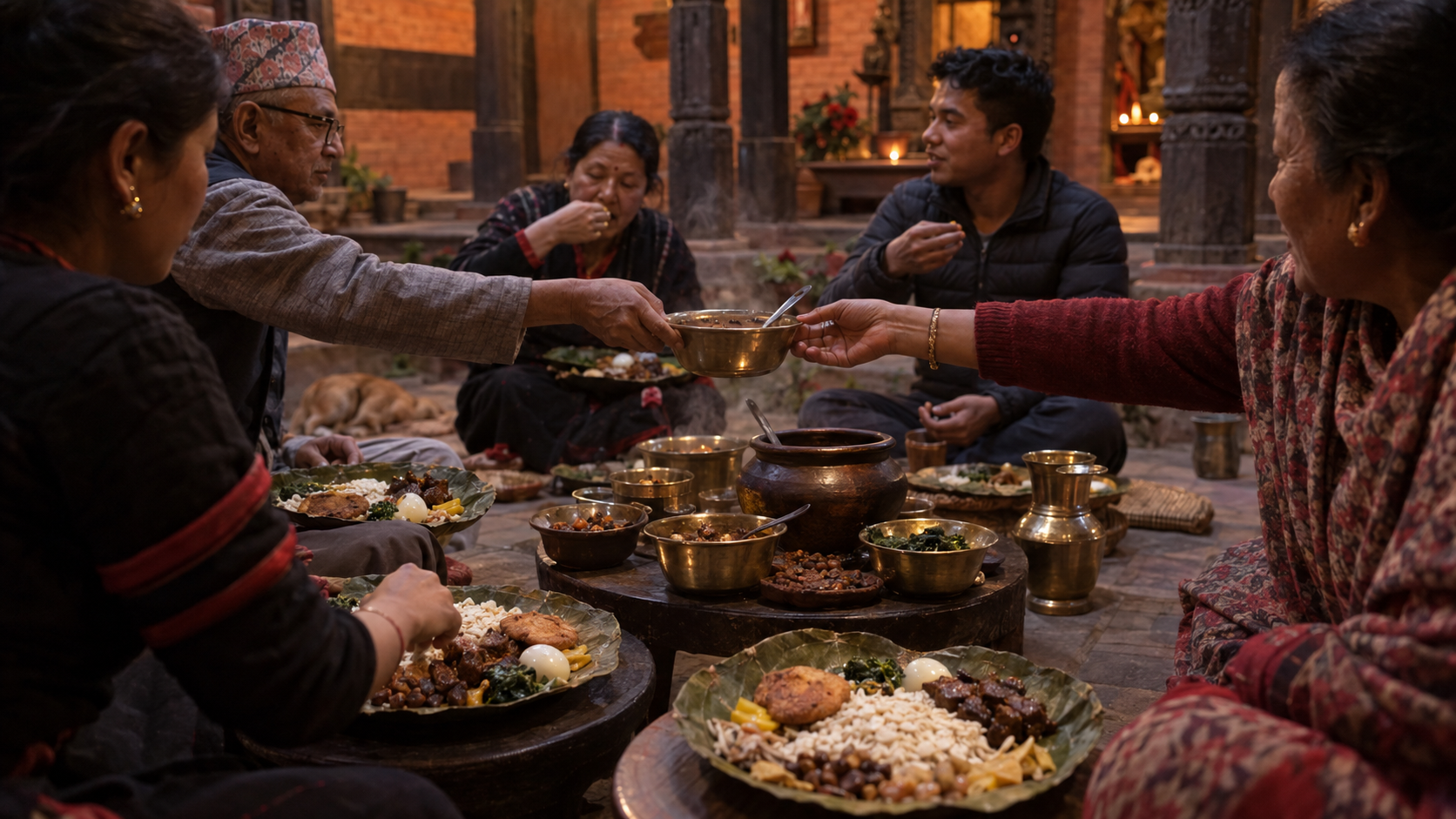
A Tantric reading does not ask you to escape material life in order to find sacred meaning. It asks you to notice how meaning is disclosed through material relationships. Samay Baji is therefore best understood through a sequence of three movements.
- Arrangement: Distinct foods share one ordered field. Difference is preserved without becoming disorder.
- Sensory encounter: Sight, smell, touch and taste turn a cosmological scheme into immediate experience. The elements are no longer only names.
- Transformation: Eating combines what was visibly distinct, while digestion changes food into bodily life. The person eating is not outside the elemental cosmos but composed within it.
The third movement is easy to overlook. Fire is active in transformation, air in breath and circulation, water in cohesion, earth in bodily substance, and space in the ordered field that allows all these processes to occur. The platter does not merely sit in front of a human observer. It enters a body already participating in the same elemental order.
This gives the communal feast a further significance. People do not have to become identical in order to share an order, just as the components of the platter do not have to lose their particular qualities in order to form a whole. That social reading is an interpretation, not a substitute for locally transmitted ritual meanings, but it helps you see why a cosmological meal belongs naturally in a gathering rather than only in a museum display.
The setting remains important. A restaurant presentation may preserve the cuisine and still offer an opportunity for reflection, but it does not automatically reproduce the ritual relationships of a family observance, festival or communal feast. Food, occasion, participants and inherited practice work together. Do not assume that obtaining the right ingredients is enough to recreate the rite.
How to approach Samay Baji without flattening it
You can participate respectfully without pretending to possess specialised ritual knowledge. The practical rule is simple: let the people sustaining the tradition tell you which distinctions matter in that setting.
- Identify the occasion. Ask what is being marked before asking what every item symbolises. The same cuisine can carry different weight in a public celebration, a community feast and a domestic rite.
- Wait for the host’s cue. If the arrangement or order of eating matters, changing it prematurely can erase part of what you are trying to understand.
- Ask a narrow question. Try, “Does the arrangement have a meaning on this occasion?” or “How does your family understand the five elements here?” A precise question leaves room for a precise local answer.
- Separate three kinds of knowledge. Record what you observed, what a practitioner explained, and what you inferred as three different things. This single habit prevents personal speculation from hardening into a supposed universal rule.
- Preserve variation. If two explanations differ, do not rush to declare one corrupted or incomplete. Note the community, household or ritual context attached to each explanation.
- Avoid recreating a rite from an infographic. A diagram can help you remember concepts, but it cannot supply the relationships, authority or occasion through which a living ritual acquires meaning.
This method is especially important when writing, photographing or teaching about Samay Baji. A visually neat one-to-one chart may travel well online, yet false certainty does more damage than an acknowledged gap. If no practitioner has confirmed a particular correspondence, describe the broader elemental logic and leave the unverified detail open.
Key takeaways
- Samay Baji is not only a collection of foods; in a Newari Tantric reading, the arranged and eaten meal makes a five-element cosmos tangible.
- Earth, water, fire, air and space are better approached as interdependent processes than as five compulsory menu positions.
- The cosmological movement runs from arrangement to sensory encounter to bodily transformation.
- Local explanations outrank universal-looking charts. Ask how the platter is understood in the particular family, festival or lineage before assigning fixed meanings.
- Respectful participation begins with observing the occasion and following the host’s cues.
The next time you encounter Samay Baji, give the platter one quiet moment before the first bite. Notice how difference has been ordered without being erased, then ask one informed question about the occasion. That small pause will take you closer to its cosmology than any memorised list of correspondences.
References

Leave a Reply
You must be logged in to post a comment.