
Perhaps you’ve seen the argument: a ruler associated with land now in Pakistan is claimed as a national ancestor, then assigned a modern ethnic or religious identity. If you question the assignment, the discussion quickly turns into a loyalty test. You are expected to choose between calling Pakistan wholly foreign to the subcontinent or accepting every ancestry claim made in its name.
You don’t have to accept that choice. The useful question is not whether Pakistanis are indigenous or foreign as one undifferentiated people. It is what kind of inheritance is being claimed, what the chronology permits, and what evidence connects a historical person to a present population. That method protects the Dharmic past more effectively than exchanging one national myth for another.
Separate four kinds of inheritance before you argue
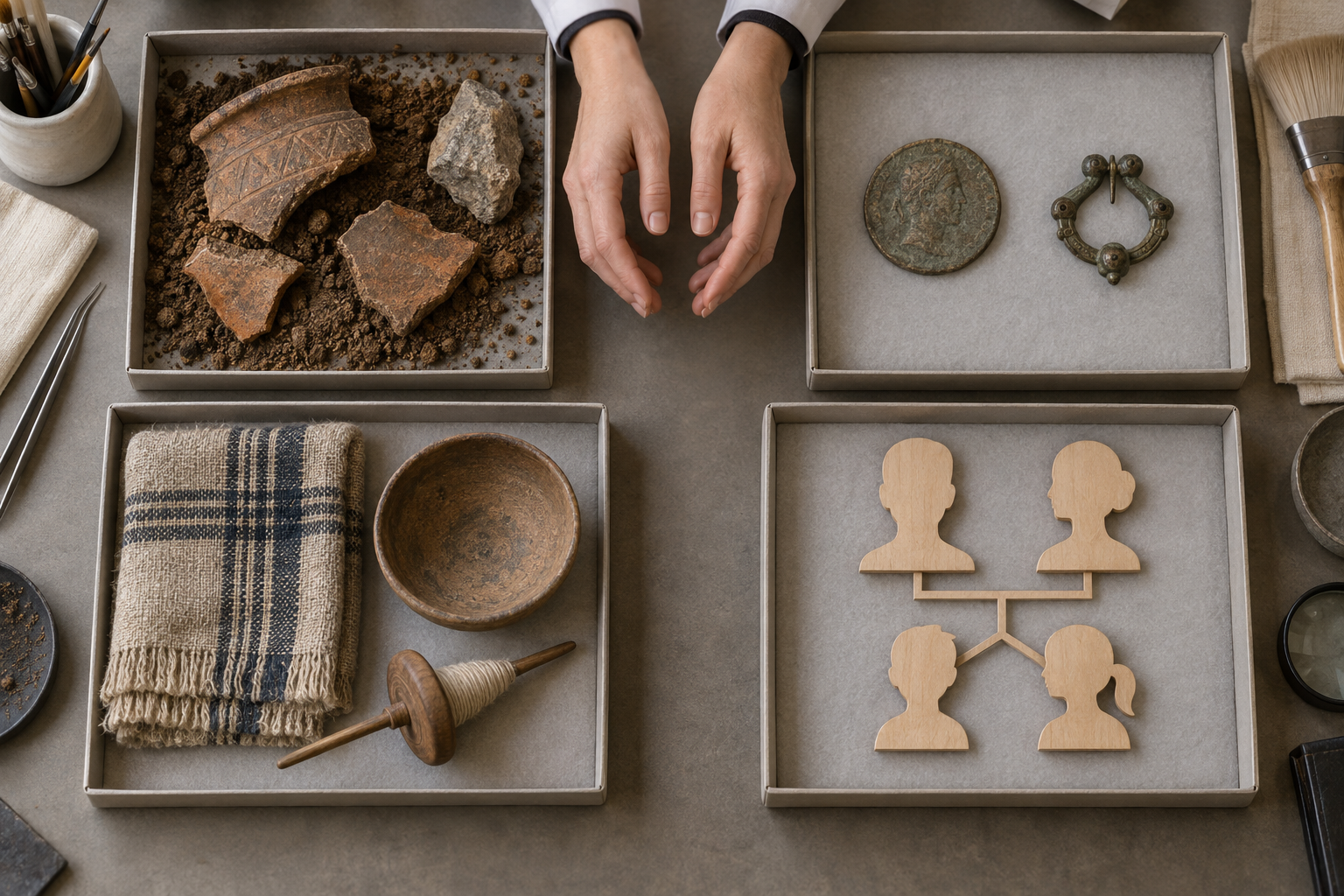
Most ancestry disputes become incoherent because several different meanings of inheritance are packed into one word. Before accepting or rejecting a claim, separate these four relationships:
- Genealogical inheritance means descent between people. It requires an evidentiary chain appropriate to the scale of the claim. A ruler’s presence in a region does not by itself make the ruler an ancestor of everyone who later lived there.
- Cultural inheritance includes languages, customs, stories, artistic forms and religious practices transmitted through communities. It can cross family lines and does not require biological descent.
- Territorial inheritance arises because a present society occupies land containing older sites, memories and historical events. It creates a duty of preservation. It does not grant exclusive ownership of every civilization that once occupied the land.
- Political inheritance is the account of the past that a modern state uses to explain itself. It can select, rename or neglect historical layers, but official preference cannot alter the date or identity of an earlier figure.
When someone says that a conqueror was our ancestor, ask which of the four claims is intended. The speaker may only mean that the conqueror once ruled part of the present country. That is a territorial or political connection, not proof of descent. If the answer keeps changing as you test it, the original statement was an expression of belonging rather than a historical conclusion.
This distinction also prevents an unnecessary false choice. A Pakistani can have deep indigenous ancestry without descending from a celebrated invader. A Muslim society can be responsible for preserving a region’s pre-Islamic Hindu past without claiming that every pre-Islamic ruler was Muslim. Territorial stewardship, cultural participation, religious commitment and family descent can coexist without becoming identical.
Put the sixth century back in the sixth century
A revealing test case comes from the conflict between Yasodharman of Malwa and the Alchon Hun king Mihirakula, remembered locally as Mehr Gul. At Sondani, Yasodharman defeated Mihirakula in 528 CE, with the victory recorded through the Mandsaur pillar inscriptions. The event belongs to the history of the wider subcontinent, including the contest for Punjab and northern India.
In a recorded exchange at Kehror Pucca, 86 km south of Multan, a shopkeeper first wanted to know whether Yasodharman was Hindu. Once told that he was, the shopkeeper assumed that Mehr Gul must have been Muslim and associated the familiar-sounding name with a Pakhtun identity. That conversation is not survey evidence about an entire population. It is useful because it compresses several common mistakes into a few questions.
- Anachronism: a figure fighting in 528 CE could not have been Muslim because Islam did not yet exist. A later religious category cannot be projected backward merely because it is important now.
- The opponent fallacy: if one side was Hindu, it does not follow that the opposing side belonged to a religion familiar from a much later period. Historical adversaries are not obliged to fit a modern Hindu-Muslim binary.
- Name matching: Mehr Gul sounding like a name used by later communities does not establish Mihirakula’s ethnicity, religion or descendants. Names travel, change form and can be reinterpreted long after their bearers die.
- Border projection: modern borders do not divide an older event into nationally pure parts. Yasodharman, Mihirakula, Malwa and Punjab must first be understood in their own political world.
Chronology is the quickest safeguard. Write 528 CE beside the claim before discussing modern identity. Then ask which religious, ethnic and political categories actually existed at that date. One correct date can expose a confident story that a long ideological argument leaves untouched.
This does not make chronology sufficient. A date can disprove an impossible label, but it cannot establish ancestry on its own. After eliminating the anachronism, you still need evidence connecting the historical actor to the people being discussed.
Use seven questions to audit an ancestral claim

You can test almost any viral claim about Pakistan’s ancestors without becoming trapped in a contest of slogans. Work through these questions in order:
- What is the exact proposition? Rewrite the claim as one sentence. Ruled this land, came from this region, influenced this culture and biologically fathered this population are different propositions.
- What is the date? Put the event and the proposed identity on the same timeline. If the identity did not exist at the time, stop there; the label is anachronistic.
- How did the person identify in that period? Prefer contemporary titles, religious affiliations and political relationships over labels supplied by later national memory. Do not make a historical person answer a modern census question.
- What evidence supports the relationship? An inscription can establish that a ruler won a battle or held a title. It does not automatically establish the genealogy of a later population. Name resemblance and present-day admiration are weaker still.
- What is the scale of the claim? Evidence about one ruler, clan or dynasty cannot silently become a conclusion about every citizen of a modern state. Each jump in scale needs its own support.
- Is the standard symmetrical? If ruling the territory turns a western conqueror into a national ancestor, the same rule must apply to indigenous Hindu rulers connected to the land. If religion determines belonging in one case, it cannot be ignored whenever it produces an inconvenient answer.
- What would change your conclusion? A historical claim must be open to correction by better dating, clearer inscriptions or a stronger genealogical connection. If no possible evidence could alter it, you are dealing with an identity commitment, not an investigation.
Watch for a further warning sign: the argument moves from connection to ownership. A society may legitimately value every layer of history found on its land. It cannot use that connection to erase the identities those people held, or to exclude neighbouring communities from a shared civilizational history.
Apply the method to your own preferred narrative as firmly as you apply it to Pakistan’s. A pro-Hindu account loses credibility if it answers careless Muslim anachronism with careless Hindu overreach. Not every pre-Islamic person was Hindu, and the presence of a Hindu kingdom does not prove the religious identity of every descendant who may remain in that region. Defend what the evidence establishes. Leave open what it does not.
Protect Dharmic memory without inventing a mirror myth
For a Dharmic readership, the first obligation is satya: do not make the truth smaller for political convenience, and do not enlarge it beyond the evidence. The pre-Islamic past of the lands now governed by Pakistan does not become foreign merely because the present state defines itself through a later religious identity. Hindu history connected to those lands should be named as Hindu history, not translated into a Muslim prehistory to make it nationally comfortable.
There is an equal danger in the opposite direction. Treating every Pakistani as a concealed Hindu, or reducing living people to the religion an unknown ancestor may have followed, denies their present agency. Conversion can change religion without changing all ancestry; migration and intermarriage can complicate both. Without a specific genealogical chain, sweeping certainty is unwarranted.
You can answer contested claims firmly without humiliating the person making them. Use language that identifies the precise error:
- If a sixth-century king is called Muslim, say: The event is dated to 528 CE, so that religious label is historically impossible. Let us identify him using categories available in his own time.
- If conquest is presented as proof of descent, say: Rule establishes political presence. What evidence turns that ruler into the biological ancestor of this later population?
- If a familiar name is offered as proof, say: Similarity of names is a clue to investigate, not a conclusion about ethnicity or religion.
- If Hindu history is dismissed as irrelevant to Pakistan, say: A modern border cannot remove an older event from the history of the land where it occurred or from the wider Bharatiya civilizational record.
- If a Pakistani chooses to honour the region’s Dharmic heritage, receive that interest without imposing a religious identity on the person. Historical recognition does not require coerced theological agreement.
This approach keeps two responsibilities together. We should resist the erasure of Hindu memory, especially when a present identity is projected backward over a demonstrably earlier past. We should also distinguish a state’s simplifying narrative from the dignity and complexity of every person living under it. Historical correction is strongest when it is exact enough that it does not need collective contempt.
Key takeaways
- Separate genealogical, cultural, territorial and political inheritance; evidence for one does not automatically prove the others.
- Put the date beside the identity claim. A label that did not exist at the time cannot describe the historical figure.
- Do not treat a familiar-sounding name, conquest or present border as proof of religion, ethnicity or biological descent.
- Recognise Pakistan’s responsibility for its pre-Islamic heritage without allowing a modern national narrative to rename that heritage.
- Defend documented Hindu history while refusing the mirror myth that every present Pakistani must therefore possess or accept a Hindu identity.
The next time an ancestral claim appears, do three things before joining the argument: write the claim in one sentence, place its date beside it, and name the exact relationship being asserted. Many myths collapse at that point. The claims that survive can then be examined through inscriptions, genealogy and historical context rather than volume.
The durable pro-Dharma position is not the largest claim we can make. It is the clearest claim we can still defend after applying the same standard to friend and opponent. Preserve the documented Hindu past, expose impossible labels, and leave ancestry open wherever the necessary evidence is absent.
References
