
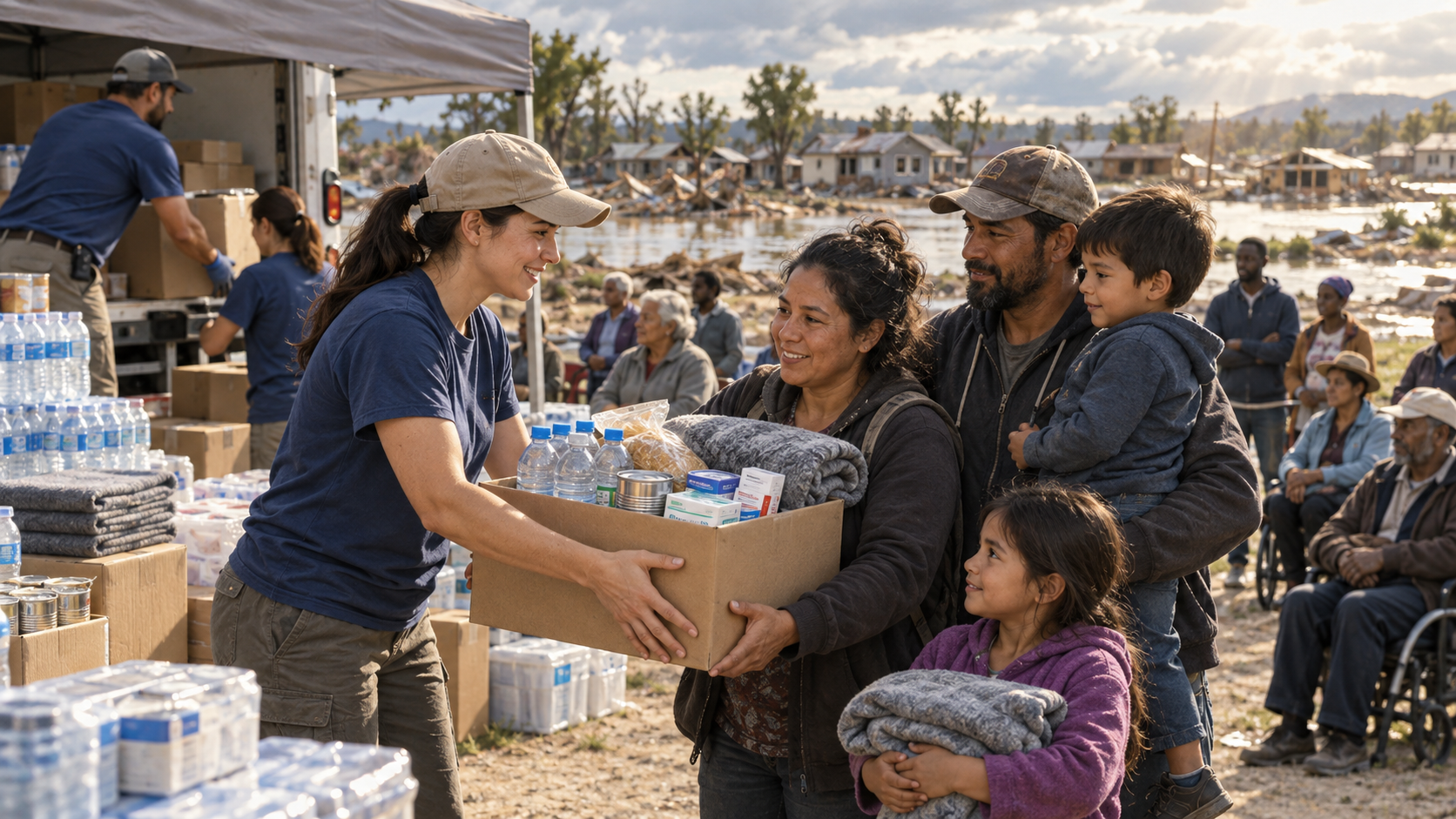
A flood has destroyed a family’s home. Food, medicine, and temporary shelter are urgent. The organisation able to reach them first has a missionary affiliation, and you are deciding whether to donate, volunteer, host its workers, or warn the affected community. The useful question is not whether religious people may serve. It is whether survivors can receive essential help without surrendering religious freedom.
Use one clear rule: faith may motivate the giver, but it must never become the price paid by the receiver. That rule protects Hindu, Buddhist, Jain, Sikh, Christian, Muslim, and non-religious families alike. It also gives Dharmic organisations a practical standard for seva that is more demanding than good intentions.
The line is crossed when relief becomes leverage

A faith-based organisation is not automatically a conversion operation. Volunteers may pray privately, wear religious clothing, or explain their institutional identity. Survivors may also request prayer or spiritual care. None of that, by itself, makes humanitarian assistance coercive.
The ethical problem begins when access, timing, dependence, or authority is used to obtain religious participation. A person waiting for drinking water cannot freely refuse the worker controlling the queue. A displaced child cannot negotiate with an adult offering food, education, or relocation. Consent given under those conditions may look voluntary on a form while being constrained in practice.
This is why the channel chosen for public relief deserves scrutiny without prejudging every worker in it. On August 28, 2026, the United States announced $500,000 in flood assistance for Nepal, with the first consignment routed through Catholic Relief Services and Caritas Nepal. Their religious affiliation does not prove misconduct. It does make transparent safeguards especially important in a region where aid-linked proselytisation has previously been alleged.
Look for conduct, not merely a cross, tilak, khanda, or institutional name. Six warning signs matter:
- Religious activity comes before relief. In earthquake-stricken El Salvador, Samaritan’s Purse volunteers were reported to have held half-hour prayer meetings before teaching residents to construct temporary homes. The sequence matters: a survivor should not have to sit through preaching before learning how to obtain shelter.
- Sacred literature is bundled with essential goods. After the 2004 tsunami, Gospel for Asia founder K.P. Yohannan acknowledged that 14,500 missionaries distributed Bibles and evangelical pamphlets to victims. Literature requested freely is one thing; literature inserted into a relief transaction is another.
- Religious outcomes are counted as relief successes. Southern Baptist missionaries reported more than 4,000 professions of Christian faith and more than 1,400 churches started along the coasts of Bharat and Bangladesh after the tsunami. When conversion numbers appear beside humanitarian results, donors should ask whether the operational boundary was real.
- Children are moved, housed, or educated through a religious pipeline. Evangelical organisations proposed moving Acehnese children into Christian homes or schools; in Tamil Nadu, a professor alleged that predominantly Hindu children in an unauthorised orphanage were required to recite Christian prayers repeatedly. Emergency care must not become an informal route to religious custody.
- The organisation obscures who it is. Members of a Texas church reportedly presented themselves in Sri Lankan camps as an NGO while conducting explicitly evangelical activities. A generic humanitarian label should never conceal the body directing the work.
- Aid is denied or delayed after a religious refusal. Villagers in Samanthapettai alleged that nuns asked them to convert before distributing biscuits and water. That is a serious allegation and should be investigated as such, not converted into a claim against every Christian relief worker.
These signs do not all carry equal evidentiary weight. A rumour about a leaflet is not equivalent to a recorded condition placed on food. An organisation’s theological mission is not proof that a particular distribution was coercive. Separate verified conduct, first-person testimony, institutional material, and uncorroborated accusation. You can be vigilant without becoming careless with facts.
Audit the operation before you fund or host it

Do not settle for a verbal assurance that nobody is forced to convert. Pressure usually appears in the workflow: who controls registration, what happens before distribution, what children are told, which data are recorded, and how success is reported. Ask for the written code of conduct, safeguarding policy, beneficiary form, partner list, complaints process, latest situation report, and the budget treatment of religious activity.
| Ask this question | A credible answer | A warning sign |
|---|---|---|
| How is eligibility decided? | Need, location, vulnerability, and available supplies determine access. | Religious identity, attendance, or willingness to meet a missionary affects priority. |
| When may prayer or teaching occur? | Only by free request, after aid is secured, and separately from registration and distribution. | A sermon, prayer, testimony, or devotional performance precedes food, shelter, transport, or medical care. |
| How is religious literature handled? | It is available separately to adults who request it. | It is placed in relief packages, handed to children, or paired with an appeal to change faith. |
| What protections apply to children? | Verified guardianship, child-safeguarding procedures, competent local oversight, and documented consent govern every placement. | Emergency workers recruit children for distant homes, schools, camps, or religious instruction. |
| How is the organisation identified? | Its legal name, religious affiliation, funding relationships, and local partners are disclosed accurately. | It uses neutral branding in the field while describing the same work to donors as a mission campaign. |
| What outcomes are reported? | Households reached, supplies delivered, delivery time, unmet needs, safety incidents, and complaints resolved. | Conversions, baptisms, professions of faith, congregations founded, or new religious contacts are treated as disaster-relief results. |
| Can a beneficiary complain safely? | A local-language channel permits confidential complaints without loss of aid, with escalation outside the field team. | The worker controlling aid also controls complaints, or no appeal route exists. |
| How are public or restricted funds separated? | Accounts and staff time distinguish humanitarian delivery from explicitly devotional activity. | The same budget, event, worker, and beneficiary list serve both relief distribution and religious recruitment. |
A written policy is only the first test. Ask the organisation to describe one distribution from arrival to departure. Who greets the family? What must the family sign? Does anyone pray before a token is issued? Can a person decline conversation and remain in the same queue? What happens when a volunteer violates the rule? Concrete answers reveal more than a polished mission statement.
For a substantial donation, put the safeguards in the grant or partnership terms. Require accurate public identity, separation of devotional and humanitarian activities, protection of children, confidential complaints, and reporting based on human need. If the organisation refuses these conditions, fund a different channel. Do not transfer the risk to people who have fewer choices than you do.
When a survivor encounters religious pressure, secure help first

Do not tell a hungry, injured, or displaced person to reject life-saving assistance in order to make a symbolic point. Their immediate safety comes first. The responsibility for ethical conduct belongs to the organisation with resources and power, not to the survivor navigating an emergency.
- Find an unconditional route. Ask the camp coordinator, local administration, another relief body, or a trusted community network whether the same food, medicine, shelter, or transport is available without religious participation.
- Ask one neutral question. Use plain language: Can this family receive the aid without attending prayer, taking literature, sharing religious information, or speaking with a missionary? Request the answer in writing when circumstances permit.
- Record conduct, not conclusions. Note the date, place, organisation, worker role, exact request, item involved, whether aid was delayed or denied, and any witnesses. Preserve leaflets or forms. Do not embellish the account with assumptions about motives.
- Protect identities. Do not publish a survivor’s face, address, medical details, religion, or a child’s identity merely to prove the allegation. Public exposure can invite retaliation, stigma, or further exploitation.
- Escalate through more than one channel. Notify the operation’s safeguarding or complaints lead and an independent local relief authority. If a child is being removed, concealed, threatened, or separated from a lawful guardian, contact the competent child-protection or emergency authority promptly.
- Get local legal advice before making legal claims. Laws governing conversion, charitable activity, child custody, privacy, and foreign funding differ by jurisdiction. Describe the evidence accurately and let qualified local counsel or authorities determine the applicable offence or remedy.
- Correct false claims as firmly as misconduct. If verification shows that participation was genuinely optional and aid was unaffected, say so. Credibility built by correcting errors makes substantiated complaints harder to dismiss.
Keep three categories separate in your notes: religious affiliation, proselytisation, and coercion. They are not synonyms. A Christian organisation can provide unconditional aid. A Hindu organisation can behave improperly. An invitation may be unwanted without being coercive. A demand tied to water, shelter, medical attention, child care, or continued access is far more serious because dependency supplies the pressure.
Make unconditional seva a system, not a slogan

Dharmic communities answer conversion-linked relief most effectively by building trustworthy relief capacity of their own. That does not mean copying a competition for adherents. It means serving so reliably that a distressed family never has to choose between bodily survival and continuity of faith.
A mandir, gurdwara, Jain sangh, Buddhist vihara, or secular Dharmic charity should display a beneficiary pledge in every working language: Relief is based only on need. You do not have to attend a ritual, accept literature, change your beliefs, provide a testimony, pose for publicity, or disclose unnecessary religious information.
Turn that pledge into daily practice:
- Separate spiritual care from the aid desk. Aarti, paath, meditation, prayer, or pastoral conversation may comfort people who request it. Offer it at another place or time, after access to relief has been settled.
- Never turn a queue into a captive audience. Safety instructions and distribution information belong there. Religious teaching, political messaging, donor promotion, and recruitment do not.
- Collect the minimum data. Record information necessary to deliver assistance and prevent duplication. Do not build religious profiles or future outreach lists from disaster registrations.
- Train volunteers to accept refusal gracefully. A survivor who declines prayer, conversation, a photograph, or a pamphlet should receive the same greeting, quantity, service, and follow-up.
- Place children under stronger safeguards. Verify guardianship, document consent, prohibit private religious counselling by unsupervised adults, and keep emergency relief separate from recruitment into residential or educational institutions.
- Measure service rather than gratitude. Track households reached, shortages, delivery delays, safety problems, inclusion gaps, and complaints resolved. Do not expect public praise, devotional participation, or loyalty in return.
- Invite independent observation. Include respected local people from more than one community in distribution oversight. Publish partner identities, basic accounts, eligibility rules, and complaint contacts.
- Plan beyond the first photograph. Food packets attract attention, but replacement documents, school continuity, livelihood recovery, safe housing, and repeated follow-up determine whether a family actually regains independence.
This standard is not hostility to religious conviction. It is a defence of conviction from economic manipulation. Seva remains Dharmic when the recipient keeps agency, privacy, family bonds, and freedom of conscience. The giver’s discipline is to serve without purchasing influence from another person’s misfortune.
Key takeaways
- Judge a relief operation by eligibility rules, sequence, child safeguards, data practices, outcome metrics, and complaint handling rather than by its label alone.
- Faith-inspired service becomes coercive when essential aid is delayed, denied, or made socially conditional on religious participation.
- Secure a survivor’s immediate needs before documenting and escalating suspected pressure; do not ask vulnerable people to bear the cost of making a public stand.
- Treat allegations carefully. Distinguish confirmed conduct, direct testimony, institutional claims, and rumours, and protect the identities of survivors and children.
- Dharmic seva needs a written no-conditions pledge, trained volunteers, independent oversight, transparent accounts, and humanitarian rather than conversion-based metrics.
Before the next emergency, choose one relief organisation you already support and request its written rules on religious activity, children, beneficiary data, complaints, and outcome reporting. If those rules do not exist, help establish them now. Conditions belong on the conduct of the giver, never on the conscience of the person receiving aid.
References
