
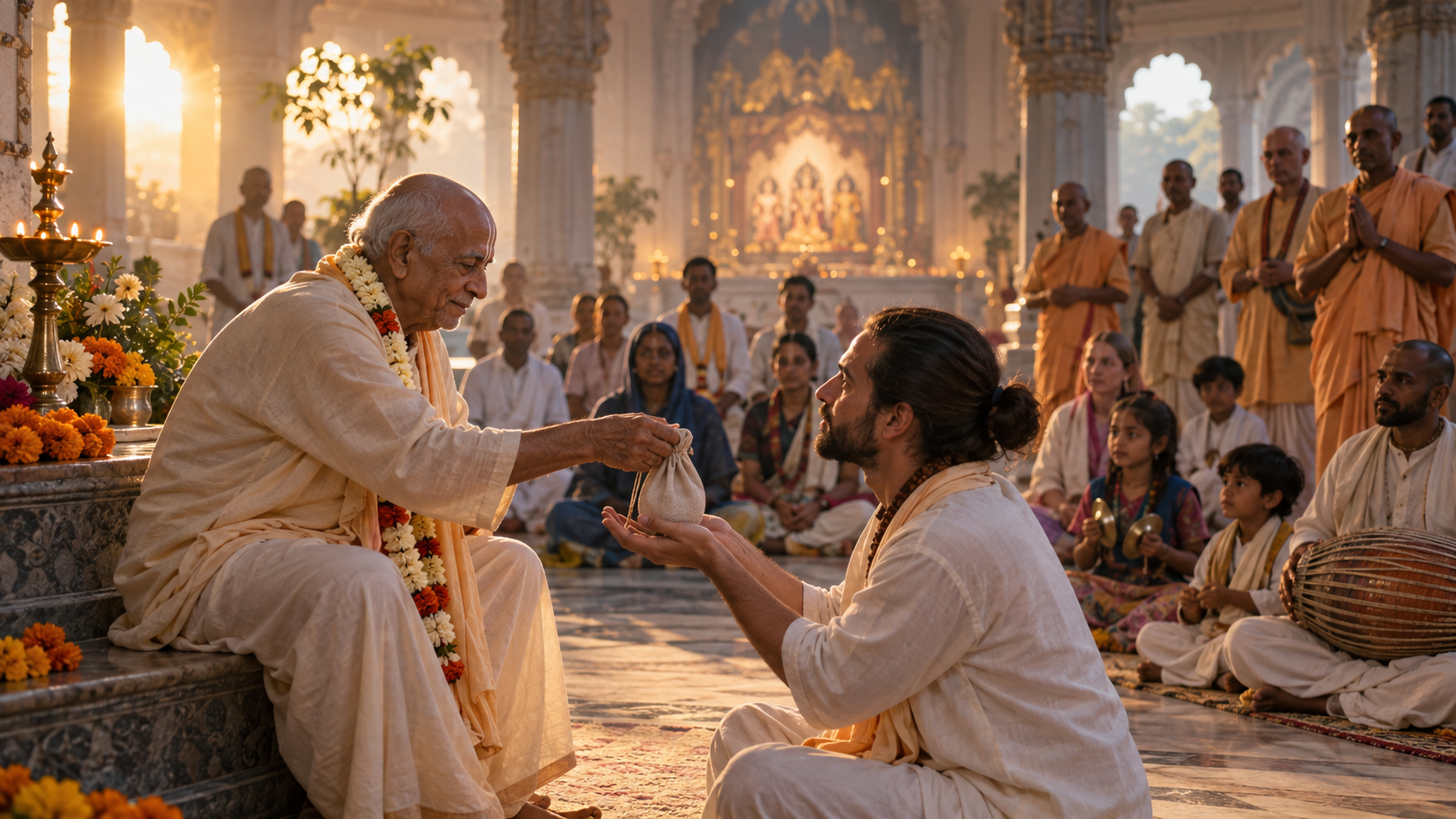
You may be wondering what ISKCON’s sixtieth anniversary asks of an ordinary devotee. You may not manage a temple, lead a congregation, or travel as a preacher. You still help determine whether the next chapter will be a living transmission of bhakti or merely an affectionate memory.
The most fitting observance is therefore not nostalgia on a larger scale. It is a deliberate renewal of what you practise, what your community makes possible, and what another person can receive from you. Sixty years is long enough to inherit a tradition; it is also long enough for inheritance to become habit unless someone consciously receives it again.
Treat sixty as a handover, not a museum date
An anniversary can honour the past while quietly avoiding its demand. Photographs, recollections, festivals, and tributes matter, but commemoration becomes devotional only when remembrance changes present conduct. The practical question is not simply, “What did Srila Prabhupada accomplish?” It is, “What has reached me, and what will reach someone else because I received it?”
A sixtieth-anniversary class in Durban shows the scale at which this becomes real. A global milestone must enter a local room, become teaching, and meet people in their actual circumstances. ISKCON’s future will be decided repeatedly at that scale: one class prepared carefully, one guest welcomed properly, one service explained to a new volunteer, and one devotee helped to continue after initial enthusiasm fades.
Before your community plans another anniversary event, write three short answers:
- What did I receive? Name a teaching, practice, relationship, or opportunity rather than saying only “Krishna consciousness.”
- What has become steady in my life? Distinguish what you admire from what you actually do.
- What can I now transmit? Identify one practice you can help another person begin without making that person dependent on your personality.
If the third answer is vague, the anniversary has revealed useful work. Choose one person, one practice, and one next meeting. Transmission usually fails in the gap between inspiration and follow-up, so put the follow-up on the calendar before the first invitation is sent.
Temples can apply the same test to recurring services. For each important responsibility, ask who understands its purpose, who can perform it, and who can teach it. If only one person can do all three, that service is not yet securely handed on.
Put the potent practices back at the centre
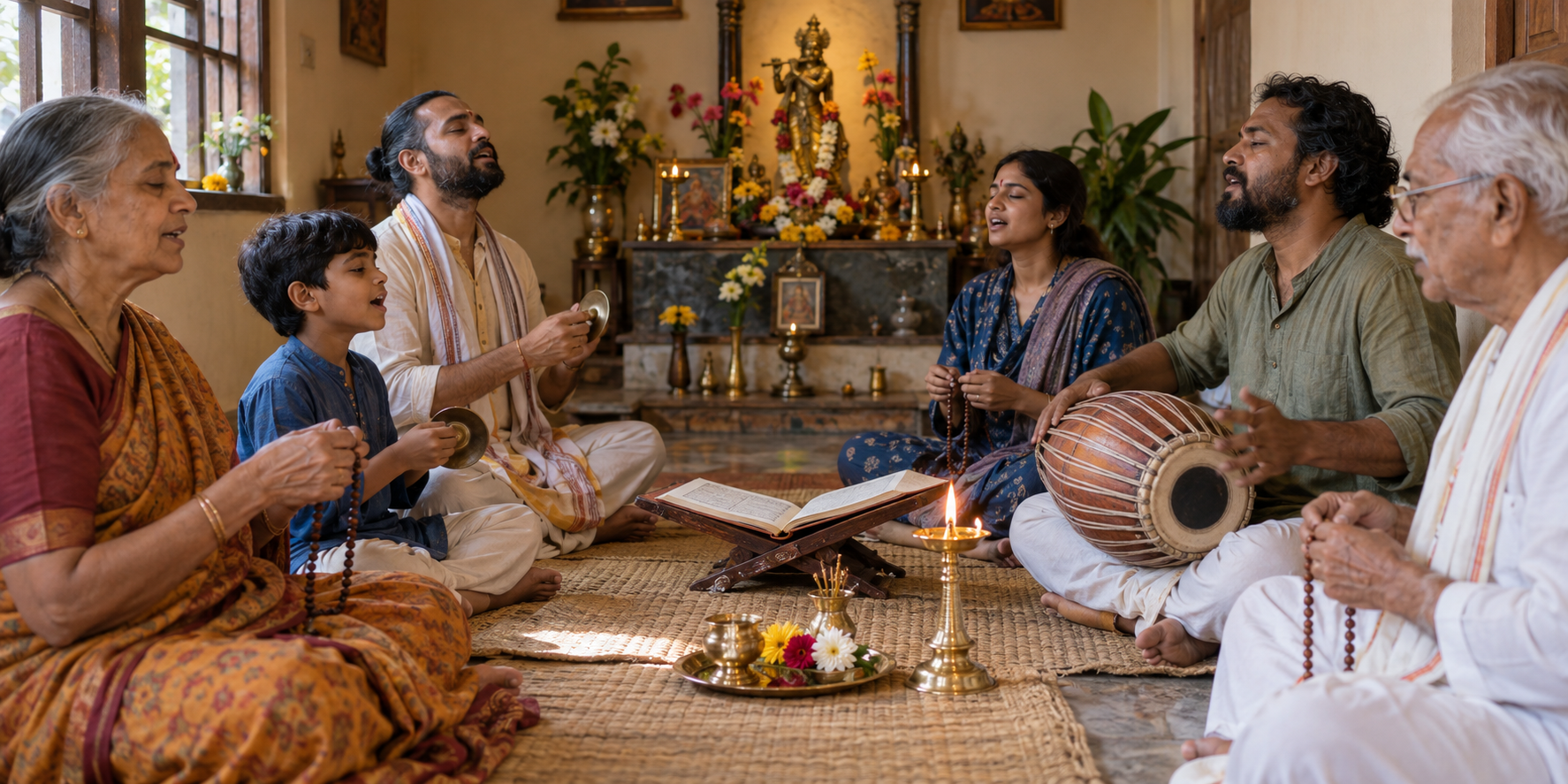
Institutional activity can create the feeling of spiritual movement even when personal practice has become thin. Meetings multiply, festivals grow, media circulates, and targets rise. None of these can replace the devotional acts from which the mission receives its substance.
Gaudiya Vaishnava teaching gives special weight to five potent practices of devotional service: association with devotees, chanting the holy name, hearing Srimad-Bhagavatam, residence in or devotional orientation toward the holy dhama, and faithful service to the Deity. They are not five competing departments. Each corrects a weakness that can develop in the others.
- Association with devotees: Choose recurring association in which you can listen, ask honest questions, render service, and be corrected. Watching devotional media can assist association, but it does not fully replace relationships in which another devotee knows how you are practising.
- Chanting the holy name: Protect attentive personal chanting and participate in congregational kirtan. Public enthusiasm should deepen personal remembrance rather than compensate for its absence.
- Hearing Srimad-Bhagavatam: Hear or read with continuity. Keep one question and one point of application from each session. Sequential hearing helps prevent sacred texts from becoming a supply of isolated quotations for positions you already hold.
- Orientation toward the holy dhama: If you can visit or serve a sacred place, approach it as a field of service rather than spiritual tourism. If you live elsewhere, let remembrance of the dhama reorder your home, time, and priorities without pretending that sacred geography is irrelevant.
- Service to the Deity: Serve with faith, cleanliness, punctuality, and respect for the standards of the temple or home altar. Consistency is a more reliable sign of devotion than adding elaborate practices that cannot be sustained.
You can audit these practices without turning bhakti into a performance score. At the end of seven days, mark each area with zero for neglected, one for present but distracted, or two for intentional engagement. The lowest mark is not a verdict on your devotion. It tells you where to place the next small act of care.
Make the correction modest enough to keep. Add one fixed hearing period, attend one dependable satsanga, prepare for one Deity service more carefully, or remove one recurring interruption from your chanting. A practice repeated with attention will do more for the next decade than an anniversary vow abandoned after a week.
Make mission goals accountable to the people they serve
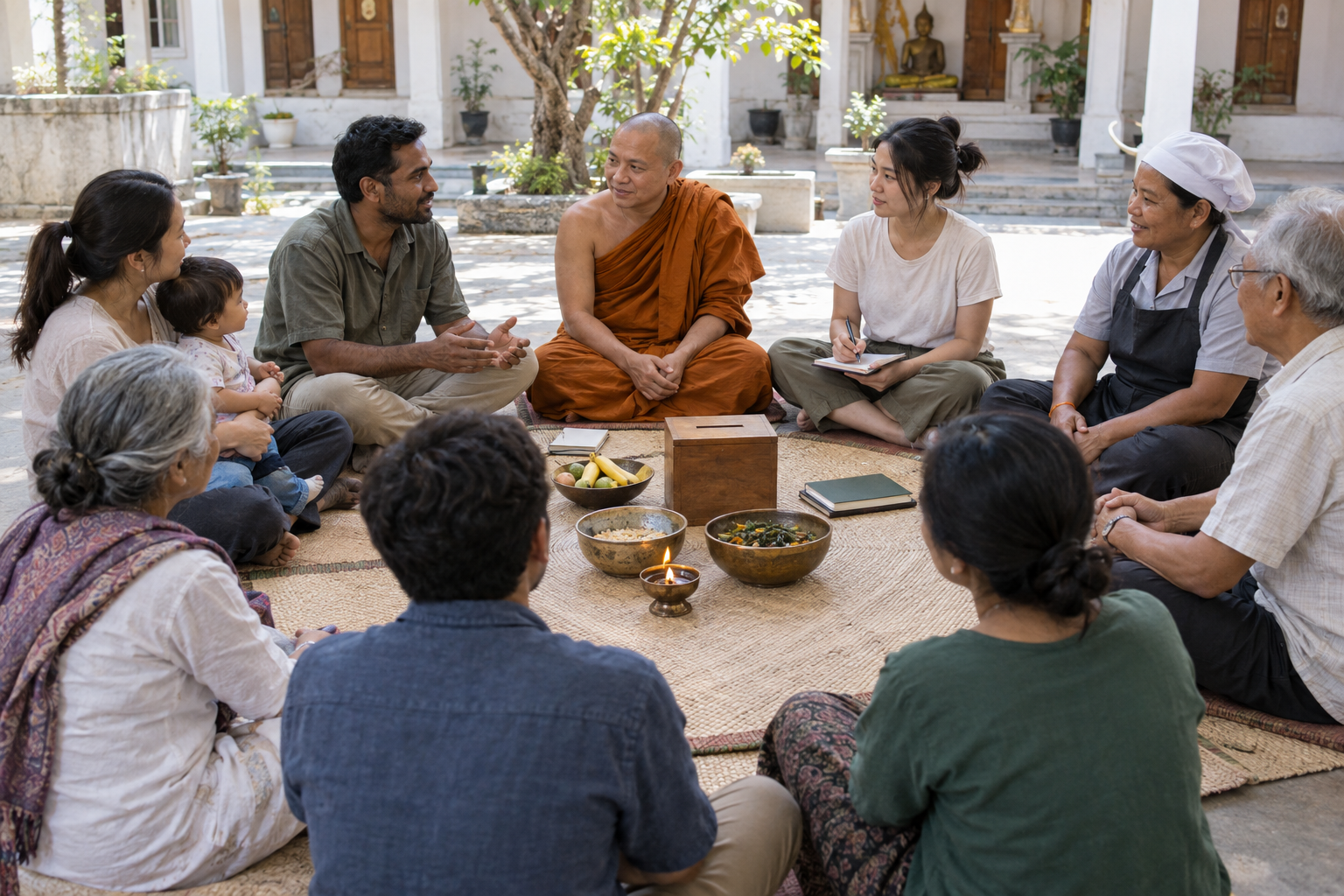
Devotion that never moves outward can become private and protective. Mission that loses its devotional centre can turn people into numbers. A mature ISKCON community must resist both failures: it should make concrete offerings while remembering that each person being approached is an atma, not an outreach unit.
Define one complete target
The conviction that “it’s not an impossible target” is valuable when it breaks inertia. It becomes healthier when enthusiasm is joined to a complete plan. Give every mission target five parts:
- A person: Who do you hope to serve? “The public” is too vague. Students, nearby families, temple visitors, online newcomers, and existing congregation members require different invitations.
- An offering: State what people will actually receive: a book, a meal, a kirtan, a discussion, a course, or a personal introduction to practice.
- An owner: Name the person responsible for the next action. Shared goodwill without responsibility usually produces a late scramble.
- A date: Put both the offering and its follow-up on the calendar. A deadline for distribution without a date for continued care measures only the first contact.
- An aftercare path: Decide what someone can do next. Give a time, place, contact, and simple first practice rather than the general instruction to “stay connected.”
For example, replace “increase outreach this month” with a plan such as: “For four weeks, we will offer one introductory reading circle each week; one volunteer will manage invitations; another will welcome first-time guests; and every guest will leave with the date and contact for the next session.” This is only a planning pattern. Your community should choose a scale that it can serve well after the initial campaign ends.
Measure outputs and outcomes separately. Books offered, meals served, or invitations sent describe activity. People who return, begin a practice, form a trustworthy relationship, or take up service reveal whether the activity opened a path. Both measurements matter, but they answer different questions.
Give every service a path of succession
A mission survives when service can pass from experienced hands to prepared ones. Create a four-step path for every recurring responsibility:
- Observe: The newcomer watches the complete service and hears why each important standard exists.
- Assist: The newcomer performs a bounded part while an experienced devotee remains responsible.
- Own: The newcomer leads the service with a named person available for questions.
- Teach: The new lead trains another person and thereby demonstrates understanding beyond task completion.
Keep a one-page handover for each service. Record its purpose, minimum standard, schedule, essential contacts, common failure points, and the person authorised to answer questions. This does not make seva mechanical. It prevents avoidable confusion from consuming the attention that should go into seva.
Translate bhakti without thinning it into lifestyle content

ISKCON’s mission has always required translation across language, culture, and circumstance. Translation does not mean hiding the tradition until nothing distinctive remains. It means creating an intelligible doorway through which a person can encounter the holy name, Krishna-katha, seva, and a community of practitioners.
A musical presentation of Gauranga’s southward call is one contemporary form for an enduring missionary impulse. Music, theatre, video, visual art, food, and digital conversation can all carry an invitation. Their devotional value depends on where that invitation leads.
Use three questions before approving an outward-facing creative project:
- What remains recognisably true? A newcomer should not have to unlearn the presentation in order to understand the tradition later.
- What can the person do next? Connect the creative experience to kirtan, hearing, prasadam, a temple visit, a reading group, or a conversation with a responsible devotee.
- Who checks fidelity? Give a practitioner who understands the siddhanta a real review role early enough to improve the work, not merely permission to object after publication.
This standard guards against two equal mistakes. One is to reject every unfamiliar form simply because it is unfamiliar. The other is to present bhakti as generic mindfulness, ethnic decoration, or uplifting entertainment. Accessibility should remove needless obstacles; it should not remove Krishna from Krishna consciousness.
A useful creative offering therefore has two endings. The artistic work ends, and then the person receives a clear invitation into practice. If your video, performance, or festival generates attention but provides no next step, the mission has created an audience without creating a relationship.
Key takeaways for your next sixty days
- Write down what you received from ISKCON, what has become steady, and what you can now help another person practise.
- Audit the five potent devotional practices for one week, then strengthen the most neglected area with one sustainable change.
- Give one mission goal a defined person, offering, owner, date, and aftercare path.
- Move one newer volunteer through the sequence of observing, assisting, owning, and teaching a recurring service.
- Make every public-facing creative project lead to a real devotional next step.
Choose one of these actions before the next programme you attend. Put a name and date beside it, and tell the person whose cooperation you need. ISKCON’s sixtieth year will become consequential when remembrance produces steadier sadhana, more humane outreach, and servants prepared to carry the mission forward.
References
- Dandavats — [MUSIC VIDEO] Gaurāṅga’s Southward Call | Bhakti Broadway
- Dandavats — “It’s not an Impossible Target” – Bhadra 2026 Message by Radheshyam Prabhu
- Dandavats — 06.09.26, SLF class for ISKCON’s 60th anniversary, SSRRT, Durban
- Dandavats — Sat Sanga | Show & Tell – The 5 Most Potent Practices of Devotional Service | Krishna Kshetra Swami
