
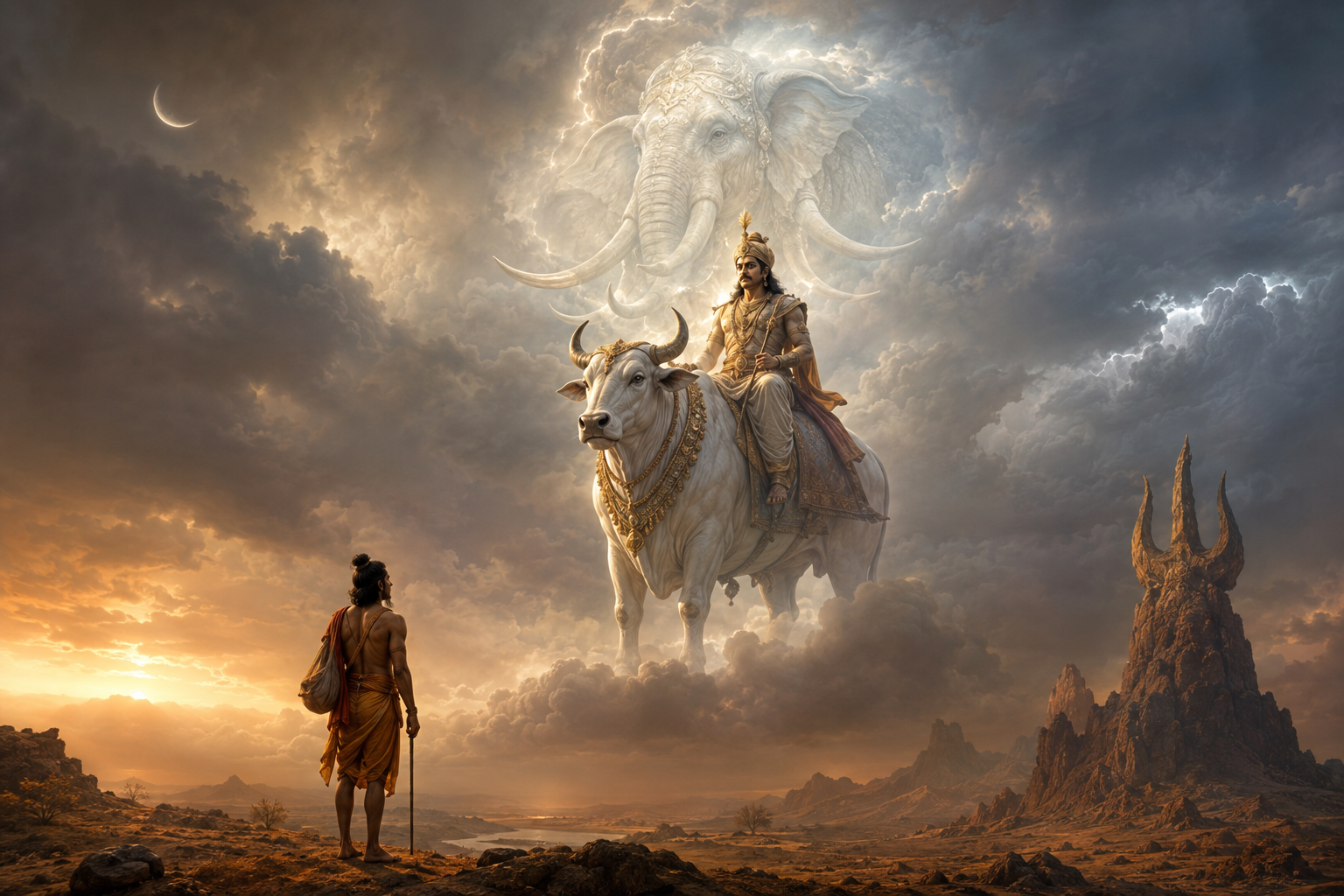
If you reached Utanka’s strange encounter with the bull and wondered whether the rider was Shiva or Indra, your confusion is justified. The image points strongly toward Shiva and Nandi, but the explanation Utanka later receives names Indra and Airavata.
The most faithful answer is therefore layered: Indra is the rider’s explicit narrative identity, while Shiva supplies a compelling iconographic and spiritual resonance. Keeping those levels distinct lets you appreciate the episode without forcing the Mahabharata to say what it does not say.
The plain textual answer is Indra
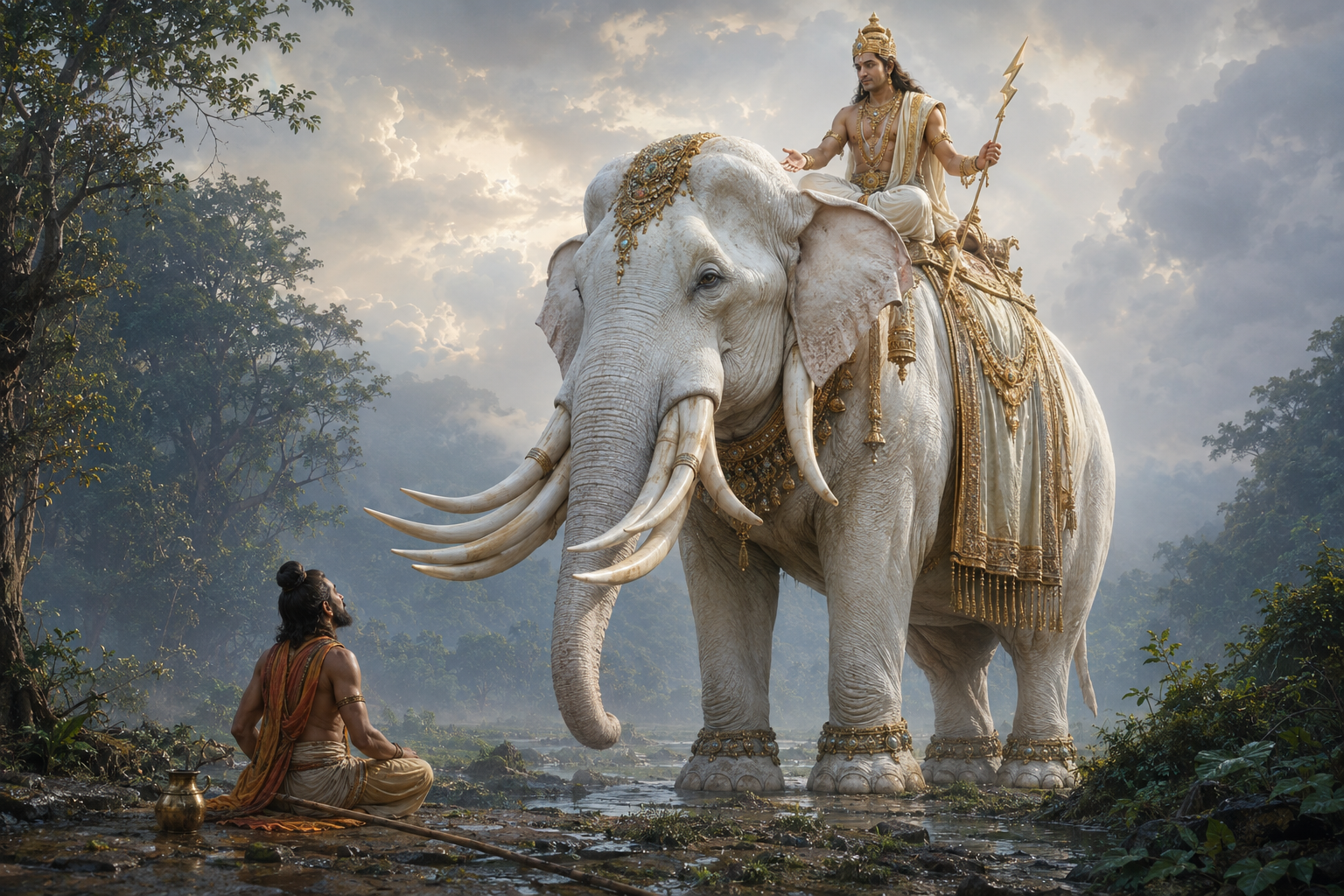
Utanka is a disciple of the sage Veda. When his education is complete, he insists on offering guru dakshina. Veda asks him to learn what his teacher’s wife desires, and she sends him to obtain the earrings worn by Queen Poushya. What looks like an errand of repayment soon becomes a sequence of spiritual trials.
On the road, Utanka sees an enormous bull carrying an equally imposing rider. The rider orders him to eat the animal’s dung. Utanka refuses. The command is repeated, now with the assurance that Utanka’s own teacher had done the same. Trust in his preceptor overcomes his revulsion: Utanka eats the dung, drinks the urine and continues toward Poushya’s kingdom.
The meaning appears only after a later danger. Takshaka steals the earrings, and Utanka pursues him into the realm of the nagas. When Utanka eventually returns, his teacher identifies the mysterious animal as Airavata, the king of elephants, and its rider as Indra. What appeared to be dung was amrita, the nectar of immortality, whose protection enabled Utanka to survive among the nagas.
This explanation leaves a visible incongruity: Utanka encountered what was described as a bull, yet his teacher identifies it with Airavata. You should not conceal that difficulty, but neither should you erase the explicit identification. If the question is, “Whom does Utanka’s teacher say he met?” the answer is Indra. If the question is, “Why does the scene look Shaiva?” a second level of reading begins.
Why the Shiva reading still has force
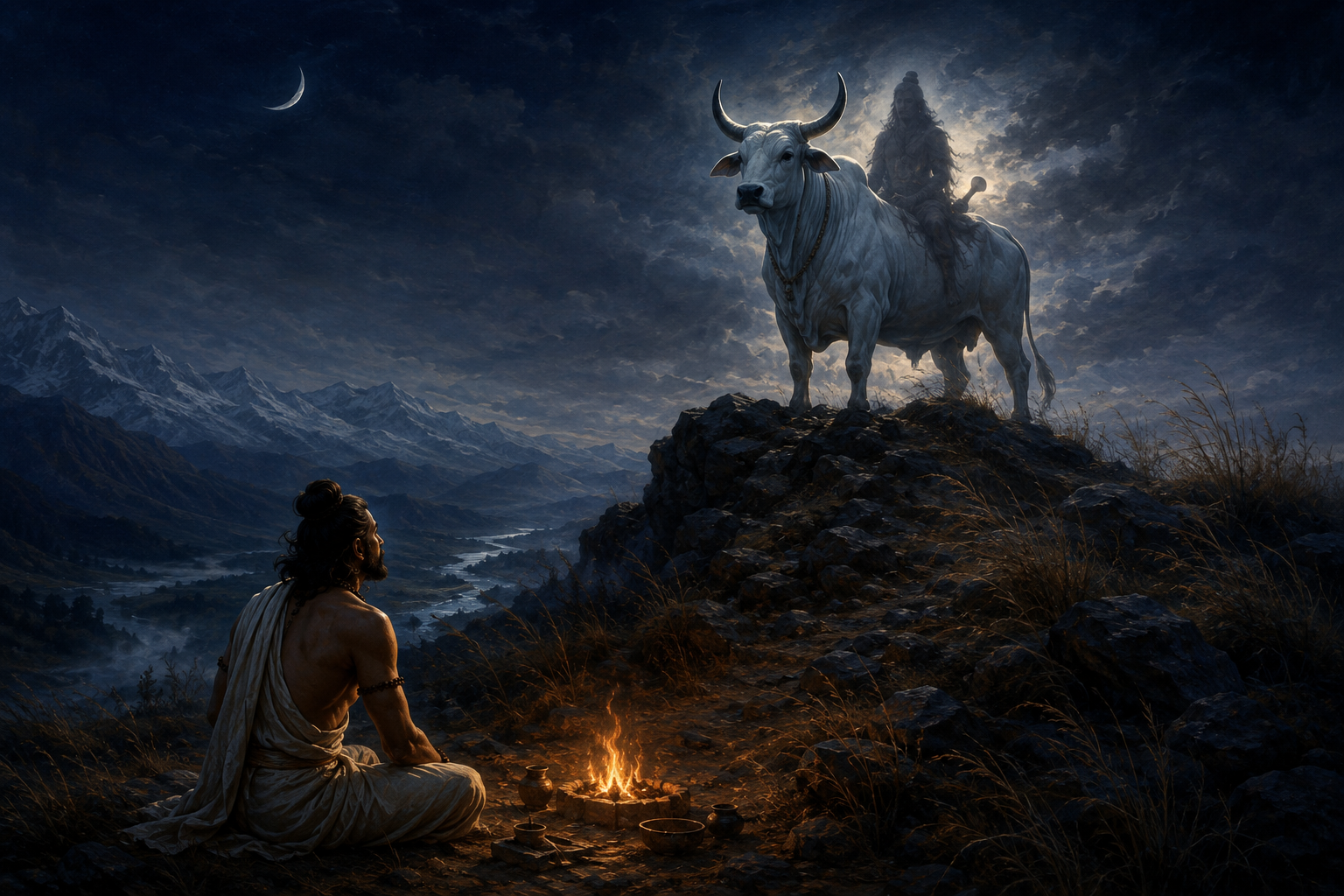
A towering rider seated upon a great bull speaks a visual language that a Hindu reader is unlikely to miss. The bull evokes Nandi, and Nandi evokes Shiva. Indra’s familiar association is with Airavata, not with a bull. The scene therefore presents Shaiva iconography before supplying an Indra-centered explanation.
Shiva’s manner elsewhere in the Mahabharata strengthens that association. He does not always approach a seeker in an immediately recognizable divine form. When Arjuna performs penance, Shiva confronts him as a kirata, a hunter, and tests him through combat before revealing himself and granting the Pashupatastra. The disguise is not decorative. It prevents reputation, expectation and outward appearance from answering the test on the seeker’s behalf.
Utanka’s encounter can be read through three distinct lenses:
- At the narrative level, the later explanation identifies the rider as Indra and the animal as Airavata.
- At the iconographic level, the bull and rider evoke Nandi and Shiva.
- At the spiritual level, divinity approaches without announcement, overturns ordinary expectations and equips the seeker for a danger he cannot yet see.
Shiva’s hidden role is strongest at the second and third levels. It need not mean that Shiva secretly replaces Indra as the episode’s canonical rider. Shaiva imagery can shape how you experience the encounter even when the narrative assigns the figure another name. The ambiguity itself makes you practise the discernment the story demands: recognize a symbol, but do not confuse recognition with textual proof.
The test begins where disgust takes over
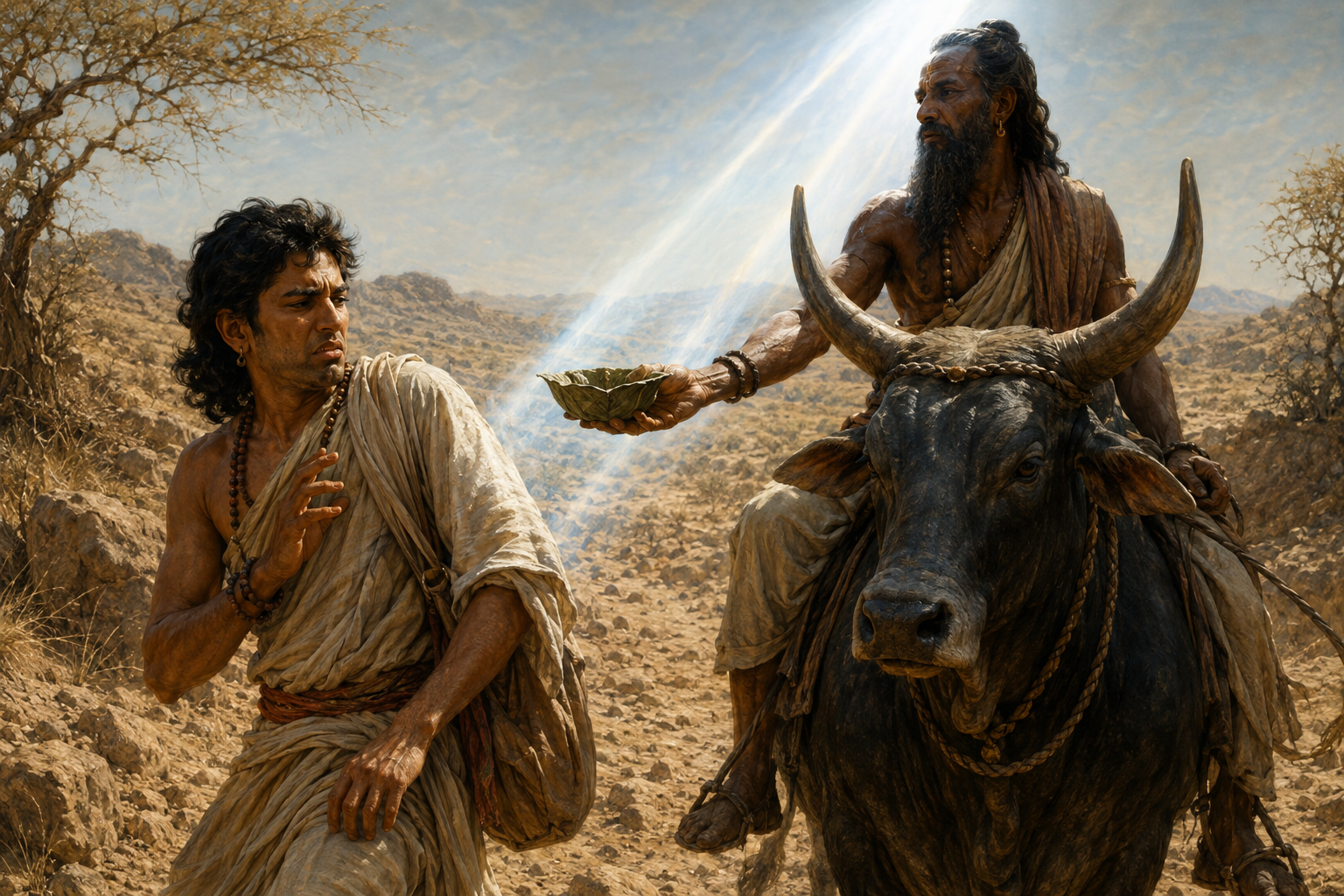
Utanka is not seeking a vision, a boon or an extraordinary experience. He is trying to complete a duty to his teacher’s household. The divine interruption meets him inside that obligation, not outside it. That matters because the test is directed at conduct rather than curiosity.
The command deliberately strikes the boundary between purity and pollution. Utanka’s immediate refusal is understandable. Nothing in the animal waste’s appearance tells him it is amrita. He must decide whether the encounter is merely degrading or whether his limited perception is concealing something essential.
The rider does not secure Utanka’s compliance by displaying divine power. He invokes the example of Utanka’s own teacher. That detail turns the command from a stranger’s arbitrary demand into a test of an already established guru-shishya bond. Utanka acts because the request has been connected to someone whose authority he has accepted through sustained discipleship.
Only afterward does the apparently polluting substance reveal its protective nature. The sequence is crucial: provision comes before the danger, while understanding comes after it. Utanka does not know that Takshaka will draw him into the naga realm when he meets the rider. The grace he needs is therefore present before he can identify his need for it.
When you apply this pattern to your own sadhana, do not look for secret nectar in every unpleasant event. Notice something more disciplined: a legitimate duty can prepare you for consequences you cannot predict, and resistance sometimes comes from wounded pride rather than genuine moral danger. The question is not simply, “Do I dislike this?” It is, “What exactly in me is resisting, and is that resistance protecting dharma or protecting ahankara?”
Do not turn Utanka into permission for blind obedience
Utanka’s action belongs to an epic narrative in which animal waste is supernaturally revealed as amrita. It is not a dietary recommendation, a purification method or an instruction for literal imitation. Consuming animal waste can be unsafe. Do not reproduce the act as a devotional experiment.
The episode also does not give a contemporary teacher unlimited authority to impose dangerous, exploitative or degrading demands. “Acharya devo bhava” in the Taittiriya Upanishad calls for reverence toward the teacher, but reverence does not abolish dharma or viveka. The Bhagavad Gita joins humility and service with honest inquiry when describing how knowledge is received. Inquiry is part of discipleship, not evidence of its failure.
Use Utanka’s test through a four-part discipline:
- Name the duty. Utanka is completing guru dakshina, not obeying a casual personality cult.
- Locate the resistance. Ask whether you are avoiding service because it is inconvenient or unflattering.
- Apply a dharmic boundary. Reject demands involving coercion, abuse, bodily danger, illegality or harm to another person.
- Allow meaning to emerge later. Do not invent a divine message merely because an experience is confusing or unpleasant.
This distinction keeps the teaching demanding without making it reckless. Spiritual maturity may require you to endure inconvenience, surrender vanity and serve without recognition. It never requires you to silence conscience in the face of actual harm.
Key takeaways
- Utanka’s teacher explicitly identifies the rider as Indra and the mysterious animal as Airavata.
- The bull-and-rider image nevertheless carries a clear Shaiva resonance through Shiva’s association with Nandi.
- Shiva’s hidden role is best understood as an iconographic and theological layer, not as a replacement for the narrative’s stated identification.
- The apparent dung is amrita given before Utanka knows he will need protection in the naga realm.
- The test concerns disciplined trust, humility and the limits of outward perception; it does not authorize blind obedience.
- A sound reading separates what the narrative states, what the symbols evoke and what you may responsibly apply.
The next time an epic image seems to conflict with its explanation, hold the tension long enough to ask three questions: What does the narrative name? What does the iconography evoke? What transformation does the encounter produce? With Utanka, those questions preserve Indra’s stated identity while allowing Shiva’s unmistakable shadow to deepen the test.
References
