
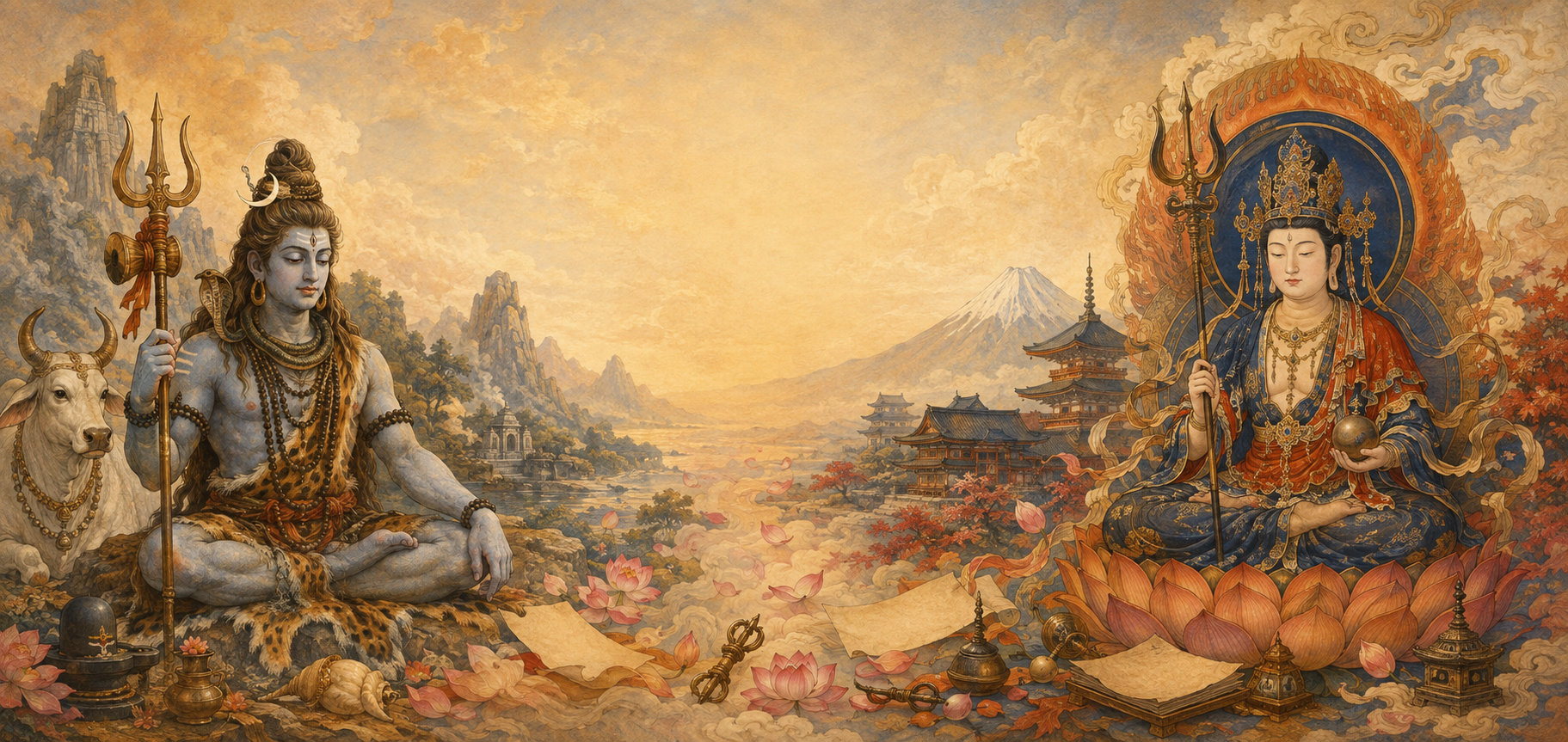
If you have encountered the claim that Daijizaiten is “the Japanese Shiva,” you need a better answer than a bare yes or no. There is a real line of religious continuity from Shiva as Maheshwara to Daijizaiten, but the journey into Japan involved adaptation as well as preservation.
The distinction matters. It lets you recognize Bharat’s spiritual influence without pretending that a deity remains unchanged after entering another language, ritual order, and civilizational setting.
The short answer: related, but not interchangeable
In Hindu traditions, Shiva is Maheshwara, the Great Lord. Within Shaiva traditions, he can be approached as the supreme focus of devotion, metaphysics, and liberation. Daijizaiten belongs to the Japanese religious world and carries the Maheshwara-Shiva connection within a Buddhist setting.
That gives us two truths to hold at once. Daijizaiten should not be treated as an unrelated Japanese invention merely because the name and setting are different. Yet Daijizaiten should not be described as a complete reproduction of every Indian understanding of Shiva. Religious ancestry is not the same as total theological identity.
The most accurate short formulation is: Daijizaiten is a Japanese religious form historically connected with Shiva as Maheshwara. If you need a slightly fuller version, say that the idea and identity of Maheshwara were received and reframed within Japan’s Buddhist religious culture.
Avoid saying only that “Japan worships Shiva” or that Daijizaiten is “exactly the same god with a translated name.” Those sentences flatten a complex act of transmission into a slogan. They also make a defensible Dharmic connection easier for a critic to dismiss.
Key takeaways
- Daijizaiten and Shiva-Maheshwara are connected through religious transmission and adaptation, not merely through a superficial resemblance.
- The strongest continuity lies in the conception of great divine lordship, sovereignty, and power.
- The principal difference is context: Shiva belongs to Hindu and especially Shaiva frameworks, while Daijizaiten is situated within a Japanese Buddhist framework.
- A shared origin does not require identical theology, ritual purpose, status, or imagery.
- Bharat’s influence is best defended through precise claims about continuity and transformation, not through exaggerated claims of perfect sameness.
A four-part comparison prevents the usual mistakes
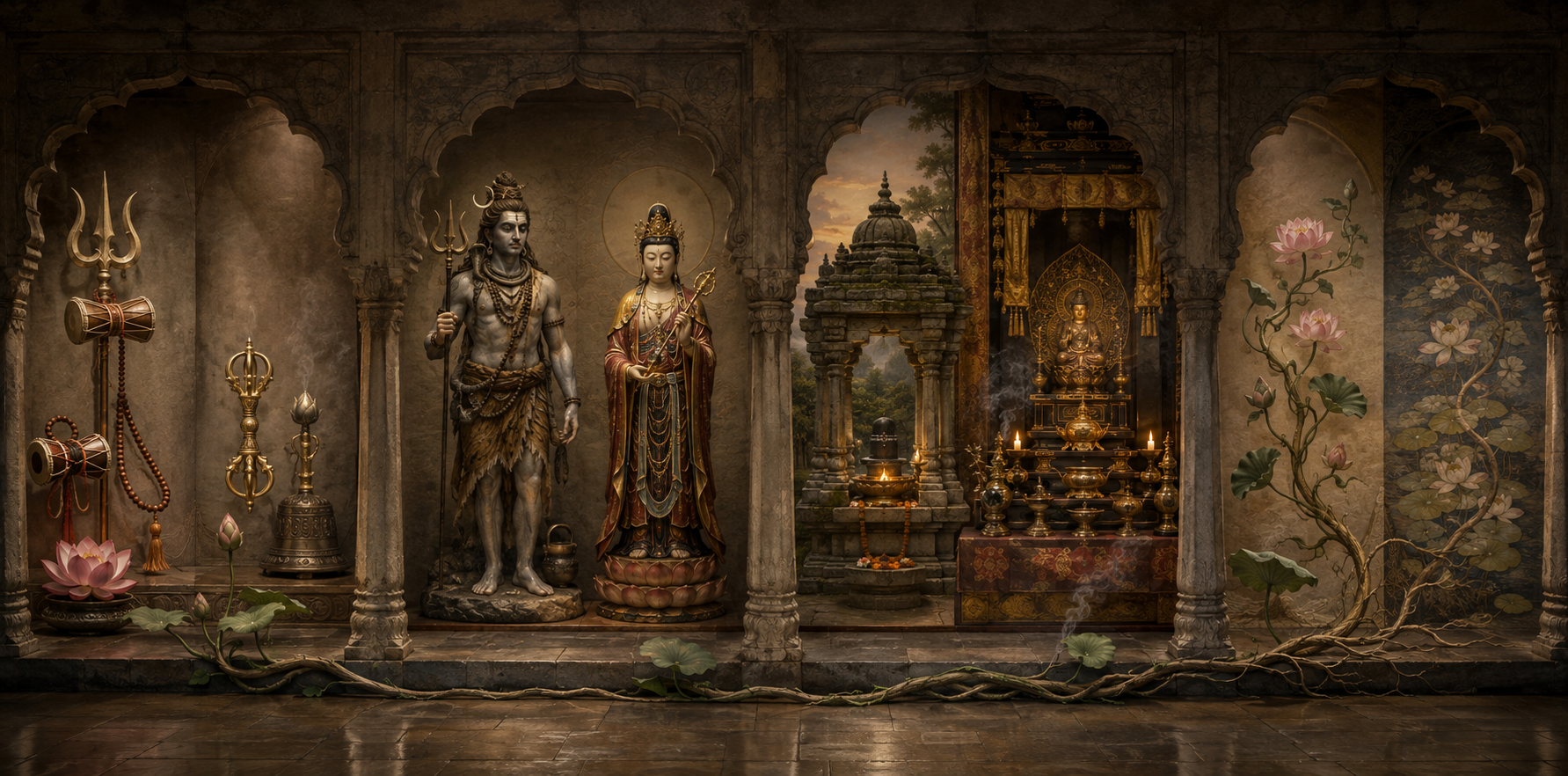
When you compare Shiva and Daijizaiten, do not begin and end with their names. Examine civilizational setting, religious position, conceptual continuity, and the limits of the comparison.
| Question | Shiva or Maheshwara | Daijizaiten | What you should conclude |
|---|---|---|---|
| Where is the figure situated? | In the Indian and Hindu religious world, particularly Shaiva traditions | In the Japanese religious world, within a Buddhist setting | The connection crosses religious and civilizational contexts |
| What does the figure’s position express? | Shiva as the Great Lord can occupy the highest devotional and metaphysical position | The inherited Maheshwara identity is placed within a different cosmological and ritual order | A title of greatness can remain while its surrounding theology changes |
| What is continuous? | The identity of Shiva as Maheshwara and the idea of transcendent lordship | A Japanese form carrying that Maheshwara-Shiva inheritance | The relationship is substantial, not just a visual analogy |
| What must remain distinct? | The full range of Hindu and Shaiva understandings of Shiva | The locally defined meaning and function of Daijizaiten | Neither figure should be used as the exhaustive definition of the other |
First, compare the titles. Maheshwara presents Shiva as the Great Lord. Daijizaiten likewise carries an emphasis on elevated sovereignty and divine freedom. This conceptual bridge is more important than a loose claim that two images happen to look alike.
Second, ask what position the deity occupies. Within Shaivism, Shiva’s lordship can define the entire theological horizon. A Japanese Buddhist reception places the inherited deity within another sacred order. Similar language of greatness therefore does not automatically produce identical religious rank or meaning.
Third, inspect iconography carefully. Attributes, posture, companions, gestures, and surrounding figures can show what a community chose to emphasize. But an image is evidence of reception, not a complete theological statement. Do not declare two forms identical because of one shared feature, and do not declare them unrelated because a local form looks different.
Fourth, examine practice. Ask who invokes the deity, in what ritual setting, and toward what religious end. Two forms can share ancestry while serving different devotional or ritual purposes. That is normal in the Dharmic world, where a divine identity may be understood through many forms without every form performing the same role.
Why Maheshwara changed while travelling east
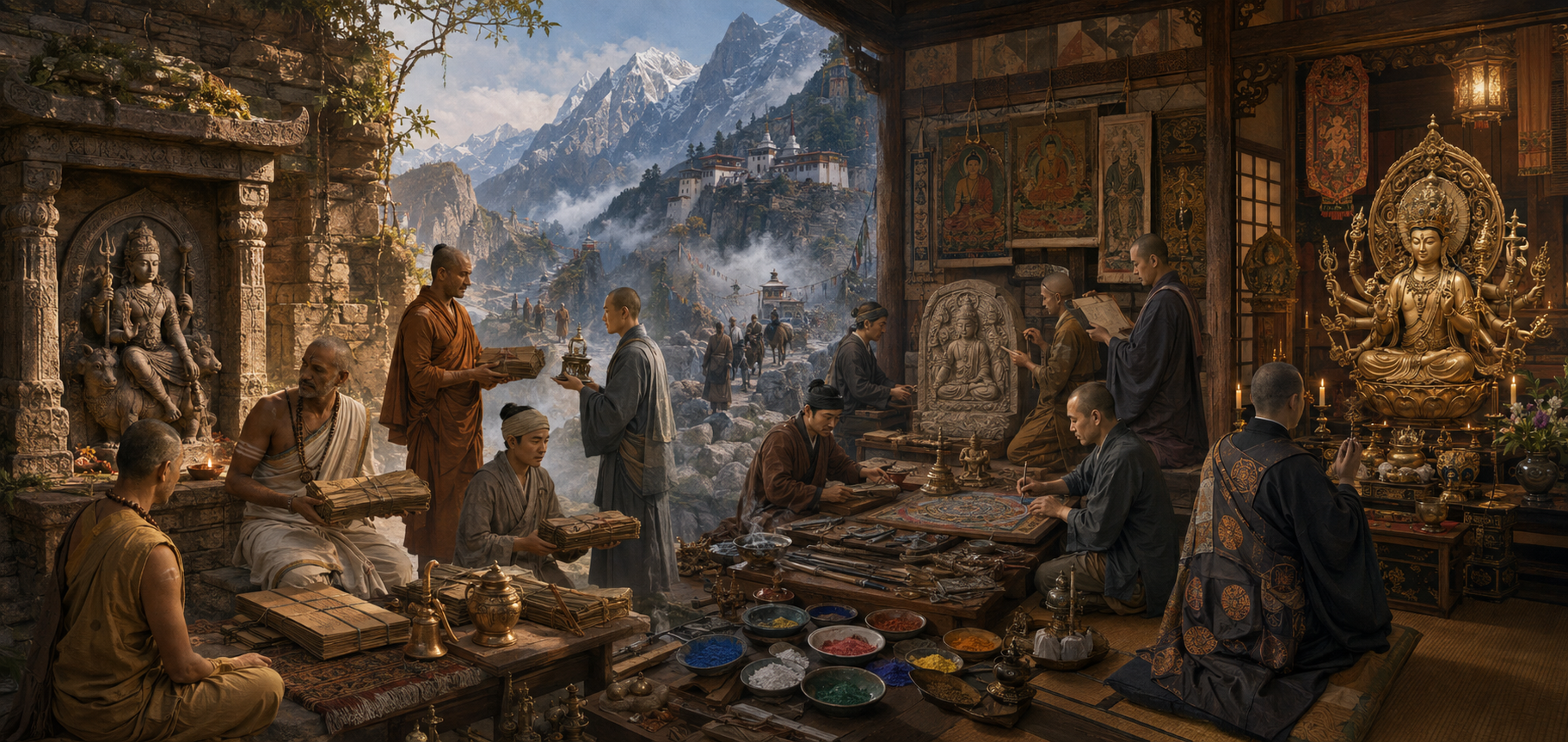
Religious transmission is closer to translation than photocopying. A sacred figure entering another civilization must be named in another language, understood through another cosmology, and placed among figures already known to the receiving community. Each step preserves something and interprets something.
Language produces the first transformation. A name is not merely exchanged for a new sound; its meaning must become intelligible to people using another religious vocabulary. The emphasis on great lordship could travel even when the Indian name, its associations, and its range of meanings did not remain fully intact.
Religious placement produces the second transformation. Japan did not receive the whole of Shaiva theology every time it received a figure connected with Shiva. The inherited deity had to be understood within a Buddhist sacred universe. This could retain the deity’s power and stature while assigning that power a locally intelligible place.
Selective preservation produces the third transformation. Communities preserve the features that answer their own ritual, artistic, or doctrinal needs. Other features recede. The result can remain recognizably connected to its Indian origin without operating as a complete account of that origin.
These changes do not invalidate the relationship. They reveal how a civilization receives an inheritance. From a Dharmic perspective, cultural reach should not be measured only by the survival of unchanged Sanskrit labels. The capacity of an Indian sacred idea to enter another culture and acquire a meaningful local form is itself significant.
Precision strengthens that significance. Daijizaiten demonstrates the movement and adaptation of a Shiva-Maheshwara identity beyond Bharat. It does not, by itself, prove that Japanese religion is simply Hinduism under different names. Nor does it mean that every Japanese interpretation must agree with a Shaiva interpretation.
How to discuss Daijizaiten without overstating the case
If you are writing, teaching, making a video, or explaining the connection in conversation, use the following sequence:
- State the relationship plainly. Begin with the historical and religious connection between Daijizaiten and Shiva as Maheshwara.
- Name both settings. Place Shiva within Hindu and Shaiva traditions and Daijizaiten within the Japanese Buddhist world. This prevents a change of context from disappearing.
- Identify the central continuity. Point to the conception of great divine lordship and sovereignty before discussing visual similarities.
- Mark the limit. Say explicitly that shared ancestry does not make every doctrine, ritual function, or representation identical.
- Use verbs that describe transmission. “Received,” “adapted,” “reframed,” and “connected with” are usually more accurate than “copied,” “renamed,” or “secretly is.”
- Let local evidence set the next claim. When examining a particular image or ritual, use its label, attributes, placement, and religious setting rather than importing every familiar feature of Indian Shiva worship.
This method also helps when you encounter other Indian deities in Asian traditions. Begin with genealogy, compare concepts and functions, and then respect the local form. You will be able to recognize Bharat’s influence without erasing the agency of the civilization that received it.
The next time someone calls Daijizaiten “the Japanese Shiva,” treat that phrase as the beginning of the explanation, not its conclusion. Confirm the Maheshwara connection, identify what was preserved, and then ask what Japan changed. That is where the history becomes more instructive than the slogan.
References
