

You can change your routine, your surroundings, your opinions, and even the way you understand yourself. But when you say, “I have changed,” what precisely has changed: the underlying reality, its present form, its condition, or its capacities?
Sankhya helps you answer that question without treating every alteration as equally deep. Its account of transformation gives you a practical discipline: identify what persists, identify what has been modified, and act at the level where the change actually occurred.
The first question is not whether change is real
We usually recognize change by comparing appearances. A lump becomes a pot. A calm mind becomes agitated. A familiar role ends and another begins. Sankhya asks a more exact question: what made the new condition possible?
A pot does not appear independently of clay. The clay is the material basis from which the pot becomes manifest. The new form is real, but it is not a creation out of nothing. This is the logic of satkaryavada: the effect is already present in its cause as a possibility and becomes manifest when the appropriate conditions arise.
This position avoids two common mistakes. The first is to imagine that a new effect can arise without a sufficient cause. The second is to say that because something persists through change, the change itself must be unreal. Clay remains the material basis, yet the pot has a form and function the undivided lump did not possess.
When you examine a change, therefore, separate three layers:
- Substratum: What continues through the process?
- Configuration: How has that continuing basis been arranged or expressed differently?
- Condition: Have its properties, capacities, or available future states also changed?
This separation matters because visible difference does not always indicate a change of underlying condition. Conversely, two things can look similar even though one has passed through a process that the other has not.
Two ways an object can undergo transformation

A practical way to understand the Sankhya distinction is to contrast a change of configuration with a change of condition.
In a change of configuration, the material basis remains available for further reshaping. Soft clay may become a pot, bowl, or figure, yet it remains workable clay. The form has changed, but another form can still be produced by reorganizing the same material.
In a change of condition, the process alters what the material can subsequently become. Once soft clay has been fired into hard pottery, it cannot be restored merely by pressing it back into a lump. Reshaping and firing are both changes, but they do not operate at the same depth or leave the same possibilities open.
Reversibility is a useful diagnostic here, not a complete definition. Some changes of form are difficult to reverse because of practical circumstances. Some changes of condition can be partly repaired through another causal process. The important question is not simply, “Can I go back?” It is, “Would going back require rearrangement, or would it require a new transformation?”
This distinction immediately improves decision-making. If the problem lies in arrangement, reorganize what is already present. If the relevant capacities have changed, rearrangement alone will disappoint you. You must establish the causes of a new condition.
Prakriti transforms while Purusha witnesses

Sankhya places the entire field of observable transformation within Prakriti. Prakriti is not merely physical matter in the narrow modern sense. The body, senses, mind, memory, emotions, and ahankara, the principle that constructs the sense of “I” and “mine,” all belong to this changing field.
Purusha is different. It is consciousness as witness, not another object among the objects being observed. A thought appears and disappears. A mood intensifies and subsides. The self-image produced by ahankara may be praised, threatened, expanded, or humbled. Each can be known because it appears to awareness. Sankhya therefore refuses to equate the changing contents of experience with the knower of those contents.
This does not give you an excuse to neglect change. It tells you where work is possible. If anger, confusion, or compulsive identification appears in the mind, calling it “my permanent nature” confuses a condition of Prakriti with Purusha. But merely declaring, “I am the witness,” while continuing to feed the same conditions is another confusion. The witness is not improved by rearranging Prakriti, but the clarity of mind through which discernment operates still depends on causes and conditions.
The practical movement has two parts. First, treat the body-mind honestly as something capable of cultivation and deterioration. Second, observe its present condition without turning that condition into an absolute identity. “Agitation is present” is more precise than “I am an agitated person.” The first statement identifies a changeable condition. The second allows ahankara to convert that condition into a definition of the self.
Use this five-question test when something changes
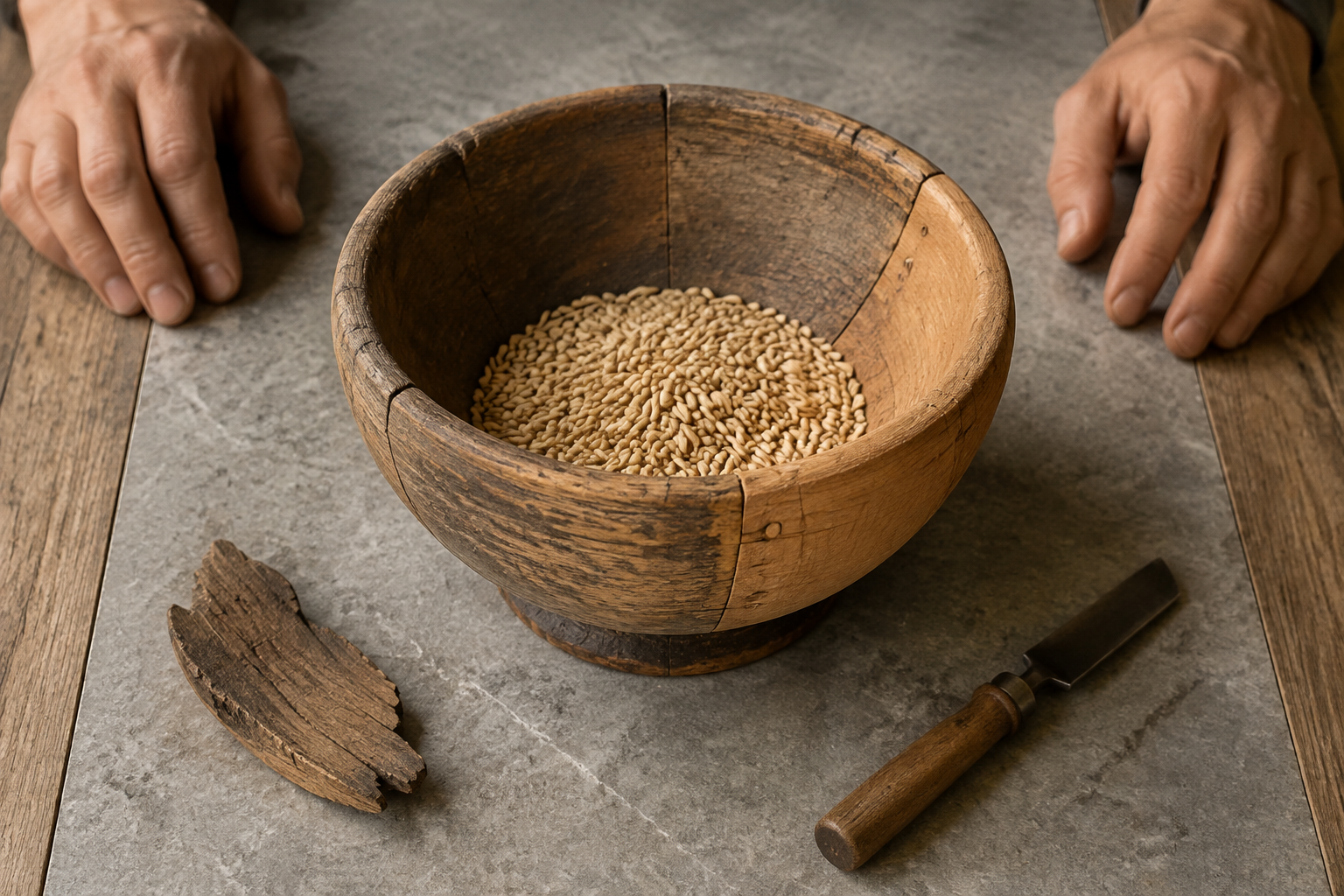
You can apply Sankhya’s reasoning whenever a change leaves you unsure whether to restore, reorganize, or begin again. Write down answers to these five questions rather than relying on the first story the mind supplies.
- What exactly is different? Name the observable change. Replace “everything is different” with a specific statement about form, behavior, capacity, or condition.
- What has persisted? Identify the continuing material, intention, relationship, skill, or circumstance. Do not assume that a changed appearance means the whole basis has disappeared.
- Which causes produced the present state? Look for the conditions that actually operated. A new result requires an adequate causal path; wishing for a different result is not itself such a path.
- Would rearrangement be enough? If the underlying capacity remains, a different schedule, sequence, setting, or form may solve the problem. If the capacity itself has been altered, you need a process that develops it again.
- What is aware of this change? Notice that the condition being described is an object of awareness. This prevents a temporary state of Prakriti from becoming a final verdict about who you are.
Suppose a change in work hours disrupts your dawn japa. The visible fact is that the old routine has stopped. Before deciding that your discipline or devotion has vanished, ask whether the practice has lost its substance or merely its former arrangement. If the intention and practical capacity remain, move the practice to a workable time. That is a reconfiguration. If repeated neglect has weakened the habit itself, changing the clock may not be enough; you will need to rebuild the supporting conditions through a smaller, consistent commitment.
The same test applies when a role, possession, plan, or self-description changes. Do not demand a deep reconstruction when a new arrangement will do. Do not expect a cosmetic rearrangement to reverse a condition-changing process. Above all, do not confuse either kind of change with the consciousness by which it is known.
Key takeaways
- Sankhya treats transformation as a real emergence from an adequate cause, not as the production of something from nothing.
- A change of configuration rearranges what is present; a change of condition alters the capacities and future possibilities of what is present.
- Reversibility helps you examine a change, but it is not an infallible definition of how deep that change is.
- Body, mind, emotion, memory, and ahankara belong to changing Prakriti. Purusha is the conscious witness of their changes.
- Your response should match the layer affected: rearrange a form, establish new causal conditions, or stop mistaking a passing state for the self.
The next time you catch yourself saying, “Everything has changed,” make the sentence more exact. State what changed, what persists, what caused the transition, and what kind of action the new condition requires. That small act of discrimination is how Sankhya becomes more than a theory: it becomes a way to meet transformation without confusion.
References
