
When a temple committee, satsang, family network, or seva team fractures, you can quickly find yourself under pressure to choose a camp. One side calls silence compassionate. Another treats public humiliation or permanent exclusion as the only proof that you take wrongdoing seriously.
You do not have to accept that choice. A Dharmic response can name misconduct clearly, protect the people affected, and still refuse to reduce a human being to the worst thing he or she has done. Prayer can support that work, but only when it steadies the community for truth and repair rather than becoming a spiritual weapon.
Name the wrong without declaring the person worthless

Compassion is not moral confusion. If conduct violates a community rule, scriptural principle, entrusted responsibility, or another person’s dignity, say what was wrong. Failure to do so can turn tolerated misconduct into an informal new standard. Yet it is possible to disapprove of an action without withdrawing all concern for the person.
Begin by separating the judgments that conflict tends to collapse:
- What happened? Describe observable words, decisions, omissions, or actions. Do not substitute a label such as toxic, evil, disloyal, or envious for facts.
- What standard was broken? Name the rule, duty, promise, or boundary that applies to everyone in the same role.
- Who needs protection now? This may require distance, supervision, restricted access, removal from a responsibility, or an impartial review.
- What would responsible repair require? Consider acknowledgment, apology, restitution, corrected information, changed conduct, or cooperation with a formal process.
- Could a path back remain? Its existence does not guarantee restoration. It prevents punishment from becoming an undefined sentence driven by anger.
This separation is visible in the Govardhana account. Krishna opposed Indra’s pride, redirected the cowherd community’s worship, and protected Vraja when Indra retaliated with destructive rain. After Indra recognized his error and approached Krishna, he received a private audience rather than further public humiliation and was permitted to continue his service. The pattern is firm intervention followed by an opening for repentance.
That sacred narrative gives leaders a posture, not an automatic personnel policy. Krishna’s treatment of Indra does not mean that every modern officeholder must retain authority after misconduct. A community still has duties of care, governance, and safeguarding. It does mean that correction should have a Dharmic purpose: stop the harm, restore truth, and encourage transformation. Inflicting avoidable shame is not an additional spiritual achievement.
Bhagavad-gita 9.30 is also easy to misuse in community disputes. Its hope for a seriously fallen person rests on a devotional determination that is rightly directed; it is not permission to continue the same conduct while demanding saintly treatment. The same teaching explicitly warns against exploiting divine kindness as a licence for deliberate wrongdoing. When deciding whether repentance is real, look beyond devotional vocabulary. Notice whether the person accepts verified facts, stops retaliation, honours boundaries, makes repair, and sustains changed behaviour.
If those signs are absent, compassion may require firm distance. You can desire someone’s spiritual welfare without giving that person access to those harmed, control over money, a teaching platform, confidential information, or leadership authority.
Use prayer to purify the response, not predetermine the verdict

The first reliable effect of community prayer should be visible in the people who are praying. They become less interested in winning the emotional contest and more capable of truthful, proportionate action. Prayer is not evidence that an allegation is true, a substitute for hearing the people involved, or a way to pressure Bhagavan into endorsing a faction.
Some bhakti practitioners describe concentrated anger, criticism, compassion, and loving attention in the language of subtle energy, mind, intelligence, false ego, and the gunas. You do not need to turn that devotional and metaphysical account of thought and energy into a claim that prayer remotely controls another person. The practical mechanism is already serious: repeated hostile speech trains participants to interpret each new event through suspicion, while shared prayer can interrupt their own habits of accusation and contempt.
The distinction matters because prayer should not be advertised as a guaranteed technique for changing an institution. In one Vaishnava community prayer circle, participants reported becoming happier, closer, and more caring toward one another, while its organiser could not claim that the temple dispute itself had improved. That is an honest measure of prayer’s immediate fruit: a healthier spiritual posture among participants, without pretending that unresolved governance problems have disappeared.
Pray for outcomes broad enough to include truth:
- clarity about what actually happened;
- protection and support for anyone harmed;
- courage for responsible people to acknowledge and repair wrongdoing;
- wisdom for leaders, mediators, families, and witnesses;
- freedom from revenge, favouritism, gossip, and fear; and
- an outcome aligned with dharma, even if it is not the result your group currently prefers.
A usable prayer is simple: May truth become clear without distortion. May anyone harmed be protected. May those who caused harm gain the courage to admit it and repair it. May leaders act without fear, favouritism, or vengeance. May our speech serve dharma rather than our faction. May the proper outcome unfold, even if it is not the one we prefer.
Honesty belongs in prayer. Srila Prabhupada encouraged devotees to place distress and confidential problems before Krishna, not to perform a polished spirituality that excludes family strain and ordinary human difficulty. Speak honestly about fear, anger, grief, or confusion. Then surrender the demand that your preferred solution must be the divine solution.
Different Dharmic communities will express this through their own discipline: puja, ardas, mantra, kirtan, contemplative recitation, meditation, or silent prayer. The shared test is not uniform language. It is whether the practice increases truthfulness, self-restraint, compassion, and willingness to make repair.
Build a prayer circle that cannot become another faction

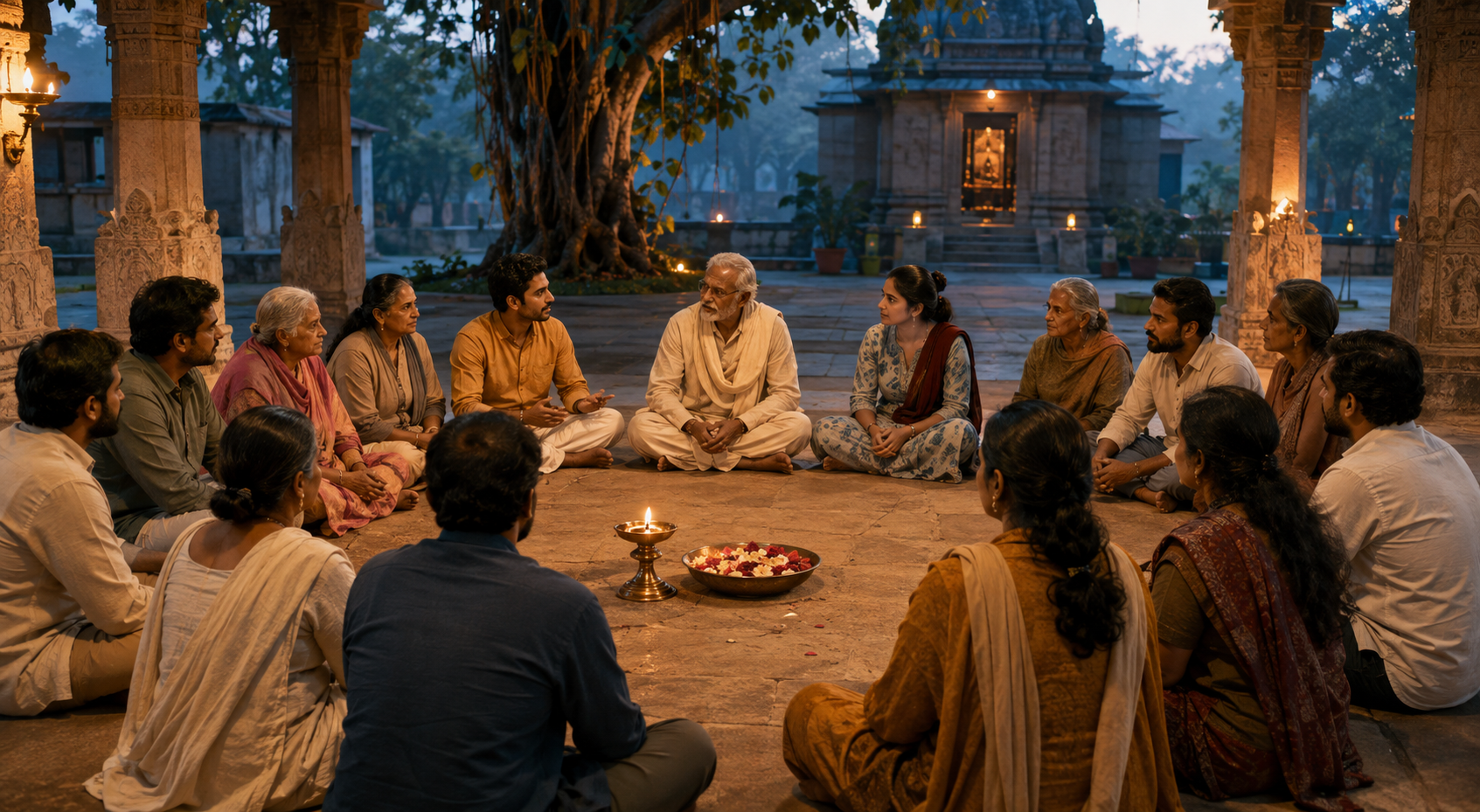
A prayer gathering can deepen conflict if it becomes a caucus with sacred vocabulary. People may repeat unverified allegations as prayer requests, identify a supposed enemy, and leave feeling that God has confirmed their side. Prevent that drift through an explicit covenant and a clear boundary between pastoral care and adjudication.
A weekly rhythm is workable; a Vaishnava group that met once a week found that sharing life concerns and praying for one another created genuine closeness. Frequency is less important than a stable form. Use this sequence:
- Invite people willing to pray for the welfare of the entire community, including those with whom they disagree. Do not describe the gathering as neutral if it is open to only one faction.
- Choose a facilitator who can interrupt gossip, motive-reading, sermons aimed at absent people, and attempts to relitigate the dispute.
- Read the covenant aloud: We will not use prayer to spread allegations, recruit allies, pronounce guilt, or demand reconciliation from anyone who feels unsafe.
- Settle the mind through the community’s normal spiritual practice before discussing requests.
- Let participants name their own distress and needs. Replace They are destroying everything with I am angry and afraid; I need restraint, clarity, and guidance about my duty.
- Pray for truth, safety, accountability, humility, and the welfare of everyone involved. Avoid prayers that assume a disputed conclusion.
- Close with a practical act within the group’s authority, such as arranging a meal, checking on an isolated family, locating a qualified mediator, or asking the governing body to explain its process.
- Record commitments, not confidential stories. The prayer group should not become an unofficial archive of accusations.
If names are used for personal prayer, seek consent when possible. In an active dispute, naming an alleged wrongdoer before a group can function like a public charge even when no evidence is presented. Pray for the affected people and the community without converting a sacred gathering into a trial.
Do not pressure a harmed person to attend, pray beside the person accused of harming them, offer forgiveness publicly, or disclose details as proof of spiritual sincerity. Participation must remain voluntary. Prayer for another person’s welfare can happen without physical proximity or restored contact.
Confidentiality also needs a safety exception. A group must not promise secrecy when a child or vulnerable person may be at risk, when there is a credible threat of violence or self-harm, or when applicable law or safeguarding policy requires a report. Follow the relevant local process and seek qualified professional guidance if the duty is unclear.
Turn compassionate intention into accountable repair
Prayer can prepare people to act well, but it cannot perform fact-finding, restore missing funds, correct a false statement, protect someone from intimidation, or decide who should hold authority. Keep a care lane and an accountability lane. They may inform each other, but neither should impersonate the other.
Match the process to the seriousness of the situation:
- For a difference of judgment, an isolated harsh remark, or a misunderstanding, begin with a private conversation. Use a mutually trusted mediator if direct conversation repeatedly becomes defensive.
- For repeated misconduct, retaliation, a serious power imbalance, or disputed facts that affect the community, use a documented complaint process and an impartial review. Interim boundaries may be necessary while facts are assessed; they are protective measures, not final verdicts.
- For immediate danger, threats, abuse, child-safety concerns, or possible criminal conduct, prioritise physical safety and the appropriate safeguarding or public authorities. Do not route the matter solely into private mediation or prayer. Spiritual care can accompany professional, legal, medical, or psychological help; it must not replace it.
For an ordinary corrective conversation, prepare six elements before you speak:
- Observation: identify the conduct without exaggeration. At the committee meeting, you disclosed the family’s private request after agreeing it would remain confidential.
- Standard: state the shared duty. People seeking pastoral help were promised privacy.
- Impact: explain the concrete consequence. The family withdrew, and others now fear asking for help.
- Request: name the repair sought. Correct the disclosure with those who heard it, apologise to the family without pressuring them to respond, and stop repeating the information.
- Support: state what help is available. This could include training, supervision, mediation, or a temporary reassignment.
- Boundary and review: explain what access or responsibility changes now, who will review progress, and what evidence of change will matter.
This form keeps the conversation anchored in dharma rather than personality. Avoid claims about hidden motives unless the person has stated them. Avoid always and never unless the record genuinely supports those words. If you do not know whether something happened, say that it was reported or alleged and identify how it will be checked.
Forgiveness, trust, reconciliation, and office are different decisions
Communities often create fresh harm by treating four distinct choices as a single package. They are not the same:
- Forgiveness can mean relinquishing the wish to humiliate or retaliate. It does not require calling wrongdoing acceptable.
- Trust concerns what access or reliance present conduct can safely support. It grows through demonstrated change, not through a demanded emotional declaration.
- Reconciliation requires enough truth, willingness, and safety on all sides to rebuild a relationship. One person cannot command it from another.
- Leadership or service office is a responsibility held for the community. Someone may be treated with dignity, welcomed to suitable spiritual association, and still remain unfit for a former role.
The accounts of Krishna forgiving Indra and Brahma, and Shiva restoring Daksha after correction, emphasise that discipline can leave room for the wrongdoer’s spiritual recovery. They do not prove that every role must be returned. In a modern community, restoration should move through a visible sequence: a truthful account, acknowledgment of harm, appropriate repair, sustained behavioural change, renewed trust, and only then consideration of responsibility. Progress at one stage does not entitle anyone to skip the next.
An apology is important, but it is not the whole test. Notice what happens after the apology. Does the person accept consequences without mobilising supporters? Do they correct misinformation as widely as they spread it? Do they respect the pace and boundaries of those harmed? Do they change when no audience is watching? Compassion keeps the possibility of growth alive; accountability tests whether growth is occurring.
Key takeaways
- Name the specific conduct and the shared standard before judging a person’s entire character.
- Protect people first. Compassion never requires unsafe contact, secrecy about serious harm, or premature restoration of authority.
- Pray for truth, safety, repentance, wisdom, and freedom from revenge rather than for divine confirmation of a faction’s verdict.
- Keep prayer, pastoral support, fact-finding, and disciplinary decisions in clearly defined lanes.
- Distinguish forgiveness from trust, reconciliation, access, and return to office.
- Evaluate repentance through repair, respect for boundaries, and sustained change, not devotional language alone.
Before you send the next community message, answer four questions privately: What actually happened? Who needs protection? What repair is required? What path back could remain if there is honest change? Then pray until you can pursue those answers without concealment or humiliation. Send only the message that serves that work.
References
- Dandavats — Disapproved but not Disowned
- Dandavats — Thoughts, Energy, Prayer: The Power of a Family, or Community, Prayer Group
