

You may be trying to settle a difficult question: does Hindu tradition expect a woman to disappear from social and moral life when her husband dies? If you turn to the Ramayana and the Mahabharata, the answer is not the one supplied by the familiar stereotype of widowhood as social extinction.
Across both epics, widowhood does not automatically cancel a woman’s agency, status, or purpose. That does not make bereavement painless, prove that every constraint was just, or erase later mistreatment of widows. It gives you a firmer and more precise starting point: the death of a husband is a profound loss, but it is not the death of his wife’s personhood.
Separate bereavement from social erasure
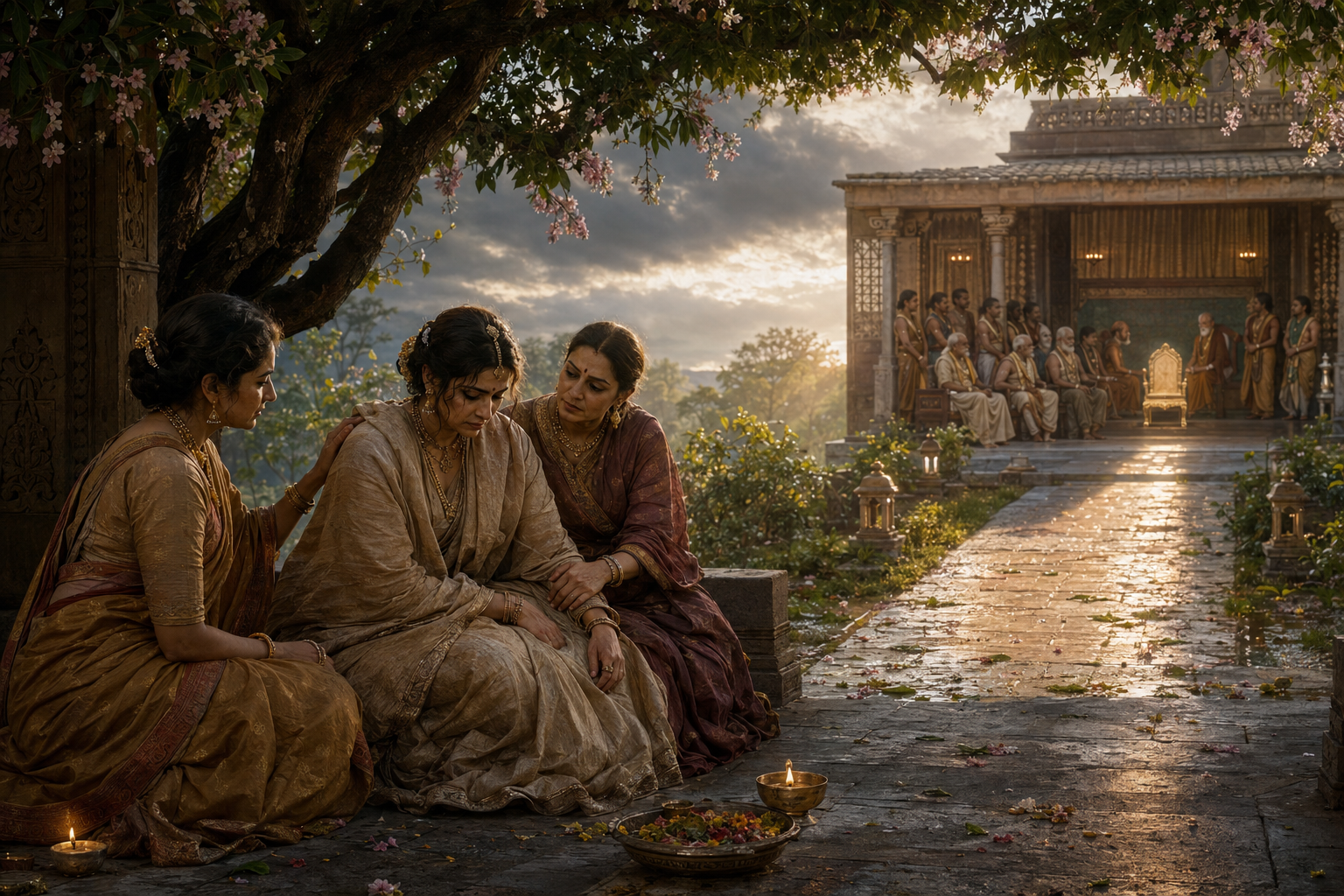
The first distinction is simple but decisive. A husband’s death is an event in a woman’s life. The claim that his death must end her public identity, moral authority, relationships, and responsibilities is a social verdict. The epics portray the first without making the second an automatic consequence.
This changes how you should read a widow’s story. Do not stop when death occurs, or count only the expressions of grief that immediately follow it. Keep reading. Ask whether the woman remains part of the moral and social world of the narrative. Does she still interpret events? Does she retain responsibilities? Do her decisions affect other people? Does the narrative give her a future-facing purpose?
Those questions matter because grief can look like passivity when a reader examines only a single scene. Mourning describes what a woman is enduring; it does not, by itself, tell you whether she has ceased to be an agent. A woman can grieve intensely and still possess judgment, dignity, influence, and obligations.
The chronological distinction matters as well. The later social image of widowhood as an affliction should not be projected backward and treated as though it exhausts the Ramayana or the Mahabharata. Within Hindu tradition, these works are Itihasa. They must be read in their own narrative settings, not used as empty containers for every custom that appeared in later society.
Recognize the three dimensions of epic agency
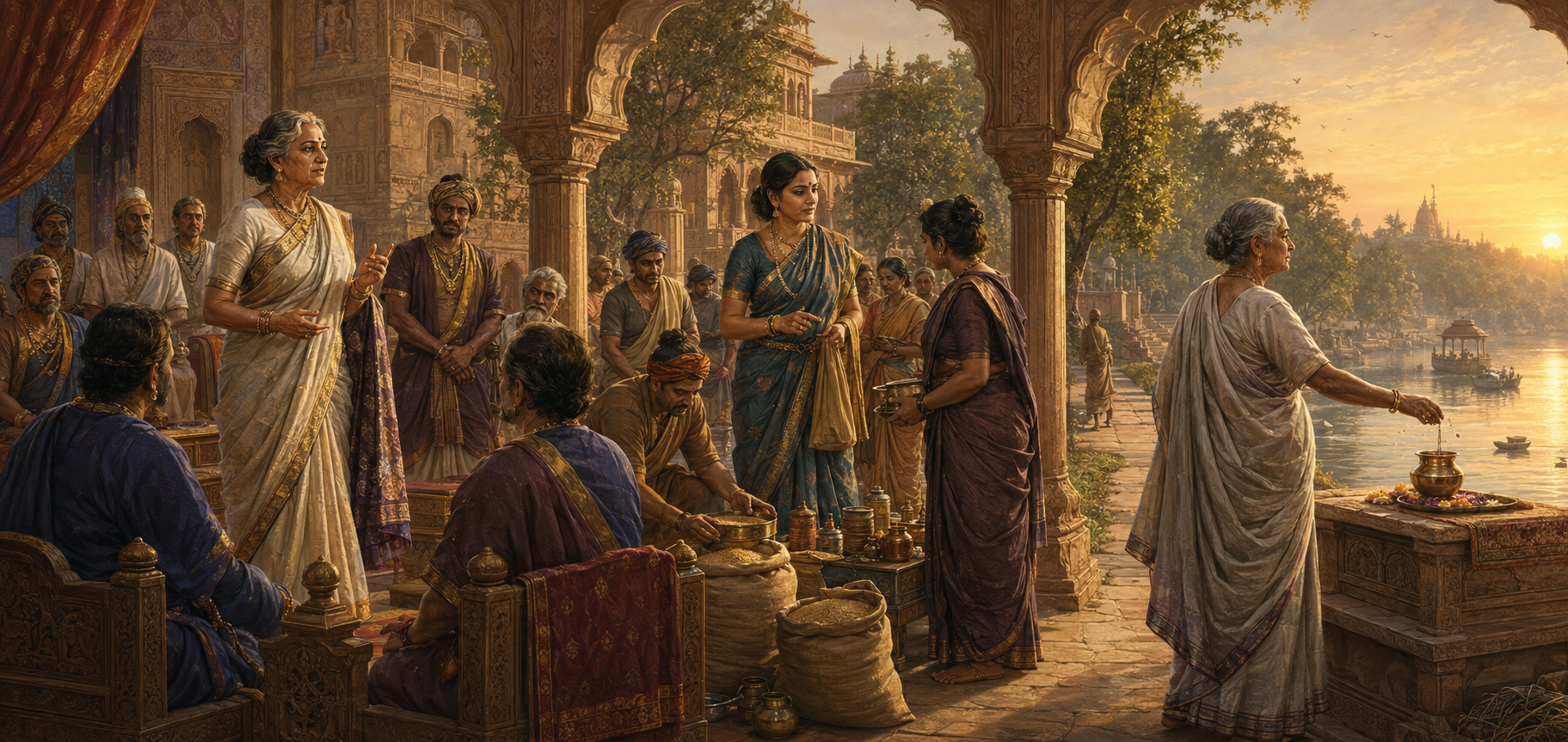
Agency is often treated as a yes-or-no condition: either a woman has complete freedom or she has none. That is too crude for epic literature and too crude for real life. A person can act within severe limits, possess authority in one sphere but not another, or preserve moral independence while lacking political power.
To read widowhood carefully, separate status, purpose, and active judgment. They overlap, but they are not interchangeable.
Status: does she remain socially legible?
Status is not merely a title. It is the continuing recognition that a woman belongs within a family, community, or political order and that her presence has weight. Look for how other characters address her, whether relationships survive the husband’s death, and whether her position is acknowledged when decisions are made.
This test prevents a common error. A change in status is not necessarily the elimination of status. Widowhood may alter a woman’s place without making her a non-person. Your task as a reader is to identify what changed and what remained, not to assume total erasure from the fact of loss alone.
Purpose: does her life still point forward?
Purpose appears wherever a widow continues to carry responsibilities, loyalties, commitments, or a role in what happens next. The useful question is not whether she resumes the life she had before bereavement. She cannot. Ask instead whether the narrative leaves her with meaningful work in the world after the marriage has ended through death.
This distinction is especially important when a widow’s purpose is connected to family or duty. A modern reader may dismiss relational duties as the opposite of agency. That conclusion does not follow. A duty can be imposed, chosen, interpreted, resisted, or reshaped. Examine how the woman relates to it before deciding what it means.
Active judgment: does she interpret and respond?
Agency becomes visible in decisions, counsel, refusals, commitments, warnings, and interpretations of dharma. The action need not be dramatic. A brief intervention can shape the moral direction of a scene, while a long appearance can leave a character with little control. Counting lines is therefore a poor substitute for examining consequences.
Do not romanticize constraint. The fact that a widow acts within hardship does not make the hardship desirable, and her endurance does not convert every condition surrounding her into a dharmic ideal. The sound conclusion is narrower: constraint and agency can coexist, so the presence of one does not prove the absence of the other.
Compare the Ramayana and Mahabharata without flattening them

The two epics share an important baseline: neither requires you to treat widowhood as automatic social death. A shared baseline, however, does not make every widow, episode, or narrative outcome identical. The Ramayana and the Mahabharata place women in different familial, moral, and political situations. A responsible comparison holds those differences in view.
When you compare two episodes, use the same five-part reading test for each:
- Identify the woman’s position before her husband’s death. You cannot measure change without establishing the starting point.
- Identify the immediate pressures after the death. Grief, danger, family conflict, and public responsibility can constrain different kinds of action.
- Track what continues. Note surviving relationships, responsibilities, recognition, and access to decision-making.
- Track what the woman does with what remains. Look for judgment, speech, initiative, influence, acceptance, and resistance.
- Examine the consequences. Ask whether her choices alter another character, preserve an obligation, redirect a conflict, or shape the future.
This method keeps you from comparing unlike circumstances and then attributing the difference entirely to widowhood. If two women occupied different positions before bereavement, faced different threats, and retained different resources afterward, their outward conduct cannot be treated as a controlled experiment.
It also guards against turning a narrative occurrence into a command. Something suffered by a character is not necessarily something the epic instructs society to impose. Something chosen under extreme conditions is not automatically a universal rule. Before calling an episode a model for all Hindu women, ask whether the narrative presents a duty, a personal response, a tragic necessity, or simply an event.
Use epic evidence responsibly in present-day arguments

Discussions of Hindu widowhood often become unreliable because several different claims are compressed into one sentence. You can keep the argument honest by separating four levels.
- Textual claim: What do the Ramayana and the Mahabharata actually portray after a woman’s husband dies?
- Interpretive claim: What does that portrayal imply about dignity, duty, status, and agency?
- Historical claim: How were widows treated in a particular community, place, or later period? This requires evidence beyond the epics themselves.
- Contemporary ethical claim: How should a family or community treat a widow now? This requires moral judgment, not the mechanical transfer of one narrative episode.
Once these levels are separated, two sweeping arguments fail. The first says that later mistreatment proves the Hindu epics erase widows. It confuses later social practice with epic portrayal. The second says that the epics’ recognition of widows proves every Hindu society always treated every widow well. It mistakes a textual inheritance for a complete social history.
A serious pro-Hindu position does not need either exaggeration. It can acknowledge injustice where it occurred while insisting that social erasure is not the only model available within the Hindu inheritance. The epics preserve a more demanding principle: a woman’s identity, moral capacity, and responsibilities do not expire with her husband.
That principle should affect conduct, not remain a debating point. In a family, temple, or community setting, do not use widowhood as a reason to speak over a woman, decide her role without asking her, or reduce every part of her identity to bereavement. Ask which responsibilities she wants to retain, what participation matters to her, and what support would make her own decisions possible. Respect for agency begins by addressing the woman herself.
Key takeaways
- The Ramayana and the Mahabharata portray a husband’s death as a profound loss, not as the automatic end of his wife’s personhood.
- Agency should be assessed through continuing status, forward-looking purpose, active judgment, and consequences, not through the absence of grief or constraint.
- The two epics share a baseline without offering identical situations. Compare episode with episode rather than reducing both works to a slogan.
- Later customs cannot simply be projected backward into Itihasa, and epic portrayals cannot prove that every later Hindu community acted consistently with them.
- The practical dharmic lesson is to recognize a widow as the continuing subject of her own life, not merely as the surviving half of a marriage.
The next time someone makes a sweeping claim about Hindu widowhood, open the relevant episode at the moment of loss and keep reading. Mark every relationship, responsibility, judgment, and consequential action that survives. That discipline replaces an inherited stereotype with attention to the text. In present life, apply the same discipline more directly: listen to the widow before deciding what widowhood is supposed to mean for her.
References
