

If you have heard that Bharat gave the world zero but still wondered how an abstract mathematical system could survive for centuries and travel across languages, the missing part is not another roll call of famous scholars. It is the method of preservation: Sanskrit verse, disciplined memorisation, exacting grammar, and teachers who knew how to unfold a compressed line.
That method matters because it changes how you should read claims about Indian mathematics. A verse was neither decorative packaging nor a self-explanatory equation. It was durable intellectual compression. To understand what crossed from Pataliputra and Ujjain to Baghdad, and from there towards Europe, you have to examine the words, the mathematical conventions behind them, and the human chain that made them intelligible.
Verse functioned as a storage technology
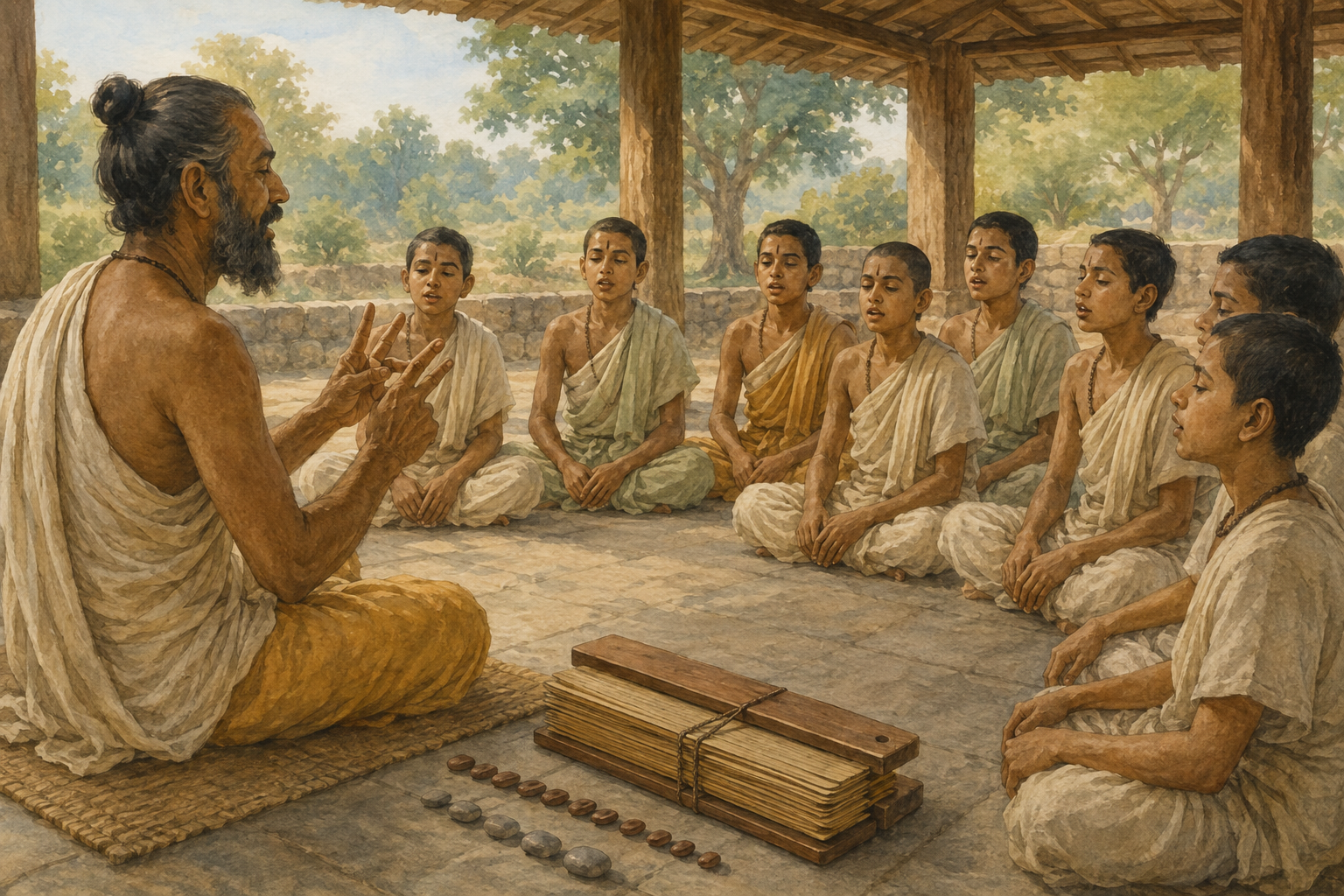
Mathematics in verse seems unusual only when you assume that a printed page or digital file is the normal home of knowledge. In a manuscript culture, a physical copy could decay, burn, disappear in war, or simply become inaccessible. A text committed to trained memory could be reproduced after the object carrying it had vanished.
Metre made that memory more dependable. Rhythm and syllabic structure gave the reciter a pattern to follow. If a word disappeared or an extra sound entered a line, the metre could warn that something had shifted. This was not an infallible checksum, but it supplied a form of error detection unavailable to loose prose.
Panini’s tightly ordered grammatical system supplied a second constraint. Grammar governed how words could be formed and related; metre governed how they could fit the verse. Neither constraint made a technical statement automatically clear, but together they helped stabilise its verbal form. The practical lesson is important: Sanskrit preserved scientific thought through structure, not through some vague claim that the language was inherently mystical.
The degree of compression could be remarkable. In 499 CE, the twenty-three-year-old Aryabhata placed major mathematical and astronomical ideas into thirty-three Sanskrit verses composed at Pataliputra. Those verses included a calculation of the solar year to seven decimal places and an explanation of the apparent movement of the stars through the Earth’s daily rotation. A short recitable work could therefore carry results that required substantial mathematical reasoning to derive.
Śūnya shows how much can sit behind a compact term. Its ordinary sense of emptiness became mathematically productive when an empty position had to be represented within decimal place-value notation. A small circle could mark that absence, but the mark was not the whole achievement. The decisive idea was that position determines value and that an empty position must still be accounted for. Once you distinguish the symbol, the concept, and the numerical system in which it operates, the significance of zero becomes much easier to explain accurately.
When you encounter a celebrated Sanskrit verse, therefore, ask three separate questions: What does the line state explicitly? What technical conventions would a trained reader already know? What explanation is supplied by a teacher or commentator? Collapsing those questions produces either romantic praise without mathematics or a modern equation with the historical method erased.
Compression preserved words, but teachers preserved meaning

A dense verse can be memorised precisely and still remain opaque to an untrained reader. That is not a defect peculiar to Sanskrit. Every compressed notation depends on shared conventions. A modern formula is concise because a mathematician already knows what its symbols and operations mean. Sanskrit technical verse worked through a comparable partnership between concise expression and learned explanation.
This is why the transmission system needed human carriers. When an Indian mathematical manuscript reached Baghdad, a scholar named Kanika did more than pronounce its lines. He acted as the interpretive key, unpacking the compact language for an Arabic-speaking astronomer. The verse preserved the intellectual object; the teacher reopened it.
You can apply the same discipline when studying or teaching a Sanskrit mathematical passage now:
- Keep the Sanskrit wording beside the translation so that interpretation can be checked against the transmitted line.
- Parse the grammar before converting the statement into modern notation. A convenient equation may conceal which relationships the verse actually expresses.
- Expand every implied operation. If an intermediate step is supplied by convention or commentary rather than by the verse, label it as such.
- Work at least one numerical example. A paraphrase can sound plausible while giving the wrong procedure; a calculation exposes the difference.
- Separate the historical explanation from modern terminology. Use a familiar name to orient the reader, but do not let that later name replace the earlier Indian formulation.
This method protects against two opposite errors. One is treating the verse as a talisman whose antiquity proves anything attributed to it. The other is assuming that, because the verse needs explanation, the mathematics must have been supplied by a later interpreter. Compression always requires expansion. The question is whether that expansion follows the language, conventions, and demonstrable mathematical structure of the transmitted work.
Baghdad reveals the complete transmission system
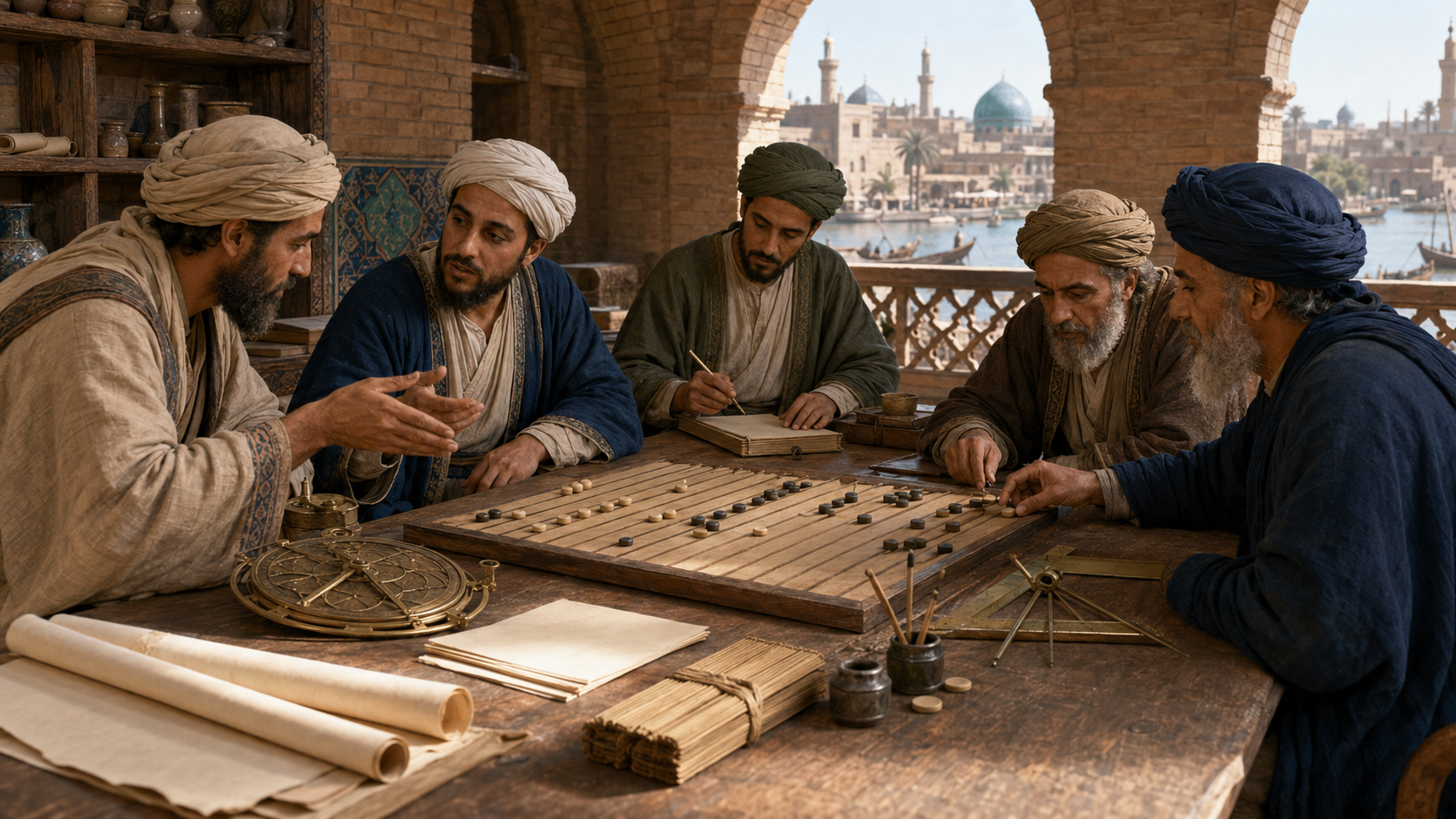
In 773 CE, an Indian delegation arrived at the Abbasid court of Caliph al-Mansur with a mathematical and astronomical manuscript. The court had requested not only the work but also Brahmin scholars from Ujjain who could explain it. The Arabic world came to know the work as the Great Sindhind.
That request shows unusually clear awareness of the problem posed by compressed knowledge. Possessing the manuscript was not enough. The court needed someone trained in the intellectual tradition from which it came.
Under court patronage, the astronomer al-Fazari worked with Kanika to render the Sanskrit material into Arabic prose while preserving its mathematical content. Translation therefore involved more than replacing Sanskrit nouns with Arabic ones. Metre had to become exposition. Implied procedures had to become readable instructions. Indian numerals and zero had to be taught as parts of a coherent system rather than copied as unfamiliar marks.
The patrons themselves reveal a wider Dharmic geography. The Barmakid family had roots in the Buddhist Navavihara monastery near Balkh, in present-day Afghanistan, before rising within the Abbasid administration. Their support connected Buddhist Central Asia, Brahmin scholarship from Ujjain, and the Arabic intellectual world. Indian knowledge did not travel through a single religious institution or a single political identity. It moved through overlapping scholarly, monastic, mercantile, and courtly networks.
Al-Khwarizmi later encountered this Indian mathematical inheritance in Baghdad. His Arabic works clarified and extended the use of decimal calculation, helping the system move into new linguistic and practical settings. His Latinised name became the ancestor of the word algorithm, while a title associated with his work furnished the word algebra. Those familiar European terms preserve one stage of a longer journey, not the journey’s beginning.
The ideas continued through Islamic Spain and the translation activity of Toledo. Leonardo Fibonacci met the Indian numerical method in North Africa and presented it to European readers in Liber Abaci in 1202 as the modus Indorum, the method of the Indians. Europe did not receive a bare symbol called zero. It received a usable system after generations of explanation, translation, adaptation, and teaching.
This route gives you a better vocabulary for discussing civilisational influence. Formulation, preservation, translation, extension, and popularisation are different achievements. Naming the scholar or community responsible for each stage produces a stronger account than assigning the entire history either to the earliest originator or to the last person who made the method famous.
Modern names can hide older mathematical questions
A modern label is useful for recognition, but it can distort history if you mistake the label for the birth of the underlying idea. Indian scholars studying the possible arrangements of long and short syllables in Sanskrit poetic metres described numerical patterns centuries before those patterns became associated in Europe with Fibonacci. This is a particularly revealing case: the mathematical result emerged from the internal demands of verse itself. Poetry was not merely carrying mathematics. Prosody could generate mathematical problems.
The same caution applies to the Kerala school. Beginning with Madhava of Sangamagrama, successive Sanskrit scholars developed infinite-series results corresponding to what later European terminology would call the Gregory-Leibniz series for pi and power series for sine and cosine. Their work continued across five generations and produced increasingly precise planetary calculations.
Saying that an Indian result corresponds to a later European formula does not mean that the scholars used identical notation, proofs, or philosophical language. It means that the mathematical relationship must be compared at the level of procedure and result. If you want to argue for priority, demonstrate that correspondence instead of relying only on the resemblance between two modernised equations.
Priority and transmission must also be kept separate. Sanskrit works can establish that a result was known in Kerala before its publication in Europe. They do not, by themselves, prove that a particular European mathematician received it from Kerala. How the Kerala results may have reached Europe remains unresolved. Jesuit contact in sixteenth-century Kerala is a proposed route, not a demonstrated chain. A serious account should state the Indian priority supported by the texts while leaving the transmission question open unless firmer evidence appears.
Key takeaways
- Sanskrit verse was durable intellectual compression, not a substitute for explanation.
- Metre and grammar helped stabilise wording; trained teachers and commentaries recovered the operational meaning.
- The passage through Baghdad was a relay involving Indian scholars, Buddhist-rooted patrons, Arabic translators, and later European adapters.
- Origin, transmission, extension, and popularisation should be credited separately.
- Indian priority does not automatically prove a particular route of transmission to Europe; the Kerala connection remains an open historical question.
Use five questions to test a transmission claim
You do not have to choose between dismissing Indian achievements and accepting every sweeping civilisational claim. Use a repeatable test. It works when you are reading a popular history, preparing a lesson, discussing a Sanskrit passage, or deciding whether a viral claim deserves to be shared.
- What exactly is being claimed? The invention of a symbol, the formulation of a concept, a computational method, a proof, or the transmission of an existing result are not interchangeable claims.
- What is present in the historical formulation? Identify the Sanskrit term, rule, procedure, or relationship before translating it into the name of a later European result.
- Who could unlock the compression? Look for teachers, commentators, translators, bilingual scholars, and institutions. A manuscript changing location is not yet evidence that its meaning was understood.
- What changed during translation? Note where verse became prose, an implicit convention became an explicit rule, or a specialist method was adapted for merchants, astronomers, or another readership.
- How certain is each link? Distinguish a dated formulation from a documented translation, a plausible contact route, and an unresolved hypothesis. Do not allow confidence in one link to spill into another.
This test also improves how we honour Sanskrit learning. Civilisational pride becomes more durable when it rests on recoverable operations, dated works, named carriers, and clearly marked uncertainty. Exaggeration makes a claim easier to attack; precision reveals a history that is already remarkable without embellishment.
The next time you meet a mathematical śloka, do not display it as an isolated ornament. Place the original beside a careful translation, expand the calculation step by step, identify the knowledge a trained reader supplied, and map the people who carried it into another language. That is how you turn inherited memory into living knowledge—and continue the transmission rather than merely celebrating it.
References
