
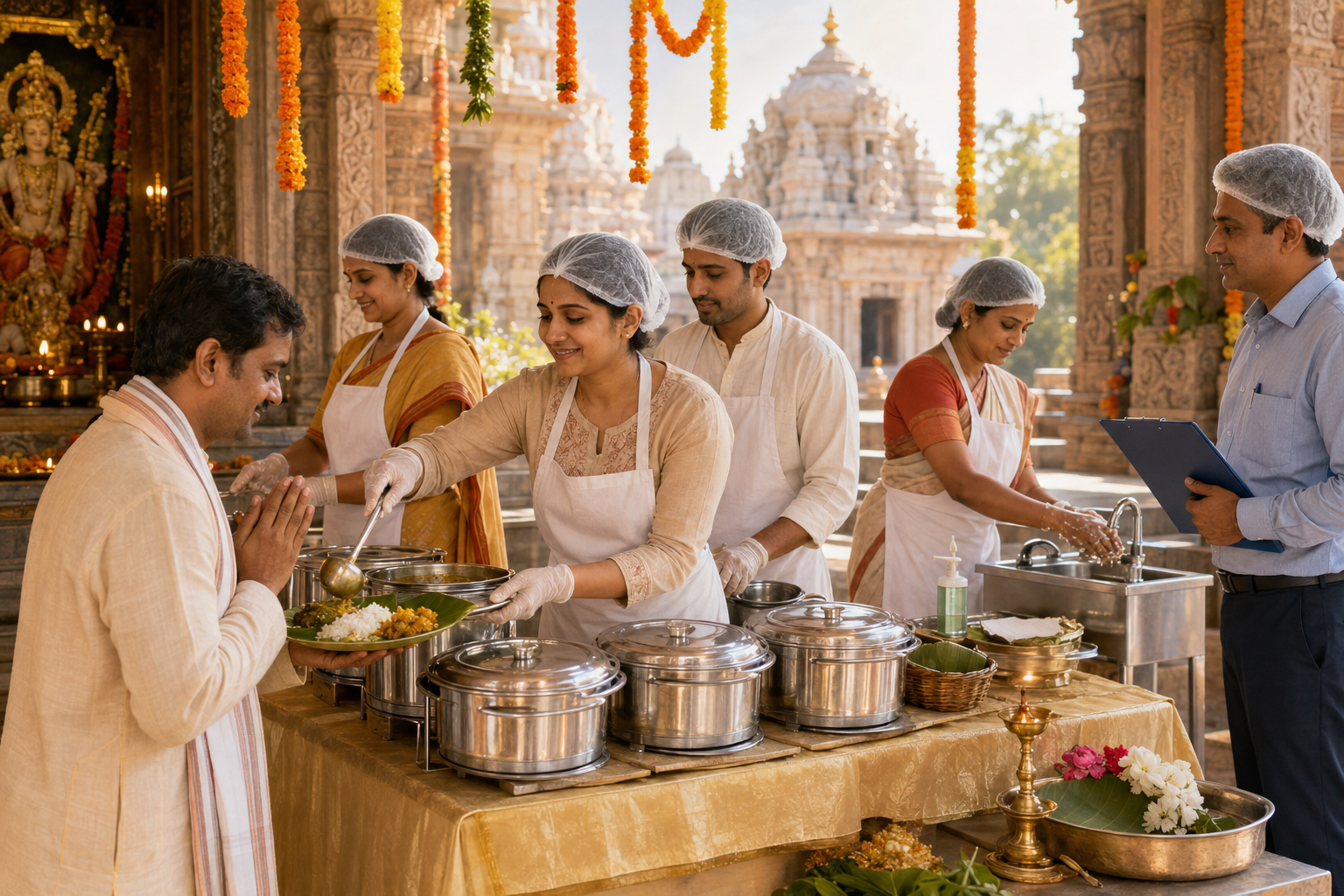
If your temple is suddenly facing food-control demands, do not begin with the claim that Mahaprasad must remain beyond regulation. Begin with three questions: What is the exact rule, what food-safety risk triggers it, and are comparable non-temple meals treated the same way? Those questions protect both the sanctity of the offering and the rights of devotees.
In Ratnagiri, the Maharashtra Mandir Mahasangh has submitted memorandums objecting to what it describes as FDA regulation directed only at Hindu Mahaprasad and Bhandaras. That is a serious allegation, but an allegation of selective treatment must be tested against the operative rule and its actual enforcement. A strong Hindu response should demand evidence, equal standards and a workable remedy.
The real issue is equal safety, not exemption from safety
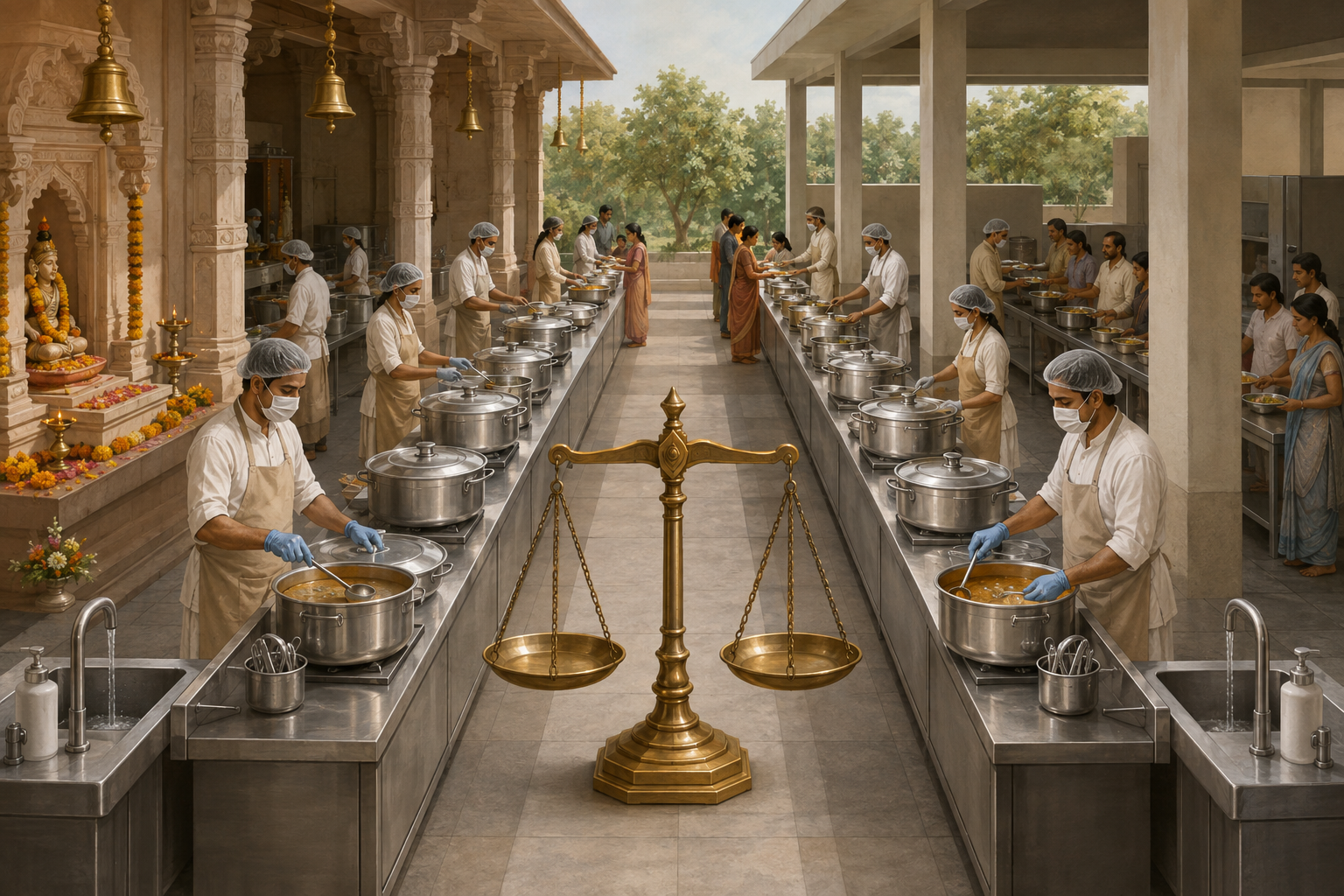
Mahaprasad is not an ordinary commercial product in the eyes of a devotee. It has first been offered to the deity and is then received with reverence. A Bhandara is also more than food distribution: it is seva, hospitality and community participation. Regulation that ignores this religious character can become intrusive even when its stated purpose is legitimate.
Yet sacred status does not remove the practical duty to serve food safely. Water, utensils, ingredients, storage, preparation and distribution can all affect the person receiving the offering. Protecting devotees from avoidable harm is consistent with seva. Temples weaken their case if they appear to reject every food-safety obligation merely because the food is sacred.
The sound principle is simple: the same material risk should attract the same rule. Different treatment may be reasonable when it follows a relevant distinction such as the scale of preparation, duration of service, packaging method, kitchen infrastructure or manner of public distribution. It becomes suspect when the decisive classification is simply Hindu religious identity and comparable activities carrying comparable risks escape the same burden.
This distinction matters when you speak to officials. Do not ask them merely why temples are being regulated. Ask why the particular obligation applies, which risk it addresses, and which other institutions are governed by the same criterion. That moves the conversation from rhetoric to administrative accountability.
Five checks that reveal whether regulation is selective
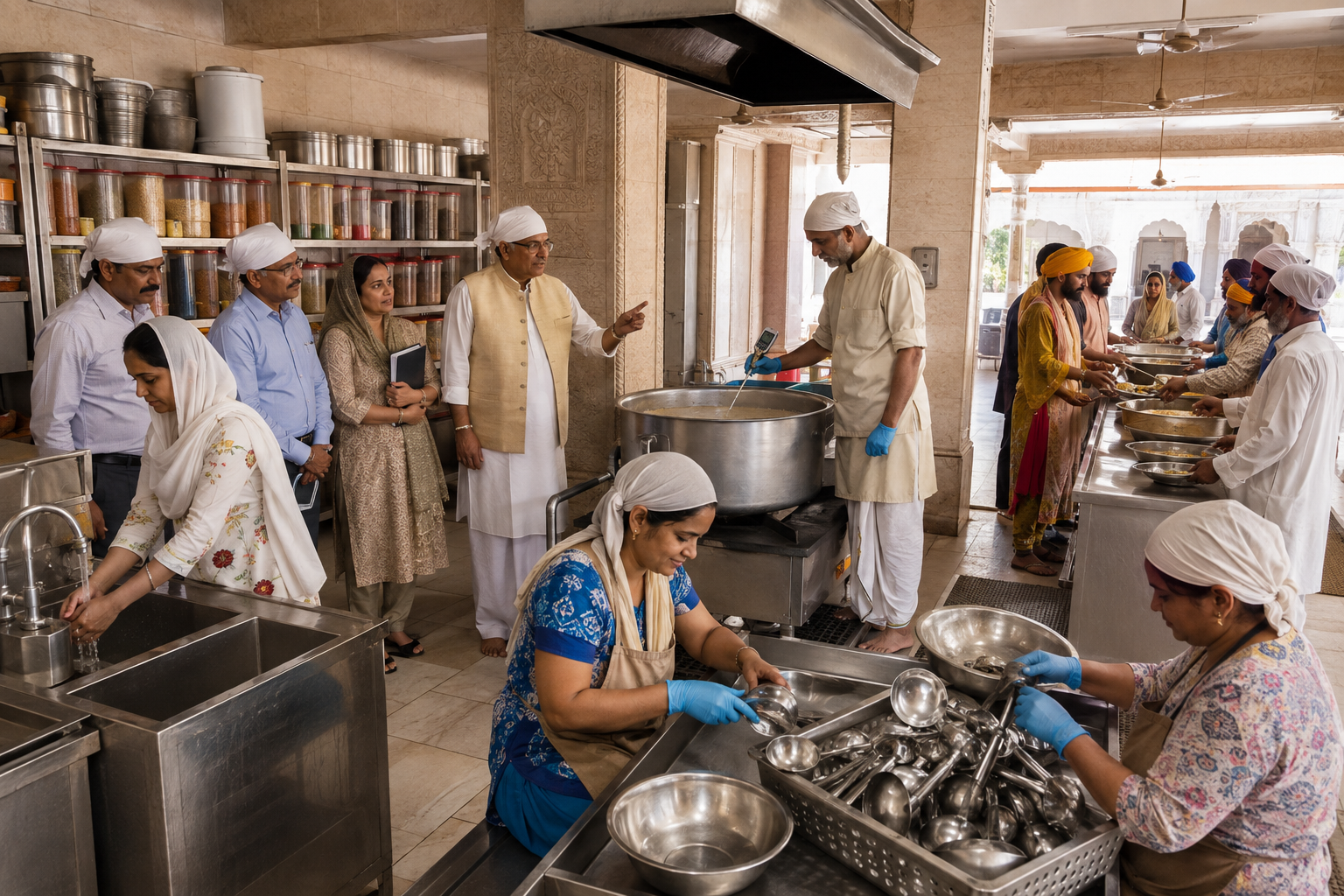
A press statement, verbal instruction or photograph of a notice is not enough to establish the complete regulatory position. Before repeating a discrimination claim as settled fact, a temple committee should conduct five checks.
- Obtain the operative instrument. Ask for the complete notice, circular, order, licence condition or written direction. Record its title, issuing office, date, jurisdiction and legal basis. A verbal demand should be followed by a written request asking the official to identify the authority for it.
- Identify the actual trigger. Mark the words defining who must comply. Does the requirement apply because food is offered as Mahaprasad, because a large meal is served, because preparation occurs in a certain kind of kitchen, or because food is distributed to the public? These are not equivalent classifications.
- Choose valid comparators. Compare temple distribution with other community meals, charitable food service, festival kitchens or catered gatherings operating under materially similar conditions. A small daily offering and a large public meal may not be meaningful comparators merely because both involve food.
- Examine enforcement, not only wording. A neutral-looking rule can still be applied selectively, while a notice addressed to temples may simply be one part of a wider programme. Request information about inspections, notices and compliance directions issued to comparable food providers in the same jurisdiction and period.
- Ask for the regulator’s explanation. Give the responsible office a precise opportunity to explain the safety rationale, coverage and enforcement policy. Preserve the reply. No reply, an incomplete reply and a reasoned reply are different facts and should be described differently.
Keep three columns in your working notes: what is established, what still needs evidence, and what is your interpretation. The Ratnagiri memorandums establish that an organised objection has been raised. Whether the disputed requirements are legally or operationally confined to Hindu institutions requires the underlying regulatory and enforcement record. Keeping that boundary clear makes your advocacy more credible.
Build a temple record that protects devotees and the institution
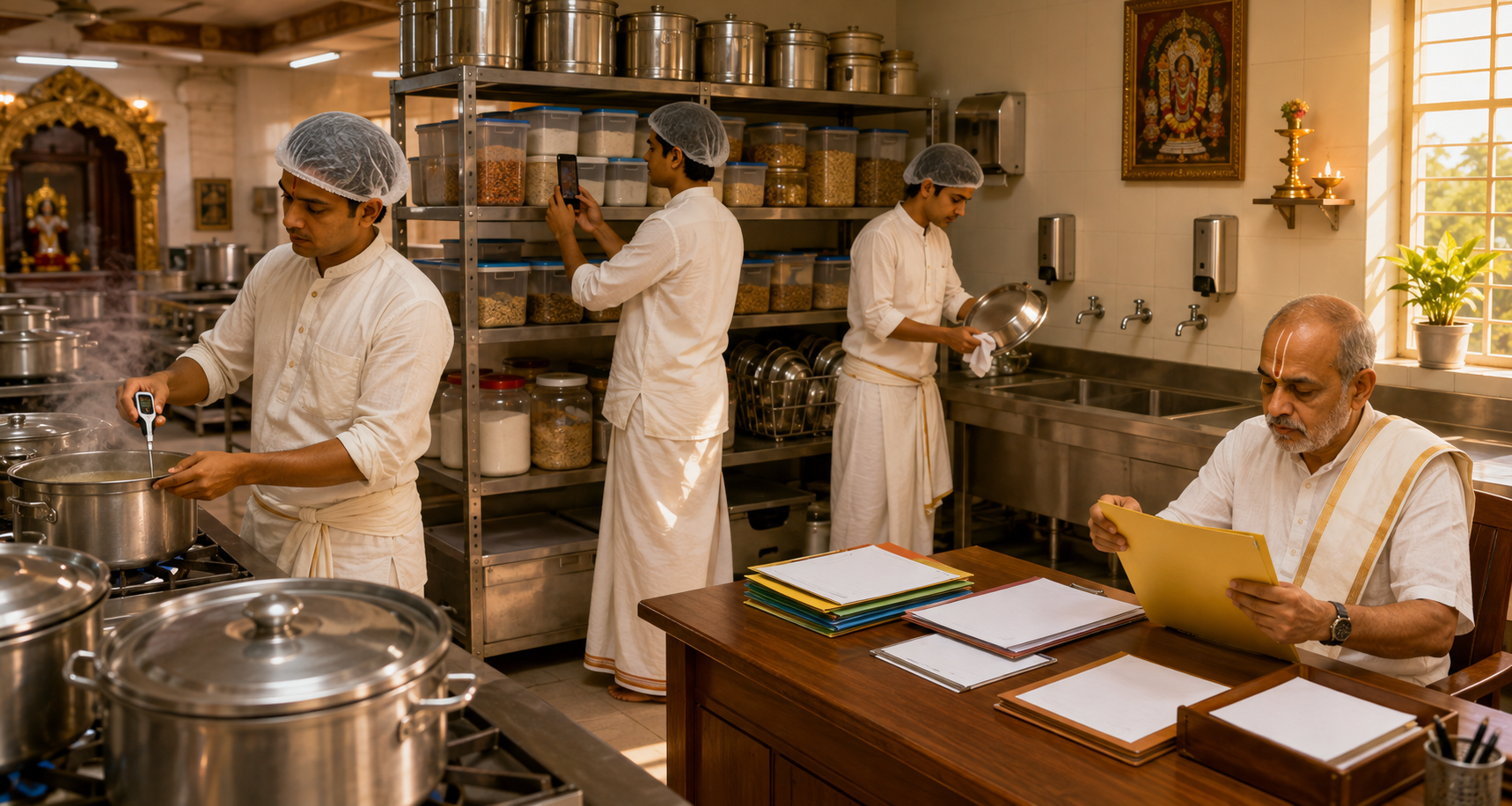
A temple should not wait for a controversy before documenting its kitchen. Good records help volunteers prevent mistakes, show inspectors what is actually happening and distinguish a genuine safety concern from an arbitrary demand. The system can remain proportionate to the temple’s scale.
- Name a responsible person for each preparation period. Volunteers should know who can pause distribution, replace an unsafe ingredient or answer a practical question.
- Maintain a simple preparation log. Record the date, dishes prepared, principal ingredients and suppliers, approximate preparation and distribution times, and the person responsible. If a problem is reported later, this gives the committee something firmer than memory.
- Write down the kitchen routine. Cover handwashing, cleaning of utensils and surfaces, protection of ingredients, safe water, separation of waste and the handling appropriate to hot or perishable dishes. A procedure that exists only as custom may be applied inconsistently when volunteers change.
- Record incidents and corrective action. If food is discarded, distribution is stopped or a devotee reports a problem, note what happened and what was changed. Do not conceal a safety concern in the belief that acknowledging it diminishes the sacred offering.
- Preserve regulatory communications. Keep complete copies of notices, replies, inspection records and compliance receipts. Store the original-language document with any translation so that disputed wording can be checked.
- Separate cooperation from agreement. Temple representatives can cooperate with a lawful inspection while formally disputing a religion-specific or unsupported condition. Obstructing an official may create a separate problem and distract from the equality question.
If a direction carries penalties, threatens closure or requires expensive structural changes, obtain advice from a qualified local lawyer and an appropriate food-safety professional before deciding whether to comply, appeal or challenge it. A general principle of equal treatment cannot determine the legal effect of a particular notice.
Turn a grievance into a precise demand for equal treatment

The weakest representation says only that Hindu sentiments have been hurt. The strongest identifies the disputed action, supplies a fair comparison and asks for a remedy that an authority can actually grant. Religious dignity should be stated plainly, but it should be joined to an administrative case.
- Describe the action accurately. Quote the relevant wording from the complete notice and identify the office that issued it. Do not rely on a cropped image or paraphrase when the exact language is available.
- Explain the religious impact. State how the requirement treats Mahaprasad or Bhandara as a religious practice, not merely as generic catering. Identify the ritual or operational burden without claiming that every safety condition is an attack on Dharma.
- Present a risk-matched comparison. Show which non-temple food activities operate under similar conditions and which obligation they allegedly do not face. Include documentary evidence where possible.
- Request a specific remedy. Depending on what the record shows, ask for a written clarification of universal coverage, equal enforcement against comparable activities, removal of explicitly religion-based wording, or review of a requirement that lacks a relevant safety justification.
- Ask for a reasoned written response. A written answer allows trustees, devotees and advisers to evaluate the regulator’s position instead of arguing over competing accounts of a meeting.
A concise request can follow this structure: identify the exact direction; state the burden it creates; name the comparable activities; attach the supporting records; and ask the authority either to explain the material distinction or apply a common standard. Avoid calling every inspection anti-Hindu before that work is done. Overstatement gives officials an easy way to dismiss a legitimate equality concern.
Devotees also have a useful role. Ask the temple whether it has received a written direction, whether its food-handling routine is documented, and whether its public claims distinguish established facts from unresolved questions. Ask the regulator for the governing criterion and its general application. Supporting the temple does not require suspending scrutiny; careful scrutiny is what makes support effective.
Key takeaways
- Mahaprasad deserves recognition as a sacred offering, while devotees still deserve careful food handling.
- The proper standard is equal, risk-based regulation: comparable food-safety conditions should receive comparable treatment.
- A claim of selective enforcement needs the exact rule, valid comparators and evidence of how the rule is applied in practice.
- Temple records strengthen both safety and cultural advocacy by replacing assumption with verifiable facts.
- A useful representation asks for a defined remedy and a reasoned written response, not merely an expression of outrage.
If you serve on a temple committee, make the first move deliberately ordinary: request the complete direction, open a preparation and incident log, and build a comparison based on equivalent risks. If you are a devotee, ask both the temple and the regulator the same precise questions. The durable defence of Mahaprasad is a position that refuses two false choices: neglecting safety in the name of sanctity, or accepting unequal treatment in the name of safety.
References
