
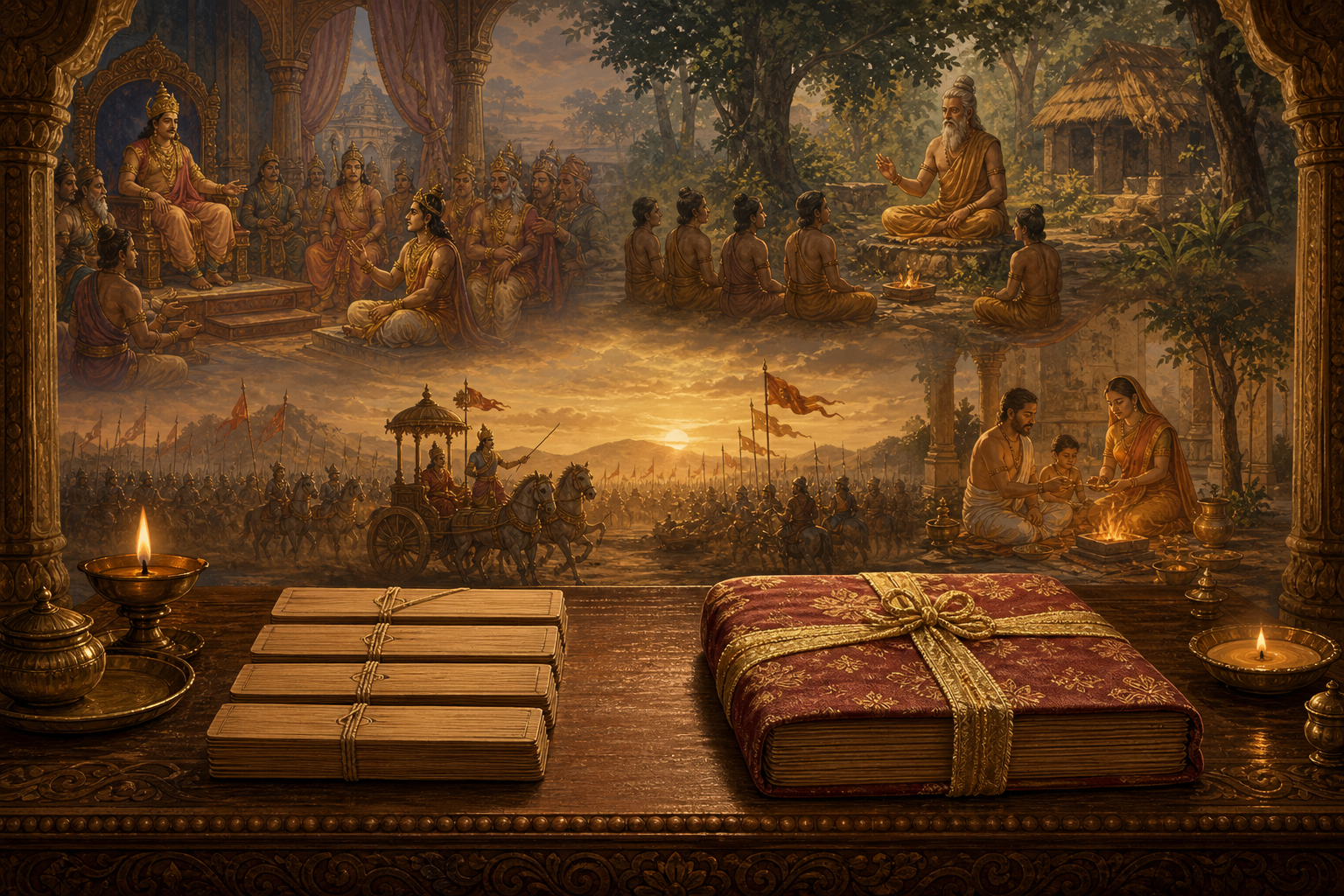
You may have heard that the Mahabharata outweighed the four Vedas and wondered what you are actually expected to believe. Is the epic therefore a Veda? Is it a sacred authority of another kind? Or is the comparison simply devotional praise?
The clean answer is that the Mahabharata is scripture, but it is not ordinarily classified as Shruti. Its traditional identity as Itihasa does not diminish its sacred authority. It tells you what kind of authority you are encountering and how you should read it.
The precise answer depends on what you mean by scripture
The English word scripture is broad. It can mean any text that a religious community receives as sacred, authoritative, spiritually formative or indispensable to understanding its tradition. Under that broad definition, the Mahabharata plainly belongs within Hindu scripture.
Shruti is a narrower traditional category. The word refers to that which is heard, and the Vedas hold this status. Smriti refers to remembered tradition. Itihasa, the category to which the Mahabharata belongs, is generally placed on the Smriti side of this broad distinction.
| Term | What it identifies | What it means for the Mahabharata |
|---|---|---|
| Scripture | A broad English term for sacred and authoritative religious texts | The Mahabharata can properly be called Hindu scripture |
| Shruti | The distinctive revealed status traditionally associated with the Vedas | The Mahabharata is not ordinarily classified as Shruti |
| Smriti | Remembered sacred tradition transmitted in several textual forms | Itihasa is commonly situated within this broad category |
| Itihasa | Sacred history and teaching communicated through an extended narrative | This is the Mahabharata’s more precise traditional classification |
This distinction prevents two opposite errors. Calling the Mahabharata only literature understates its religious standing. Calling it a Veda in exactly the same technical sense as the four Vedas erases a distinction that Hindu tradition has preserved. You can honor both truths at once: the Vedas are Shruti, and the Mahabharata is an extraordinarily authoritative Itihasa.
What the weighing of the Mahabharata and the Vedas means
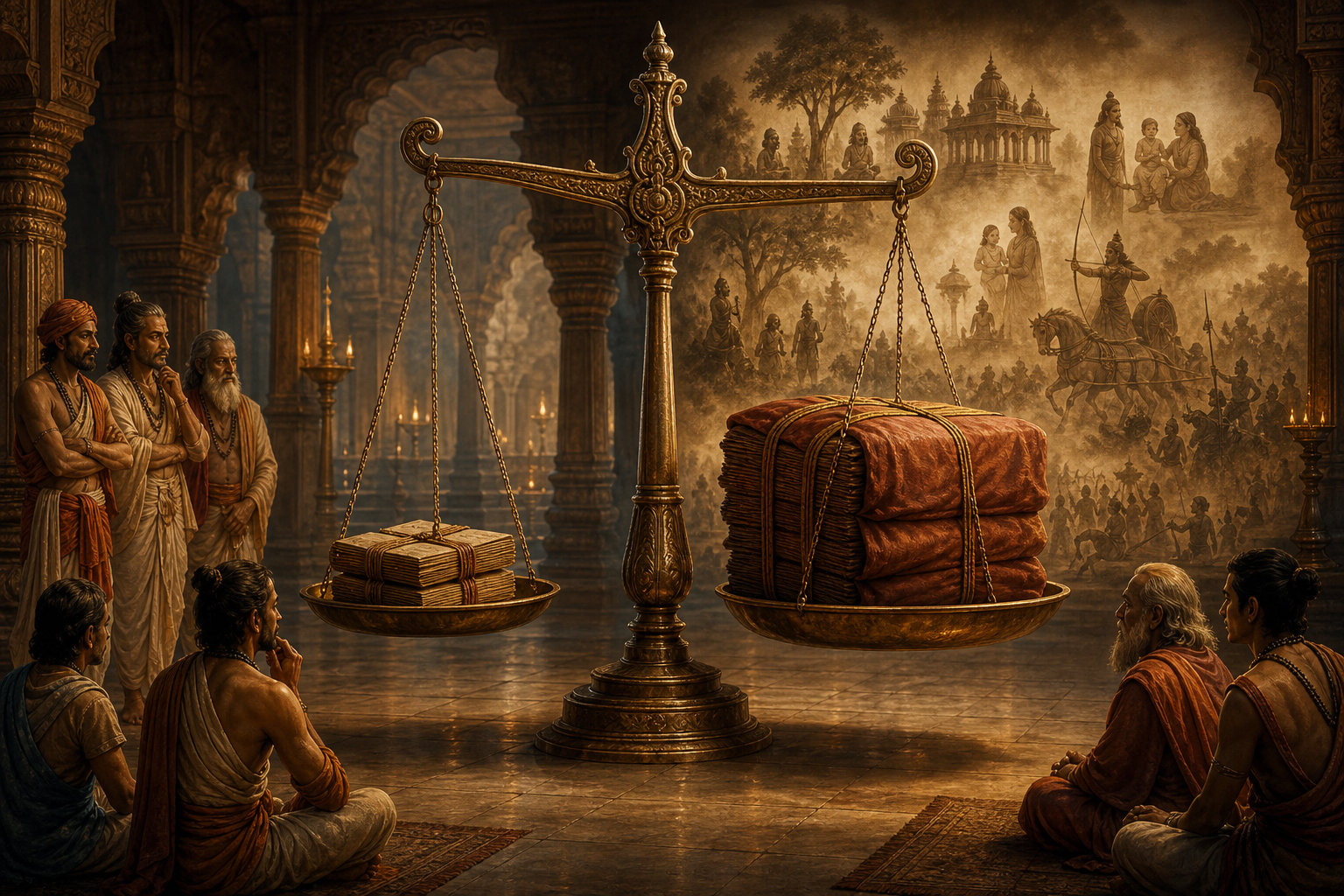
The Mahabharata makes a remarkable claim about its own stature near the beginning of the work. At the close of the Anukramanika Parva, Sauti recounts how the gods and great sages placed the Bharata on one side of a scale and the four Vedas on the other. The Bharata proved heavier.
That image is meant to stop the listener from approaching the Mahabharata as an entertaining tale with a few moral lessons attached. It assigns immense weight to the whole work before the great narrative unfolds. Because the declaration appears in the opening frame, it shapes how the audience is expected to receive what follows.
Weight, however, is not the same thing as textual classification. A sacred weighing dramatizes greatness, value and consequence. It is not a library label that turns Itihasa into Shruti or abolishes the special standing of the Vedas. The comparison therefore should not be paraphrased as a claim that the Vedas have been rejected, defeated or rendered unnecessary.
The more careful reading is also the stronger one. The Mahabharata presents the Bharata as carrying an extraordinary concentration of religious significance. Its teaching is not light, secondary or dispensable. It takes the principles of dharma into the conditions in which people must actually choose: family obligation, public duty, loyalty, ambition, grief, power, restraint and the consequences of action.
If someone asks you whether the Mahabharata is greater than the Vedas, avoid answering with an unexplained yes or no. Say this instead: the Mahabharata portrays the Bharata as outweighing the four Vedas, thereby declaring its exceptional sacred weight; that declaration does not require us to pretend that Itihasa and Shruti are identical categories.
Its authority becomes visible when dharma enters real life
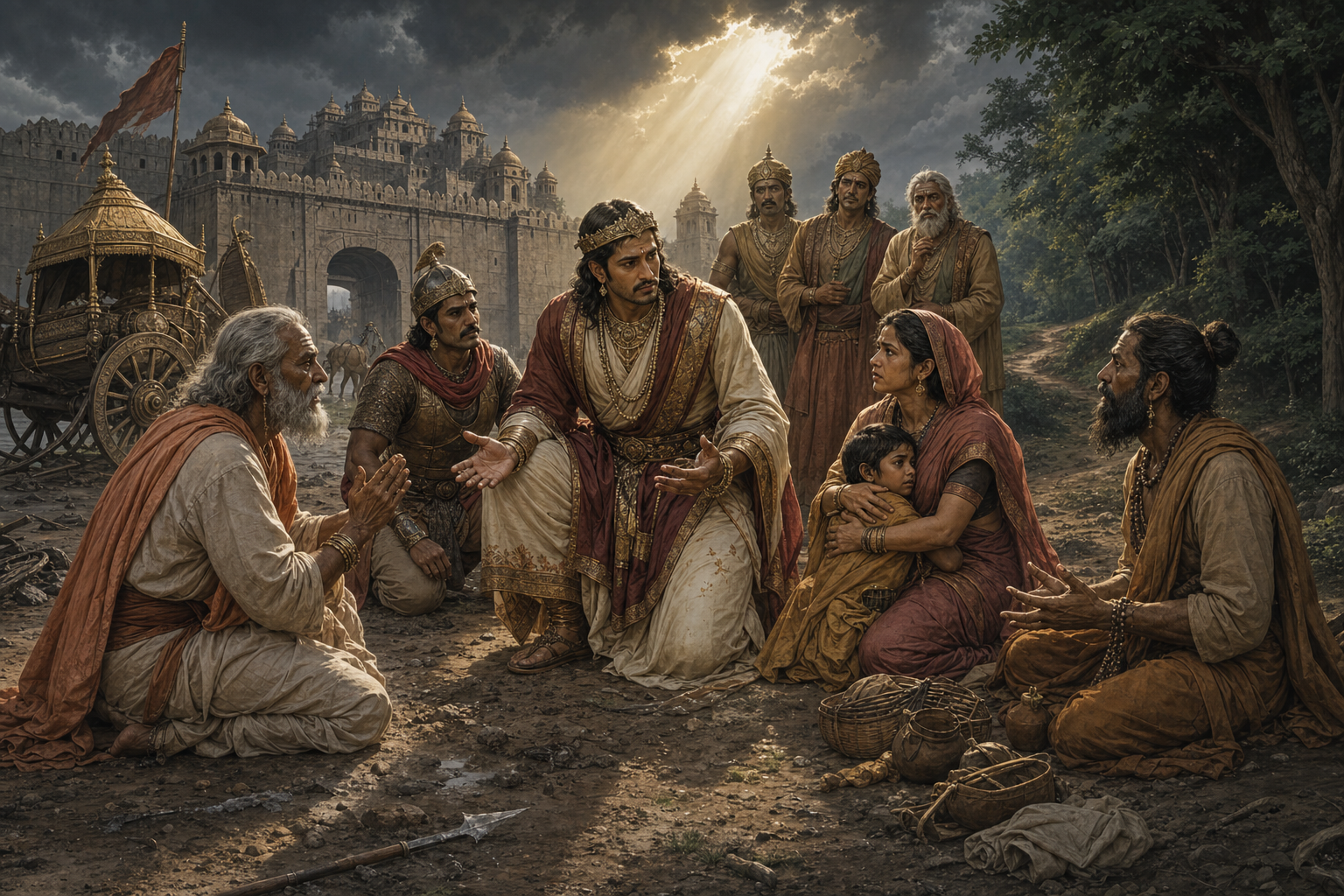
The Mahabharata rarely allows you the comfort of examining dharma only as an abstract definition. It places duties in collision. A responsibility that appears clear in isolation becomes difficult when it meets another responsibility. A promise can preserve integrity in one setting and deepen disaster in another. A respectable argument can conceal attachment, fear or the desire for power.
This is a major part of the epic’s scriptural function. It trains discernment. You see not only a principle but also the speaker using it, the circumstances surrounding it and the consequences that expose whether the reasoning was sound. The narrative form is therefore not ornamental packaging around the teaching. It is one of the means through which the teaching works.
The Bhagavad Gita’s place within the Mahabharata offers the clearest familiar example. A concentrated spiritual teaching occurs inside a crisis of duty rather than outside human conflict. The setting matters because the question is not merely what is true. The question is how a person should understand and act upon truth while facing obligation, attachment and consequence.
When you study a Mahabharata passage, use five checks before treating a line or action as a rule:
- Identify the speaker. A narrator’s framing, a character’s opinion and a teaching delivered within a dialogue do not automatically carry the same force.
- Name the kind of speech. Decide whether you are reading an instruction, argument, vow, lament, boast, warning, praise or description.
- Mark the circumstances. Ask what pressure, relationship, duty or conflict makes the statement necessary at that moment.
- Follow the consequences. The epic may test or overturn a character’s reasoning through what happens next.
- Return to the larger movement. Read enough before and after the passage to see whether its apparent lesson survives the full narrative context.
This method keeps reverence from becoming credulity. A sacred narrative can faithfully preserve confusion, temptation and moral failure without commanding you to imitate them. Scriptural seriousness means paying closer attention to those distinctions, not less.
Four mistakes that distort the Mahabharata’s stature
Mistake 1: Treating epic as a synonym for secular fiction
Epic is a useful literary description, but it does not settle religious status. A text can be a vast narrative and also function as scripture. When you hear the phrase Hindu epic, do not silently translate it into an impressive old story. Ask what role the work plays in transmitting dharma, spiritual teaching and civilizational memory.
Mistake 2: Assuming sacred authority must be flat
Not every sacred text needs the same classification to matter profoundly. The desire to place everything on one level usually comes from using scripture as though it were a single technical rank. Hindu textual culture preserves multiple forms of authority. Precision about those forms protects the Vedas’ identity without pushing the Mahabharata to the margins.
Mistake 3: Turning every deed into a command
A character’s conduct is not automatically an instruction for the reader. The Mahabharata frequently teaches through tension, error and consequence. Before citing an incident as proof of what Hindu dharma requires, distinguish between what the narrative depicts, what a speaker defends and what the wider course of events ultimately validates.
Mistake 4: Forcing the scale episode into a modern ranking contest
The weighing should deepen your estimation of the Mahabharata, not become a weapon for belittling the Vedas. The image concerns sacred weight. Reducing it to one text winning and another losing imports a competitive frame that obscures the traditional relationship between different kinds of scripture.
Key takeaways
- The Mahabharata is properly called Hindu scripture in the broad and meaningful sense of a sacred, authoritative and spiritually formative text.
- Its precise traditional classification is Itihasa, commonly placed within Smriti, rather than Shruti.
- The Vedas retain their distinctive Shruti status; reverence for the Mahabharata does not require erasing that distinction.
- The sacred weighing in the Anukramanika Parva declares the Bharata’s extraordinary weight and significance without functioning as a technical reclassification.
- You should interpret a passage by examining its speaker, type of speech, circumstances, consequences and wider narrative setting.
The next time you open the Mahabharata, do not ask only what happened or which character appears justified. Ask how the narrative is training you to recognize dharma under pressure. That shift lets you meet the work on its own terms: not as a substitute for the Vedas, not as mere literature, but as a weighty Itihasa whose sacred authority becomes clearest through careful reading.
References
