

You hear that a blue bird carried Shiva’s blessing to Rama before the fall of Ravana. At a hill temple, you hear that its deity was established by Parashurama in Treta Yuga. If you want to repeat either account faithfully, what should you call it: scripture, history, temple legend or devotional symbolism?
You do not have to choose between uncritical acceptance and casual dismissal. The better approach is to identify the kind of claim being made, understand the spiritual work it performs and preserve its proper setting. That lets you honor Shaiva sacred lore without attributing words to a text that does not contain them.
First identify the layer of tradition you are hearing
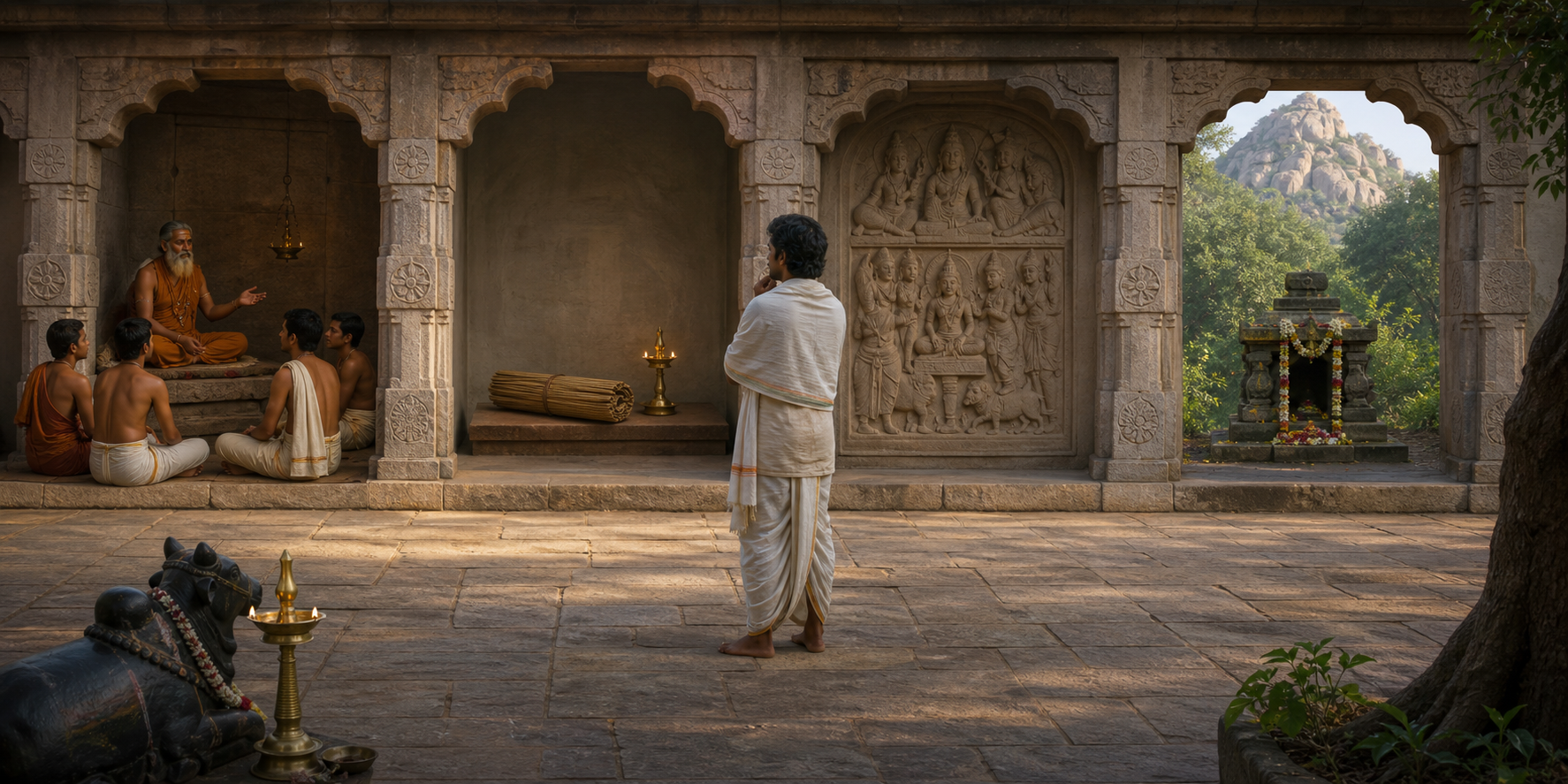
Hindu sacred memory does not travel through one channel. An account may appear in an epic text, a later retelling, oral memory, a temple’s sthalapuranam or a living observance. These forms can reinforce one another, but they do not make identical claims.
- Explicit epic narration: A particular event or teaching can be located in a named text. When someone says that Valmiki narrates an incident, you should be able to ask where it occurs.
- Later devotional memory: Regional tellings and oral traditions may connect an epic event with a deity, omen or local custom not stated in the earliest named version. The connection can carry genuine religious meaning without being retroactively inserted into that version.
- Sthalapuranam: A sacred-place account explains why a temple stands where it does, how its deity became present there and what a pilgrim should remember at the site. It is the sacred biography of a place.
- Living practice: A festival custom, family observance or act of pilgrimage embodies the lore. Practice can keep a meaning alive even when participants do not know its complete literary history.
This classification is not a ranking from true to false. It is a safeguard against confusion. A temple tradition should not be rejected merely because it is absent from a particular epic version. By the same rule, its devotional importance does not authorize you to present it as a verse or episode from that epic.
When you encounter a Shaiva claim, begin with one practical question: Where does this particular form of the account live? Ask for the name of the text, retelling, shrine or observance. That one question usually reveals whether you are dealing with narration, interpretation, sacred geography or ritual memory.
Shiva’s grace in the devotional memory of Rama’s victory

The Neelkanth offers a clear example. The name recalls Shiva as the blue-throated bearer of the halahala poison from the samudra manthan. The Indian Roller, identified as Coracias benghalensis, carries striking blue plumage, making the bird a natural visual reminder of that Shaiva image.
In later regional narratives and temple memory, a Neelkanth sighting near the culmination of the Lanka war becomes Shiva’s tacit benediction upon Rama’s righteous cause. The sign joins two devotional ideas: Shiva’s protective grace and Rama’s struggle to restore dharma after Ravana’s adharma.
You will not find a direct reference to the Indian Roller appearing on that battlefield in the Valmiki Ramayana. This distinction produces a more accurate and more interesting reading, not a poorer one. The absence tells you that the bird belongs to the epic’s later devotional reception. Its persistence tells you that communities found the image spiritually effective.
If you teach the account, write about it or tell it to children, use wording that preserves both facts: Later devotional tradition remembers the Neelkanth as a sign of Shiva’s favor during Rama’s final struggle against Ravana. Do not shorten that to a claim that the Valmiki Ramayana records the bird. The first sentence transmits a living tradition. The second misattributes it.
The omen also has a practical ethical meaning. It does not turn victory into a reward for merely spotting a bird. Rama’s cause is remembered as worthy of blessing because it is aligned with dharma. For you, the useful question after encountering the symbol is therefore not, What fortune have I been promised? It is, What righteous duty must I now carry out with steadiness?
That interpretation matters on Vijayadashami, when many communities consider a Neelkanth sighting auspicious before a new undertaking. Observe the bird where it lives, without pursuit, capture or disturbance. A practice associated with Shiva’s protection should deepen care for life rather than turn a living creature into a ritual object.
A sthalapuranam turns landscape into sacred memory

Epic lore can gather around a character or event. Temple lore gathers around a place. A sthalapuranam tells you why this hill, sanctum, water body, tree or pathway belongs to a particular sacred story. It converts geography into a field of remembrance and gives the pilgrim a way to inhabit the account rather than merely hear it.
Sri Parvathi Jadala Ramalingeswara Swamy Devasthanam stands on a hillock at Cheruvugattu. Its local sacred history holds that Ramalingeswara Swamy was established by Parashurama in Treta Yuga. That statement places the shrine within sacred time and associates its identity with a figure known for forceful duty, tapas and accountability.
The local account also recalls Karthikaya taking Kamadhenu and her calf from Sage Jamadagni’s ashram while Parashurama was absent. Within the temple’s narrative world, the loss directs attention toward duty, protection and restitution. The point is not detached chronology alone. It is the moral pressure created when something entrusted to an ashram is violated and must be set right.
This is why a sthalapuranam should not automatically be treated as either an archaeological report or disposable folklore. It answers a different first question: What makes this place sacred to its worshipping community? Historical dating, inscriptions and material evidence may answer other questions. They should be examined on their own terms rather than used to erase the shrine’s theological identity.
The physical journey then completes what the narrative begins. At Cheruvugattu, the ascent, hilltop setting and quiet sanctum frame the pilgrim’s encounter with Ramalingeswara Swamy. Wind, sky and stone are not incidental scenery. They slow the visitor, mark a transition from ordinary movement to deliberate approach and give the sacred account a bodily setting.
When you visit a temple with a sthalapuranam, take three notes before trying to harmonize it with stories you already know:
- Record the names and sequence exactly as they are given at the shrine.
- Ask whether the account comes from a displayed inscription, a temple publication, a formal recitation or current oral explanation.
- Separate what the temple explicitly claims from what you infer because a name resembles one in another narrative.
This discipline becomes especially important when a local name or sequence differs from a version familiar to you. Verify the temple’s wording before correcting, conflating or modernizing it. Faithful preservation includes preserving difference.
Use four questions before repeating any sacred claim

You can apply the same test to an epic omen, a shrine-origin account or a family custom. It takes only a few minutes and prevents the most common forms of distortion.
- Who is making the claim? Identify the named epic version, regional retelling, temple tradition or living community. Avoid the vague phrase scripture says when you cannot name the scripture.
- What kind of claim is it? Decide whether it is textual, historical, theological, symbolic, ritual or local. One account can work in several modes, but you should not silently convert a symbolic association into a textual quotation or a sacred-time attribution into a modern calendar date.
- What does the account ask you to notice? The Neelkanth association directs attention from blue plumage to Shiva’s protective identity and then to the victory of dharma. The Cheruvugattu account directs attention from a hill shrine to sacred presence, duty and restitution. Naming this movement reveals why the lore matters.
- What conduct should follow? A sound interpretation produces responsibility: truthful transmission, disciplined action, respect for a temple’s custodians and care for the living world. If an interpretation encourages fabrication, coercion or harm, something has gone wrong in the passage from lore to practice.
Notice how the wording changes when these questions are applied. Instead of saying that the Valmiki Ramayana records Shiva sending the Indian Roller, say that later devotional memory reads the Neelkanth as Shiva’s blessing upon Rama’s cause. Instead of claiming that archaeology has established a Treta Yuga foundation date for Cheruvugattu, say that the temple’s sthalapuranam attributes the establishment of Ramalingeswara Swamy to Parashurama in sacred time.
Neither correction drains the account of sanctity. Precision protects it. A tradition becomes easier to transmit when a listener knows whether it is hearing an epic passage, a devotional development or the sacred memory of a particular kshetra.
This approach also respects plurality within the wider Dharmic world. Hindu, Buddhist, Jain and Sikh traditions should not be flattened into interchangeable doctrines. Yet truthful speech, self-restraint, reverence for life and responsible remembrance remain intelligible points of ethical conversation. You preserve that conversation by describing each tradition on its own terms.
Key takeaways
- Begin by asking whether a Shaiva account belongs to an explicit epic passage, later devotional memory, a sthalapuranam or living practice.
- The Neelkanth’s connection with Rama’s victory is a later devotional association; it is not a directly narrated battlefield episode in the Valmiki Ramayana.
- A sthalapuranam gives a temple its sacred biography and moral geography. It should not be mislabeled as either an epic quotation or an archaeological conclusion.
- Absence from one named textual version does not erase devotional meaning, but devotional meaning does not permit false textual attribution.
- Let sacred lore shape conduct: uphold dharma, preserve local memory accurately, respect temple practice and observe wildlife without disturbance.
The next time you hear a striking claim at a temple or festival, write down its exact wording and ask where that form of the account lives. Pass it on with its setting intact. One careful sentence can preserve scripture, local tradition and devotion at the same time.
References
- DharmaRenaissance Blog – Neelkanth in the Ramayana: Shiva’s Blessing and Rama’s Triumphant Victory over Ravana
- DharmaRenaissance Blog – Unveiling Cheruvugattu’s Sacred Legacy: Sthalapuranam of Jadala Ramalingeswara Temple
