
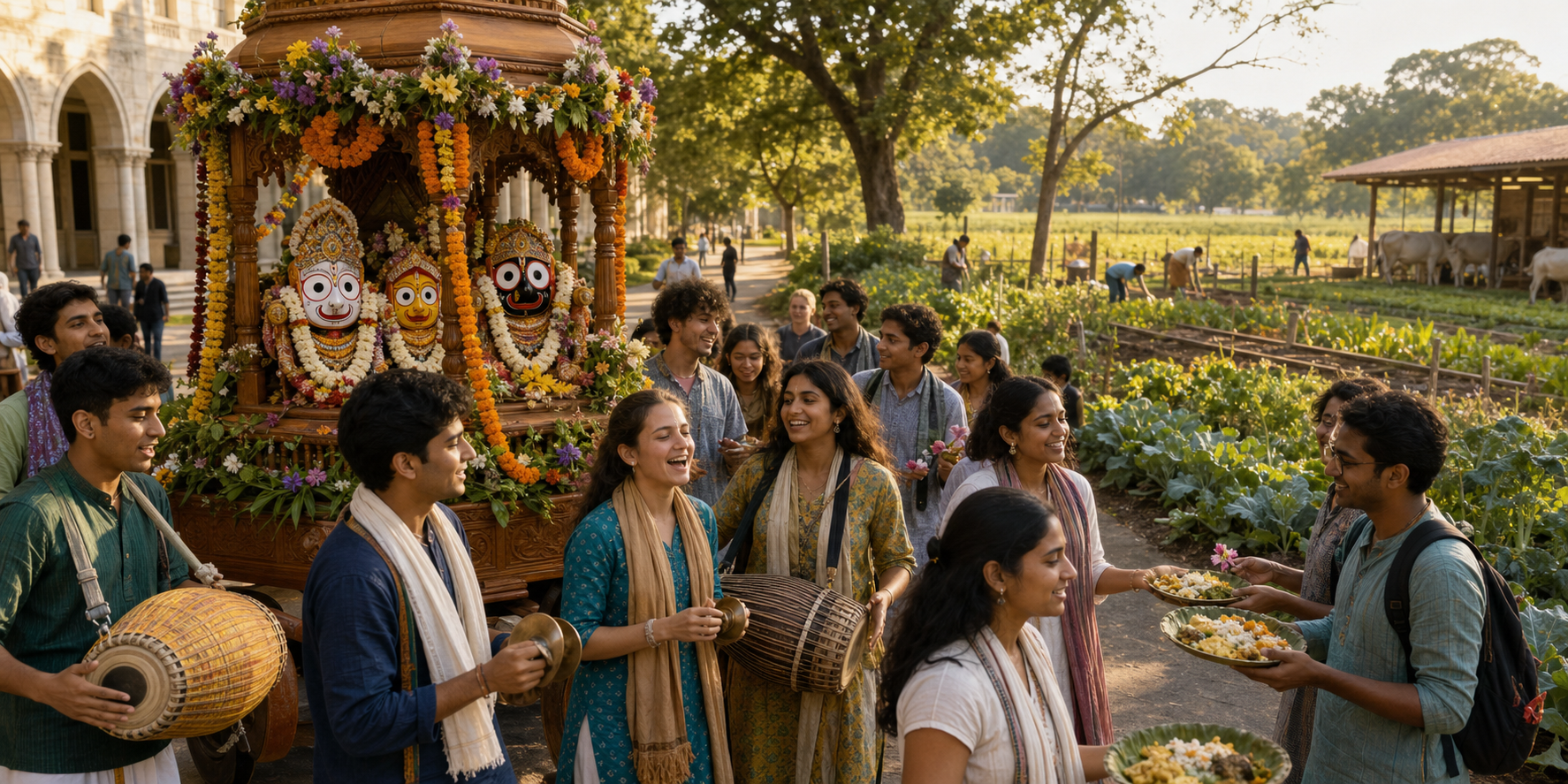
If you are trying to help students encounter Dharma without reducing it to either a classroom abstraction or a one-day spectacle, you need two kinds of space. One must be easy to enter. The other must be deep enough to show what a Dharmic life asks of a person.
ISKCON’s campus festivals and agrarian projects offer a useful architecture. Rath Yatra can bring darshan, kirtan, seva and prasadam into university life. A farm can make cow protection, cultivation, food and devotional discipline tangible. The practical task is to build a path from encounter to participation and from participation to sustained practice.
Let students approach Dharma through participation
A campus outreach program should not assume that every student arrives ready for a lecture, a commitment or even a theological conversation. It should offer an honest, recognizably Dharmic encounter with several legitimate ways to participate.
Delhi University’s fifth consecutive ISKCON Rath Yatra drew more than 500 devotees, students, faculty members, officials and volunteers. Kirtan accompanied the procession, while decorated chariots stopped at college and faculty entrances. Principals, professors and other university officials offered aarti and received maha-prasadam. The festival remained explicitly centered on Lord Jagannath, yet people could enter through devotion, culture, hospitality, music or service.
That combination matters. If the sacred center is hidden to make an event seem neutral, students encounter a cultural performance with no clear spiritual meaning. If every newcomer is treated as though prior belief is required, the threshold becomes unnecessarily high. Good outreach holds the center and opens the circumference: Lord Jagannath remains the focus, while a newcomer may begin by chanting, pulling the chariot, helping a volunteer, accepting prasadam or asking a question.
If you are planning a campus event, settle these elements before discussing decoration or publicity:
- The sacred center: State plainly whom the festival honors and what the principal practices mean. Do not make students guess whether they are attending a parade, a food fair or an act of worship.
- Institutional cooperation: Work with responsible faculty members and university officials early. At Delhi University, the organizing network included the ISKCON Delhi University Centre, university administrators, college faculty and student volunteers. Collaboration made the event part of campus life rather than an intrusion upon it.
- Several entry points: Give newcomers simple choices: walk with the procession, hear kirtan, help distribute prasadam, receive a book or speak with a volunteer. Participation should be invited, never manufactured through social pressure.
- A visible next step: Announce the next gathering, service opportunity or study circle before the procession ends. A student should not have to search the internet later to discover whether the community still exists.
- A named host: Make a trained person responsible for receiving newcomers after the event. Posters and contact forms cannot replace a human welcome.
The Delhi event distributed around a thousand plates of prasadam and around a hundred books by Srila Prabhupada. Do not turn figures like these into a supposed conversion rate. A plate records hospitality offered; a book records an opportunity for longer engagement. Neither number reveals what a student understood, believed or later practiced. Track each form of engagement for what it actually establishes.
Student seva changes the relationship from audience to community
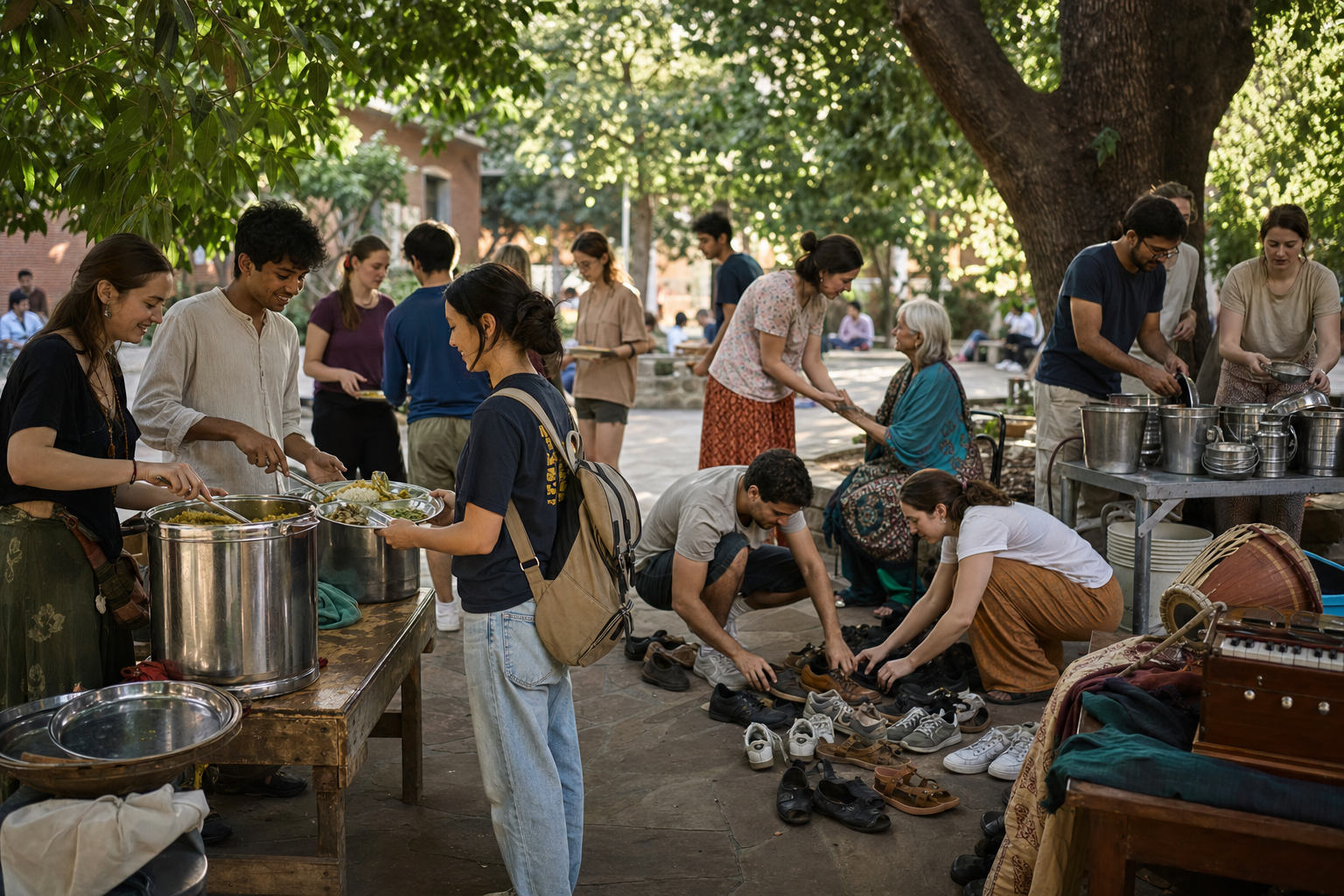
The decisive question is not only how many students attend. It is whether students can become responsible participants. An audience receives a program arranged by somebody else. A seva team learns that the program depends on its attention, discipline and care.
Student volunteers from ETHICRAFT, ISKCON’s student outreach initiative, did more than stand beside the Delhi procession. They pulled the chariots, helped manage the crowd, distributed prasadam and handled other services. Their society-branded shirts also made it easy for newcomers to identify whom they could approach. The practical lesson is simple: students should be hosts of campus Dharma, not merely targets of it.
Build a service ladder that allows responsibility to grow. A new volunteer might begin with a clearly bounded task under supervision. A returning volunteer can coordinate a small team. A dependable student can later help plan the route, communicate with college representatives, organize prasadam distribution or welcome first-time participants. Advancement should reflect reliability and maturity, not enthusiasm alone.
A workable volunteer system needs four things:
- Defined ownership: Every task should have a responsible lead. Telling everyone to help usually means that essential work belongs to no one.
- Brief preparation: Explain the devotional purpose of the service as well as its mechanics. Crowd assistance, for example, is not merely event management; it is care for the people who have come to see Lord Jagannath.
- Supervision proportionate to the task: New volunteers should not be left to improvise around crowds, food distribution or institutional representatives.
- A real debrief: Ask what created confusion, what newcomers asked and which volunteers want to serve again. Use those answers to shape the next gathering.
This is also where value-based language must become concrete. Leadership is not a slogan printed on a shirt. On the day of an event, it means arriving when promised, caring for people outside one’s own circle, completing an unglamorous task and remaining steady when the program becomes busy. Seva gives students a setting in which those qualities are practiced rather than merely praised.
An agrarian setting makes Dharmic principles physical
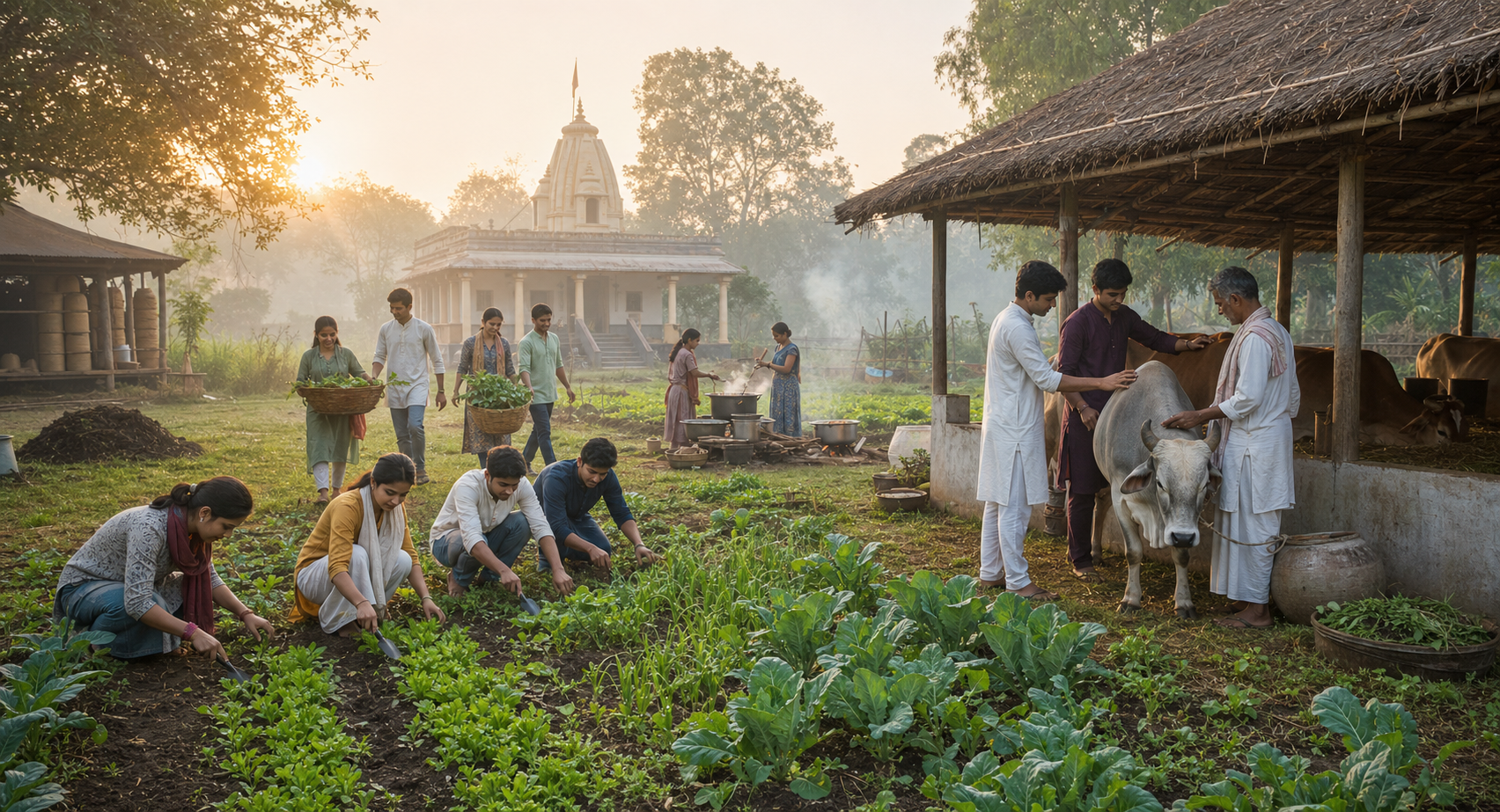
Campus outreach meets students inside an environment organized around classes, examinations, credentials and careers. An agrarian project introduces another rhythm. Food has to be cultivated. Cows require continuing care. Meals connect labor, land, gratitude and offering. Spiritual life is no longer confined to a scheduled talk.
New Godruma Dhama Farm in Lanchang, Pahang, is a 400-acre agricultural project established on August 30, 2013. Managed by ISKCON Malaysia, it focuses on cow protection, organic farming and immersion in a spiritual way of life. It is roughly 120 kilometers, or a two-hour drive, northeast of Kuala Lumpur. That distance makes a visit an intentional commitment rather than a casual stop between other appointments.
The farm’s educational force lies in ordinary acts. During one visit, prasadam included fruits and vegetables from the gardens, while cows were fed jackfruit and watermelon. The connection between cultivation, care and sanctified food did not need to be presented as an abstract diagram. It could be seen and performed.
A farm visit should therefore be designed around meaningful participation, not rural scenery. A useful immersion can include an orientation to the farm’s devotional purpose, a supervised cow-care or cultivation task, prasadam connected to what is grown there, and time to reflect on how the day’s work relates to responsibility and interdependence. Any feeding or handling of animals must follow the caretakers’ instructions; cow protection is continuing responsibility, not a photo opportunity.
Do not advertise agrarian life as an escape from effort. That would teach the opposite of what the setting can reveal. The farm matters because ideals acquire duties. Reverence for the cow entails feeding, protection and patient care. Respect for food entails cultivation, preparation, offering and avoidance of waste. Community entails sharing work as well as sharing a meal.
Distance also changes how you should plan. When a farm is outside the city, visitors need a clear purpose, transport arrangements, appropriate clothing, an honest description of physical tasks and a person responsible for receiving them. If a full farm is not reachable, use the closest truthful equivalent: a temple garden, goshala, prasadam kitchen or community cultivation project. The principle is embodied service, not possession of a particular acreage.
Build the handoff before staging the public event
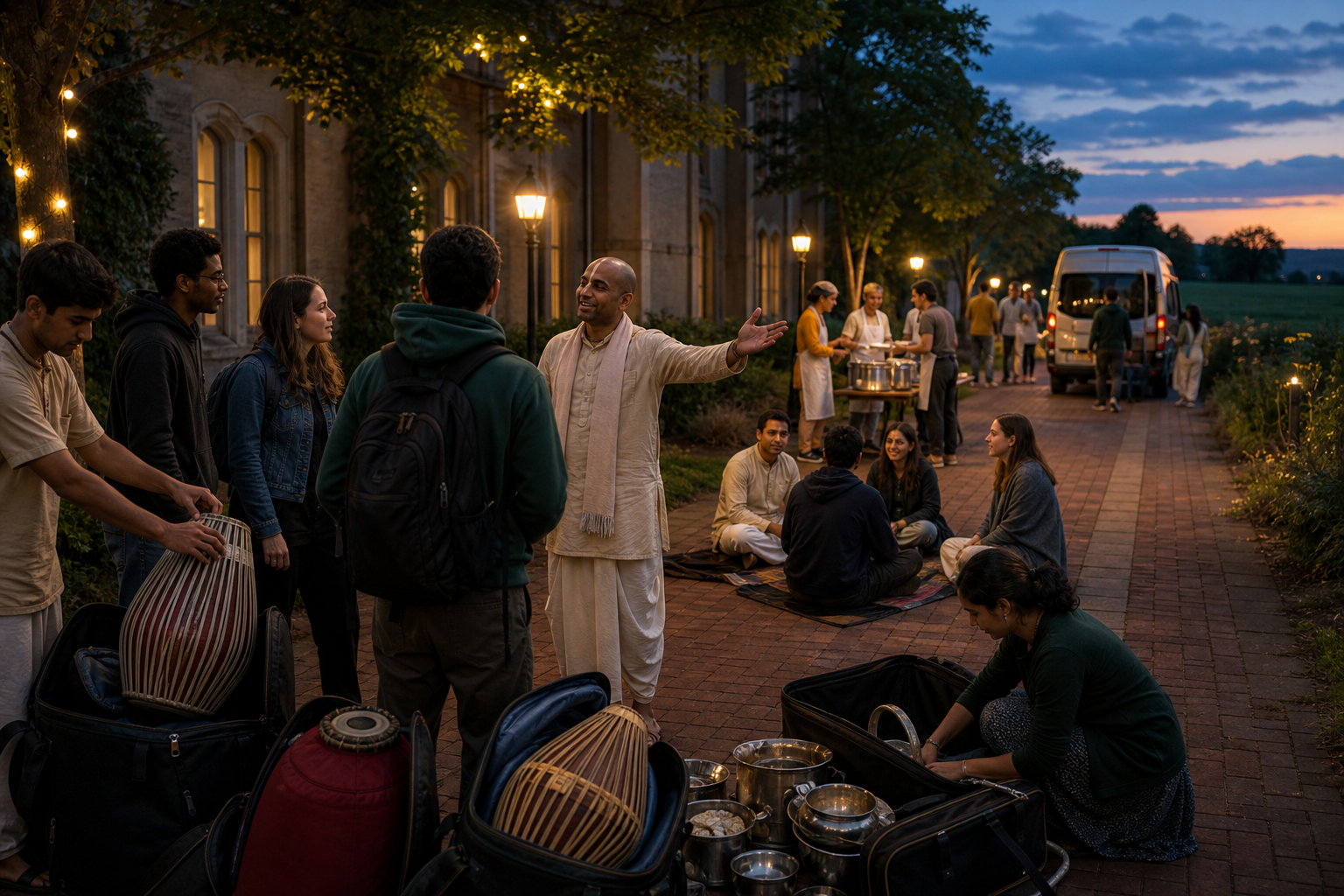
A large festival and a working farm solve different outreach problems. The festival lowers the threshold of encounter. The agrarian setting raises the depth of participation. Neither automatically performs the other’s function.
The Delhi University procession and the Malaysian farm are geographically distinct initiatives, not one documented recruitment pipeline. Your local application should therefore begin with a map of reachable relationships. Which temple, goshala, garden, kitchen, study group or farm can receive an interested student after the campus program? Who will welcome that student? What service can be offered without requiring an immediate identity commitment?
| Stage | Best setting | Student’s practical question | Appropriate invitation | What to notice |
|---|---|---|---|---|
| Encounter | Campus festival | Can I approach this? | Hear kirtan, join the procession or receive prasadam | Whether newcomers can participate without confusion or pressure |
| Contribution | Student seva team | Is there a place for me? | Take a bounded service role with guidance | Whether volunteers return and accept responsibility |
| Practice | Temple or agrarian immersion | How do these values shape a day? | Serve in cow care, cultivation, cooking or another supervised routine | Whether the setting connects teaching with duty |
| Understanding | Study circle and continuing association | What does this tradition teach? | Read, discuss and ask questions without pretending that one meeting settles everything | Continuity, seriousness of questions and willingness to apply what is learned |
The handoff must be prepared before publicity begins. Otherwise the festival may generate attention that the community has no structure to receive. Put the follow-up invitation in the program, train volunteers to explain it, obtain contact details only with clear consent, and make sure the receiving group knows that newcomers may arrive with curiosity rather than commitment.
Measure continuity without pretending to measure the soul. Attendance tells you about reach. Prasadam distribution tells you about hospitality delivered. Book distribution tells you that reading material was offered. Returning volunteers, repeat visits and continuing service indicate a durable relationship. None of these alone proves inner transformation, but the distinctions prevent impressive totals from concealing a weak path forward.
Key takeaways
- Keep campus outreach unmistakably Dharmic while providing several respectful ways for a newcomer to participate.
- Treat collaboration with faculty and university officials as part of the work, not as a ceremonial addition after planning is complete.
- Give students real seva with defined ownership, preparation and supervision; belonging grows through responsibility.
- Read prasadam, attendance and book totals as different kinds of reach, not as proof of spiritual commitment.
- Use farms, goshalas, gardens, kitchens and temples to connect teachings with recurring duties such as cultivation, cow care and sanctified food.
- Design the next invitation before the public festival so that curiosity has somewhere concrete to go.
If you are planning an outreach effort, write the handoff first. Name the nearby place, responsible person and meaningful service that a curious student can approach after the kirtan ends. Then shape the campus event and the deeper immersion around that path. Dharma becomes durable when someone can move from seeing it, to serving within it, to allowing its disciplines to order part of life.
References
- Dandavats — Godruma Dhama Farm Malaysia
- Dandavats — Fifth and Grandest Ever Rath Yatra by ISKCON at Delhi University
