
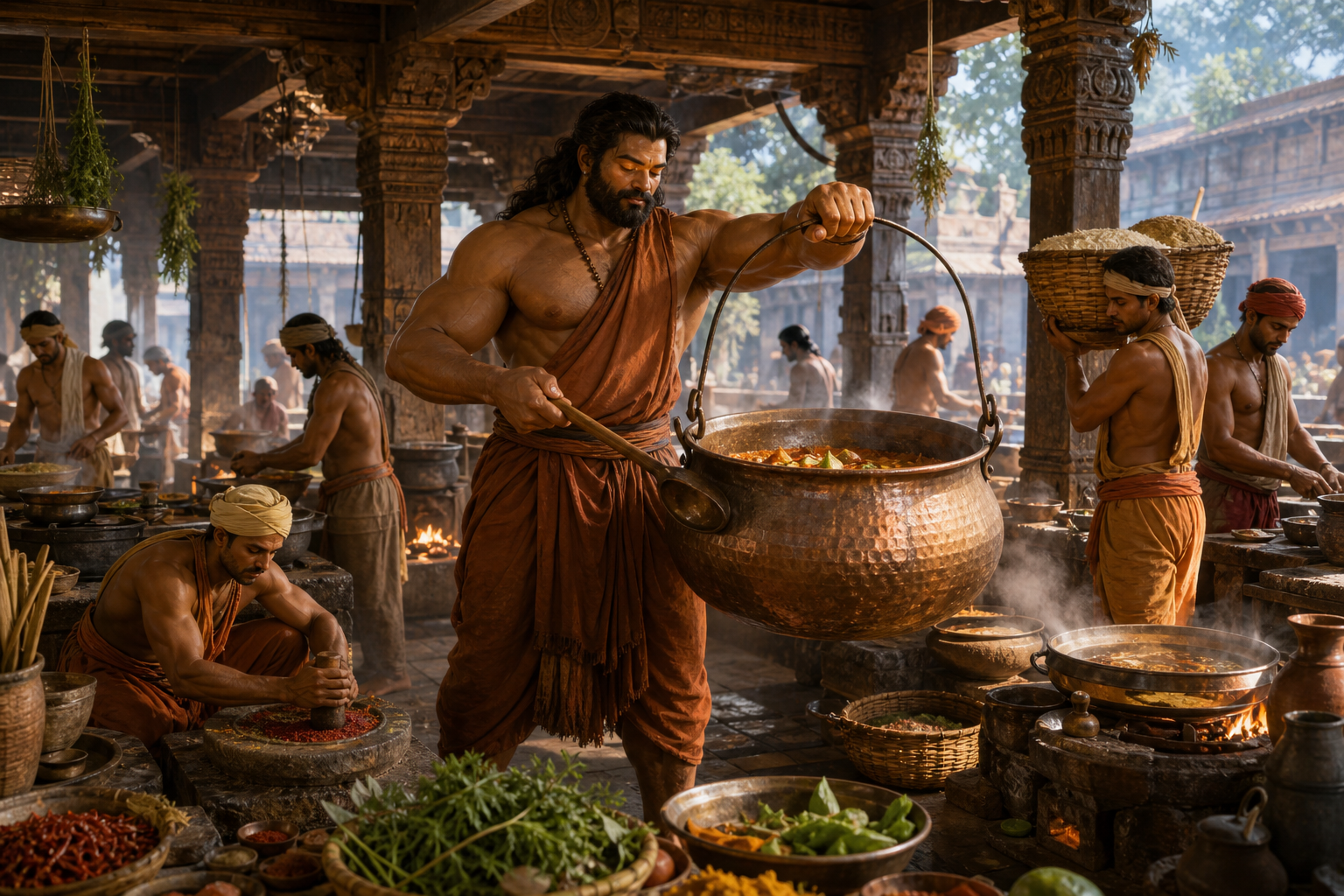
If you are wondering how Bhima, the most physically conspicuous of the Pandavas, could possibly live unrecognized in a royal palace, the answer is not that he suddenly became weak or timid. His disguise worked because it gave his strength a different public meaning.
That distinction opens the Virata episode. Bhima does not abandon his nature. He places it under discipline, gives it a courtly function, and refuses to let every display of power disclose the man behind the role.
The real challenge of the Pandavas’ final year
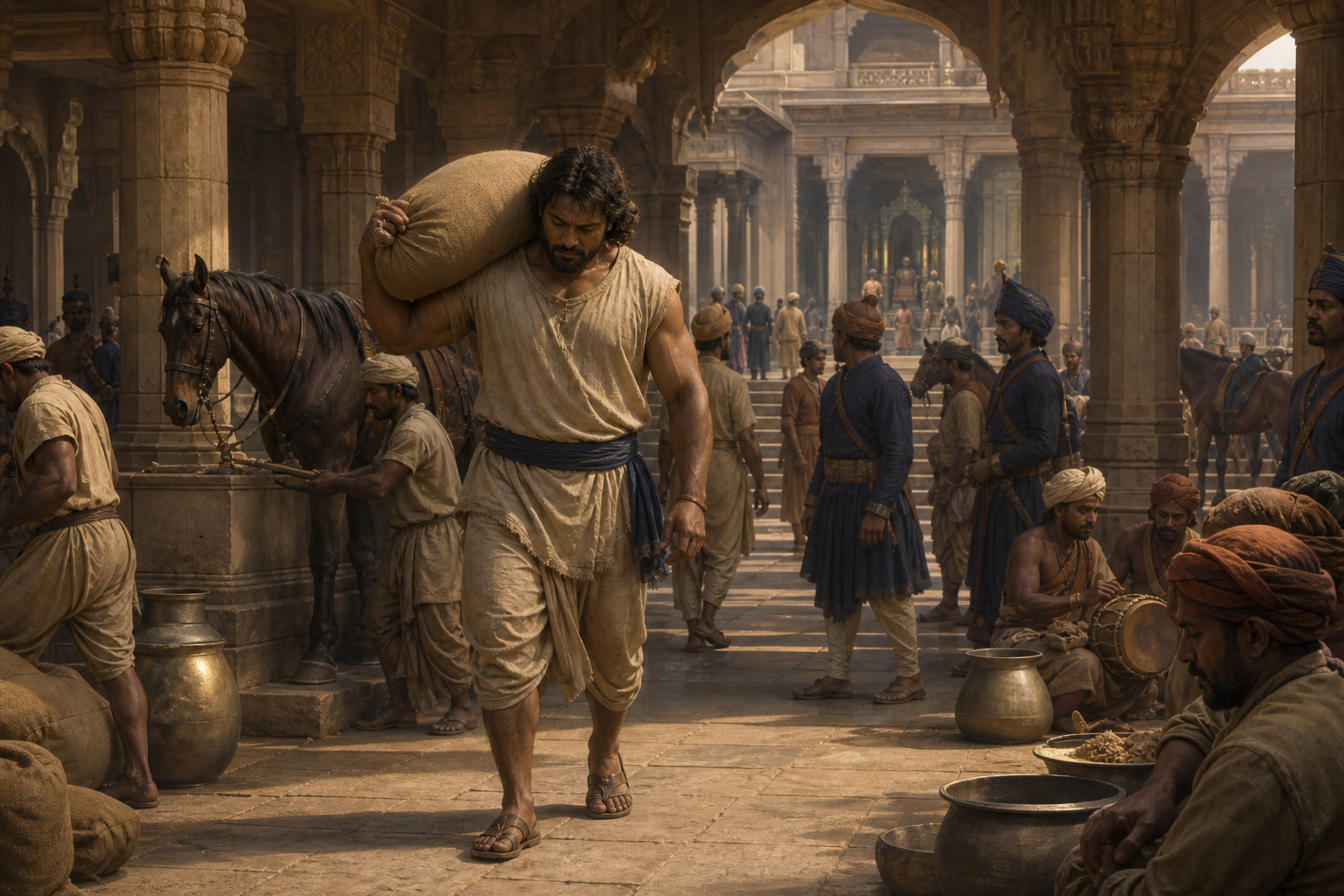
The Pandavas entered their thirteenth year of exile under a demanding condition: they had to remain incognito for twelve months. They chose Matsya, the kingdom ruled by Virata, and adopted disguises suited to their abilities.
Ajñātavāsa is therefore more than hiding one’s face. A person living in a forest can reduce contact with potential observers. A person serving in a royal court must speak, work, respond to authority, and become useful without becoming recognizable. The danger lies in repeated exposure: a disguise that survives one meeting may fail after months of familiar conduct.
Bhima makes that problem especially sharp. His exceptional power is an asset, but it is also evidence. If he suppresses it completely, he must live in constant pretence and may fail in the work assigned to him. If he displays it without restraint, observers may begin asking who could possess such strength. His solution is controlled visibility.
When you read this part of the Mahabharata, do not ask only whether the costume is convincing. Watch how each Pandava manages the quality most likely to reveal the person beneath it. For Bhima, disguise is chiefly a discipline of conduct.
Bhima redirects his strength instead of denying it
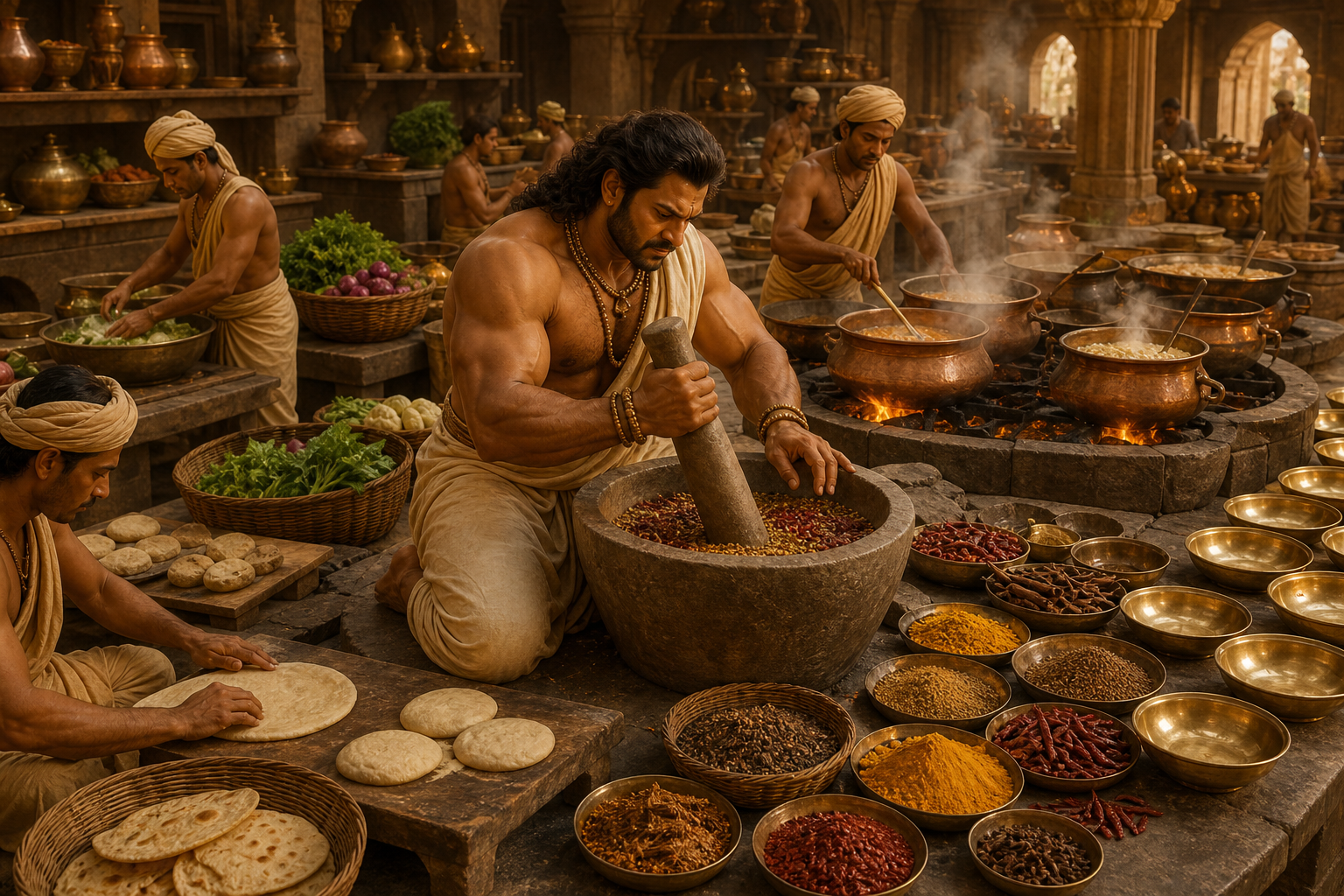
Bhima’s court life places his physical ability inside a role that can account for visible feats. His involvement in palace combat and spectacle, including encounters associated with lions, has led to the vivid description of him as a gladiator in Virata’s palace.
That comparison is useful if you keep it precise. It helps a modern reader picture organized displays of combat or strength within a royal environment. It should not be turned into a claim that Matsya possessed the same institution, social structure, or terminology as a Roman arena. “Gladiator” is an explanatory analogy, not Bhima’s civilizational identity.
The deeper point is that a good disguise does not always conceal a conspicuous trait. Sometimes it supplies an ordinary explanation for it. Court spectators can see an unusually powerful performer and interpret what they see through his assigned function. The feat remains visible; its connection to the Pandava prince remains hidden.
This is why Bhima’s role is more intelligent than a simple pretence of helplessness. Total suppression would create its own inconsistencies. Redirected strength lets him remain useful while narrowing the conclusions that others can draw. When reading each display, ask two questions: what does the court think it is seeing, and what does the audience of the Mahabharata know it is actually seeing? The tension between those answers is the heart of the episode.
Restraint becomes Bhima’s harder form of courage
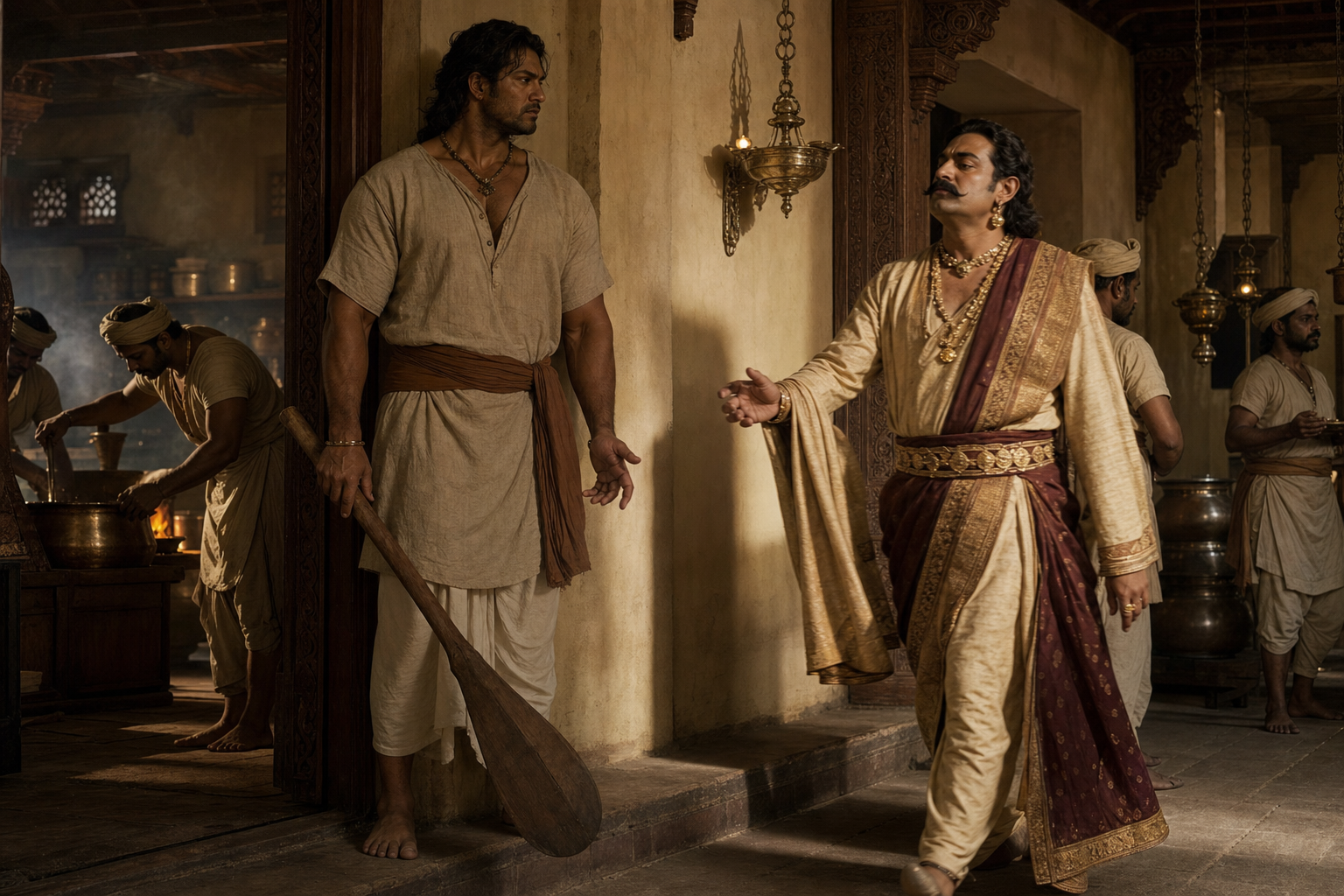
Bhima is easy to admire when a crisis permits direct action. Virata’s court asks you to notice another kind of greatness: a powerful person accepting limits because a shared undertaking depends upon them.
He must distinguish capacity from authority and authority from timing. Capacity asks, “Can I overpower this obstacle?” Authority asks, “Is this action mine to take?” Timing asks, “Would acting now protect the larger duty, or satisfy only the immediate impulse?” Strength answers the first question. Dharma requires attention to all three.
This makes restraint different from fear. Fear withdraws because it cannot bear the danger. Disciplined restraint may remain fully capable of action while refusing to spend power carelessly. During the incognito year, unnecessary self-revelation would not be a private mistake. It would endanger the Pandavas’ common purpose.
Nor does restraint mean passivity under every circumstance. The useful distinction is between power governed by purpose and power released merely because it has been provoked. Bhima’s challenge is not to become less formidable. It is to ensure that force remains answerable to duty.
You can use that distinction beyond this episode without reducing the Mahabharata to a motivational slogan. In any position of responsibility, first identify the obligation that governs your power. Then decide what level of action serves that obligation. Ability alone does not settle what should be done.
Why Virata’s court is essential to the lesson
A royal court is not merely the background for Bhima’s disguise. It is the mechanism that tests it. Courts organize people through offices, ranks, duties, reputations, and expectations. They also create audiences. A conspicuous deed can travel through a palace as a story even when the doer’s true name remains unknown.
That environment gives Bhima both protection and exposure. His accepted function provides cover because observers already possess a category in which to place his displays. At the same time, every exceptional performance risks exceeding that category. Incognito life is therefore not a disguise chosen once; it is a boundary maintained repeatedly.
The palace also reverses Bhima’s usual relationship to status. A Pandava prince now operates within another king’s household and must be judged by the service he appears to provide. His identity remains unchanged, but public recognition of that identity is temporarily surrendered. The episode separates dignity from title: Bhima does not cease to be Bhima merely because others cannot address him as a Pandava.
This is a particularly valuable point for a Dharmic reading. Svabhava, role, and immediate duty can overlap without being identical. Bhima’s strength belongs to his nature. His incognito position determines how that strength may appear. The Pandavas’ shared commitment determines when preserving secrecy takes priority over personal recognition.
On your next reading, track three boundaries rather than searching only for action scenes: what Bhima is capable of doing, what his public role permits others to see, and what the larger vow requires him to withhold. The differences among those three reveal the moral architecture of his year in Matsya.
Key takeaways
- Bhima’s disguise works by redirecting his recognizable strength into a plausible courtly function, not by pretending that the strength has disappeared.
- Ajñātavāsa tests habits and judgment as much as outward appearance. Remaining unknown for twelve months requires sustained control of conduct.
- The word “gladiator” can help you visualize palace combat, but it is a modern comparison and should not be mistaken for the epic’s own institutional category.
- Bhima’s restraint is active discipline. He must weigh capacity, authority, and timing before releasing power.
- Virata’s court shows that public rank and inward identity are different. Bhima can serve under a concealed name without losing his dignity or nature.
Return to Bhima’s Virata year with one practical question: not simply “How strong is he?” but “What governs his strength here?” That shift turns an entertaining episode of disguise and combat into a serious meditation on power made obedient to dharma.
References
