
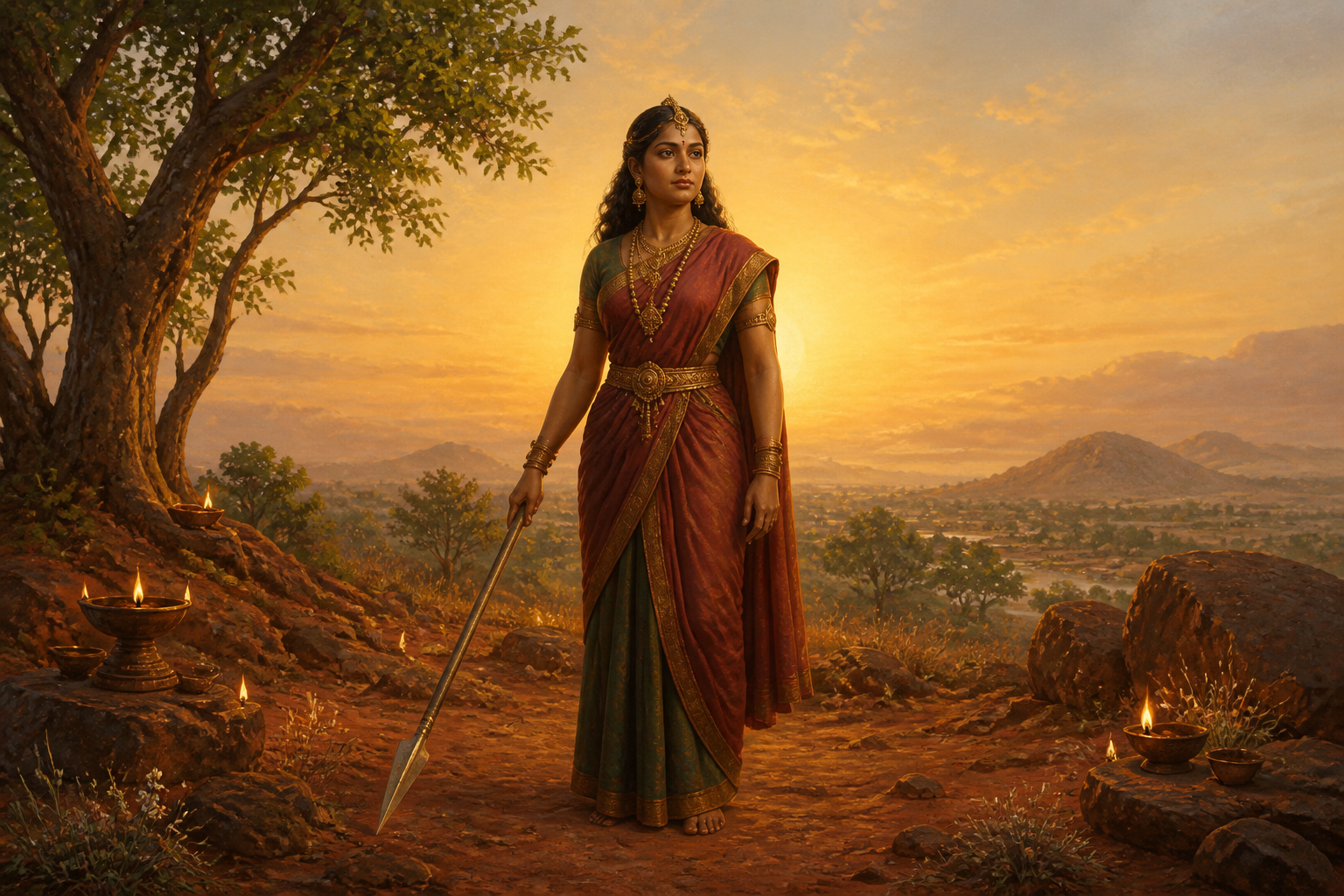
You may meet Kotravai through a Tamil name, a local shrine, a family memory, or a claim that she is merely an earlier version of another goddess. The practical question is how to recognize her place within the wider Dharmic world without erasing what is specifically Tamil about her.
Begin with what can be said securely: Kotravai is an ancient Tamil Mother Goddess and protectress. Her worship extended across the ancient Tamil lands, while reverence for her continues in the Palakkad region of Kerala. Those facts give you three firm anchors: her own name, her Tamil sacred setting, and a tradition that has not been reduced to archaeology.
Put Kotravai’s name before any comparison
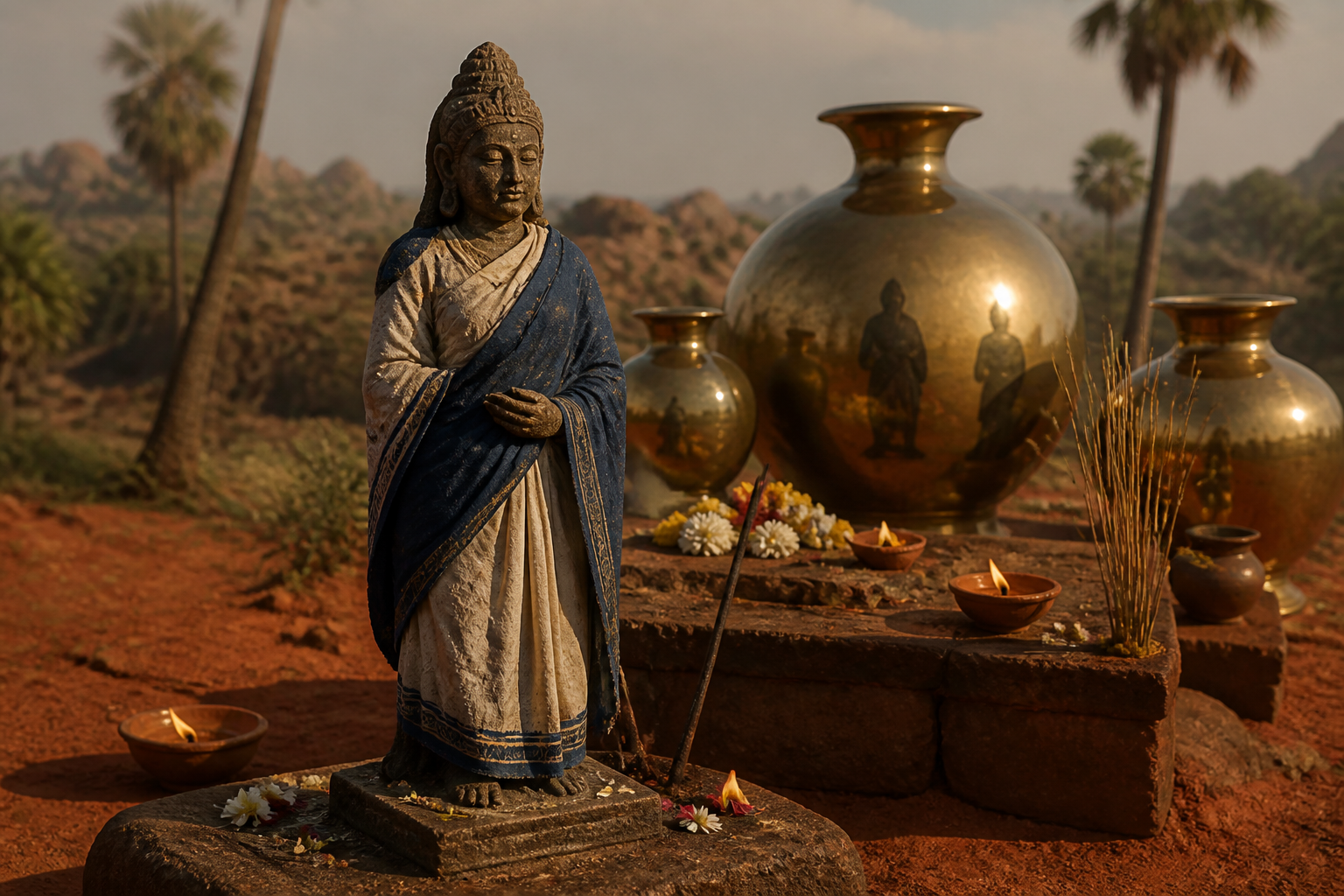
Calling Kotravai a mother goddess is useful, but it is not enough. The indefinite phrase can make her sound like an anonymous specimen from a vanished culture. Kotravai is a proper name belonging to a particular religious world. Use it.
A reliable one-sentence description is: Kotravai is an ancient Tamil Mother Goddess and protectress whose worship belongs to the religious heritage of the Tamil lands and remains living in Palakkad. This wording does not settle every theological question, but it preserves what should not be lost at the beginning.
Only then should you ask how she may relate to other forms of Devi. The order matters. If a better-known name replaces Kotravai before her own setting has been considered, the comparison stops illuminating her and starts absorbing her. If she is isolated from the wider Goddess tradition merely because her Tamil identity is strong, another distortion appears.
So resist the demand for an immediate either-or answer. A deity can possess a distinct regional name, history, sacred geography, and community of worship while also being understood through broader Dharmic ideas of divine feminine power. Distinctiveness and relationship are not opposites.
Her antiquity is not a licence to call her primitive
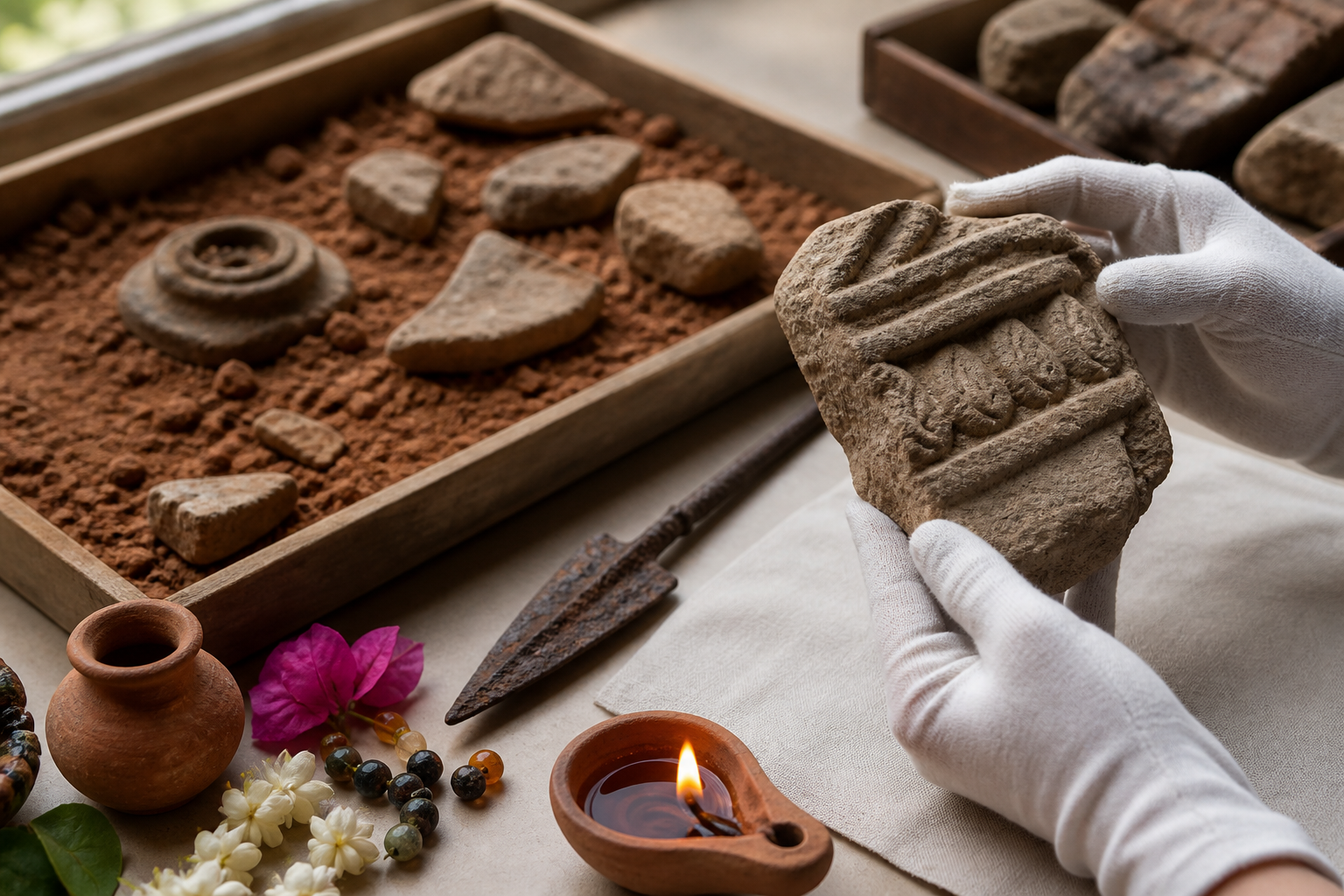
Kotravai’s remembered antiquity reaches into a religious world before stone temples and codified scriptures became the dominant public markers of sacred authority. That does not place her outside Dharma. It reminds you that Dharma has also been carried by names, places, customary worship, oral memory, ritual communities, and relationships with the surrounding landscape.
Modern readers often look first for a monumental temple, a single canonical biography, or a neatly defined institutional lineage. When those markers are absent or less visible, they may assume that a tradition is marginal. That assumption confuses one method of preservation with preservation itself.
Use a layered method when you encounter a claim about Kotravai:
- Identify the layer. Is the claim about ancient Tamil memory, a present local practice, or a later theological interpretation?
- Keep the layers distinct. A belief held at a living shrine may be religiously authoritative there without automatically proving that every detail has the same antiquity.
- Look for continuity without demanding sameness. Worship can endure while names, explanations, images, and institutions develop.
- Preserve uncertainty. If the available evidence supports only a broad claim, do not manufacture a precise date, ritual, genealogy, or equivalence.
This method lets you take antiquity seriously without romanticizing it. Ancient does not mean crude, and living does not mean unchanged. Both mistakes prevent you from seeing how a tradition actually survives.
Ask what kind of identity claim you are hearing
Statements such as Kotravai is another goddess, Kotravai became another goddess, or Kotravai is entirely separate may sound like competing answers to one question. Often they are answers to different questions.
An identity claim can be theological, historical, ritual, iconographic, linguistic, or administrative. A devotee may be affirming that all forms of the Goddess share one divine reality. A historian may be asking when two names became associated. A shrine custodian may be describing how worship is conducted in that particular place. Those claims should not be treated as interchangeable.
When you hear a confident equivalence or separation, test it with five questions:
- What name do the worshippers themselves use?
- Which place and community does the statement concern?
- Is the speaker making a theological affirmation or a historical claim?
- Which features are known to be old, and which belong to present practice?
- Does the explanation clarify Kotravai’s identity, or make her own name unnecessary?
The last question is especially useful. A good comparison reveals more about both forms under discussion. A poor comparison leaves the better-known form untouched while Kotravai disappears inside it.
The opposite claim deserves equal scrutiny. Describing Kotravai as an isolated remnant from outside the Dharmic world does not follow simply from her antiquity or regional character. Tamil tradition is not less Dharmic because it preserves an old Tamil divine name. Regional rootedness is one of the ways Dharma has lived across Bharat.
Palakkad turns historical interest into a living encounter
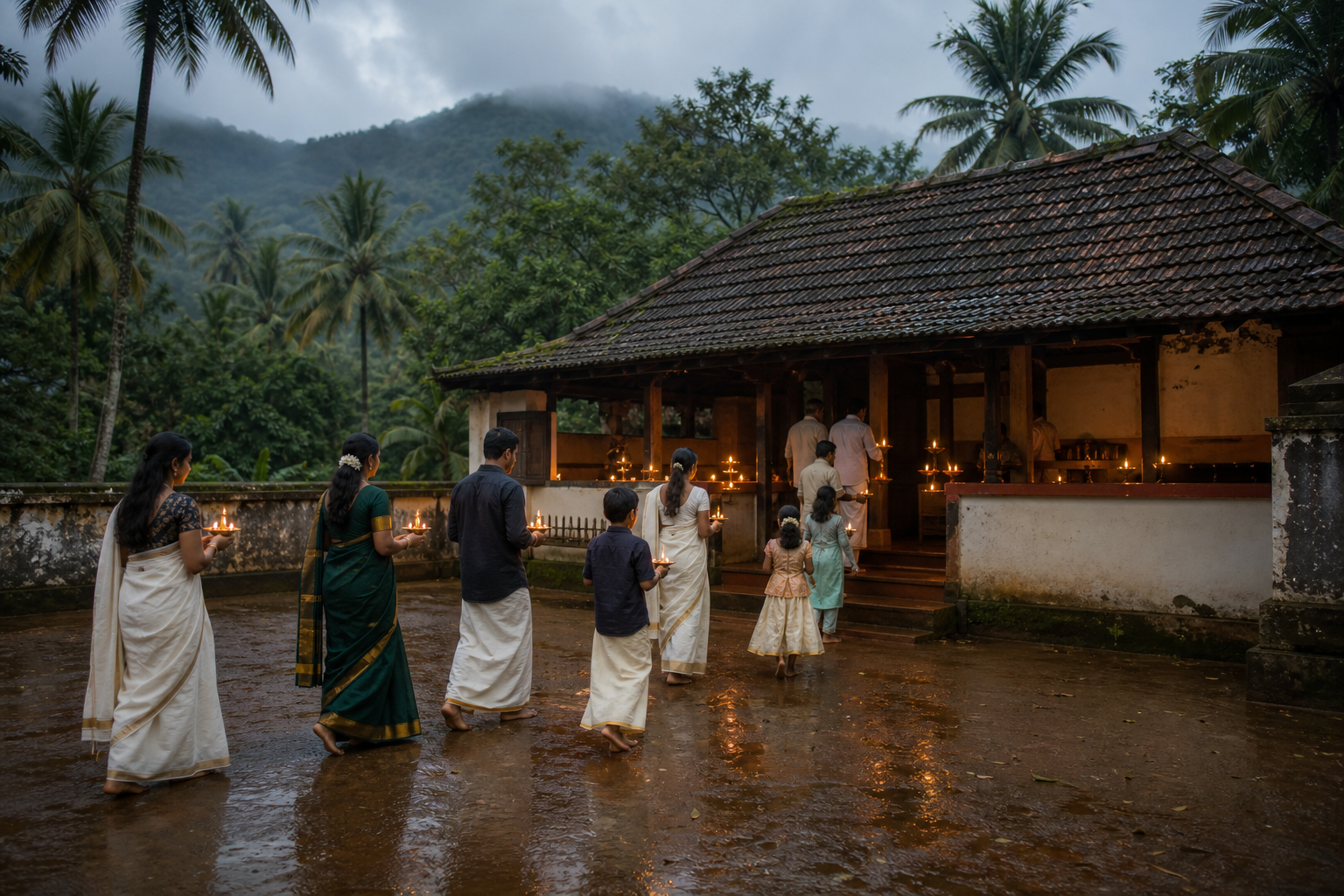
Continuing reverence in Palakkad changes how you should approach Kotravai. She is not only a figure to classify from a distance. Present worshippers and custodians belong to the story, and their practice should not be treated as a decorative survival from someone else’s past.
Palakkad also warns against projecting modern state borders backward. A tradition associated with the ancient Tamil lands can remain alive in a region that is now within Kerala. Sacred geography, language, migration, and community memory do not always fit the political map that a modern reader brings to them.
If you visit a place where Kotravai is worshipped, approach it as a living sacred setting:
- Use the local divine name rather than replacing it with the name you already know.
- Ask how the community identifies the deity before offering your own classification.
- Follow the shrine’s current rules concerning entry, offerings, photography, and ritual participation.
- Do not reproduce a practice taken from an old description or an online retelling without guidance from the people responsible for the living tradition.
- Record local explanations accurately, including who gave them and where, rather than presenting one local account as the only account everywhere.
If you are studying rather than visiting, apply the same discipline. Keep historical claims, theological interpretations, and current observances in separate notes. That small habit prevents a modern practice from being casually labelled ancient and prevents an ancient name from being treated as though it has no living meaning.
Key takeaways
- Kotravai is best introduced by her own name: an ancient Tamil Mother Goddess and protectress.
- Her association with the ancient Tamil lands and continuing reverence in Palakkad make her both a historical and a living religious presence.
- Antiquity does not make a tradition primitive, non-Dharmic, or frozen in its earliest form.
- Comparisons with other forms of Devi can be meaningful, but they should clarify rather than erase Kotravai’s Tamil identity.
- Historical relationship, theological unity, and present ritual identity are different questions; determine which one is actually being answered.
- Living communities should guide your understanding of current worship, while historical claims should remain proportionate to the evidence.
Your next step depends on where you encountered Kotravai. In a historical discussion, preserve the Tamil name and setting. At a shrine, listen first to its custodians. In a theological comparison, separate spiritual unity from claims about historical identity. That is how you allow Kotravai to remain a subject of Tamil religious tradition rather than an object of someone else’s theory.
References
