
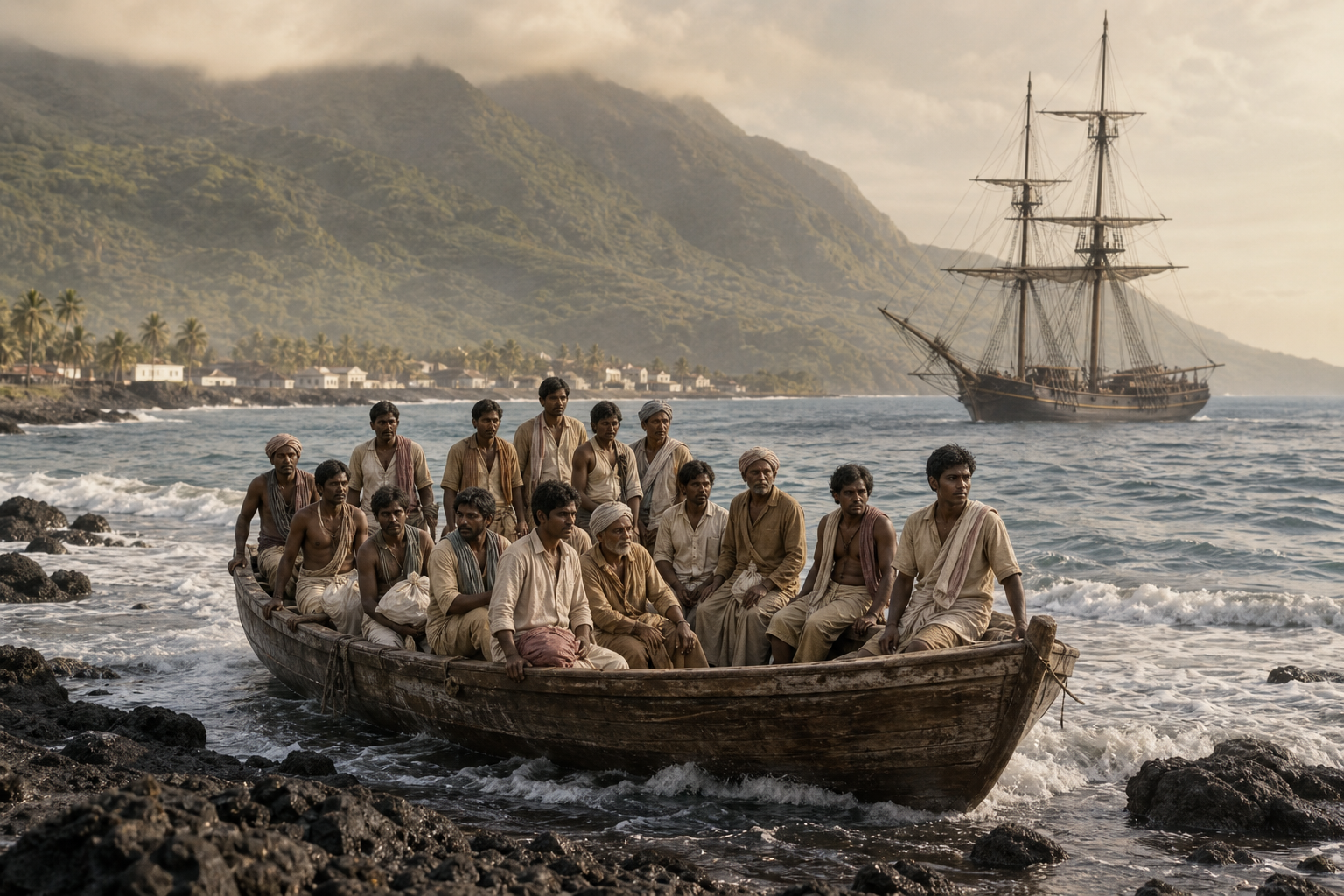
If the indenture timeline you learned begins in Mauritius in 1834, you are missing the event that may move its starting point back six years. Réunion, then known as Bourbon, received 15 Indian agricultural workers aboard La Turquoise at Saint-Denis on 3 June 1828.
That correction only holds if you use the word first carefully. Indians had been reaching the island long before 1828, while the mature indenture system eventually operated on a far greater scale than one voyage. What 1828 gives Réunion is a strong claim to being the first destination of structured nineteenth-century Indian indentured migration. If you teach, commemorate, or trace this history, that is the distinction to preserve.
Key takeaways
- La Turquoise arrived at Saint-Denis on 3 June 1828 with 15 Indian agricultural workers, before the conventional 1834 starting date for British indenture in Mauritius.
- Réunion’s Indian connection reaches back to the seventeenth century, so 1828 should not be described as the beginning of all Indian presence on the island.
- The first group is identified as Telugu-speaking farmers from the region now called Andhra Pradesh. Later phases brought more than 120,000 workers from the Indian subcontinent.
- A formal labour contract did not guarantee free or informed consent. Deceptive recruitment, vulnerability, movement restrictions, and debt could make indenture coercive in practice.
- Hindu temples, Pongal, Mariamman processions, Indo-Muslim identity, language, and food preserve different parts of Réunion’s Indian inheritance; none should be reduced to a decorative remnant of the past.
The word “first” needs three historical boundaries
Several different beginnings can be hidden inside a question about the first Indian migrants. Separating them prevents a valid correction from becoming a new historical error.
- The first Indian connection: Réunion had ties with India from the seventeenth century. This is the longest timeline, but it is not yet the history of structured indenture.
- Earlier individual and small-group migration: Indian artisans and labourers travelled to Bourbon and Mauritius during the seventeenth and eighteenth centuries. Their presence means the 15 passengers of La Turquoise were not the first Indians on the island.
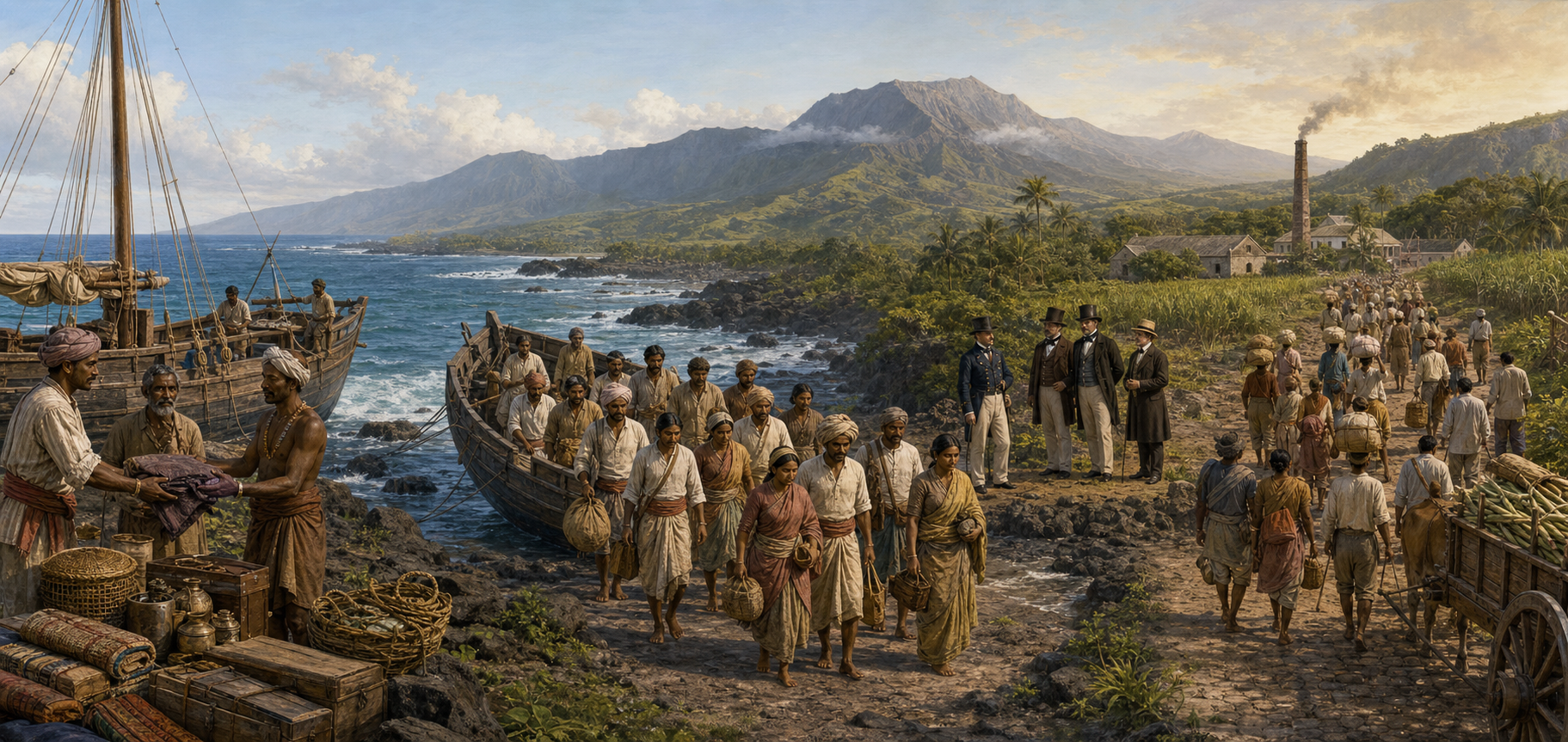
- The beginning of structured nineteenth-century indenture: The 1828 arrival placed a specifically recruited group of Indian farmers in the service of colonial landowners. This is the basis of Réunion’s claim to precede the British system usually dated from Mauritius in 1834.
A defensible short answer is therefore: Réunion has an archival claim to the first organised arrival of Indian indentured workers in the nineteenth century, at Saint-Denis on 3 June 1828. Do not shorten this to “the first Indians arrived in 1828.” That wording erases at least two centuries of earlier contact and migration.
The departure details require an explicit caution: 15 April from Pondicherry with a 49-day passage and 16 March from Yanam are both attached to the voyage. Those particulars cannot all describe one uninterrupted chronology as written. Unless you have examined the underlying archival record, anchor a lesson, plaque, or family timeline to the stable arrival facts: La Turquoise, 15 workers, Saint-Denis, 3 June 1828. Mark the precise sailing date and port as requiring further verification.
The small number should not lead you to dismiss the voyage. It was a threshold event, not a representative sample of the migration that followed. Réunion eventually received more than 120,000 workers from the Indian subcontinent. The movement from 15 people to more than 120,000 is exactly why the first organised arrival matters.
The first workers are described as Telugu-speaking farmers from the area now known as Andhra Pradesh. Keep that regional origin visible, but do not turn those 15 men into the presumed ancestors of every Indian custom or community on Réunion. Many later arrivals contributed to the island’s far broader Indian inheritance.
La Turquoise itself sank during a cyclone the following year. That detail belongs to the vessel’s history; it does not establish what happened to the 15 workers after their arrival. A responsible account must not accidentally place them aboard the ship at the time of its loss.
A contract could still conceal coercion
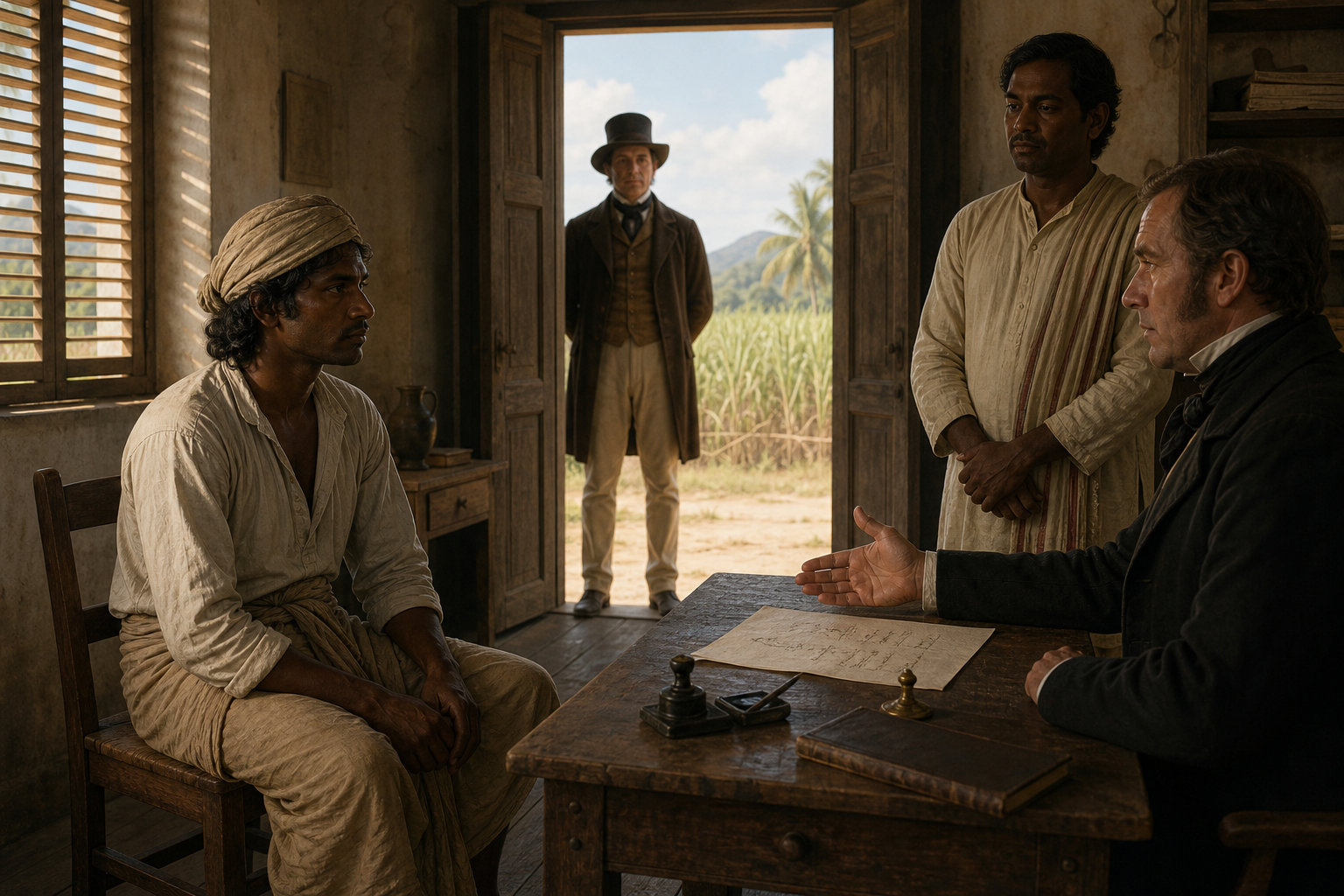
Indenture was legally presented as contracted labour rather than ownership of a human being. That legal distinction matters, but it does not settle whether a worker exercised meaningful freedom. Consent is thin when a recruiter controls the information, the worker cannot understand the contract, departure follows deception, debt limits every choice, or movement is restricted after arrival.
The wider plantation system sought cheap Indian labour as enslaved African labour was being replaced. Its coercive indicators included abuse of vulnerability, deceptive recruitment, restriction of movement, and debt bondage. Illiteracy in European languages and famine conditions in parts of India widened the power gap between recruiters and recruits.
Dr. Naren Prasad, an economist with the International Labour Organization, uses the phrase slavery 2.0 to stress this combination of contractual form and practical compulsion. The phrase is an interpretive judgement, not a neutral legal classification. It is useful when it directs your attention to power and coercion; it becomes misleading if it is used as a substitute for examining the circumstances of a particular person or voyage.
Prasad’s account of ancestors who were captured and trafficked also shows why “they volunteered” is too confident as a blanket description. At the same time, one family’s experience cannot by itself establish the exact recruitment history of every migrant, including the 15 farmers on La Turquoise. When individual records are incomplete, “recruited under indenture” is usually the more accurate wording.
If you are assessing whether a migration was genuinely voluntary, ask five concrete questions:
- Could the worker understand the terms in a language he or she knew?
- Was the destination, type of work, pay, debt, and duration explained accurately?
- Could the recruit refuse without being threatened, detained, or financially trapped?
- Could the worker leave the employer or move freely after arrival?
- Did famine, poverty, or another acute vulnerability give the recruiter overwhelming leverage?
A signed document answers none of those questions on its own. This is the central caution to carry into any family history or public commemoration: contractual status should not be mistaken for informed consent.
The French and British systems also should not be collapsed into one administrative model. French rule placed greater pressure on assimilation and citizenship, while British rule comparatively allowed more religious practice but continued to control workers. The comparison is relative. Greater room for religious observance did not make the British system free of coercion, just as access to citizenship did not make French assimilation culturally neutral.
Réunion’s Indian inheritance is living, layered, and plural
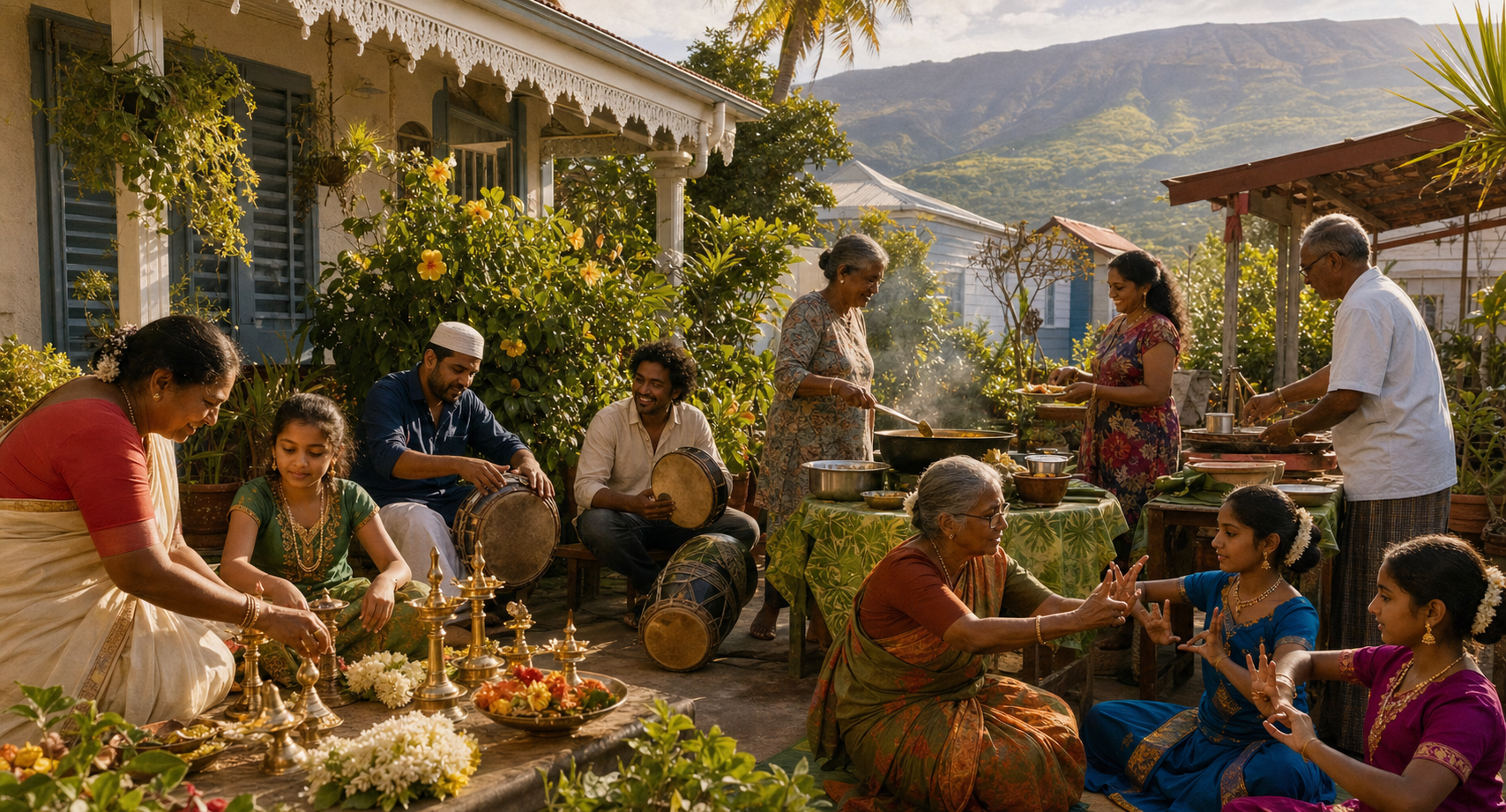
For a Dharmic reader, the most important legacy is not merely that Indians survived overseas. They rebuilt religious and cultural life under conditions that pushed them toward assimilation. The result is neither a museum copy of India nor a culture detached from Bharat. It is a Réunionnais inheritance shaped by continuity, pressure, adaptation, and local creation.
The distinction between the Malbar Hindu community and the Zarab Indo-Muslim community is essential. “Indian” does not mean one religion, region, language, or migration experience. If you use the word as though it were a complete identity, you will miss the internal plurality that Indian migrants and their descendants maintained.
You can notice that inheritance through three different kinds of evidence:
- Sacred architecture: Réunion has both simple traditional temples and temples with recognisably Dravidian forms. Their differences can reveal changing resources, community organisation, and ways of making Hindu worship visible.
- Ritual and festival life: Pongal observances and Mariamman processions carry practices associated with southern India into Réunion’s public and religious calendar.
- Everyday culture: Indian influence remains in local language and cooking, including the use of Indian spices and culinary techniques. These less formal inheritances may survive even where family knowledge of a specific village or ancestor has faded.
Keep those trails separate before connecting them. A temple can establish religious continuity, but its present form does not automatically date a family’s arrival. A food term may preserve Indian influence without proving descent from the first Telugu group. A festival can unite a community while also having changed in Réunion. With more than 120,000 later arrivals in the island’s history, no single ship should be made to explain every Indian practice found there.
This is also why assimilation should not be narrated as total erasure. Temples, processions, festival calendars, language, and cuisine show that inherited practices endured. Yet survival did not require freezing culture in its nineteenth-century form. Adaptation is part of the historical record, not evidence that the tradition became inauthentic.
How to teach or commemorate Réunion’s place accurately
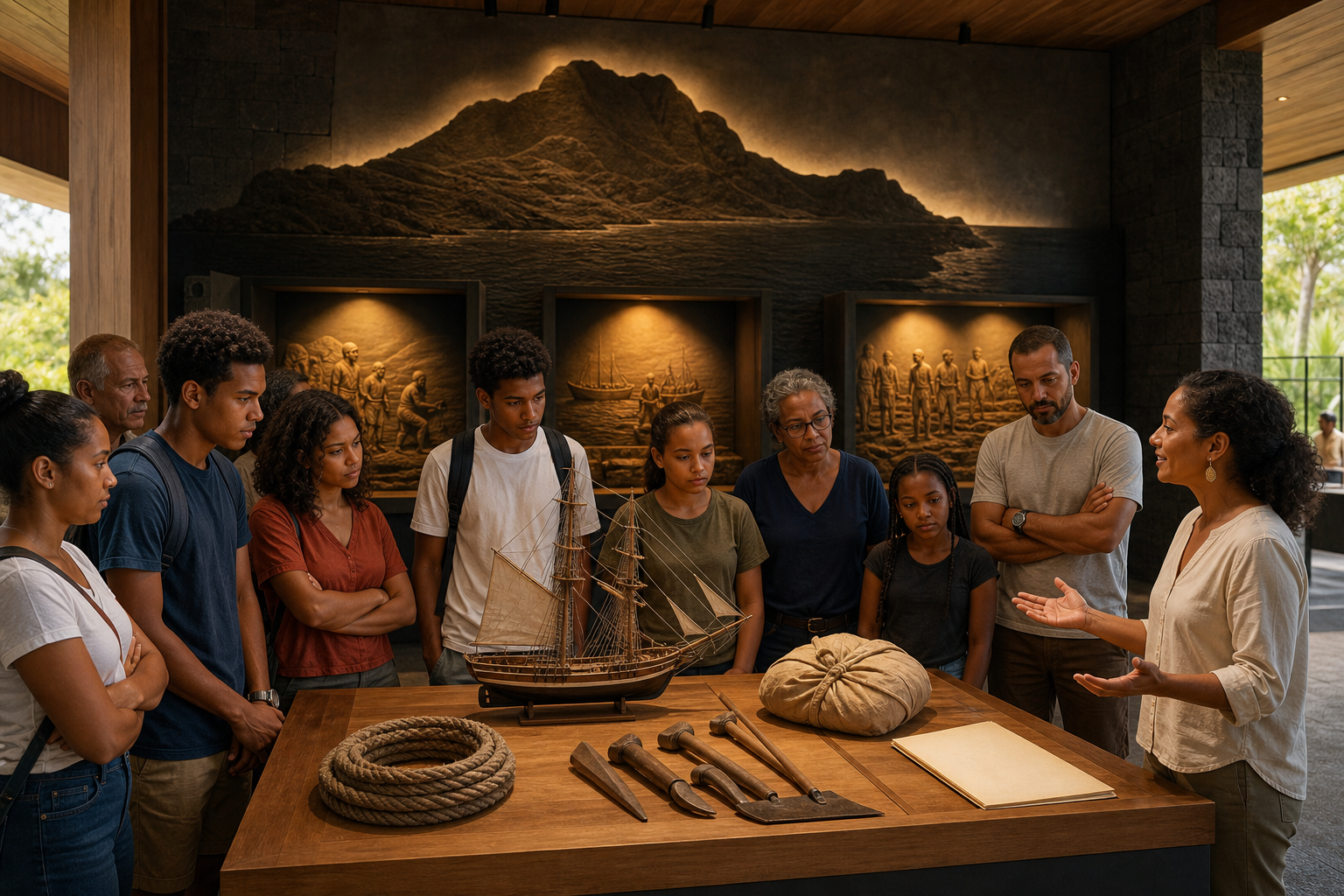
A school handout, temple programme, family history, museum label, or community event can be concise without flattening the story. Build it in five moves:
- Name both places: explain that Réunion was formerly called Bourbon. This helps readers connect older records with the island they know today.
- Separate contact from indenture: begin with seventeenth- and eighteenth-century Indian connections, then identify 1828 as the structured indenture milestone.
- Centre the workers: name the 15 Telugu-speaking farmers and their placement with colonial landowners, not only the ship and its officers.
- Explain how coercion operated: mention recruitment deception, vulnerability, movement restrictions, and debt rather than treating the existence of a contract as proof of free choice.
- Carry the story into the present: connect later migration with the Malbar and Zarab communities, temples, festivals, language, and cuisine without attributing every tradition to the first group.
Suggested label text: On 3 June 1828, La Turquoise arrived at Saint-Denis with 15 Indian agricultural workers. Earlier Indian migrants had already connected India and Bourbon, but this voyage marks an archival beginning of structured nineteenth-century indentured migration to Réunion, before the British system usually dated from Mauritius in 1834. Later phases brought more than 120,000 workers from the Indian subcontinent, and Réunion’s Indian inheritances remain visible in its religious and everyday life.
If space allows, add a note that the departure date and port require verification because March and April chronologies are both in circulation. That small disclosure does not weaken the 1828 case. It shows readers which facts are firm and which remain open to archival checking.
The shortage of public memorials dedicated to indentured workers has been contrasted with the visibility given to other subjects, including London’s memorial to animals in war. You do not need a monumental project to begin correcting that imbalance. A permanent date plaque, a recorded family testimony, a carefully labelled temple exhibit, or a school timeline can preserve names and distinctions that an annual speech may lose. Whatever form you choose, leave a durable record and identify uncertainty rather than filling gaps with legend.
When you next encounter a timeline that begins with Mauritius in 1834, add Réunion in 1828 and the earlier Indian connection that made even that date possible. Then ask what the labour contract concealed, whose voice is missing, and which living practices still carry the history. That precise correction moves Indian workers and their descendants from the margin of the indenture story to their proper place near its beginning.
References
