

If you are planning worship for Saturday, October 18, 2025, two calendar movements need your attention. The Tamil month of Aippasi begins on this civil date, while the lunar day changes from Krishna Paksha Dwadashi to Krishna Paksha Trayodashi at about 1:20 PM in most regions.
The practical rule is simple: use Aippasi to frame the month, and use the tithi to time observances that depend on the lunar day. Do not treat the whole of October 18 as Trayodashi merely because it begins later that afternoon, and do not assume the opening of Aippasi erases the Dwadashi duties with which the day starts.
Read October 18 through three calendar layers

A civil date, a Tamil solar month, and a lunar tithi answer different questions. The civil date tells you when to gather. The solar month locates the day within the Tamil religious year. The tithi determines whether a tithi-bound observance belongs before or after a particular transition.
| Calendar layer | Status on October 18, 2025 | How you should use it |
|---|---|---|
| Civil calendar | Saturday, October 18 | Use it for family, travel, and temple scheduling. |
| Tamil solar calendar | Aippasi begins; the month extends through November 16. | Use it to begin the month’s devotional routine and prepare for its festivals. |
| Lunar Panchang | Dwadashi continues until about 1:20 PM in most regions; Trayodashi follows. | Use the locally verified boundary for tithi-dependent rites. |
The 1:20 PM transition belongs to the lunar calculation. It should not be read as the stated moment at which the Tamil solar month begins. The two changes coincide on the same civil date, but they are not the same calendrical event.
There is another important qualification. Tithi timings can vary with latitude, longitude, and the calculation system followed by a regional Panchang. Treat 1:20 PM as a broad reference for planning, then replace it with the time published for your location before performing a vrata, temple rite, or household observance whose validity depends on the tithi.
Plan Dwadashi duties before using the afternoon boundary
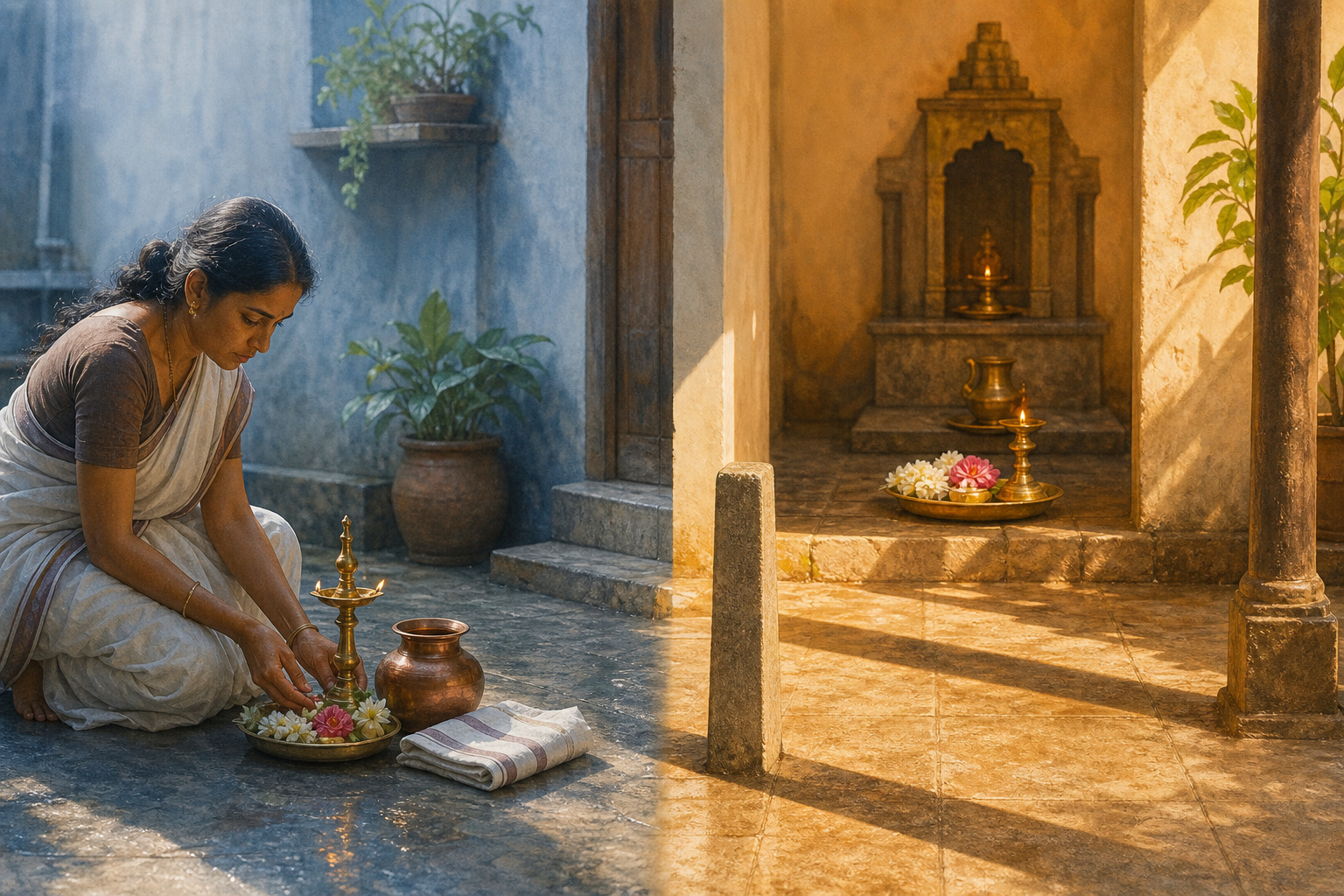
If you observed Ekadashi
Dwadashi follows Ekadashi and is commonly associated with parana, the timely completion of an Ekadashi fast. October 18 therefore begins with a practical question: what parana window does your own sampradaya and local Panchang prescribe?
Do not substitute the general 1:20 PM tithi endpoint for a verified parana window. The endpoint tells you approximately when Dwadashi gives way to Trayodashi across much of Bharat; it does not, by itself, provide every rule needed for your fast.
- Check the Panchang for the city where you will actually observe the vrata, not merely the calendar of your ancestral town or a temple in another time zone.
- Confirm the parana interval used by your family, guru, or temple. If their schedule differs from a general online time, follow the locally applicable observance guidance.
- Arrange the food and water needed for parana beforehand so that avoidable household delays do not push the observance beyond its prescribed window.
- After parana, return to a simple sattvic routine. Quiet japa, devotional reading, gratitude, and seva fit the steady character traditionally associated with Dwadashi.
When Trayodashi begins
After the locally confirmed transition, mark the tithi as Krishna Paksha Trayodashi. This later part of the waning fortnight carries a preparatory quality in many households. It is a suitable time to clean the puja space, organize offerings, check what will be needed for forthcoming worship, and continue a calm devotional practice.
You do not need to interrupt ordinary prayer at the exact transition. The boundary matters when a rite is tied specifically to Dwadashi or Trayodashi. Japa, scriptural reading, gratitude, and service can continue across it. The point of knowing the time is to place tithi-specific duties correctly, not to make the rest of the day spiritually fragmented.
This date alone does not supply Nakshatra, Rashi, Abhijit Muhurat, or other shubh-muhurta details. If your planned act depends on any of them, the tithi transition is not enough information. Consult the full local Panchang or the temple conducting the rite.
Begin Aippasi as a month-long discipline

Aippasi is the seventh month of the Tamil calendar and corresponds with the Sun’s passage through Tula. In 2025 it runs from October 18 to November 16. It is especially associated with devotion to Lord Shiva and Lord Murugan, and it carries the seasonal movement from late monsoon rains toward festival light, renewal, and communal worship.
You do not have to fit the entire meaning of Aippasi into its opening day. A better approach is to choose a sustainable practice on October 18 and then carry it through the month.
- Choose one daily anchor. This may be early-morning puja, a short Shiva or Murugan stotra, japa, a rice-flour kolam, or lighting a deepam at dusk. Choose something your household can maintain without turning devotion into a rushed obligation.
- Mark your temple rhythm. Check when a nearby temple offers Shiva abhishekam, Murugan archana, or relevant recitations. Add those actual local times to your calendar instead of relying on a schedule from another region.
- Give service a date. Annadanam, food distribution, assistance to elders, and support for a local temple are concrete expressions of the compassion and community care emphasized during the month. Decide what you will do and when.
- Add festival dates only after verification. Deepavali normally falls within Aippasi, while Skanda Sashti forms a central devotional sequence associated with Lord Murugan. Obtain the precise 2025 dates and temple program from the Panchang followed by your community.
Skanda Sashti is traditionally observed through a six-day devotional arc culminating in Soorasamharam. Some devotees undertake vrata, recite the Skanda Shasti Kavacham, or attend temple processions. Deepavali brings its own household practices, including the traditional oil bath, lamps, prayers, and the sharing of sweets. These observances belong within Aippasi, but their exact timings should not be inferred from the October 18 tithi change.
This distinction is particularly useful for Tamil families living outside Tamil Nadu, Pondicherry, or Sri Lanka. Keep the shared month and its devotional meaning, but use your local temple calendar and location-specific Panchang for the clock times. A calendar copied from Bharat can preserve the correct festival date yet still give a tithi boundary that does not apply where you live.
Key takeaways for October 18, 2025
- Saturday, October 18 is the opening date of Aippasi in 2025; the Tamil month continues through November 16.
- The lunar day is Krishna Paksha Dwadashi until about 1:20 PM in most regions, followed by Krishna Paksha Trayodashi.
- The 1:20 PM time is a broad Panchang reference, not a universal local cutoff and not the stated time of the Aippasi solar transition.
- If you observed Ekadashi, verify your local parana window rather than treating the end of Dwadashi as a complete fasting instruction.
- Nakshatra, Rashi, shubh muhurta, and temple timings require additional local information.
- Begin Aippasi with one repeatable devotional practice, one locally scheduled temple observance, and one concrete act of service.
Write one calendar note that preserves every distinction
A useful personal entry would read: Saturday, October 18, 2025: Aippasi begins. Krishna Paksha Dwadashi until approximately 1:20 PM in the broad regional timing, then Trayodashi. Replace the tithi time with the local Panchang calculation; verify parana and any muhurta separately.
Add your temple’s Aippasi program beneath that note as soon as it is published. You will then arrive at October 18 knowing what belongs to the morning, what changes after the tithi boundary, and what practice you intend to sustain through November 16.
References
- DharmaRenaissance Blog – Essential Panchang for Oct 18, 2025: Master the Tithi Shift from Dwadashi to Trayodashi
- DharmaRenaissance Blog – Aippasi Masam 2025: Discover the Complete Guide to Tamil Calendar’s Sacred Month of Light
