
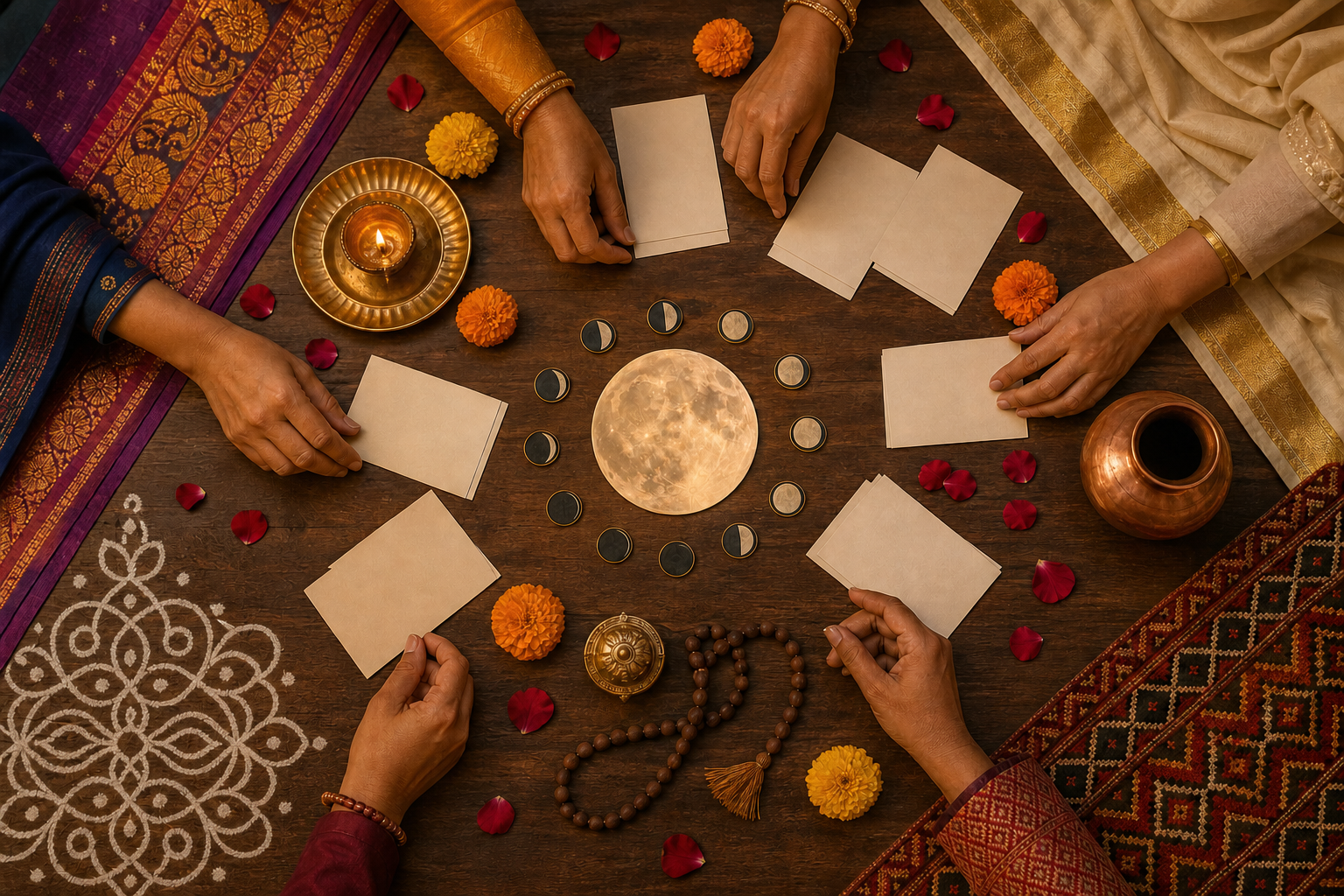
If one family calendar says Kartik, another says Ashwin, and a Tamil invitation says Aippasi, don’t assume that somebody has chosen the wrong Diwali date. Regional calendars can give different month names to the same phase of the Moon, while distinct communities may observe different vrats on the same tithi.
You can resolve most apparent conflicts by checking five things in order: the observer’s location, the tithi, the regional calendar, the particular sampradaya or family custom, and the rule for completing the vrat. That sequence matters. A shared date does not automatically mean a shared ritual.
The tithi is the anchor; the month name is a translation
A civil date runs from midnight to midnight. A tithi is a lunar division whose beginning and end can fall during the civil day. A religious observance may also depend on sunrise, dusk, star-sighting, or a prescribed period on the following tithi. This is why a date printed without a location and tithi window is incomplete for vrat planning.
There is another layer. Many North Indian calendars follow a full-moon-ending, or purnimanta, lunar-month convention. Many western and southern calendars use a new-moon-ending, or amanta, convention. The dark fortnight approaching Deepavali can therefore appear as Kartik Krishna Paksha in a North Indian calendar but as Ashwin or Ashwayuja Krishna Paksha elsewhere. The month label changes even when the relevant tithi and civil date coincide.
| 2025 calendar marker | North Indian label | Other regional label | Observances it helps you locate |
|---|---|---|---|
| 13 October, Krishna Ashtami | Kartik Krishna Ashtami | Ashwin Krishna Ashtami in Marathi, Telugu, Kannada, and Gujarati calendars | Ahoi Ashtami, Dampatya Ashtami, and Maharashtra’s Karashtami with Bhaldevi Puja |
| 17 October, Krishna Ekadashi | Kartik Krishna Ekadashi | Ashwayuja Krishna Ekadashi in Gujarat, Maharashtra, Andhra Pradesh, Telangana, and Karnataka | Rama Ekadashi, sometimes called Diwali Ekadashi because of its seasonal position |
| 18 October to 16 November | Not a one-to-one lunar-month equivalent | Aippasi in the Tamil solar calendar and Thulam in the Malayalam solar calendar | A solar-month frame within which Tamil and Kerala households organize their seasonal worship |
Treat this as a translation key, not as a universal timetable. Start with the lunar designation, such as Krishna Ashtami or Krishna Ekadashi, and then ask how your calendar names that fortnight. After that, verify the actual tithi window for the city where you will perform the observance. A relative’s panchang can identify the tradition, but its clock times may not apply where you live.
One Ashtami can hold several distinct vows
The 2025 example is especially instructive because three observance names converge on Krishna Ashtami. They are not competing titles for one standardized puja. Each vrat has its own sankalpa, devotional center, and household practice.
Ahoi Ashtami: a vow centered on children’s welfare
Ahoi Ashtami is undertaken for the prosperity, progress, protection, and long life of children. Its home-centered pattern commonly includes a day-long fast, an evening puja, and completion after the stars are sighted. Families may draw an eight-compartment figure on a clean wall, depict Ahoi Mata with symbols associated with nature and offspring, hear the vrat katha, and offer water, milk, simple sweets, or seasonal grains.
The katha gives the ritual an ethical direction: unintended harm is met with remorse, responsibility, compassion, and renewed conduct. If you are preparing the puja, don’t reduce it to a picture and a plate of offerings. Set aside time for the story and for a family sankalpa concerning how children, animals, and vulnerable beings will be treated.
Dampatya Ashtami: a disciplined reset for partners
Dampatya Ashtami directs the same broad season of restraint toward marital harmony, mutual respect, and household well-being. A practical observance can include a joint sankalpa, a diya, a simple fast within one’s capacity, prayer before the household deities, charity, and a quiet period without devices. Gentle speech and attentive listening are not optional decorations around this vrat; they are among the clearest ways to enact its purpose.
If you observe as a couple, choose one concrete act before the day begins: settle a neglected household responsibility, listen without interrupting, seek an elder’s blessings, or perform seva together. This keeps the sankalpa from becoming a vague wish for peace while the habits that disturb peace remain untouched.
Karashtami: Maharashtra’s Bhaldevi threshold
Karashtami marks a Maharashtrian threshold into the Diwali season through Bhaldevi Puja. The emphasis is on protection, prosperity, clarity of purpose, and an orderly transition into the festive period. Lamps, mantra, simple naivedya, household cleaning, and the beginning of Diwali faral preparations can all belong to the day.
A Maharashtrian household need not replace Karashtami with Ahoi merely because a North Indian calendar gives greater prominence to Ahoi Ashtami. Likewise, a family that has inherited Ahoi or Dampatya practice does not need to merge Bhaldevi worship into it. If traditions meet within one household, keep separate sankalpas and puja sequences while sharing practical preparations such as cleaning, diya arrangements, prasada, and seva.
Discipline, compassion, generosity, family responsibility, and reverence for light resonate across the wider Dharmic family. Ritual identities should still remain clear. Ahoi, Rama Ekadashi, Jain remembrance of Bhagwan Mahavira’s nirvana, and the Sikh observance of Bandi Chhor Divas are not interchangeable simply because they occur within the wider Deepavali season.
The end of a fast belongs to the vrat, not the date
Writing only “fast” beside a festival name creates the most common practical confusion. You also need to record what is avoided, what devotional practice accompanies the restraint, and exactly what event permits the fast to end.
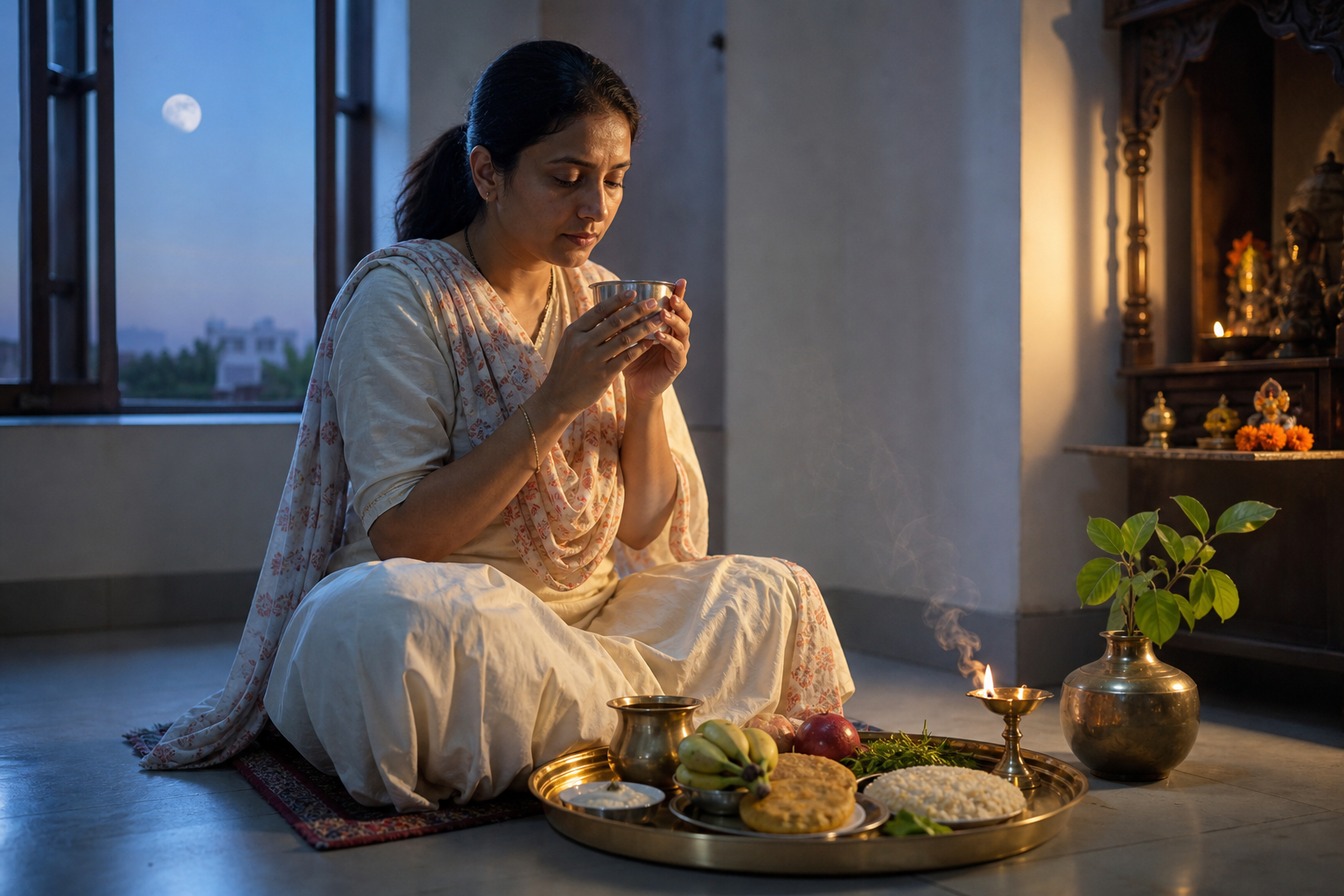
- Ahoi Ashtami commonly uses a day-long fast followed by evening puja and completion after star-sighting. The relevant marker is the appearance of the stars, not merely the clock passing a convenient hour.
- Dampatya Ashtami is often kept through simple fasting or restrained food, followed by a family prayer and fruit or a light meal in the evening. Details vary by household, so confirm whether your inherited practice has a stricter rule.
- Rama Ekadashi commonly involves phalahara or another sattvika discipline, with grains and pulses avoided. Tulsi offerings, Vishnu Sahasranama, Rama Nama japa, kirtan, charity, and seva can structure the day. Parana belongs on Dwadashi after sunrise and after Hari Vasara has ended, within the locally calculated window.
Rama Ekadashi therefore cannot be completed by borrowing Ahoi Ashtami’s star-sighting rule. Nor should you break an Ekadashi fast merely because the civil date changed at midnight. Record the Dwadashi parana window when you first enter Ekadashi on the calendar; waiting until the next morning to search for it invites avoidable uncertainty.
Fasting intensity is not a measure of anyone’s spiritual worth. If a health consideration makes the customary austerity unsuitable, adapt the food discipline with appropriate guidance and retain the sankalpa through prayer, truthful speech, restraint, dana, and seva. Intention does not require turning a manageable observance into a health risk.
Build a calendar your whole household can actually use
Add the solar-month layer where the family uses it
Tamil and Malayalam calendars add a solar framework to the Diwali-season picture. In 2025, both Aippasi and Thulam ran from 18 October through 16 November, beginning with the Sun’s transition into Tula. Aippasi is the seventh Tamil month; Thulam is the third Malayalam month. Their matching 2025 date range does not make them alternative names for Kartik or Ashwin, because they are solar months rather than the lunar labels used in the Ashtami and Ekadashi rows above.
Within Tamil practice, Deepavali falls on Aippasi Amavasya and is associated with abhyanga snanam, lamps, sweets, temple visits, and family greetings. Aippasi also holds Skanda Sashti observances for Lord Murugan and Pournami worship such as Annabhishekam in Shiva temples. In Kerala, Thula Sankramanam can be marked with dawn prayer, lamps, Surya worship, simple offerings, temple visits, and charity. These month-long frames help households coordinate sadhana and travel; they do not remove the need to check the individual tithi for each observance.
Use one entry format for every regional observance
- Name the observer and tradition. Record “Ahoi,” “Dampatya,” “Karashtami-Bhaldevi,” or “Rama Ekadashi,” not merely “family fast.”
- Set the location where the ritual will occur. This is the location whose sunrise, dusk, star-sighting conditions, and tithi timings matter.
- Enter the civil date, then add the tithi. For example: “13 October 2025 — Krishna Ashtami.”
- Add the regional month in the form your family recognizes. Where useful, place the translation beside it: “Kartik Krishna Ashtami / Ashwin Krishna Ashtami.”
- Write the puja purpose and essential preparations. Ahoi needs its evening image or drawing, katha, and offerings; Karashtami needs the Bhaldevi arrangement and naivedya; Rama Ekadashi needs the chosen Vishnu or Rama practice.
- State the food discipline and completion rule separately. “After stars” and “Dwadashi after sunrise, following Hari Vasara” are not minor notes; they determine how the vrat is kept.
- Verify the final timing through a reliable local panchang, temple calendar, or sampradaya authority. For families outside India, use a calculation or temple schedule made for the place of observance rather than importing a muhurta from a relative’s city.
A reusable calendar line can be as simple as this: observer; location; calendar tradition; civil date; tithi; regional month; vrat; food rule; puja materials; completion or parana rule; local timing reference. Once those fields are present, family members can see whether two entries truly conflict or merely use different regional vocabulary.
For a mixed-region household, don’t force every observance into one naming system. A single entry may retain both “Kartik Krishna Ashtami” and “Ashwin Krishna Ashtami,” while a separate Tamil column records Aippasi. Preserving each name teaches the next generation how the traditions relate without erasing where they differ.
Key takeaways
- A Kartik-versus-Ashwin disagreement may be a difference in lunar-month convention rather than a different tithi or civil date.
- A shared Ashtami can support distinct vrats. Choose the ritual through family tradition, deity, and sankalpa, not through the date alone.
- Record how a fast ends when you record when it begins. Ahoi uses star-sighting; Rama Ekadashi uses a locally calculated Dwadashi parana window.
- Aippasi and Thulam are solar-month frameworks. Keep them alongside, rather than forcing them into, North Indian lunar terminology.
- Location is part of the religious date. Verify tithi, sunrise, dusk, and parana for the place where you will actually observe.
Before the next Diwali-season calendar message circulates through your family, ask four questions: Which tithi? Which location? Which regional calendar? Which vrat rule? Put those answers into the shared entry now, and the season can begin with clarity rather than a last-minute argument over labels.

References
- Hindu Pad — Dampatya Ashtami 2025: Discover the Complete Vrat Guide for Marital Harmony and Blessings
- Hindu Pad — Rama Ekadashi 2025: Complete Guide to Date, Significance, Fasting Rules, and Parana Times
- Hindu Pad — Karashtami 2025: Discover the Essential Bhaldevi Puja Rituals and Maharashtra’s Diwali Start
- Hindu Pad — Complete Ahoi Ashtami Vrat Katha: Discover Proven Rituals for Children’s Prosperity and Long Life
- Hindu Pad — Discover Thula Masam 2025: Complete Guide to Dates, Sankramanam, Significance
- Hindu Pad — Aippasi Masam 2025: Discover the Complete Guide to Dates, Skanda Sashti, and Deepavali
