
You may have encountered Shah Alam II through stories of palace indulgence, opium and humiliation. If you are trying to decide whether a decadent emperor destroyed the Mughal Empire, those stories are a poor place to begin. Start with three harder questions: who collected the revenue, who controlled armed force and who made the emperor’s survival possible?
That approach reveals something more consequential than one ruler’s character. Under Shah Alam II, the Mughal throne remained politically valuable after it had ceased to be politically self-sufficient. The empire did not simply disappear. Its authority separated into money, military power and imperial legitimacy, and those assets passed into different hands.
The emperor remained visible after sovereignty had moved elsewhere
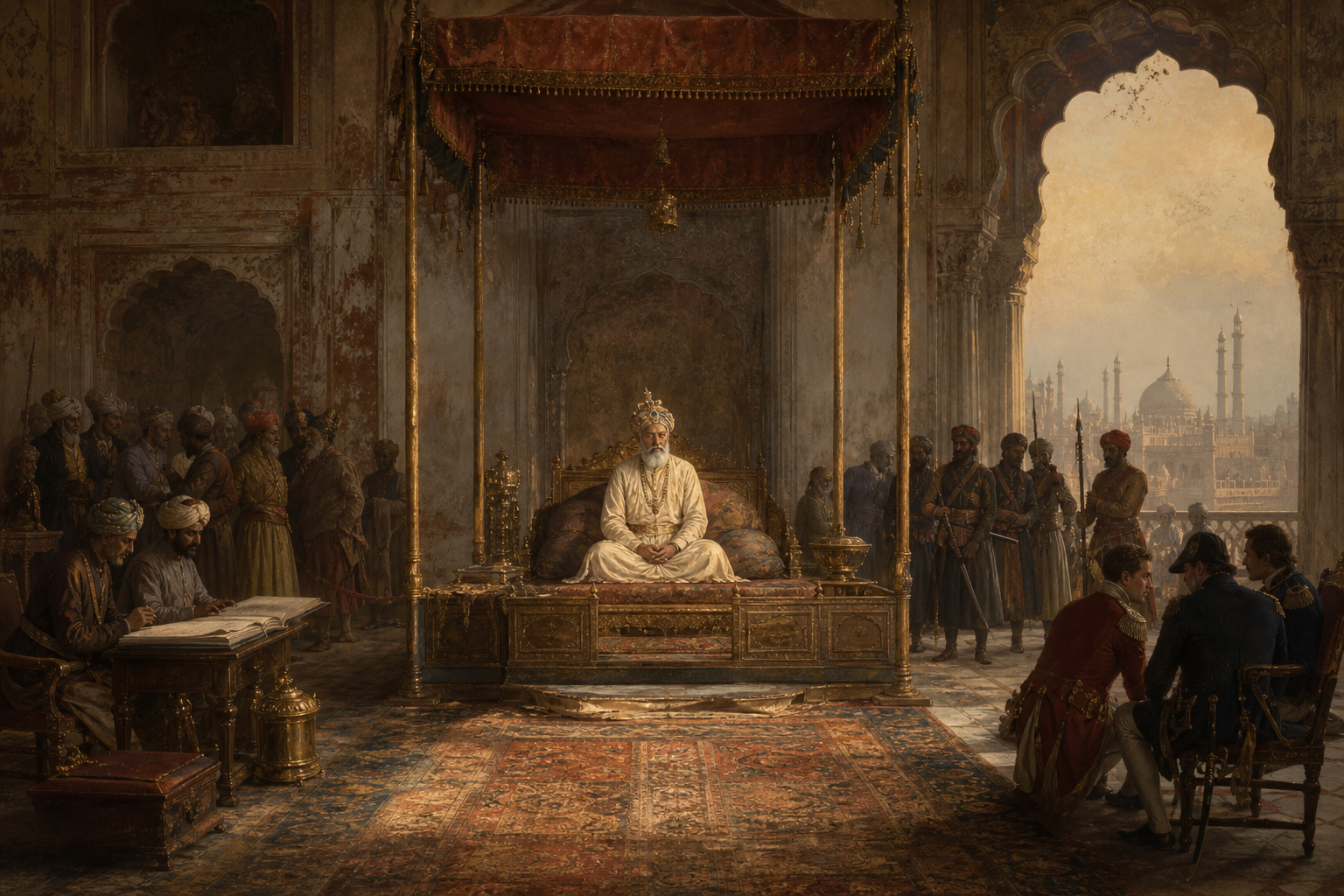
An imperial title can survive the machinery that once made it effective. Ceremonies may continue. Courtiers may observe old forms. Petitions may still be addressed to the monarch. None of this proves that the sovereign can raise dependable revenue, enforce an order or protect the capital without assistance.
That distinction is essential in Shah Alam II’s case. Delhi still contained a Mughal court, and the emperor’s name still carried legitimising weight. Yet his room for independent action was increasingly defined by stronger political patrons. Between 1780 and 1786, Anand Rao Narsi Yerulkar represented Mahadji Scindia at the imperial court. His presence was not merely diplomatic decoration. It showed that Maratha power had entered the daily operation of Mughal politics.
A public scene staged during Holi in 1786 made the imbalance unusually plain. Yerulkar presented a rag-clad elderly man beside an ornamented child. The juxtaposition turned royal poverty and fragile dynastic prestige into spectacle. Whatever private intentions lay behind it, the tableau could work only because the emperor’s material weakness was already recognisable at court.
When you read that Shah Alam II was still emperor, therefore, do not translate the title into modern assumptions about executive command. Ask who financed the court, who protected Delhi and whose representative could publicly expose imperial penury. Those questions locate power more reliably than the throne does.
Fiscal failure was the hinge of the collapse
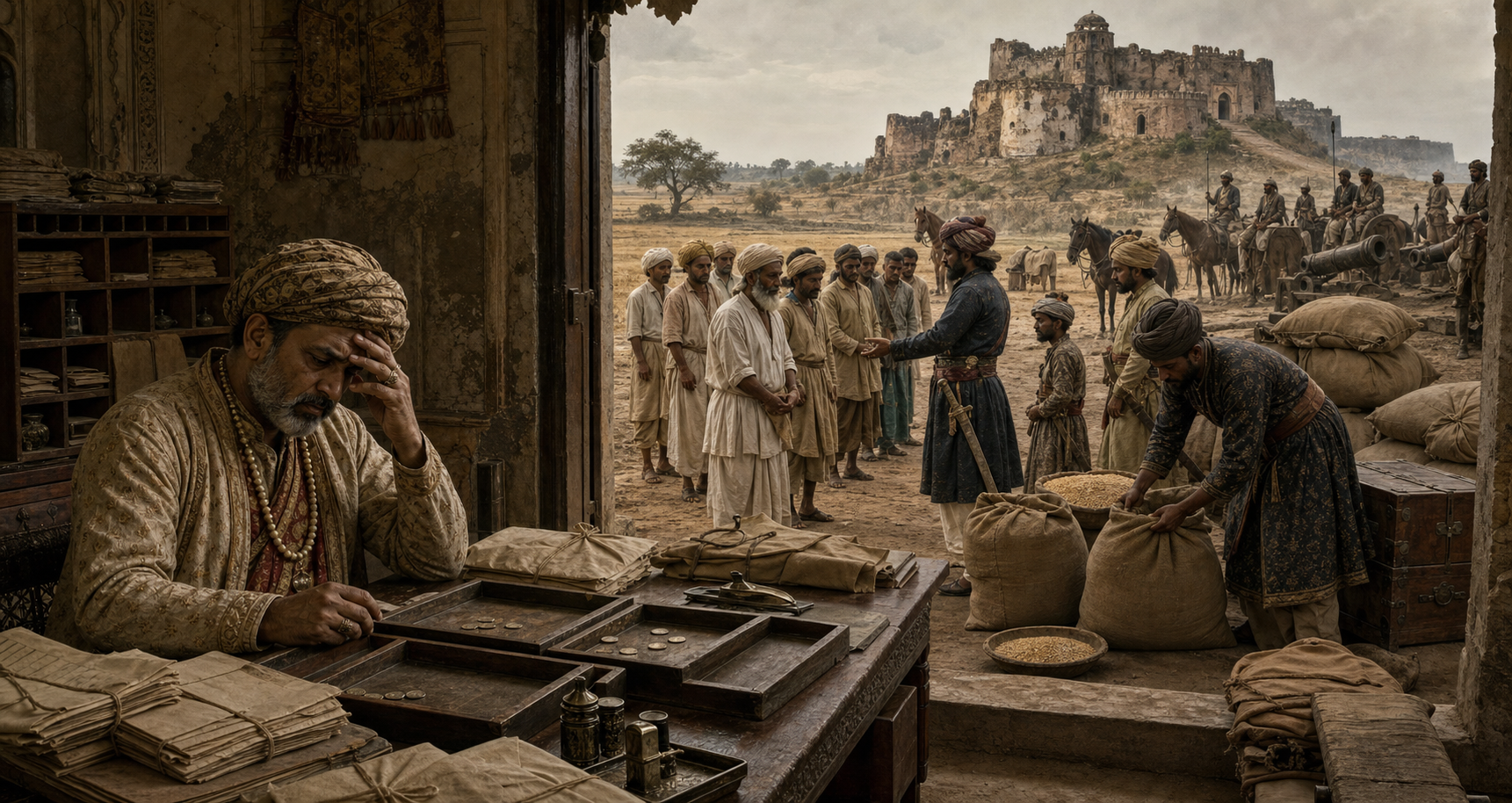
A court can endure military defeat if it preserves revenue, administration and loyal territory. It cannot sustain sovereignty indefinitely by borrowing to reproduce the appearance of abundance. Shah Alam II’s establishment faced precisely that contradiction: courtly expenditure and personal consumption continued while revenue weakened.
This is where palace detail becomes historically useful. A large zenana, an expanding royal family, numerous dependants and extensive patronage obligations required regular income. You should not treat any single total of consorts or children as secure because the surviving figures vary. The dependable point is structural: the household’s obligations continued to multiply after the fiscal base supporting them had contracted.
Adult princes confined within the Red Fort precincts were sometimes called “Shahzada Prisoners” and reportedly received an allowance of one rupee a day. They nevertheless maintained households of their own. Historian Jadunath Sarkar understood this as a cycle in which family obligations accumulated without sufficient means to discharge them. The result was not merely domestic discomfort. It was an imperial household unable to support its own status without deepening resentment, dependency and debt.
Borrowing could keep a ceremony intact for another day, but it could not restore the revenue system behind the ceremony. It also strengthened whoever supplied the money. Each subsidy therefore had two effects: it preserved the emperor as a symbol while reducing his ability to act independently. That is why financial assistance from Mahadji Scindia could be both generous and constraining.
When judging imperial collapse, treat insolvency as more than an accounting problem. Revenue pays troops, retains officials, rewards loyalty and makes commands credible. Once a ruler depends on an outside protector for those functions, formal rank begins to conceal practical subordination.
Decadence was an accelerant, not a complete explanation
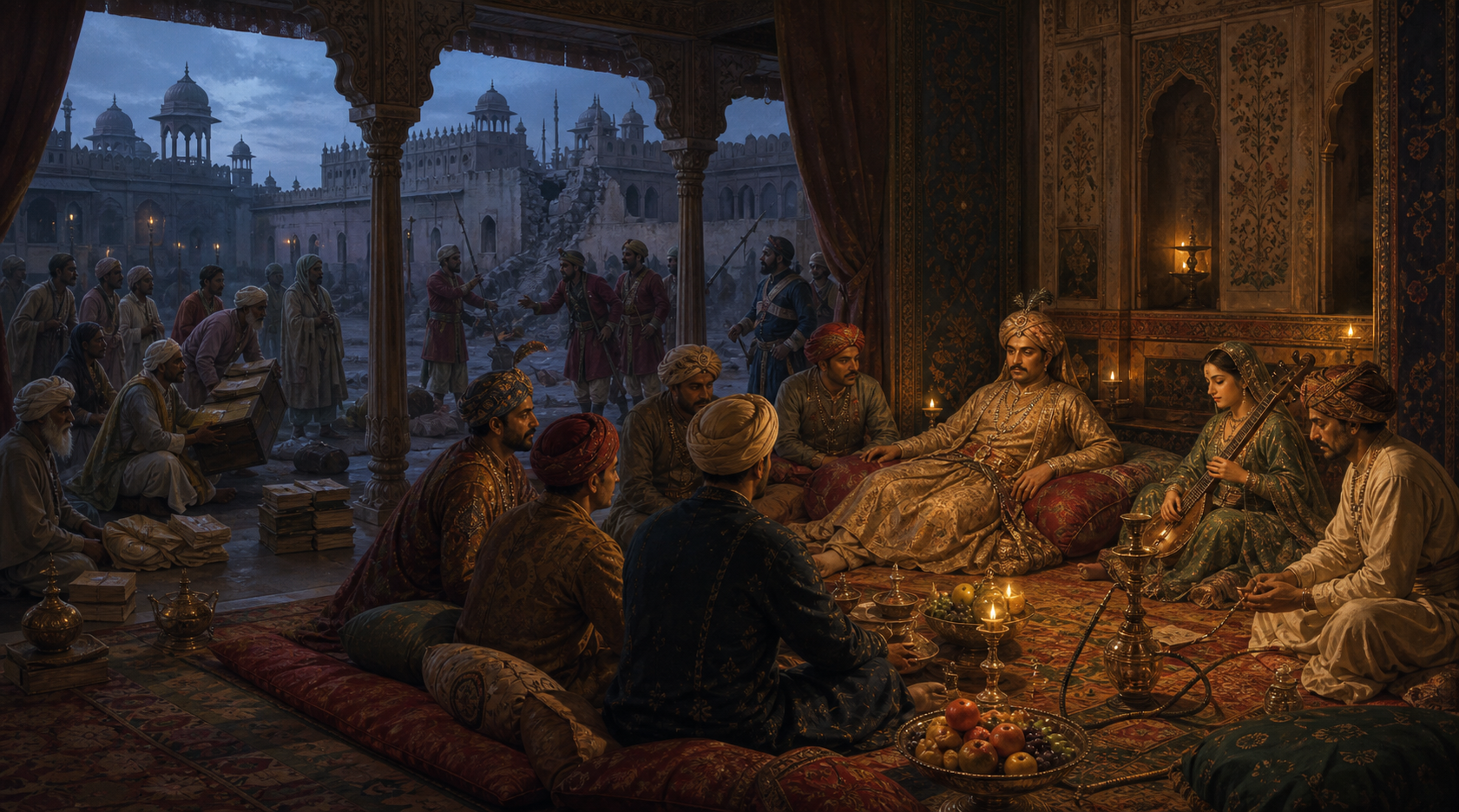
The sensual reputation of Shah Alam II’s court cannot simply be ignored. Several European visitors portrayed a ruler drawn to pleasure, flattery and ease while his establishment struggled for money. Yet their descriptions were personal and sometimes impressionistic. Lurid character judgements deserve less confidence than dated political events, recurring fiscal patterns and identifiable relationships of dependency.
A sound reading separates three kinds of claim. First come verifiable changes in control, such as the presence of Scindia’s agent or the British occupation of Delhi. Second come recurring institutional conditions, such as borrowing, inadequate allowances and dependence on stipends. Third come judgements about appetite, weakness or moral character. The third category can illuminate a ruler’s choices, but it cannot substitute for the first two.
Opium provides a good test of this discipline. On March 25, 1797, John Shore told William Wilberforce that the emperor had used opium for a long time and had increased his dosage. Shore reduced the contradiction of the late court to a memorable description:
Shah Alam II “lives in darkness, surrounded with empty state and real penury.”
John Shore to William Wilberforce, March 25, 1797
The habit mattered to the emperor’s health, attention and reputation. It also placed personal consumption within a commercial network increasingly influenced by the East India Company. Nawab Abdul Ahad Khan even requested high-quality Azimabad opium from British authorities. But opium did not by itself transfer taxation, territorial command or military power away from Delhi. It belonged within an existing structure of dependency; it was not a sufficient explanation for that structure.
The same caution applies to Shah Alam II’s devotional gatherings. Faqirs and mullas performed energetic ritual acts around him, and the emperor visibly cultivated religious figures. It is easy to turn such scenes into proof of irrationality. A more exact interpretation notices that ritual legitimacy becomes especially important when coercive and fiscal power are failing. Sacred association was one of the few forms of authority the court could still display without first recovering an army or a revenue base.
You do not have to excuse indulgence to reject a monocausal morality tale. Extravagance worsened the mismatch between income and obligation. Flattery could weaken judgement. Addiction could diminish an already constrained ruler. The mistake is to claim that the empire fell because the emperor enjoyed pleasure. By Shah Alam II’s later years, personal vice operated inside a political order whose essential resources had already migrated to regional and colonial powers.
Maratha protection preserved the throne that the Company captured
Mahadji Scindia’s relationship with Shah Alam II exposes the intermediate stage between sovereign rule and colonial subordination. Maratha money and influence could sustain the emperor, but the support was conditional. The emperor retained prestige; Scindia possessed much of the leverage needed to convert prestige into political action.
This was not yet the same arrangement that followed the British capture of Delhi. A powerful indigenous patron might protect the imperial person, influence appointments and use Mughal legitimacy while leaving the old court in place. The East India Company eventually incorporated that symbolic institution into a more decisive system of external control.
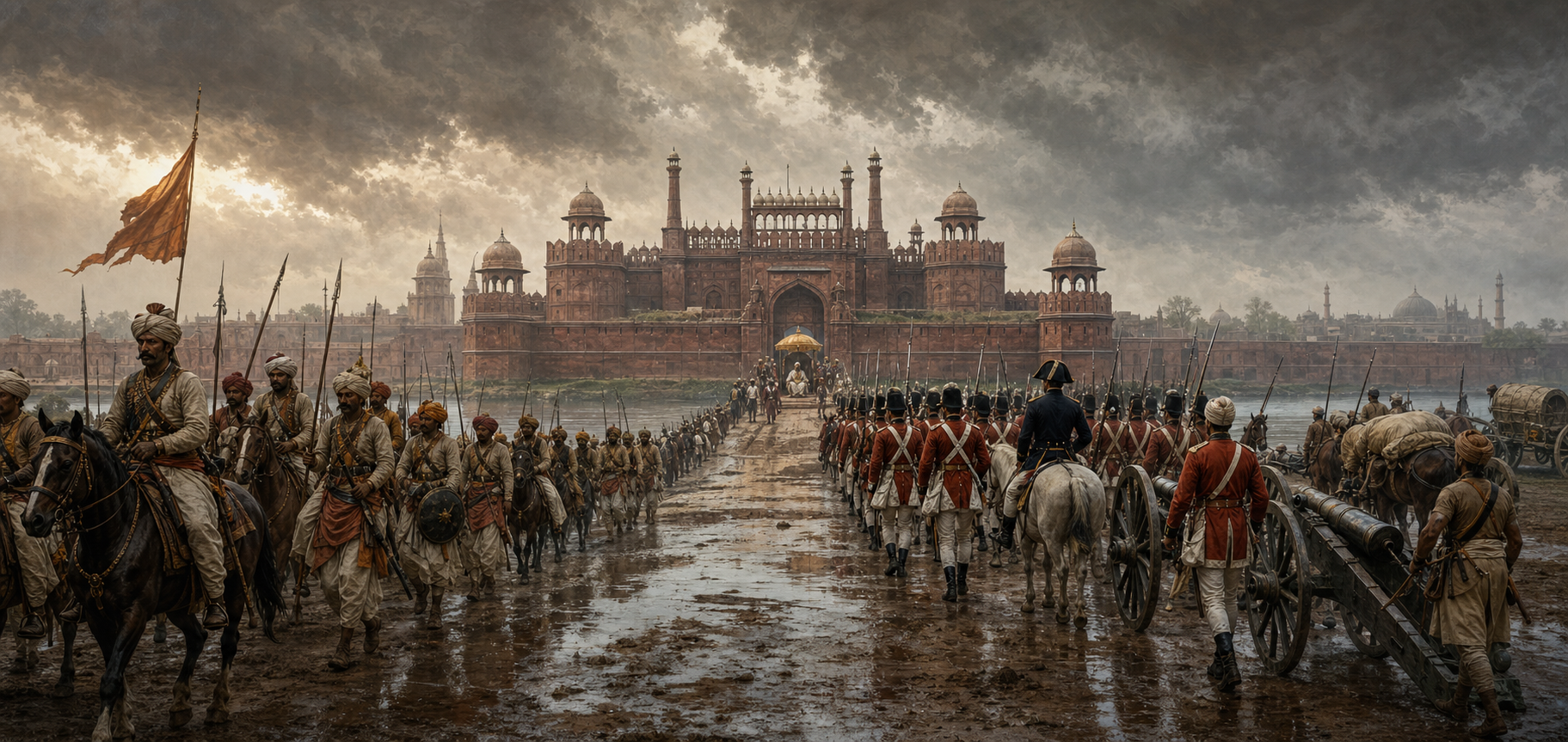
The crucial date is September 14, 1803, when British forces captured Delhi. The event did not suddenly create every Mughal weakness. It formalised the result of a longer process: depleted finances, military dependence, contested patronage and a sovereign title detached from sovereign capacity. Mughal authority continued in name and ritual, but the Company now controlled the political environment in which that authority could be exercised.
This sequence corrects two common misreadings. The first is that Mughal rule remained fully sovereign until one final British blow. The second is that the empire had already become meaningless before the British arrived. Both miss the value of the imperial symbol. Regional powers invested in the emperor precisely because his recognition still mattered. The Company preserved that useful shell after acquiring the means to contain it.
Shah Alam II died on November 19, 1806. His tomb near the Dargah of Qutbuddin Bakhtiar Kaki embodies the final paradox of his reign: an emperor surrounded by the forms of inherited greatness, yet buried after the effective centre of political command had moved beyond his dynasty.
Key takeaways for reading an imperial collapse
- Separate the title from the machinery of rule. A sovereign may retain ceremony and recognition after losing dependable revenue, armed enforcement and administrative freedom.
- Trace the money before judging the spectacle. Borrowing, stipends and conditional subsidies reveal who can keep the court functioning and what influence that support purchases.
- Identify the protector. If another power guards the capital or sustains the ruler, protection may have become a form of supervision.
- Rank evidence by what it can prove. A dated transfer of control explains more than a visitor’s judgement about personality. Palace scandal can reveal dysfunction, but it cannot carry the whole causal argument.
- Do not mistake symbolic survival for irrelevance. Maratha leaders and the East India Company continued to deal with the emperor because Mughal legitimacy still had political uses.
For a Dharmic reader, this precision matters. A pro-Dharma history does not become stronger by converting every Mughal failure into a lurid anecdote. It becomes stronger when it shows exactly how power worked, how indigenous forces such as the Marathas changed the balance and how a commercial company turned financial and military leverage into political supremacy.
In the vocabulary of rajadharma, Shah Alam II’s predicament was not merely a loss of splendour. Rank, duty and capacity had come apart. The emperor remained responsible for his choices, especially expenditure and personal habits that aggravated weakness. But responsibility must not be confused with complete control. A ruler dependent on patrons inherits less freedom than his title implies.
The next time you encounter a dramatic claim about Shah Alam II, place it in the chain that actually explains the collapse: revenue, armed protection, patronage, administrative freedom and symbolic recognition. Ask which link the anecdote proves. If it proves none, it may be memorable, but it is not yet an explanation.
References
