
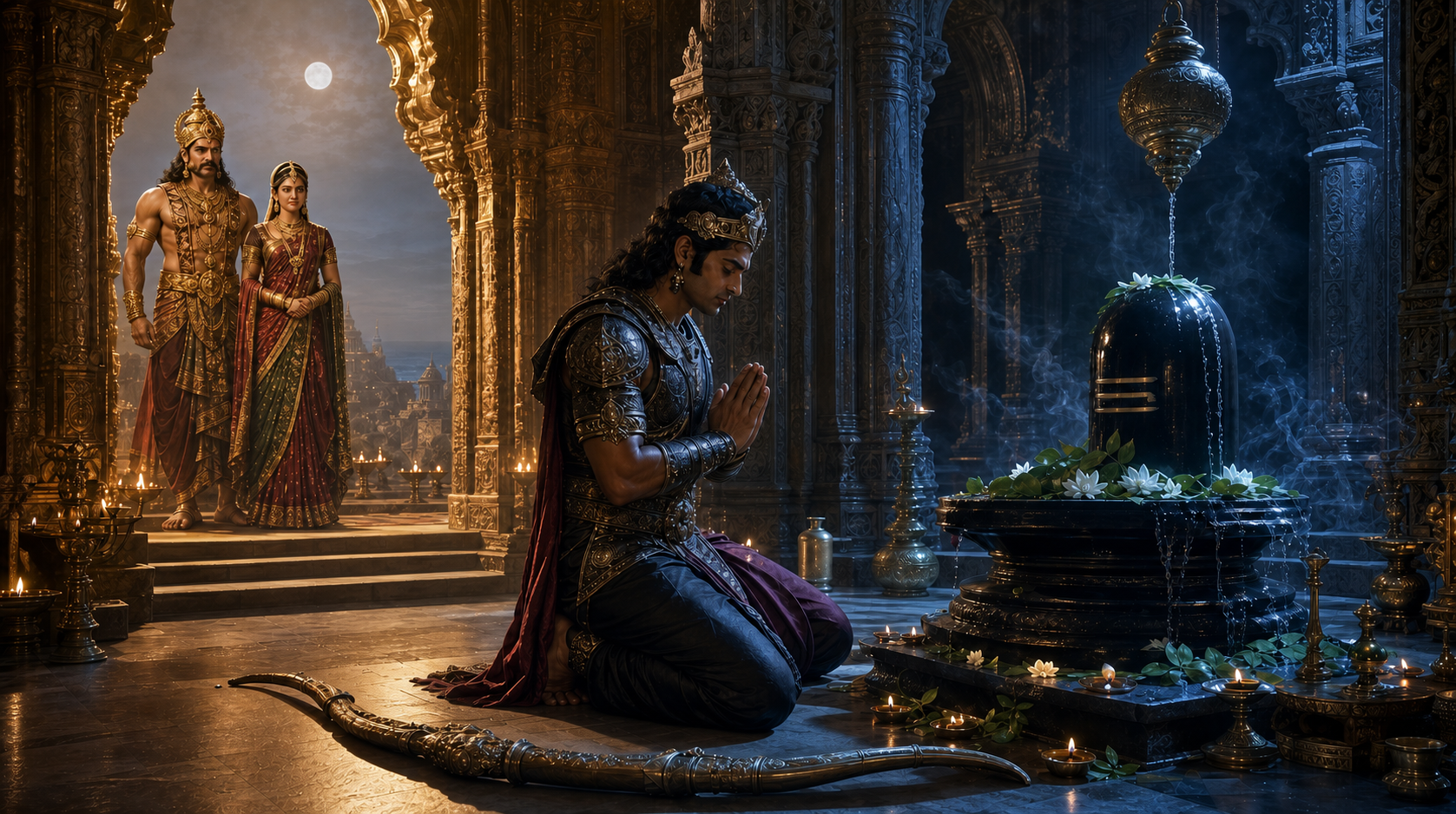
If you have heard that Indrajit was Shiva’s son, the direct answer is this: not by birth in the Valmiki Ramayana. Indrajit, also known as Meghnad, is the son of Ravana and Mandodari. The connection with Shiva belongs to a different register of sacred kinship.
That distinction lets you avoid two common mistakes. You do not have to rewrite Indrajit’s genealogy to respect a Shaiva tradition, and you do not have to dismiss every use of the word “son” as a factual error. You first have to ask what kind of sonship is being claimed.
Begin with the kind of sonship being claimed
In ordinary conversation, “son” usually means a biological child. In Sanskrit and Puranic religious language, filial terms can also express initiation, spiritual inheritance, participation in divine power, or belonging to a deity’s sacred family. Those meanings are related, but they are not interchangeable.
Key takeaways
- Biological lineage: In the Valmiki Ramayana, Indrajit’s parents are Ravana and Mandodari.
- Theological kinship: Within later and regional traditions, Indrajit can be associated with Shiva as an amsha, a diksha-putra, or a spiritually empowered devotee.
- Textual status: A later devotional interpretation can carry religious meaning without becoming the birth account of the primary epic.
- Ethical limit: Divine favor, ritual mastery, and great ability do not release Indrajit from responsibility for serving Ravana’s adharma.
When someone says, “Indrajit was Shiva’s son,” ask that person to finish the sentence more precisely: son by birth, son through initiation, manifestation of a portion of Shiva’s power, or member of Shiva’s spiritual family? The answer determines whether you are dealing with genealogy, theology, or a mixture of the two.
What Indrajit’s Valmiki lineage actually establishes
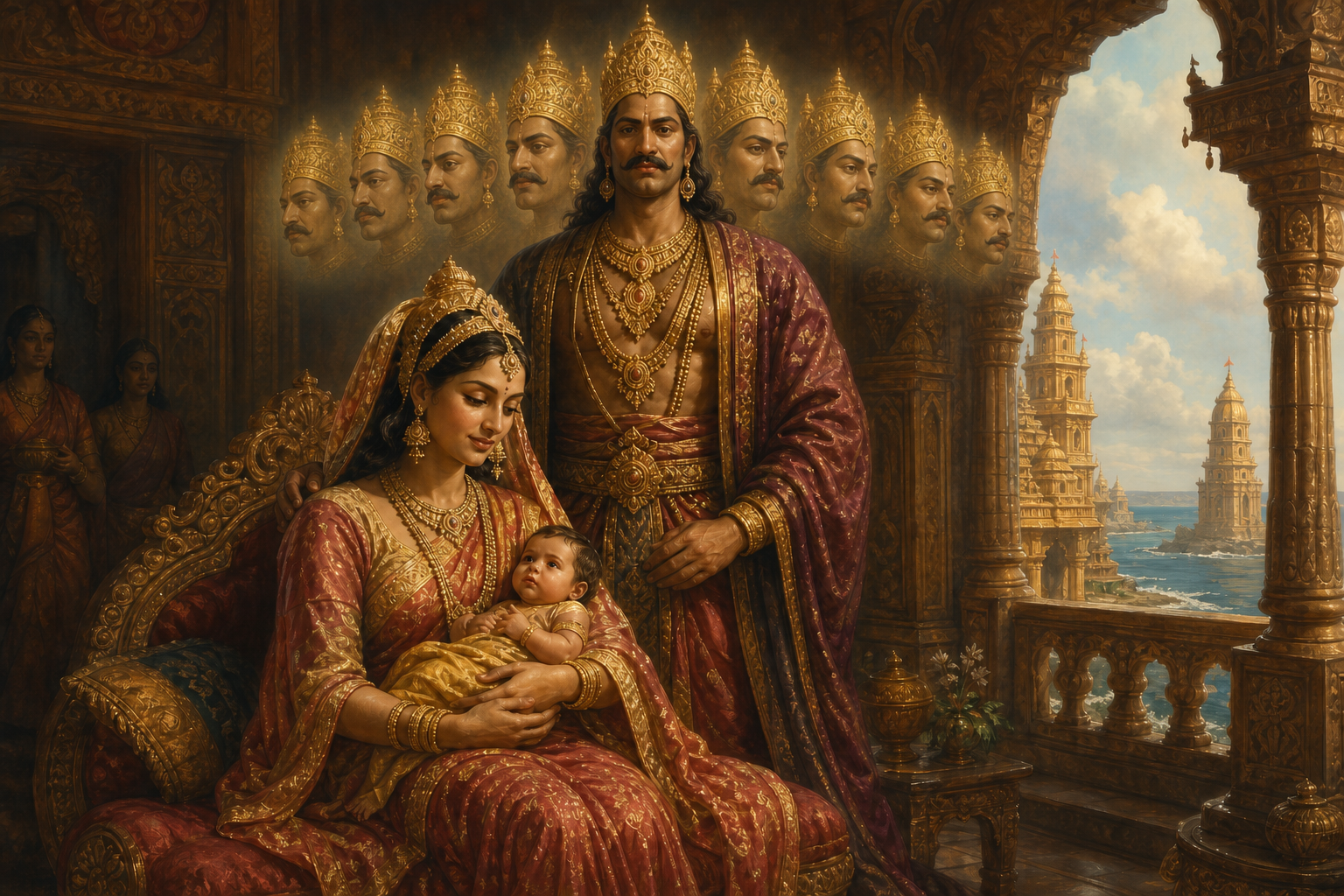
In the Valmiki Ramayana’s genealogical account, Indrajit is explicitly born into Ravana’s household through Mandodari. That is the firm starting point for answering a question about his biological father.
His extraordinary stature does not require a hidden divine parent. He becomes formidable through mastery of astras, disciplined practice, austerity, ritual accomplishment, and divine boons, including favor associated with Brahma. His yajna at Nikumbhila is also integral to his battlefield power. Skill and sadhana, rather than an alternative birth story, explain why he can confront Rama’s forces so effectively.
This gives you a useful rule for reading epic characters: supernatural ability is not proof of supernatural parentage. A warrior may receive an astra from a deity, perform tapas, obtain a boon, or enter a divine sphere of patronage without becoming that deity’s biological child. Conflating empowerment with birth produces a claim stronger than the evidence supports.
The same rule protects the plurality of Ramayana traditions. Ravana and Mandodari remain Indrajit’s parents at the genealogical level. A later community may still interpret his religious identity through Shaiva categories. The honest way to preserve both is to name the level of the claim instead of forcing one level to displace the other.
Why Shaiva kinship remains a meaningful interpretation

Indrajit’s Shaiva association is not arbitrary. His reputation rests on qualities that make a theological affiliation intelligible: austerity, concentration, ritual discipline, formidable spiritual power, and the ability to bring sadhana into the most demanding circumstances. These qualities create a strong devotional resemblance even when they do not establish biological descent.
Three terms help clarify what such an association can mean:
- Amsha: A manifested portion or participation in divine power. Applied to Indrajit, it elevates the spiritual quality of his power without necessarily changing his human or dynastic parentage.
- Diksha-putra: A son through initiation or sacred formation. Here, kinship identifies the lineage through which a person receives spiritual identity and empowerment.
- Parivara: A deity’s sacred family or circle. Belonging to such a family can indicate devotional affiliation, function, or participation rather than physical descent.
When one of these ideas is intended, “Shiva’s son” operates as compressed theological language. It tells you whose spiritual power, discipline, or sacred family is believed to mark Indrajit. It does not automatically tell you who fathered him in Lanka.
The order of reasoning matters. Indrajit’s character and sadhana can invite a Shaiva interpretation; that interpretation does not retroactively prove a biological event. Keeping the order straight allows devotional meaning to remain rich without turning resemblance into genealogy.
Dharma places a limit on devotional elevation
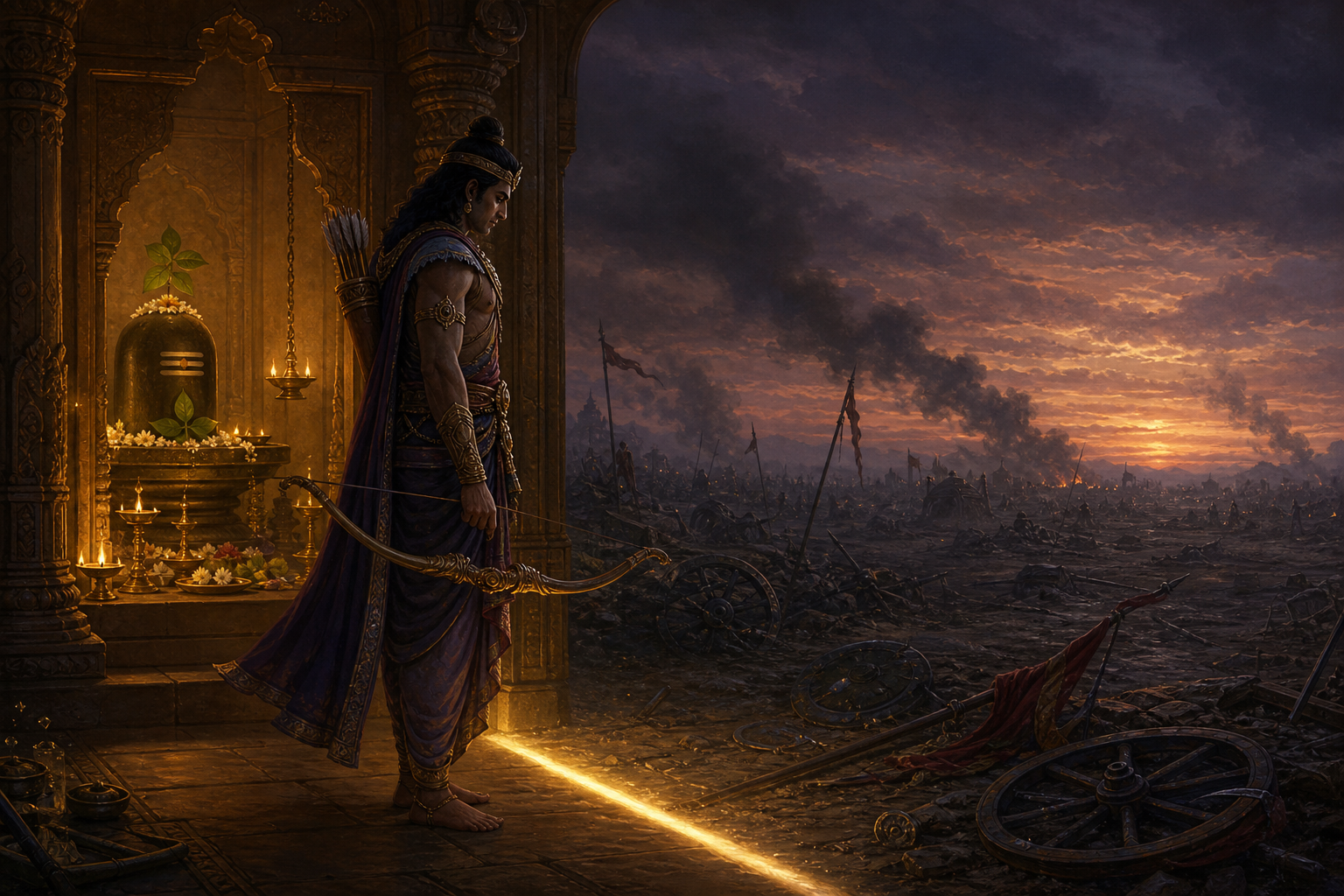
The deeper danger is not merely getting Indrajit’s family tree wrong. It is treating divine proximity as moral acquittal. Indrajit possesses courage, loyalty, ritual knowledge, strategic intelligence, and extraordinary martial power. Yet he directs those gifts in service of Ravana and becomes bound to his father’s adharma.
That tension is central to understanding him. His valor need not be denied, and his sadhana need not be trivialized. But neither quality decides whether his cause is dharmic. Power tells you what a person can do. Allegiance and action tell you what that power serves.
You can apply a four-part dharmic reading to Indrajit or any other empowered epic figure:
- Gift: Identify the abilities, astras, boons, or favor the person receives.
- Practice: Notice the tapas, discipline, initiation, or ritual through which power is cultivated.
- Alignment: Ask whose purpose the person chooses to serve and whether that purpose accords with dharma.
- Consequence: Observe how karma follows the use of power, not merely its sacred origin.
Indrajit passes the tests of ability and discipline. His tragedy lies in alignment. His loyalty to Ravana may be personally admirable as filial constancy, but loyalty does not transform an adharmic cause into a dharmic one. A virtue detached from right discernment can deepen bondage instead of overcoming it.
This moral structure has resonance across the dharmic family without erasing the differences among Hindu, Buddhist, Jain, and Sikh teachings. Discipline matters. Intention matters. Conduct matters. Spiritual attainment does not grant immunity from the consequences of one’s choices.
Use four questions when you encounter the claim again
A confident statement in a discourse, video, or conversation may silently combine several layers of tradition. Before accepting or rejecting it, run the claim through these four questions:
- Which narrative layer is being invoked? Is the speaker referring to the Valmiki Ramayana, a later regional telling, or a devotional interpretation? If no tradition is identified, the claim is not yet precise enough to evaluate.
- What does “son” mean in this setting? Determine whether it denotes biological descent, initiation, amsha, devotional identity, or membership in a divine parivara.
- Is the connection stated or inferred? An explicit declaration of kinship is different from an inference based on Indrajit’s austerity, power, or ritual conduct. Both may be meaningful, but they carry different evidentiary weight.
- What work is the claim doing? It may explain spiritual power, honor Shaiva devotion, place Indrajit within a sacred lineage, or magnify his stature. None of those purposes, by itself, changes his parents or excuses his moral alignment.
A precise answer you can give
If you need a single sentence, use this one: Indrajit is the biological son of Ravana and Mandodari in the Valmiki Ramayana, while some later devotional traditions describe a theological kinship with Shiva through ideas such as amsha, initiation, or divine affiliation.
That answer is neither evasive nor needlessly polemical. It tells the listener which claim is textual genealogy and which is devotional theology. It also leaves room for Hindu traditions to communicate sacred relationship through more than one kind of kinship.
When you meet the question again, do not begin with an unqualified yes or no. Name the narrative layer and the meaning of “son” first. You will preserve both textual accuracy and the spiritual insight that power received through grace must still be placed in the service of dharma.
References
