
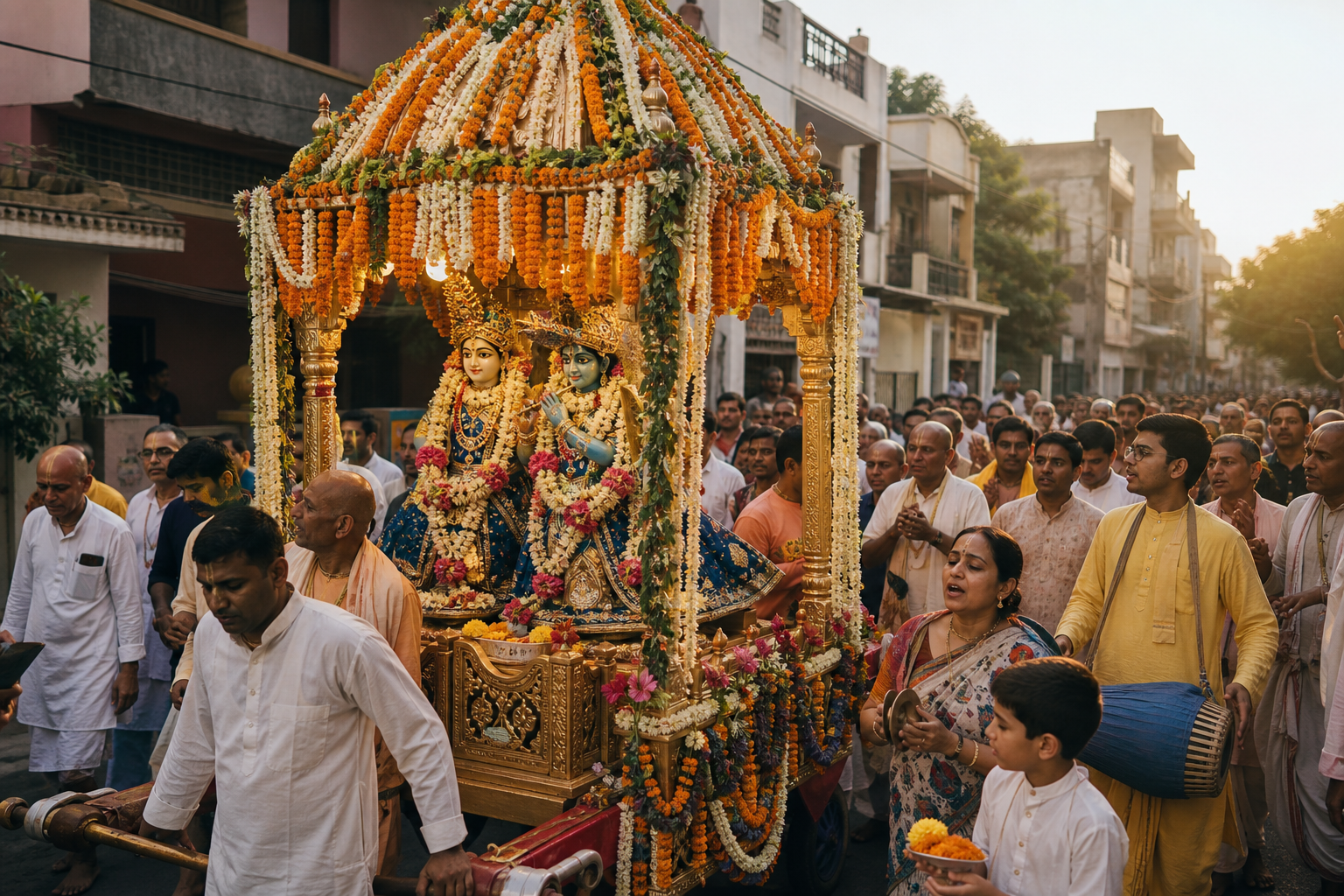
If you searched for Karnal’s Krishna-Balaram Shobha Yatra because you want to understand what actually made it significant, don’t judge it only as a procession. Its deeper value lay in giving devotion enough time and local reach to become a shared community practice.
The 2025 Sri Sri Krishna Balaram Shobha Yatra extended from 10 September to 5 October and reached three locations in Karnal. That combination of duration and distribution is the key to reading the event: it created more than a single public moment. It gave families, young people, elders, residents, and visitors repeated opportunities to enter a devotional rhythm.
Start with the timeline, not the spectacle
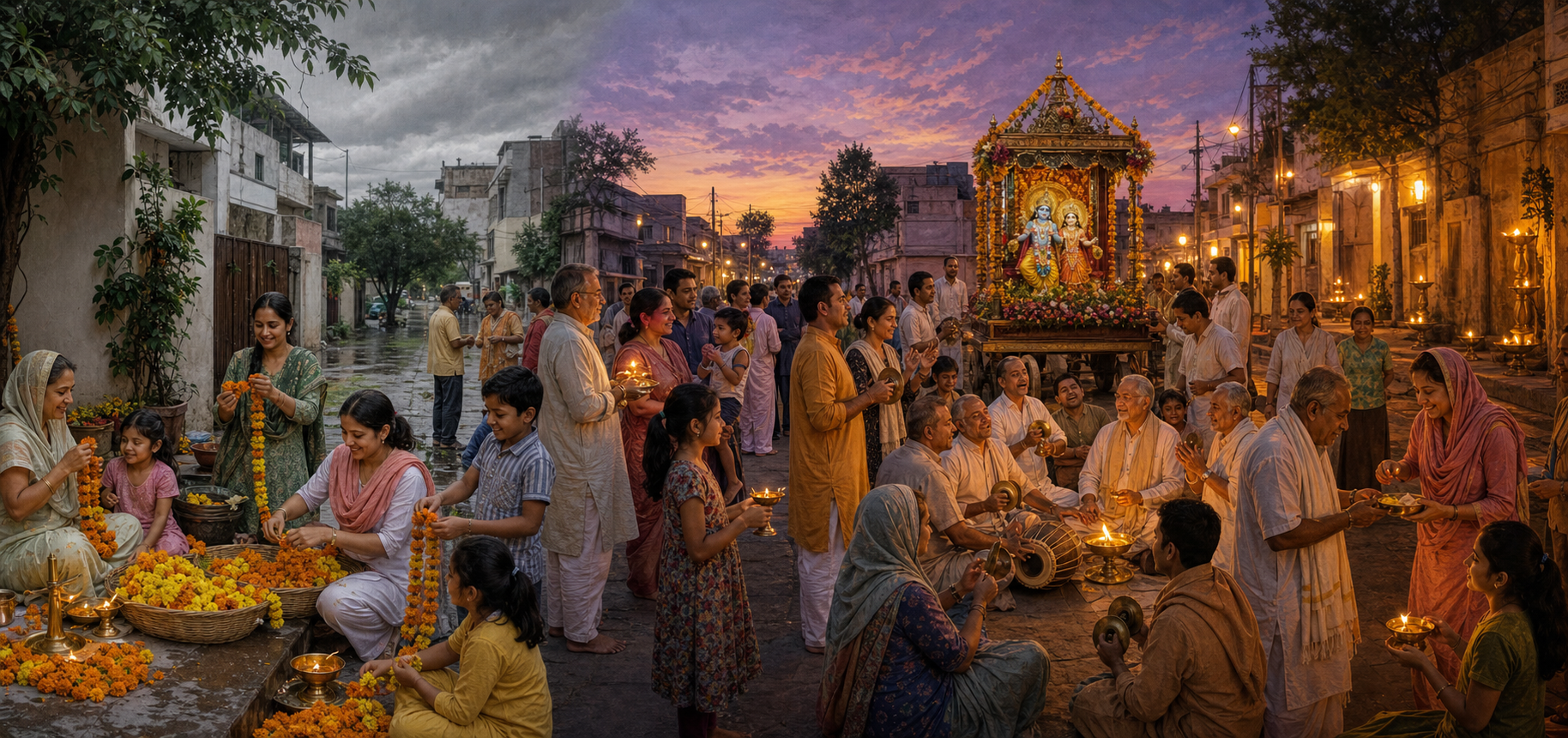
A one-day procession is usually remembered through its most visible elements: movement through the streets, a gathered crowd, ceremonial beauty, and a concentrated atmosphere of celebration. Karnal’s 2025 observance requires a different measure because it continued across several weeks.
Duration changes participation. A person who misses one occasion may join another. Someone who first arrives as an observer may return with family or accept a service role. An elder can transmit the meaning of a practice to a younger relative without having to compress that conversation into a few hurried minutes. Repetition also gives devotion a chance to influence ordinary conduct after the immediate excitement has passed.
This is why crowd size alone would be a poor test of the yatra’s value. If you are evaluating or helping organise a similar celebration, look for continuity instead: Did people return? Did different generations have meaningful roles? Did participation produce further seva? Did relationships continue after the ceremonial programme ended? These questions reveal whether a public festival generated lasting community life or only temporary visibility.
The 2025 dates must not be treated as a timetable for a future edition. If you hope to attend another Karnal yatra, confirm the year, venue, hours, route, accessibility arrangements, and volunteer contact with local organisers. A previous date range tells you what happened; it does not establish what will happen next.
Keep the Hindu devotional centre clear
A shobha yatra brings reverence into public space. In this case, the name of Sri Krishna and Balaram keeps the centre unmistakably Hindu and devotional. The gathering should therefore be understood through bhakti: participation directed toward the Divine through remembrance, worship, service, discipline, and loving commitment.
That clarity matters. A public celebration loses depth when sacred forms are treated merely as colourful heritage. Cultural expression is present, but it serves devotion rather than replacing it. If you attend, begin by noticing what the hosts regard as sacred. Follow their lead during devotional practices, receive instructions respectfully, and avoid obstructing worship for photographs or social-media footage.
The yatra also placed compassion, seva, commitment to truth, and social harmony in the foreground. These values create genuine points of contact among Hindu, Buddhist, Jain, and Sikh communities. The bridge is ethical kinship, not an assertion that all four traditions have identical scriptures, doctrines, or forms of worship.
You can preserve both unity and difference by using precise language. Call the yatra a Hindu festival grounded in bhakti. Welcome neighbours from other dharmic paths through shared commitments such as service, compassion, and truthful conduct. Do not ask guests to erase their own identities, and do not dilute the host tradition to make hospitality appear easier. Respectful distinctness is stronger than vague sameness.
Three locations turned access into part of the practice
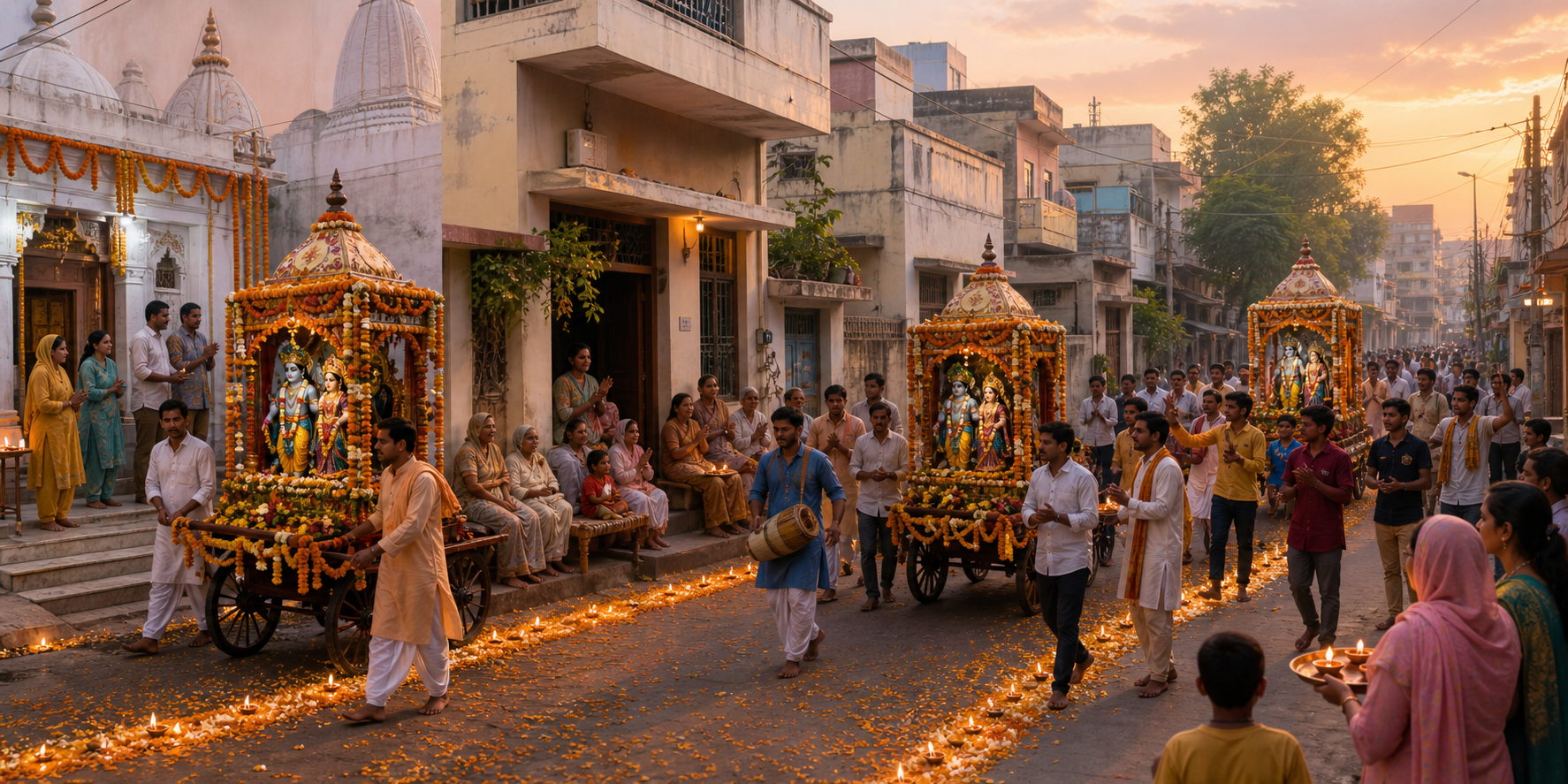
Holding the observance at three locations was not a minor logistical detail. It broadened access by bringing the celebration into familiar settings for different parts of Karnal. People did not all have to relate to the festival through one central venue.
Distributed celebrations can reduce practical friction, but their spiritual advantage is just as important. A neighbourhood becomes a participant rather than a distant audience. Local families can bring children and elders into a setting they know. Volunteers can form smaller working relationships. The festival’s identity is then carried through several communities without depending on one concentrated gathering.
The format still needs a coherent centre. If every location operates as an unrelated programme, reach increases while meaning fragments. Organisers adapting Karnal’s model should keep the devotional purpose, expected conduct, and central message consistent while allowing each locality to contribute its own volunteers and community relationships.
- Publish the exact date, address, start time, route, and local contact for each venue. Do not make families reconstruct essential details from scattered announcements.
- State the devotional purpose before promoting secondary attractions. Participants should know why they are gathering, not only where a crowd will form.
- Give families, youth, and elders defined ways to contribute. A role with a clear time and responsibility is easier to accept than a general appeal for help.
- Make seva concrete. Name the task, the person coordinating it, the expected duration, and what happens after the programme.
- Create one follow-through point after each local celebration, such as a congregation meeting, a service activity, or a confirmed channel for future notices.
These steps do not require making the festival larger. They make it easier for devotion to become dependable community action.
How to participate without becoming a spectator
Before you go
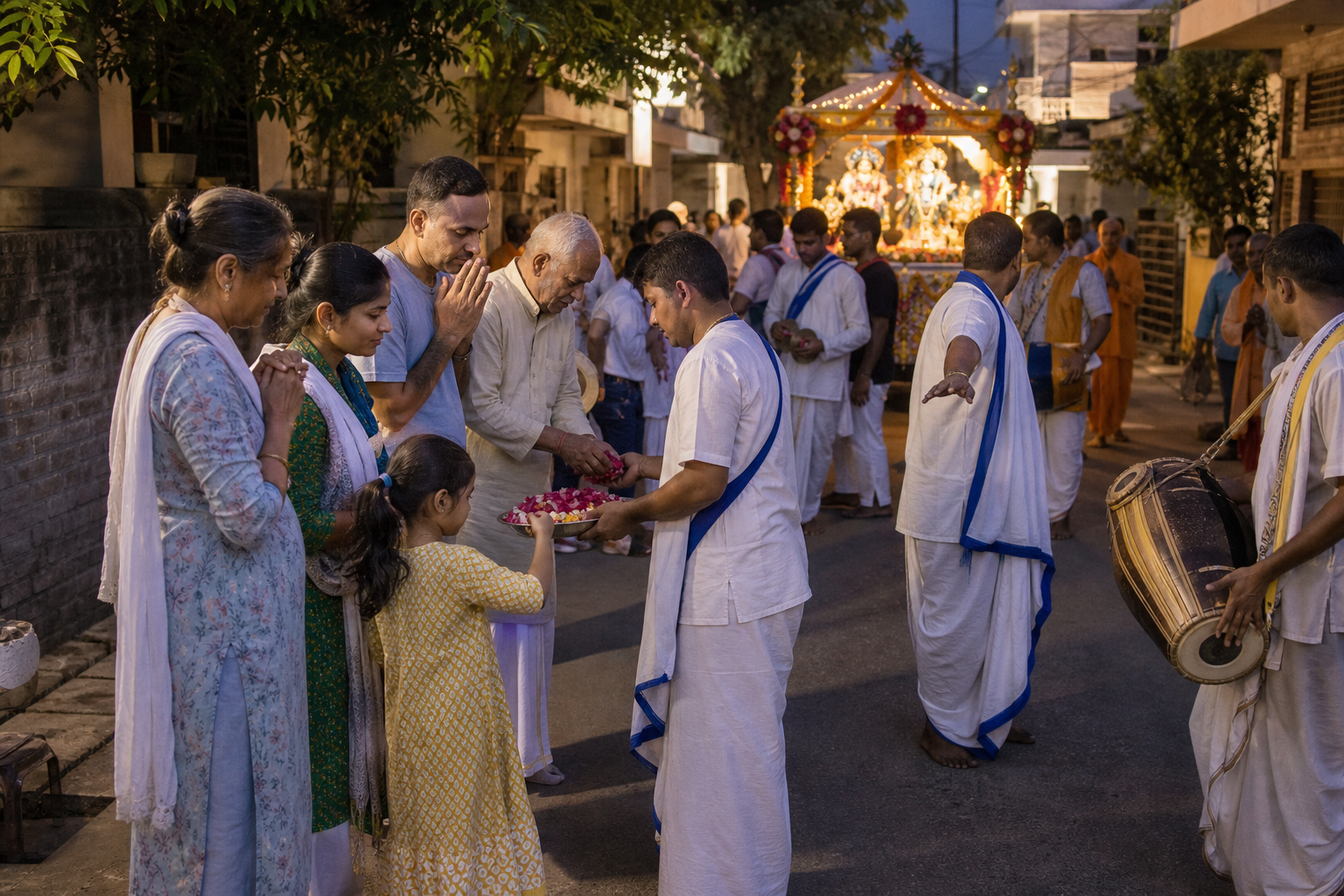
Decide whether you are attending for darshan and devotional participation, accompanying family, learning about the tradition, or offering seva. You may do more than one, but naming your purpose prevents the event from becoming passive sightseeing. Confirm current details locally and ask whether volunteers need to register before arriving.
If you are bringing children, explain in simple terms that this is a sacred gathering in public space. Tell them whom the celebration honours and identify one behaviour they can practise, such as listening during worship, helping an elder, or following the procession without pushing ahead. A small, specific instruction teaches more than a vague demand to behave.
While you are there
Watch how the local congregation participates before assuming what is appropriate. Follow announced directions. Keep paths usable for elders, families, and organisers. If you take photographs, do so without interrupting worship or treating participants as scenery.
If you offer help, accept an actual task rather than hovering around the organisers. Seva becomes useful when someone can depend on you to complete a defined responsibility. It also turns the yatra’s values into conduct: patience when plans shift, truthfulness about what you can do, and consideration for people whose needs differ from yours.
The participation of families, youth, and elders is especially worth noticing. Multi-generational presence does not automatically transmit tradition; interaction does. Ask an elder what a devotional act means. Invite a young participant to help with a real responsibility. When knowledge and service move in both directions, heritage remains living rather than ceremonial.
Afterward
Choose one modest continuation within a day or two. Contact the congregation about the next gathering, complete a promised service task, speak with your family about what the yatra meant, or adopt one practice of compassion and truthful conduct in daily life. The point is not to manufacture a dramatic personal transformation. It is to prevent devotion from ending when the public programme does.
Key takeaways
- Karnal’s 2025 Sri Sri Krishna Balaram Shobha Yatra ran from 10 September to 5 October across three locations.
- Its sustained format matters because repeated opportunities can move people from observation toward participation, relationship, and seva.
- The event’s centre was Hindu bhakti; its wider dharmic welcome rested on shared ethical values, not on erasing differences among traditions.
- Three locations widened access and gave neighbourhoods a more direct relationship with the celebration.
- If you attend a future yatra, verify current details, follow the congregation’s devotional lead, accept a defined service role, and continue one practice afterward.
If you want to carry Karnal’s example forward, start small and specific. Confirm the next genuine opportunity to participate, bring one other family member or neighbour, and commit to one useful act of seva. A shobha yatra fulfils its public purpose most fully when the devotion seen on the road becomes steadiness in the community.
References
